wayground logo

Free Printable Worksheets

Font size

S
M
L
XL
Worksheets

Atmosphere & Weather

Total questions: 100

Worksheet time: 3610secs

Name
Class
Date
1.
Warm air expands and rises and becomes ________ dense.
a)
more
b)
less
2.
_______ winds are caused by unequal heating of the Earth's surface within a small area.
a)
local
b)
global
3.
When the land cools more quickly than water, so the air over the land becomes cooler than the air over the water.  The flow of air from land to the body of water is called a _________ breeze.
a)
sea
b)
slight
c)
land
d)
wet
4.
_______ is the direct transfer of energy by electromagnetic waves.
a)
convection
b)
conduction
c)
radiation
5.
Which of the following is not a way that heat is transferred?
a)
radiation
b)
ultraviolet rays
c)
convection
d)
conduction
6.
When a breeze blows from the sea to the land because the air over the sea is cooler than the air over the land.
a)
sea breeze
b)
land breeze
c)
hurricane
d)
tornado
7.
As the Earth rotates counterclockwise, the ____________ causes the winds in the Northern Hemisphere to curve toward the right.
a)
Coriolis Effect
b)
Horsewinds
c)
Polar Tropical winds
d)
Maritime Tropical winds
8.
Warm air rises and spreads out to make the air in the high altitudes of the mountains _______ dense than the air at Sea level.
a)
less
b)
more
9.
The lowest layer of the atmosphere and contains weather.
a)
troposphere
b)
stratosphere
c)
mesosphere
d)
thermosphere
10.
a sudden spark, or electrical discharge, between parts of clouds
a)
Lightning
b)
Thunderstorm
c)
Tornado
d)
Hurricane
11.
Which gas in our atmosphere is most abundant?
a)
Argon
b)
Oxygen
c)
Nitrogen
d)
Carbon Dioxide
12.
What is the percentage of oxygen in Earth's atmosphere?
a)
1%
b)
21%
c)
78%
d)
90%
13.
What decreases as you go up in the atmosphere?
a)
Altitude
b)
Atmosphere
c)
Meteors
d)
Air Pressure
14.
Process of liquid water changing into a gas
a)
evaporation
b)
condenstaion
c)
precipitation
d)
transpiration 
15.
What is the process during which water cools and turns from a gas to a liquid?
a)
Codensation
b)
Runoff
c)
Precipitation
d)
Evaporation
16.
Which one heats and cools fastest?
a)
land
b)
sea
c)
both are the same rate
d)
air
17.
In convection, WARM air
a)
Rises
b)
Sinks
18.
In convection, COOL air
a)
Rises
b)
Sinks
19.
Warm air is __________ dense than cold air and rises creating convection currents.
a)
more
b)
less
20.
Which is true about the way air flows?
a)
from high pressure to low pressure
b)
from cold air to hot air
c)
from low pressure to high pressure
d)
from top to bottom only
21.
When Earth's rotation causes the wind to curve 
a)
cloudy 
b)
Coriolis effect
c)
high pressure
d)
low pressure 
22.
This storm forms over a warm, tropical oceans close to the equator.
a)
Hurricane
b)
Earthquake
c)
Tornado
d)
Windstorm
23.
This storm is a funnel-shaped windstorm that extends down from a cumulonimbus cloud.
a)
Hurricane
b)
Tornado
c)
Thunderstorm
d)
Windbreak
24.
The protective layer of ozone gas is located in which layer of Earth’s atmosphere?
a)
mesosphere
b)
troposphere
c)
stratosphere
d)
 thermosphere
25.
Which best describes what happens to air pressure as altitude increases in the atmosphere?
a)
 Air pressure becomes less.
b)
Air pressure becomes greater.
c)
Air pressure changes
d)
Air pressure stays the same
26.
Through which processes does water vapor enter the atmosphere?
a)
precipitation,  condensation
b)
 condensation, transpiration
c)
transpiration, evaporation
d)
precipitation, evaporation 
27.
How do clouds help heat the Earth?
a)
Clouds act as a blanket at night trapping warm air below.
b)
Clouds reflect sunlight into the atmosphere.
c)
Clouds absorb sunlight and release solar energy.
d)
Clouds keep temperatures from changing.  
28.
Which type of front is shown below?
a)
cold
b)
stationary
c)
 warm
d)
occluded
29.
The uneven heating of Earth’s surfaces result in 
a)
seasons. 
b)
ocean currents.
c)
variations in weather
d)
variations in living organisms.  
30.
Which system results in rainy or stormy  weather?
a)
weather system
b)
high pressure
c)
low pressure
d)
jet stream
31.
Which front is represented on a weather map with the following symbol?
a)
cold
b)
stationary
c)
warm
d)
occluded
32.
Heat trapped in the troposphere is a result of what effect?
a)
Wind effect
b)
Coriolis effect
c)
Greenhouse effect
d)
Heating effect
33.
Precipitation forms when
a)
water drops spread out and evaporate
b)
water drops combine and grow heavy enough to fall.
c)
water vapor condenses and  freezes as frost.
d)
water is released by plants through transpiration.  
34.
What conditions can lead to the formation of a hurricane?
a)
a high-pressure system over the ocean far from the equator
b)
a low-pressure over the ocean near the equator
c)
a high-pressue system over hot, dry land
d)
a low-pressure system over artic tundra
35.
When warm air rises and cool air moves into its place creating a vertical movement of air, what type of current is formed?
a)
ocean current
b)
electrical current
c)
convection current
d)
surface current
36.
Which front is represented on a weather map with the following symbol?
a)
cold
b)
stationary
c)
warm
d)
occluded
37.
Name the fast moving ribbon of air that moves near the top of the troposphere?
a)
doldrums
b)
jet stream
c)
easterlies
d)
trade winds
38.
Which weather system is shown by the diagram?
a)
high pressure
b)
cold front
c)
low pressure
d)
warm front
39.
 Which weather instrument is used for measuring rainfall?
a)
anemometer
b)
wind vane
c)
thermometer
d)
rain gauge
40.
Which weather instrument is used for measuring wind speed?
a)
anemometer
b)
psychrometer
c)
thermometer
d)
rain gauge
41.
Which weather instrument is used for measuring relative humidity?
a)
anemometer
b)
psychrometer
c)
thermometer
d)
 rain gauge
42.
What do you use to measure wind direction?
a)
wind vane
b)
anometer
c)
barometer
d)
thermometer
43.
What tool do you measure air pressure with?
a)
anemometer
b)
psychrometer
c)
barometer
d)
thermometer
44.
This layer is where satellites are found
a)
thermosphere
b)
exosphere
c)
stratosphere
d)
mesosphere
45.
This is the coldest layer of the atmosphere
a)
troposphere
b)
thermosphere
c)
mesosphere
d)
stratosphere
46.
What is the name of the weather instrument?
a)
Barometer
b)
Thermometer
c)
Psychrometer
d)
Anemometer
47.
What is the name of the weather instrument?
a)
Barometer
b)
Thermometer
c)
Psychrometer
d)
Anemometer
48.
Air pressure is greatest:
a)
closer to Earth
b)
farther from Earth
49.
Which type of storm forms over water in warm air conditions?
a)
hurricane
b)
blizzard
c)
thunderstorm
50.
Cold air mass that is carrying water is:
a)
continental tropical
b)
continental polar
c)
maritime tropical
d)
maritime polar
51.
Warm air mass that does not carry water:
a)
continental tropical
b)
continental polar
c)
maritime tropical
d)
maritime polar
52.
This type of front results in the same weather for several days
a)
warm
b)
cold
c)
stationary
d)
occluded
53.
A strong wind that starts over warm ocean water can have  winds from 75 mph to 150 mph.
a)
hurricane
b)
tornado
c)
migrate
d)
water cycle
54.
Which diagram shows the formation of a sea breeze?
a)
diagram Y
b)
diagram X
c)
neither
d)
both
55.
Which diagram shows the formation of a land breeze?
a)
diagram Y
b)
diagram X
c)
neither 
d)
both
56.
 What does E  represent?
a)
cold front
b)
warm front
c)
stationary front
d)
occluded front
57.
Isobars are lines on a map joining places that have the same 
a)
wind speed
b)
temperature
c)
humidity
d)
air pressure
58.
Scientists who study weather and try to predict it are called 
a)
astronomers
b)
volcanologists
c)
meteorologists
d)
weatherologists
59.
The boundary  between two air masses is known as:
a)
front
b)
storm
c)
climate
d)
flood
60.
What is A?
a)
Evaporation
b)
Condensation
c)
Precipitation
d)
Runoff
61.
What is B?
a)
Evaporation
b)
Condensation
c)
Precipitation
d)
Runoff
62.
What is C?
a)
Evaporation
b)
Condensation
c)
Precipitation
d)
Runoff
63.
What is      D?
a)
Evaporation
b)
Condensation
c)
Precipitation
d)
Runoff
64.
Lines connecting points of equal temperature
a)
Isobar
b)
Isotherm
c)
Front
d)
Relative Humidity
65.
As ____ evolved, they changed Earth’s atmosphere by producing oxygen.
a)
cyanobacteria
b)
reptiles
c)
trilobites
d)
dinosaurs
66.
Ozone in the stratosphere protects the Earth by _____.
a)
producing clouds
b)
absorbing ultraviolet radiation
c)
warming the polar regions
d)
heating the oceans
67.
This gas was in high concentrations in the developing atmospheres and later dissolved into rainwater, added to the oceans, then settled to the bottom of the ocean. 
a)
oxygen
b)
carbon dioxide
c)
argon
d)
water vapor
68.
Earth's first atmosphere was made of the gases: 
a)
oxygen and helium
b)
nitrogen and oxygen
c)
hydrogen and helium
d)
oxygen and hydrogen
69.
This is the symbol for a... 
a)
Cold Front
b)
Warm Front
c)
Stationary Front
d)
Occluded Front 
70.
This is the symbol for a... 
a)
Occluded Front
b)
Stationary Front
c)
Warm Front
d)
Cold Front 
71.
This is the symbol for a... 
a)
Stationary Front
b)
Occluded Front
c)
Cold Front
d)
Warm Front
72.
This weather tool measures wind speed and direction
a)
thermometer
b)
barometer
c)
anemometer
d)
psychrometer
73.
What kind of weather is usually associated with a high pressure system?
a)
Sunny weather
b)
Precipitation (rain, snow, etc.)
74.
the amount of water vapor in the air
a)
warm front
b)
precipitation
c)
humidity
d)
air pressure
75.
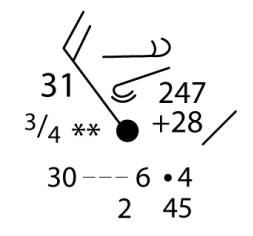
What is the wind speed at this station
a)
3 knots
b)
15 knots
c)
25 knots
d)
30 knots
76.
What is the barometric pressure at this station?
a)
247 millibars
b)
924.7 millibars
c)
1024.7 millibars
77.
What is the dew point at this station?
a)
75 degrees
b)
61 degrees
c)
987 degrees
d)
11 degrees
78.
What is the wind direction at this station?
a)
Wind is blowing from the north
b)
Wind is blowing to the East
c)
Wind is blowing from the East
d)
Wind is blowing to the North
79.

Water in its gaseous form.

a)

Atmosphere

b)

Water vapor

c)

Radiosonde

d)

Aquefer

80.

Steady winds that flow from west to east between latitudes 30 deg. N and 60 deg. N, and 30 deg. S and 60 deg. S.

a)

Sea breeze

b)

Land breeze

c)

Westerlies

d)

Jet stream

81.

The amount of water vapor present in the air compared to the maximum amount of water vapor the air could contain at that temperature.

a)

Relative Humidity

b)

Dew Point

c)

Condensation

d)

Humidity

82.

The temperature at which air is saturated and condensation can occur.

a)

Dew Point

b)

Condensation

c)

Humidity

d)

Air pressure

83.

A series of natural processes by which water continually moves along oceans, land, and the atmosphere.

a)

Dew Point

b)

Bi Cycle

c)

Water Cycle

d)

Humidity

84.

What happens to the air pressure the higher up in space you go?

a)

air pressure increases

b)

air pressure decreases

c)

air pressure stays the same

d)

there is no air pressure

85.
According to the model, how did CO2 get into the atmosphere?
a)
evaporation
b)
condensation
c)
volcanoes
d)
sediments
86.
What happened to the water vapor from Earth's early atmosphere?
a)
evaporated
b)
condensed
c)
boiled
d)
decreased in density
87.
Where did the water for oceans on earth first come from?
a)
evaporating water vapor
b)
condensing water vapor
c)
it has always been there
d)
it condensed from the sediment
88.
Which layer of the atmosphere do meteors burn up in?
a)
Exosphere
b)
Mesosphere
c)
Stratosphere
d)
Troposphere
89.
As altitude increases, air pressure...
a)
increases
b)
decreases
c)
stays the same
90.
Layer with electrically charged particles.
a)
Ionesphere
b)
Troposphere
c)
Stratosphere
d)
Have No Fear
91.
Clouds often form over mountains because ___.
a)
Air goes down the mountain and collects moisture
b)
Air is trapped and can’t move
c)
Air rises and heats up
d)
Air is forced upward and cools
92.
The cause of wind is  ___.
a)
The revolution and rotation of the earth
b)
Moving air in the atmosphere
c)
Warm temperatures near the equator
d)
he sun’s unequal heating of the earth’s surface
93.
sulfur dioxide and nitrogen oxides that combine with moisture in the atmosphere 
a)
acid precipitation  
b)
pollution
c)
ozone
d)
rain
94.
The source of energy that powers convection currents in Earth’s atmosphere:
a)
Petroleum
b)
Mantle
c)
Sun
d)
Inner Core
95.
Which global wind belt steers our weather in the U.S. from west to east across the country?
a)
Trade Winds 
b)
Doldrums
c)
Polar Easterlies 
d)
Prevailing Westerlies
96.
The Equator receives _____________ sunlight (90 degree angle), because of this, the equator is getting _________ solar energy from the sun per square foot than the polar regions.
a)
Indirect, More
b)
Indirect, Less
c)
Direct, More
d)
Direct, Less
97.
Hot feet in hot sand is an example of...
a)
convection
b)
conduction
c)
radiation
98.
An ice cream sandwich melting in your hand is an example of......
a)
convection
b)
conduction
c)
radiation
99.
The Sun's rays warming water in a pool is an example of...
a)
convection
b)
conduction
c)
radiation
100.
Which layer of the atmosphere do the Auroras(northern and southern lights) occur in?
a)
Ionosphere
b)
Mesosphere
c)
Stratosphere
d)
Troposphere