
 Worksheets
APES Unit 2 Test Review
Total questions: 95
Worksheet time: 2hrs 44mins
Name
Class
Date
1.
What is made up of nickel and iron in the Earth?
a)
core
b)
crust
c)
mantle
d)
atmosphere
2.
What are three types of rocks?
a)
sedimentary, igneous, metamorphic
b)
mantle, igneous, sedimentary
c)
crust, core, mantle
d)
igneous, seismic, lotic
3.
When lava cools what does it form?
a)
igneous rock
b)
fossils
c)
sedimentary rock
d)
metamorphic rock
4.
Mountains are formed by...
a)
wind slowly building up rocks
b)
erosion
c)
lowering of the sea level
d)
folding and faulting of the Earth's crust
5.
Which of these often occur as the Earth's crustal plates move?
a)
earthquakes
b)
floods
c)
tornadoes
d)
hurricanes
6.
Where are earthquakes and volcanoes likely to occur?
a)
anywhere
b)
at plate boundaries (along fault lines)
c)
on mountains
d)
only at transform boundaries
7.

Which stages does liquid water from the ocean turn into water vapor?
a)
condensation
b)
evaporation
c)
precipitation
d)
run off
8.

What process is occurring here?
a)
sea-floor spreading
b)
mountain formation
c)
subduction
d)
plasticity
9.

What layer is shown by letter B?
a)
Crust
b)
Mantle
c)
Outer core
d)
Inner core
10.
What layer is shown by letter D?
a)
Crust
b)
Mantle
c)
Outer core
d)
Inner core
11.

An underground layer of rock or sediment that holds water?
a)
Reservoir
b)
Aquifer
c)
Groundwater
d)
Watershed
12.

This rock was formed by smaller pieces of rock that settled at the bottom of a lake millions of years ago. What type of rock is this?
a)
Sedimentary
b)
Igneous
c)
Metamorphic
13.
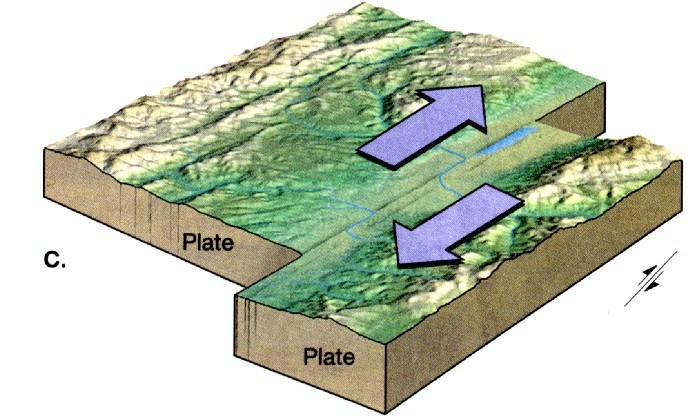
What type of plate boundary is this?
a)
Transform
b)
Convergent
c)
Divergent
d)
Plate
14.
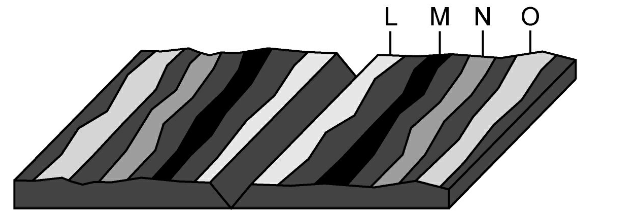
Where would the oldest rock be found?
a)
L
b)
M
c)
N
d)
O
15.
Mountains are created when....
a)
Two continental plates collide
b)
Two oceanic plates pull apart
c)
An Oceanic plate subducts under a Continental Plate
d)
Two continental plates pull apart
16.
Soil formation begins with the weathering of_______.
a)
Humas
b)
Subsoil
c)
Litter
d)
Rock
17.
The layer of soil which the topsoil is found.
a)
Horizon A
b)
Horizon B
c)
Horizon C
d)
Horizon D or R
18.
What effect did over plowing and cutting down trees in the Great Plains during the 1930’s?
a)
It had little effect
b)
It increased soil fertility
c)
It was a primary cause of the Dust Bowl
d)
Farmers had a great harvest
19.
Decayed organic material in soil is called______.
a)
Litter
b)
Silt
c)
Humus
d)
Clay
20.
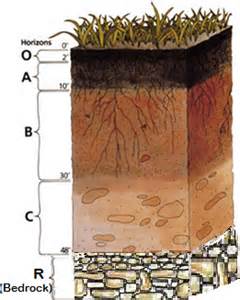
Which horizon is made up of partially weathered rocks?
a)
Horizon A
b)
Horizon B
c)
Horizon C
d)
Horizon D or R
21.
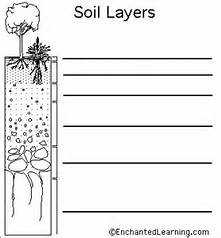
Which horizon contains clay, silt, minerals, and a little humus?
a)
Horizon A
b)
Horizon B
c)
Horizon C
d)
Horizon D or R
22.

A student in Earth science class wants to create an edible model to demonstrate the soil horizons. Which materials would be the best choice for him to use to represent LAYER 4?
a)
Solid Hershey candy bar
b)
Crumbled Oreo cookies and gummy worms
c)
Chocolate Pudding
d)
Pieces of Hershey candy bar
23.
Put the layers of the soil profile in order from top to bottom: bedrock, subsoil, organic, topsoil, parent material
a)
Organic, Topsoil, Subsoil, Parent Material, Bedrock
b)
Organic, Topsoil, Parent Material, Subsoil Bedrock
c)
Topsoil, Organic, Subsoil, Parent Material, Bedrock
d)
Topsoil, Organic, Parent Material, Subsoil, Bedrock
24.

Look at the following data table and label each soil horizon using the descriptions.
a)
Beaker 1 = Bedrock Beaker 2 = Horizon B (subsoil) Beaker 3 = Horizon A (topsoil) Beaker 4 = Horizon C (parent material)
b)
Beaker 1 = Bedrock Beaker 2 = Horizon C (parent material) Beaker 3 = Horizon B (subsoil) Beaker 4 = Horizon A (topsoil)
c)
Beaker 1 = Horizon C (parent material) Beaker 2 = Horizon B (subsoil) Beaker 3 = Horizon A (topsoil) Beaker 4 = Bedrock
d)
Beaker 1 = Bedrock Beaker 2 = Horizon A (topsoil) Beaker 3 = Horizon B (subsoil) Beaker 4 = Horizon C (parent material)
25.
Ellen grabs a topsoil sample in her hand. She rolls it into a ball. The soil feels gritty and the ball falls apart. What part of the topsoil most likely made the topsoil feel gritty?
a)
clay
b)
sand
c)
silt
d)
humus
26.
Which of the following is the largest particle in soil?
a)
sand
b)
silt
c)
humus
d)
clay
27.
Many plants cannot grow in clay soil. Why is this true?
a)
Clay soil does not have many nutrients.
b)
Roots cannot easily push through clay soil.
c)
Water doesn't drain well through clay.
d)
All of these choices.
28.
Many plants cannot grow in sandy soil. Why is this true?
a)
Sandy soil does not hold enough water.
b)
Oxygen cannot pass through sandy soil.
c)
Roots cannot easily push through clay soil.
d)
Sandy soil has too many nutrients.
29.

What is a soil problem all farmers face?
a)
soil hardening
b)
soil erosion
c)
soil spoiling
d)
soil pollution
30.
According to the laboratory experiments we completed, which soil is the heaviest and fell to the bottom of the tube?
a)
clay
b)
humus
c)
sand
d)
silt
31.
This soil has particles that are widely spaced out, which allows water to pass through it easily.
a)
sand
b)
clay
c)
silt
d)
loam
32.
Soil that is a mixture of humus, sand, silt, and clay.
a)
clay
b)
loam
c)
silt
d)
humus
33.
Huge open tanks or man made lakes are called
a)
Open tank
b)
Lake
c)
Reservoir
34.
Rivers are useful in following ways
a)
Carry fertile silt
b)
Provide water for domestic and agriculture purpose
c)
River Fish is eaten by people, it serves waterways
d)
All of above
35.
Good aquifers have...
a)
high porosity & permeability
b)
low porosity & permeability
c)
high porosity & low permeability
d)
low porosity & high permeability
36.
When it rains or snows, most water that doesn't evaporate soaks into the ground. This is called -
a)
Ice
b)
Groundwater
c)
Habitat
d)
Freshwater
37.
Bringing in water through canals or pipes from areas of much water to areas of no water is...
a)
a miracle
b)
desalination
c)
irrigation
d)
agriculture
38.
Removing salt, or saline, from sea water is called...
a)
dehydration
b)
demoralization
c)
deconstruction
d)
desalination
39.
What generally accounts for the greatest use of household water?
a)
Washing Machine
b)
Dishwasher
c)
Shower
d)
Landscaping
40.
Approximately what percentage of Earth’s water is fresh water?
a)
97%
b)
50%
c)
10%
d)
3%
41.
An aquifer is
a)
a man-made "artificial" lake that is built to store water
b)
ozone
c)
smog
d)
an underground layer of rock and soil that has pores and is capable of absorbing water
42.
What are the two main factors that determine the climate of an area?
a)
precipitation and humidity
b)
temperature and air pressure
c)
wind conditions and humidity
d)
temperature and precipitation
43.
Which BEST describes why latitudes closest to the equator have warmer climates?
a)
they are at lower elevations
b)
they receive more solar energy
c)
they are nearer to ocean currents
d)
they get more winds that carry energy in the form of heat
44.
What is the weather conditions in an area over a long period of time?
a)
climate
b)
temperature
c)
elevation
d)
precipitation
45.
____________ air sinks/falls because it is ____________dense.
a)
Cold, More
b)
Warm, Less
c)
Cold, Less
d)
Warm, More
46.
Lands near water will usually be a little bit __________ in the summer and ________ in the winter.
a)
cooler, warmer
b)
warmer, cooler
c)
warmer, warmer
d)
cooler, cooler
47.
What is the difference between climate and weather?
a)
Climate averages the weather conditions in a specific place over a long period of time, while weather describes the state of the atmosphere at a specific moment in time.
b)
Weather averages the weather conditions in a specific place over a long period of time, while Climate describes the state of the atmosphere at a specific moment in time.
c)
Climate describes the weather conditions at night, while weather describes the conditions during the daytime.
d)
There is not a difference between climate and weather.
48.

Which season is taking place in the Northern Hemisphere in Position 3?
a)
Winter
b)
Spring
c)
Summer
d)
Fall
49.

At position A, which hemisphere would have summer?
a)
Northern hemisphere
b)
Southern hemisphere
50.

Why is the Equator warmest?
a)
Because it is closest to the sun.
b)
Because it receives the most direct sunlight
c)
Because no clouds form here.
d)
Because it is far from the sun
51.
Our largest supply of fresh water can be found in the
a)
Atmosphere
b)
Ocean
c)
Ice
d)
Land
52.
During an El Nino, it rains
a)
in the central Pacific
b)
in the eastern Pacific
c)
in the western Pacific
d)
In all of the Pacific
53.
For warm water fish, during an El Nino:
a)
The ability to find prey is enhanced
b)
Reproduction rates increase steadily
c)
Their habitable range decreases
d)
Their habitable range increases
54.
During a La Nina, cold water fish have two options:
a)
Migrate west or north
b)
Migrate south or east
c)
Migrate north, or dive deeper
d)
Dive deeper or migrate west.
55.
Without question, ENSO events:
a)
Are preventable
b)
Impact carrying capacity
c)
Increase birth and death rates
d)
Are a benefit to commercial fisherman
56.
A halocline, created by excess precipitation in odd areas during an El Nino, is a:
a)
Change in temperature
b)
Change in salinity
c)
Change in currents
d)
Change in temperature and salinity
57.
The coriolis effect deflects:
a)
Only winds and currents near the equator
b)
Only winds and currents near the poles
c)
No winds, only ocean currents
d)
All winds and ocean currents
58.
El Nino occurs when the tropical ocean waters are warmer in which ocean?
a)
Atlantic
b)
Indian
c)
Pacific
d)
Arctic
59.
The three zones of flowing water are called what?
a)
source, transition, end
b)
beginning, middle, end
c)
beginning, transition, floodplain
d)
source, transition, floodplain
60.
These are lakes in mountain regions with clear water and few nutrients.
a)
estuarine
b)
oligotrophic
c)
eutrophic
d)
marine
61.
These are lakes in lowland areas with green water from phytoplankton and rich in nutrients.
a)
estuarine
b)
oligotrophic
c)
eutrophic
d)
marine
62.
How much of Earth's water is readily available for human consumption?
a)
97%
b)
3%
c)
<1%
d)
>1%
63.
How many states does water exist on Earth?
a)
1
b)
2
c)
3
d)
4
64.
A shallow zone near the shore in an aquatic habitat, where light reaches the bottom.
a)
limnetic zone
b)
profundal zone
c)
littoral zone
d)
benthic zone
65.
A moving body of water
a)
lotic system
b)
lentic system
c)
flowing system
d)
gradient system
66.

True or False: Before 1960, the Aral Sea was a freshwater lake.
a)
True
b)
False
67.

Which one of these is NOT an effect of the Aral Sea disaster?
a)
damaging fish production
b)
air pollution
c)
increasing earthquakes
d)
salinization of the sea
68.

Which statement best describes what the graph shows about infant mortality rates in Kazakhstan and Uzbekistan?
a)
rates have remained unchanged since 1980
b)
Rates reached their highest point in 1995
c)
Rates have dropped since 2004
d)
Rates have risen since 1970
69.
What can farmers living around the Aral Sea do to help repair the environmental degradation of the sea itself?
a)
build more dams
b)
irrigate more land
c)
plant less thirsty crops
d)
increase the use of fertilizer
70.
How did salinization affect fish in the Aral Sea?
a)
it had no effect on many species
b)
many species died out completely
c)
many species increased in number
d)
new species replaced many old ones
71.
What is the main cause of the shrinking of the Aral Sea?
a)
the decreased number number of fish living in the sea
b)
the increased use of water from the sea by local towns
c)
the decreased precipitation in the region around the sea
d)
the increased use of rivers flowing into the sea for irrigation
72.

Texas acted to manage problems arising from the Dust Bowl in the 1930s by---
a)
planting new trees and vegetation to prevent erosion
b)
building windmills to power water pumps
c)
halting cattle drives through the Panhandle
d)
moving major agricultural production out of the Panhandle
The New Deal programs
The New Deal programs
73.
The following farming methods were used at the time of the Dust Bowl:
a)
crop rotation and tilling
b)
plowing and tilling
c)
plowing, crop rotation, and tilling
d)
irrigation farming and plowing
74.
What was one of the major causes of the Dust Bowl?
a)
Cold and windy weather
b)
Increasing prices and demand for crops
c)
Removal of grasses and overfarming
d)
Sandy soil composition that would not stay in place
75.
What was one of the factors that contributed to the Dust Bowl?
a)
Too much crop rotation
b)
A drought which lasted for many years
c)
A lack of wind and weather
d)
Humans building on the land
76.
In Japan, residents have to worry about...
a)
active volcanoes
b)
earthquakes
c)
tsunamis
d)
all of these
77.
What are some ways that people can protect themselves from tsunamis?
a)
build protective walls
b)
use tsunami warning devices (buoys and signals)
c)
live / retreat to higher elevations
d)
all of these
78.
Earthquakes under the water can cause -
a)
tornadoes
b)
tsunamis
c)
El Nino
d)
hailstorms
79.
An instrument that detects and measures earthquakes is a
a)
seismogram
b)
focus seismic map
c)
focus
d)
seismograph
80.
The focus of an earthquake is
a)
The point (below Earth's surface) where rock breaks
b)
The closest seismic station
c)
The place where the greatest damage occurs
d)
A fault
81.
The epicenter of an earthquake is
a)
The point below the surface where rock begins to break and the first motion occurs
b)
The seismic station closest to the earthquake
c)
The place where the greatest damage occurs
d)
The point on the surface directly above the focus
82.
97 % of all water on Earth is in the oceans. Which of the following is the correct order of the Earth’s water storage compartments from largest to smallest?
a)
ocean, atmosphere, lakes, groundwater, rivers, ice caps
b)
ocean, groundwater, rivers, ice caps, atmosphere, lakes
c)
ocean, ice caps, groundwater, lakes, atmosphere, rivers
d)
ocean, lakes, ice caps, groundwater, atmosphere, rivers
83.
A cone of depression may develop
a)
in any area where artesian wells are common
b)
in areas where the water table is rapidly drained for human use.
c)
in unconfined aquifers where water is used for irrigation.
in unconfined aquifers where water is used for irrigation.
d)
near a deep well from which a great deal of water is rapidly pumped.
84.
Which describes the problems with the Aral Sea in Central Asia?
a)
Diversion of rivers increased the water levels and decreased salinity.
b)
Diversion of water decreased the water levels and increased salinity.
c)
Increased drilling for oil created numerous oil spills.
Increased drilling for oil created numerous oil spills.
d)
Dust storms prevented recreation.
85.

Use Figure provided. Household per capita daily use of water is greatest in
a)
Cambodia
b)
Australia
c)
Canada
d)
The United States
86.
Which describes a benefit of dams?
I. Creates a reservoir for drinking water
II. Powers turbines that generate electricity
III. Improves salmon migration
I. Creates a reservoir for drinking water
II. Powers turbines that generate electricity
III. Improves salmon migration
a)
I and II
b)
I and III
c)
II and III
d)
I, II and III
87.

Traditionally, floodplains were very important for development of human habitation because
a)
rivers contain a good supply of fish for food.
b)
when rivers overflow they deposit nutrient rich sediments for agriculture.
c)
large grazing animals inhabited those areas.
d)
rivers could be used for transportation.
88.

Levees do which of the following?
I. Prevent flooding
II. Cause flooding downstream
III. Prevent deposition of sediment on floodplains
I. Prevent flooding
II. Cause flooding downstream
III. Prevent deposition of sediment on floodplains
a)
I only
b)
II only
c)
III only
d)
I, II, and III
89.
The water table is
a)
located anywhere water is visible on the surface.
b)
the uppermost level at which water fully saturates rock or soil.
c)
located where water under pressure rises
d)
all the water in a particular watershed.
90.
Which of the following is not a primary goal of a dam and reservoir?
a)
produce electricity
b)
clean the water supply
c)
supply water for irrigation
d)
reduce downstream flooding
91.

Most of the water in the Colorado River comes from which of the following sources?
a)
Great Salt Lake
b)
Glaciers in Canada
c)
Lakes in Montana
d)
Snow melt from the Rocky Mountains
92.
What percentage of the earth's surface is covered by water?
a)
50%
b)
71%
c)
75%
d)
97%
93.
Saudi Arabia gets 70% of its drinking water from
a)
deep aquifers
b)
water imports
c)
desalinization
d)
dammed rivers
94.
According to water resource experts, the main cause of water waste is
a)
leakage
b)
long showers
c)
cheap prices
d)
dishwashers
95.
Rainwater that flows over land without sinking into the soil.
a)
runoff
b)
spring
c)
groundwater
d)
aqueduct
100 %

