
 Worksheets
Dr. K Review for 1/2 semester exam
Total questions: 94
Worksheet time: 2hrs 12mins
Name
Class
Date
1.

The Principle of Superposition states that the oldest layer of rock is located at the/a...
a)
Top
b)
Bottom
c)
Middle
d)
Random Location
2.

Index fossils CAN tell us the age of a rock layer.
a)
True
b)
False
3.
process where scientists compare rock lays with others to determine a rock's age
a)
relative dating
b)
absolute dating
4.
Fossil remains of a trilobite are most likely to be found in which type of rock?
a)
igneous
b)
volcanic
c)
sedimentary
d)
metamorphic
5.
Which best describes a fossil that helps determine the relative age of a rock layer?
a)
index fossil
b)
unconformity fossil
6.

Which layer contains the oldest index fossils?
a)
Layer 1
b)
Layer 2
c)
Layer 3
d)
Layer 4
7.

How old is the fossil in layer 7?
a)
about 1 million years old
b)
about 205 million years old
c)
about 500 million years old
d)
about 300 million years old
8.
How does the law of crosscutting explain the age of a fault?
a)
The fault is younger than the rocks above it.
b)
The fault is younger than the rocks it cuts through.
c)
The fault is older than the rocks above it.
d)
The fault is older than the rocks it cuts through.
9.
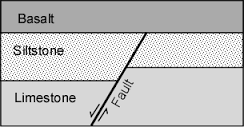
What are the relative ages of the features in order from oldest to youngest?
a)
Limestone, Basalt, Fault, Siltstone
b)
Siltstone, Fault, Basalt, Limestone
c)
Limestone, Fault, Basalt, Siltstone
d)
Limestone, Siltstone, Fault, Basalt
10.

The rock formation labeled "P" is a(n)...
a)
fault
b)
intrusion
c)
inclusion
d)
unconformity
11.
The half-life of Zn-71 is 2.4 minutes. If one had 100.0 g at the beginning, how many grams would be left after 7.2 minutes has elapsed?
a)
100.0g
b)
50.0g
c)
12.5g
d)
8.5g
12.
After the third half-life, how much of a radioactive sample is left?
a)
1/2
b)
1/3
c)
1/16
d)
1/8
13.
Barium-122 has a half-life of 2 minutes. A fresh sample weighing 80 g was obtained. If it takes 10 minutes to set up an experiment using barium-122, how much barium-122 will be left when the experiment begins?
a)
0.25g
b)
2.5g
c)
25g
d)
80g
14.
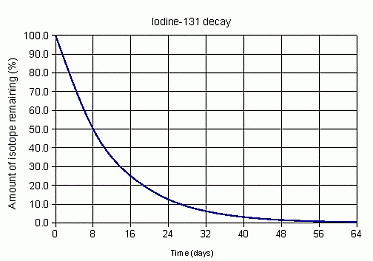
What is the half-life of iodine-131?
a)
32 days
b)
8 days
c)
16 days
d)
24 days
15.
What 2 things make a good index fossil?
a)
Good looks and a great smile
b)
widespread and on Earth of a short time
c)
widespread and on Earth for a long time
d)
only found in Clinton Twp and in every rock layer
16.
What happens during radioactive decay?
a)
A stable isotope of one element changes into an unstable isotope of a different element
b)
A stable isotope of one element changes into an unstable isotope of the same element
c)
An unstable isotope of one element changes into a stable isotope of a different element
d)
An unstable isotope of one element changes into a stable isotope of the same element
17.
Which characteristic of carbon-14 dating helps scientists determine the approximate time a species became extinct?
a)
Carbon-14 is NOT present in more recent fossils
b)
Carbon-14 increases at a constant rate over time
c)
Carbon-14 decreases at a constant rate over time
d)
Carbon-14 can only be foun in fossils of a certain period
18.
The time it takes for 50% of the nuclei in a radioactive sample to decay to its stable isotope is called _____.
a)
the daughter product
b)
geologic time
c)
the half-life
d)
the half-time
19.
When an unstable radioactive atom decays, it usually turns into:
a)
a more stable atom
b)
a less stable atom
c)
the exact same atom but with less pure energy
d)
empty space
20.
The energy from the sun is created by a process called:
a)
nuclear fission
b)
nuclear fusion
c)
nuclear reaction
d)
nuclear core
21.
Energy is created in the core when two _____________ atoms join together to form a ______________ atom.
a)
helium, hydrogen
b)
carbon, hydrogen
c)
nitrogen, helium
d)
hydrogen, helium
22.
The middle layer of the sun's interior that contains very tightly packed gas is called the _____________.
a)
photosphere
b)
chromosphere
c)
radiation zone
d)
convection zone
23.
In which area of the sun does gas rise as it heats up, then fall back down as it cools?
a)
the core
b)
the radiation zone
c)
the convection zone
d)
the corona
24.
When we look at the sun, what layer are we viewing?
a)
photosphere
b)
chromosphere
c)
corona
d)
convection zone
25.
Areas of gas on the sun's surface that are cooler than gases around them are called:
a)
corona
b)
prominences
c)
sunspots
d)
solarspots
26.
The number of sunspots on the sun varies in a cycle that is about how long?
a)
6-8 years
b)
10-11 years
c)
12-15 years
d)
365 days
27.

These colored bands of light in the sky are called ___.
a)
auroras
b)
solar flares
c)
solar prominences
d)
sun spots
28.

Which sun feature is shown here?
a)
solar flare
b)
aurora
c)
solar prominence
d)
sun spot
29.

Which sun features are shown here?
a)
solar flares
b)
solar prominences
c)
sun spots
d)
aurora
30.

What word best describes our sun?
a)
Average
b)
Supergiant
c)
Dwarf
d)
Red Giant
31.
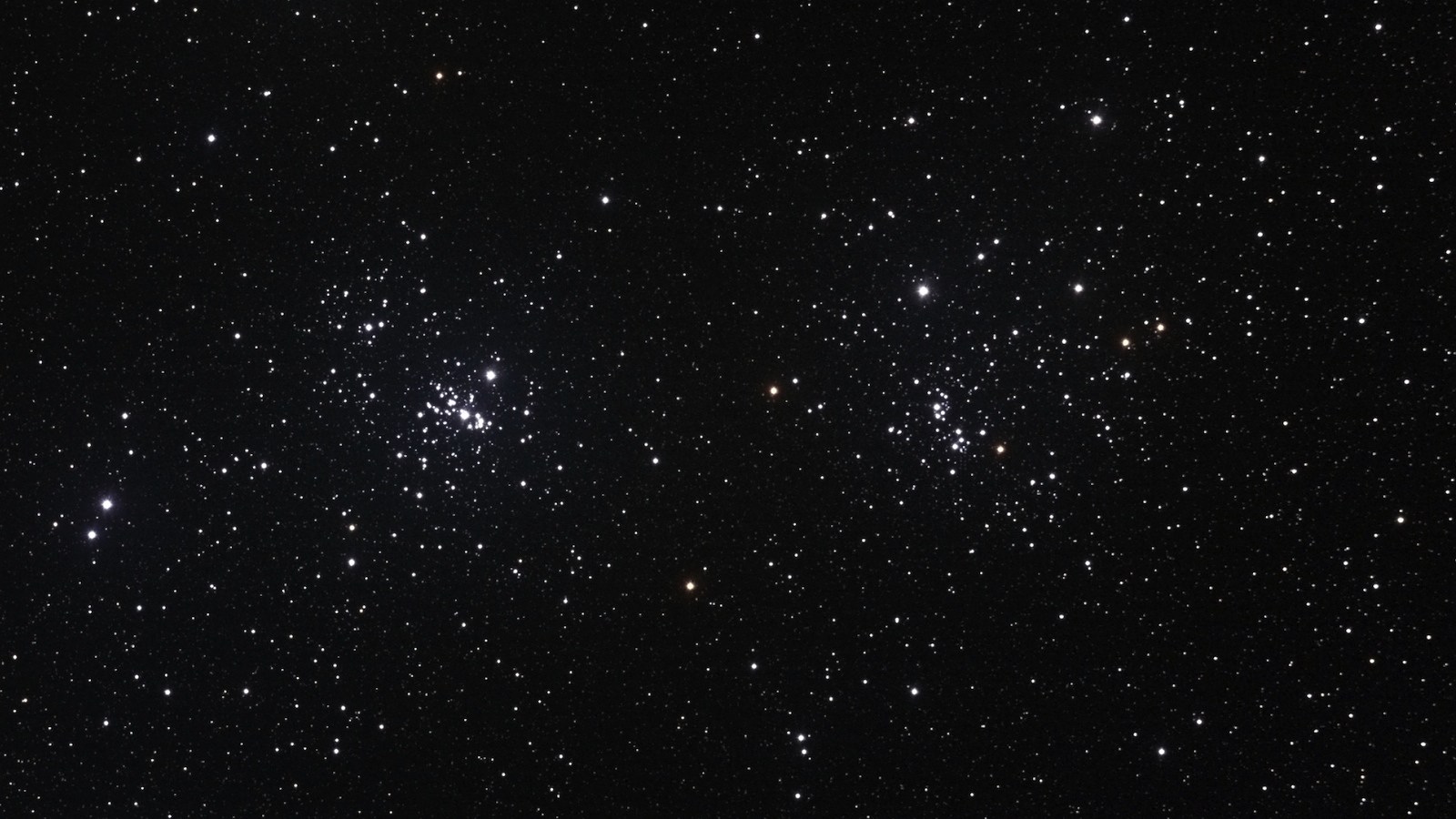
Why do other stars appear so much smaller than the sun?
a)
They are much smaller
b)
They are so far away
c)
They are not as bright
d)
They are dwarf stars
32.

What color of star is the hottest?
a)
Blue
b)
Red
c)
Yellow
d)
Orange
33.

What color of star is the coolest?
a)
Red
b)
Yellow
c)
Blue
d)
White
34.
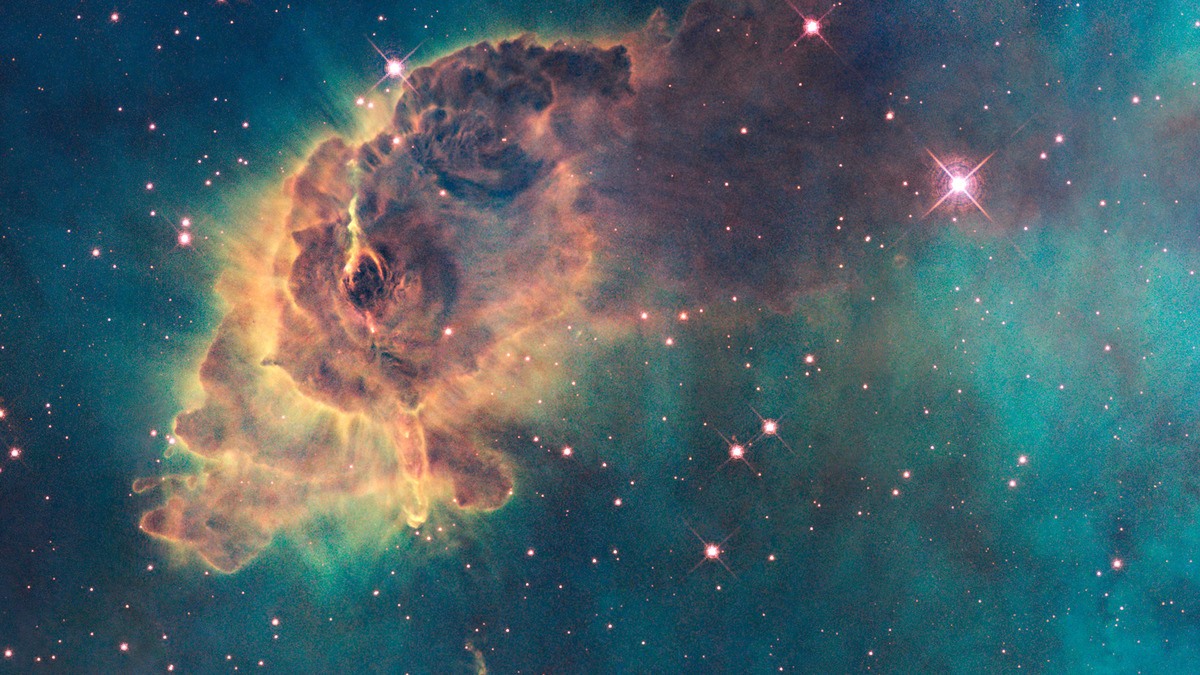
What is the name of the gas/dust clouds that form stars?
a)
Nebulas
b)
Protostars
c)
Supernova
d)
Neutron Star
35.
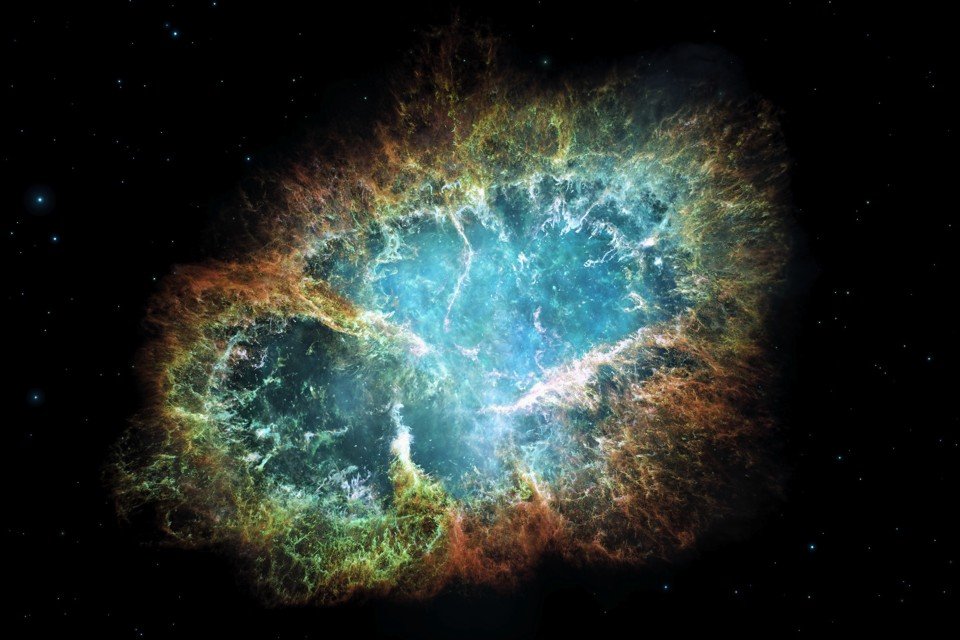
What is the name of the explosion at the death of a massive star?
a)
Supergiant
b)
Supernova
c)
Black Hole
d)
Nebula
36.

What is the best title for this picture?
a)
Birth of a Star
b)
Birth of a Universe
c)
Life Cycle of a Low Mass Star
d)
Life Cycle of a High Mass Star
37.

As a whole, Giants are considered hotter than White Dwarfs.
a)
True
b)
False
38.

Which star is the coldest?
a)
Yellow Star
b)
Red Star
c)
Orange Star
d)
Blue Star
39.

In the diagram given, what happens as we move to the left?
a)
Stars Get Larger
b)
Stars get Colder
c)
Stars get hotter
40.

Which star has the lowest temperature?
a)
A
b)
B
c)
C
d)
D
41.

Which star has the lowest luminosity?
a)
A
b)
B
c)
C
d)
D
42.

Which star is considered a Main Sequence Star?
a)
A
b)
B
c)
C
d)
D
43.
Which measurements allows astronomers to compare the brightness of stars?
a)
parallax
b)
red shift
c)
absolute magnitude
d)
apparent magnitude
44.
What do we use to classify the temperature, brightness, and size of stars?
a)
Color
b)
The star's shape
c)
H-R Diagram
45.
Brightness of a star as seen from Earth
a)
parallax
b)
apparent magnitude
c)
absolute magnitude
d)
spectrum
46.
Which stage of its life cycle does a star spend most of its time in?
a)
nebulae
b)
red giant
c)
protostar
d)
main sequence
47.

Which of these puts the main parts of an average star's life cycle in the correct order?
a)
protostar>
main sequence>
red giant >
white dwarf
main sequence>
red giant >
white dwarf
b)
protostar >
main sequence>
white dwarf>
red giant
main sequence>
white dwarf>
red giant
c)
main sequence>
protostar>
white dwarf>
red giant
protostar>
white dwarf>
red giant
d)
protostar>
red giant >
main sequence>
white dwarf
red giant >
main sequence>
white dwarf
48.
Bigger stars have longer lives than smaller stars.
a)
true
b)
false
49.
All main-sequence stars will explode as supernovae.
a)
True
b)
False
50.

Where are stars the most stable?
a)
Supergiant
b)
Main sequence
c)
White dwarf
d)
black dwarf
51.
We see the same side of the moon all the time.
a)
True
b)
False
52.
The moon reflects light from the sun.
a)
True
b)
False
53.
Which moon phase is when you can't see the moon at all?
a)
Waning crescent
b)
Full moon
c)
Waxing gibbous
d)
New moon
54.

When the Earth is between the moon and sun, it is most likely a:
a)
new moon
b)
full moon
c)
waxing crescent
d)
waxing gibbous
55.
What causes the moon's phases
a)
Where you are standing on Earth
b)
the amt of sunlight reflected onto the moon from the sun
c)
The tilt of Earth
d)
how fast the moon is moving
56.
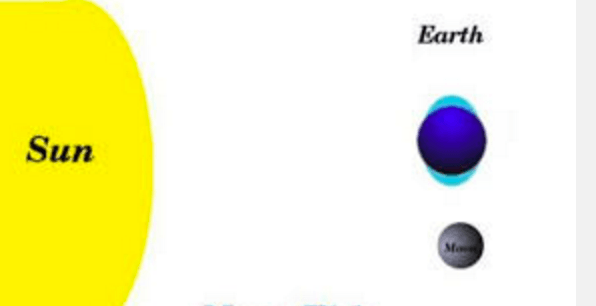
Which moon phase is shown in this diagram?
a)
new moon
b)
1st quarter
c)
full moon
d)
last quarter/3rd quarter
57.

Which moon phase is shown in this diagram?
a)
new moon
b)
first quarter
c)
full moon
d)
last quarter/3rd quarter
58.

What phase is this?
a)
Waning Gibbous Moon
b)
Waxing Gibbous Moon
c)
Waning Crescent Moon
d)
Waxing Crescent Moon
59.

What phase is this?
a)
Full Moon
b)
First Quarter Moon
c)
Last Quarter Moon
d)
New Moon
60.
We are composed mainly of rock and metal.
a)
comets and stars
b)
stars and meteors
c)
asteroid and meteors
d)
comets and asteroid
61.
Which list correctly orders the lifecycle of a piece of debris as it passes from space down to Earth's surface?
a)
meteorite-meteor-meteoroid
b)
meteor-meteorite-meteoroid
c)
meteoroid-meteor- meteorite
d)
meteor-meteoroid-meteorite
62.
What do we call an object smaller than a planet but with gravity too weak to form a spherical shape?
a)
asteroid
b)
comet
c)
meteorite
63.
What do we call the visible streak of light created by space debris entering Earth's atmosphere?
a)
meteor
b)
meteorite
64.
They are sometimes called shooting stars
a)
interplanetary dust
b)
asteroids
c)
comets
d)
meteors
65.
A meteorite is DIFFERENT from a comet mainly because
a)
has a tail of ice and gas
b)
is found in orbit between Jupiter and Mars
c)
enters the Earth's atmoshere
d)
has a nucleus mad of rock and snow.
66.
Sometimes I am called a "dirty snowball". I have a hydrogen cloud, coma, and a nucleus. I am invisible except when near the sun. What am I?
a)
Asteroid
b)
Star
c)
Meteor
d)
Comet
67.
Between a meteroid and a comet, whose orbit (ellipse) moves the furthest away from the sun and sometimes past Neptune?
a)
meteroids
b)
comets
68.
What is one difference between an asteroid and comet?
a)
A comet orbits the sun and an asteroid does not
b)
An asteroid is formed from leftovers from the formation of the solar system and a comet is not
c)
When a comet comes near the sun it loses material while an asteroid typically remains solid
d)
An asteroid orbits the sun in the oort cloud while a comet orbits the sun between Mars and Jupiter
69.
A wave with a large wavelength will have a ______ frequency and _____ energy
a)
high, low
b)
high, high
c)
low, high
d)
low, low
70.
Select the correct order of waves on the EMS
a)
Radio, Micro, Infra, Visible, Ultra, X-ray, Gamma
b)
Gamma, X-ray, Ultra, Vis, Infra, Micro, Radio
c)
Vis, Micro, Infra, Ultra, X-ray, Gamma, Radio
d)
Micro, Radio, Vis, Infra, Ultra, X-ray, Gamma
71.
Which has the LONGEST wavelength and, therefore, the lowest frequency/energy
a)
Gamma Rays
b)
Radio Waves
c)
Visible Light
d)
Infrared rays
72.
Which section of the spectrum is the ONLY one we can see?
a)
X-rays
b)
Visible Light
c)
Gamma Rays
d)
Ultraviolet Rays
73.
Put the visible light colors in order from longest wavelength to shortest wavelength
a)
Violet, Indigo, Blue, Green, Orange, Yellow, Red
b)
Red, Yellow, Green, Orange, Violet, Blue, Indigo
c)
Red, Orange, Yellow, Green, Blue, Indigo, Violet
74.
How are electromagnetic waves different from other waves?
a)
They have very short wavelengths
b)
They transmit energy instead of matter
c)
They can travel through a vacuum
d)
They can change direction by reflection
75.
As the frequency of an electromagnetic wave increases, the amount of energy in that wave...
a)
increases.
b)
decreases.
c)
stays the same.
76.
Which color has the highest frequency?
a)
red
b)
orange
c)
green
d)
blue
77.
Which color has the least amount of energy?
a)
red
b)
orange
c)
green
d)
blue
78.
Which of the following has the longest wavelength?
a)
microwaves
b)
visible light
c)
x-rays
d)
infrared waves
79.

High frequency waves have _________ wavelengths.
a)
varying
b)
long
c)
the same
d)
short
80.
What best describes the doppler effect?
a)
An apparent change in frequency of a wave due to the relative motion between a wave source and an observer
b)
When sound changes pitch
c)
When light changes color
d)
An apparent change in the amplitude of a wave due to the relative motion between a wave source and an observer.
81.
If a star is being observed from Earth and it's light has shifted towards the blue side of the electromagnetic spectrum it would be...
a)
Moving towards the Earth
b)
Moving away from the Earth
c)
This is a trick question that cannot be answered
d)
It isn't a star, it is a very large blueberry.
82.
If a star is being observed from Earth and it's light has shifted towards the red side of the electromagnetic spectrum it would be...
a)
Moving towards the Earth
b)
Moving away from the Earth
c)
This is a trick question that cannot be answered
d)
It isn't a star, it is a very large blueberry.
83.
The vast majority of galaxies in our universe are moving away from us. We know this because we observe __________ in the galaxies absorption spectra.
a)
Redshift
b)
Blueshift
c)
Turbulance
d)
Superposition
84.
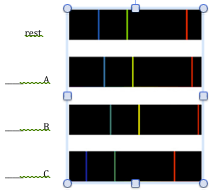
Are any of the galaxies moving towards
Earth? Explain.
a)
A. It is redshifted
b)
B. It is redshifted.
c)
C. It is blue shifted.
d)
A. It is blueshifted.
85.
Evidence suggests that the whole Universe is expanding and that it might have started billions of years ago from one place with the big bang.
a)
True
b)
False
86.
The existence of the cosmic background radiation
implies that
a)
the big bang model is wrong.
b)
the universe began in a hot, dense state.
c)
the universe did not have a moment of creation.
d)
the universe began in a cold, low-density state.
87.
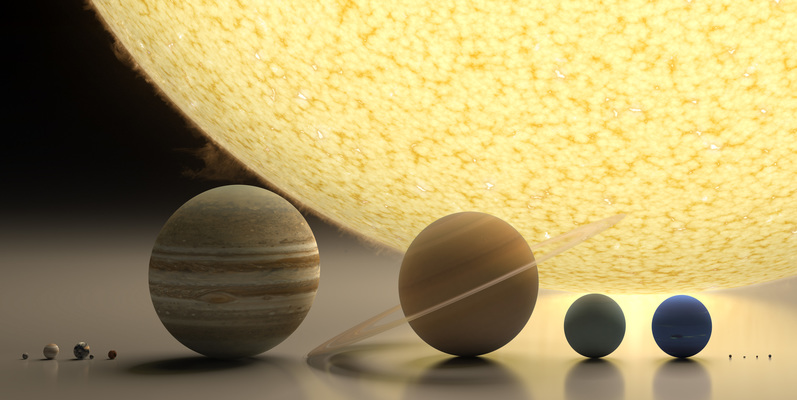
Gas giants
a)
Inner planets
b)
Outer planets
c)
Both
d)
Venus
88.

Mercury, Venus, Earth, & Mars
a)
Inner planets
b)
Outer planets
c)
Both
d)
Pluto
89.

Solid, rocky surface
a)
Inner planets
b)
Outer planets
c)
Both
d)
Saturn
90.
What is the geological time scale?
a)
a time line dividing the Earth's history into units representing millions of years.
b)
A time line of the past 100 years of development.
c)
The period of time that describes when the dinosaurs lived.
d)
A time line of how the oceans formed over the years.
91.
What is longer, a Period or an Epoch?
a)
period
b)
epoch
c)
neither, they are the same
92.
What is longer, an Era or a Period?
a)
era
b)
period
c)
neither, they are the same
93.
Which is longer, An Epoch or an Eon?
a)
Eon
b)
Epoch
c)
neither, they are the same
94.
Which is longer, an Era or an Epoch?
a)
era
b)
epoch
c)
neither, they are the same
100 %

