wayground logo

Free Printable Worksheets

Font size

S
M
L
XL
Worksheets

Chapter 6 adn 7 Test Review: Populations

Total questions: 99

Worksheet time: 2hrs 46mins
Name
Class
Date
1.
Which of the following leads to a decrease in birthrates among women?
a)
Higher Education
b)
High Infant Mortality Rate
c)
No Prenatal Care
d)
No contraceptives
2.
VOCAB: The study of human population statistics
a)
demography
b)
biology
c)
microbiology
d)
ecology
3.
VOCAB: The average number of children a female member of a population has during her lifetime
a)
total fertility rate
b)
replacement fertility rate
c)
growth rate
d)
death rate
4.
VOCAB: describes the relative numbers of organisms of each age within a population and is often represented by a graph
a)
age structure diagram
b)
population growth rate
c)
demographic transition
d)
fertility rate
5.
VOCAB: number of males compared to females in a population
a)
sex ratio
b)
age structure
c)
growth rate
d)
population shift
6.
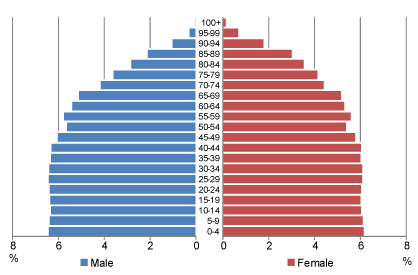
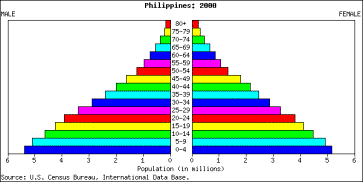
According to the population pyramid of this country, its population is most likely...
a)
growing slowly.
b)
growing rapidly.
c)
decreasing.
d)
not changing.
7.
What kind of growth is this country experiencing?
a)
Exponential Growth
b)
Stable Growth
c)
Declining Growth
8.
VOCAB: Introduction of machinery powered by fossil fuels, marked by the shift from a rural, agricultural-based society to an urban, industry-based society
a)
Industrial Revolution
b)
Greenhouse Effect
c)
Endangered Species Act
d)
Climate Change
9.
VOCAB: The average number of years an individual is expected to live.
a)
life expectancy
b)
infant mortality
c)
death rate
d)
growth rate
10.
VOCAB: how a population changes in size during a specific period of time.
a)
growth rate
b)
infant mortality
c)
life expectancy
d)
death rate
11.
The world's population in 2011 was approximately 7 billion and a steady rate of growth was expected to reach 14 billion in approximately 90 years. The period of 90 years is known as: 
a)
doubling time.
b)
life expectancy.
c)
overpopulation.
d)
demographic transition.
12.
Life expectancy is lowest in:
a)
East Asia.
b)
North America.
c)
Africa.
d)
Western Europe.
13.
The number of individuals an environment can support is known as the
a)
Total Fertility Rate
b)
Exponential Growth
c)
Limiting Factor
d)
Carrying Capacity
14.
In recent years, the human population has 
a)
increased exponentially
b)
decreased exponentially
c)
decreased slowly
d)
increased slowy
15.
High levels of GDP per capita indicate...
a)
Higher levels of happiness 
b)
Higher standard of living
c)
Equal levels of wealth 
d)
Self-sufficient communities
16.
What is one way improved agriculture contributed to population growth?
a)
it led to better sanitation
b)
it created a surplus of food
c)
it meant that horses could be used for transportation
d)
it led to the production of more wool for warm clothing
17.
What is the carrying capacity of the following graph?
a)
1000
b)
8000
c)
800
d)
600
18.
What type of population change does this graph represent
a)
Exponential Growth
b)
Massive Die-off
c)
Linear Growth
d)
Decrease in Birth-Rate
19.
A person that moves from one country to another country.
a)
Emigrant
b)
Immigrant
c)
Religious Persecution Escapee
d)
Citizen
20.
Which isn't a major way the human population can decline?
a)
war
b)
disease
c)
famine
d)
surplus
21.
The movement of individuals away from a population
a)
emigration
b)
immigration
c)
dispersion
d)
population density
22.
Which of the following words means death rate?
a)
Natality
b)
Mortality
c)
Emigration
d)
Immigration
23.
One reason for a rapid population growth is...
a)
an increase in pull factors.
b)
declining death rates. 
c)
a sparse population density. 
d)
internal migration.
24.
The average number of people living in a square kilometer is called...
a)
urbanization. 
b)
internal migration. 
c)
population density. 
d)
pull factors. 
25.
Number of organisms per unit of living area
a)
Population density
b)
dispersion
c)
carrying capacity
d)
population growth rate
26.
All of the following are demographic figures used in determining the total population of a country EXCEPT...
a)
immigration.
b)
birth rate.
c)
death rate.
d)
marriage rate.
27.
What is a population pyramid?
a)
A type of graph showing the number of males and females in different age groups.
b)
A type of graph showing the number of males in different age groups.
c)
A type of graph showing the number of females  in different age groups.
d)
A type of graph showing the number of males and females in only one age group.
28.

Which correctly describes the term demographic transition?

a)

The transition from low birth rates and death rates to high birth rates and death rates as a country develops.

b)

The transition from high birth rates and death rates to low birth rates and death rates as a country develops.

c)

The transition from high birth rates to low death rates as a country develops.

d)

The transition from low birth rates to high death rates as a country develops.

29.

A Density Independent Limiting Factor is a limiting factor of a population that can affect population growth no matter what the population density. What is a density independent limiting factor that can affect the human population growth of North Carolina?

a)

disease

b)

hurricanes

c)

food supply

d)

water supply

30.
Countries with high growth rates usually have an age structure that has
a)
an even distribution over all ages
b)
more older people than young people
c)
more younger people than older people.
d)
more middle-aged people than younger people.
31.
Which of the following makes it difficult to reduce population growth?
a)
High literacy rates result in women wanting to have more children
b)
Population sizes will not decline until some people start having to do without food and other necessities of life
c)
Many people live in cities, where large families are an advantage
d)
Many people have low literacy and limited access to healthcare
32.
Which region of the world has the fastest growing population?
a)
Southeast Asia
b)
Eastern Europe
c)
Sub-Saharan Africa
d)
Latin America
33.
Which of the following is likely to be affected by a population of 7 billion?
a)
amount of land for agriculture
b)
amount of clean water
c)
number of people who are unemployed
d)
all of the above
34.

Which problem today is primarily the result of the Industrial Revolution?

a)

extensive air and water pollution

b)

increased transmission of disease between people living in close proximity

c)

decline in quality of agricultural soil

d)

erosion from deforestation as more fuel wood is harvested

35.
Population growth and fertility rates are lowest in
a)
upper-income countries
b)
upper- and middle-income countries
c)
middle- and low-income countries
d)
lower-income countries
36.
The most populous country in the world
a)
China
b)
India
c)
US
d)
Brazil
37.
The number of babies out of 1,000 that die during their first year of life is called
a)
infant mortality
b)
growth rate
c)
demography
38.

According to this graph, Which stage of the demographic transition has the highest level of population growth?

a)

pre-industrial

b)

transitional

c)

industrial

d)

post-industrial

39.

The human population is now about

a)

300 million

b)

1.3 billion

c)

7 billion

d)

12 billion

40.
In the graph, the density-independent limiting factor is most likely
a)
predation.
b)
parasitism.
c)
seasonal cycles.
d)
disease.
41.
In an ecosystem, which is NOT a density-
dependent limiting factor?
a)
competition
b)
parasitism
c)
predation
d)
natural disaster
42.
Demographic transition represent the transition from high birth and death rates to low birth and death rates as a country develops from a pre-industrial to an industrialized economic system. A demographic transition involves four stages. What is the second stage?
a)
Birth and death rates are high and in balance.
b)
Death rates drop rapidly due to better food supply and sanitation.
c)
Birth rates fall due the increase in the status and education of women.
d)
Birth rates and death rates are both low which leads to a shrinking population.
43.
Demographic transition represent the transition from high birth and death rates to low birth and death rates as a country develops from a pre-industrial to an industrialized economic system. A demographic transition involves four stages. What is the fourth stage?
a)
Birth and death rates are high and in balance.
b)
Death rates drop rapidly due to better food supply and sanitation.
c)
Birth rates and death rates are both low which leads to a shrinking population.
d)
Birth rates fall due the increase in the status and education of women.
44.
Science discoveries and technological advances have allowed the population of the Earth to grow exponentially with no end of the growth in sight. Which statement best describes how these advancements are detrimental to the Earth?
a)
Society is learning new and more Earth friendly means of creating energy.
b)
Scientists are learning ways for people and animals to coexist in harmony.
c)
Society is learning new ways to replenish resources that we have nearly used up.
d)
The growing population is taxing Earth's resources which could lead to the extinction of many species.
45.
During the past 100 years, the growth in human populations in the urban areas of industrialized nations has greatly contributed to all BUT one of these environmental problems. That is
a)
species extinction.
b)
deforestation.
c)
water contamination.
d)
increased carbon dioxide emissions.
46.
Demographic transition represent the transition from high birth and death rates to low birth and death rates as a country develops from a pre-industrial to an industrialized economic system. A demographic transition involves four stages.. What is the third stage?
a)
Birth rates and death rates are both low which leads to a shrinking population.
b)
Birth and death rates are high and in balance.
c)
Death rates drop rapidly due to better food supply and sanitation.
d)
Birth rates fall due the increase in the status and education of women.
47.
Which statement about human population growth is LEAST likely to be correct?
a)
Modern medicine has allowed human populations to extend well past the earth's carrying capacity, as more people survive for longer.
b)
Technological advances in farming and medicine will allow human populations to continue to grow without natural limits.
c)
Advances in agriculture have allowed the world's food supply to expand dramatically in the last 100 years.
d)
Worldwide, humans are reproducing more quickly than mortality is removing people from the population.
48.
All but one of the factors listed is a major contributor to world population increases. That factor is
a)
increased birth rate.
b)
increased immigration to foreign countries.
c)
decreased death rate.
d)
an increase in the quality of medical care.
49.
Increased food supplies in an ecosystem decrease competition because the competing organisms would
a)
reproduce more often.
b)
have more space in which to live.
c)
have enough food to eat.
d)
store large quantities of food.
50.
Which is the best indicator of a population's health and nutritional status?
a)
number and causes of death
b)
number of healthy-weight infants
c)
number of low-birth weight infants
d)
number of government food programs
51.
How does an increase in population density impact the spread of infectious disease?
a)
as population density increases, spread of infectious disease decreases
b)
as population density decreases, spread of infectious disease decreases
c)
as population density decreases, spread of infectious disease increases
d)
as population density increases, spread of infectious disease increases
52.
Which is NOT a problem associated with an overpopulated country?
a)
lack of housing
b)
lack of workers
c)
poor sanitation
d)
overcrowded cities
53.
Which factor is a density-dependent limiting factor on the population of a species?
a)
seasonal variation
b)
natural disasters
c)
unusual weather
d)
predation
54.
Any abiotic or biotic factor in an ecosystem that causes a population’s size to slow or decrease is a ____________ factor.
a)
growth
b)
limiting
c)
carrying
d)
density dependent
55.
Industrialized countries like _________ tend to have lower levels of ________________.
a)
the United States, education.
b)
Mexico, personal income.
c)
Great Britain, poverty.
d)
Kenya, childbirth.
56.
When populations become so dense as to cause overcrowding, there is an increase in the rate of infectious diseases within the population. This is because overcrowding usually leads to a(n)
a)
decrease in available medical care.
b)
increase in the amount of wealth of the population.
c)
increase in quality of living conditions and sanitation.
d)
decrease in quality of living conditions and sanitation.
57.
Over a long period of time, each pair of adults in a population had only two offspring and the offspring lived to reproduce, the population would...
a)
grow
b)
shrink
c)
remain the same
d)
disperse randomly
58.
An example of a population is
a)
all trees in a forest
b)
all maple trees in a forest
c)
all plants in a forest
d)
all animals in a forest
59.
Which of the following best describes a population?
a)
members of the same species living in the same place at the same time
b)
all the red birds in an area
c)
all types of organisms living in the same place
d)
all members of the same species
60.
World population growth will eventually stop when
a)
the population reaches 9 billion
b)
most countries have replacement level fertility rates
c)
most countries have higher death rates
d)
the worldwide infant mortality rate increases
61.
Which factor contributed most to the exponential growth of the human population?
a)
more food, better hygiene
b)
higher birth rates
c)
higher fertility rates
d)
increased immigration
62.
Because bith rates have begun to fall, Earth's population will
a)
soon stabilize at the level it is today-about 7 billion
b)
begin to decrease until it reaches 5 billion
c)
increase for a short time and then decrease to current levels
d)
stabilize somewhere around 9 billion by 2050
63.
If the death rate of a population is greater than the birthrate, the population decreases.
a)
True
b)
False
64.
Exponential growth is slow and gradual.
a)
True
b)
False
65.
One of the main characteristics of a population is its
a)
dynamics
b)
density
c)
change over time
66.
One of the main characteristics of a population is its
a)
change over time
b)
geographic range
c)
dynamics
d)
habitat
67.
The average number of people per square mile
a)
population distribution
b)
population density
c)
urbanization
d)
population rate
68.
If a population grows larger than the carrying capacity of the environment, the
a)
death rate may rise
b)
birth rate may rise
c)
death rate must fall
d)
birth rate must fall
69.
What growth pattern describes a population whose growth rate slows or stops following a period of exponential growth?
a)
logistic growth
b)
population growth
c)
exponential growth
d)
predator-prey cycle
70.
Which type of growth is best illustrated by this rabbit population?
a)
exponential
b)
logistic
c)
S-shaped
d)
predator-prey
71.
What point on the graph represents the carrying capacity?
a)
A
b)
B
c)
C
d)
D
72.
When a population grows past the ecosystem's carrying capacity, what happens to the population?
a)
Continues to grow
b)
The population starts to die off to return to carrying capcity
c)
The population will go extinct due to lack of resources
d)
The population grows then finds a new carrying capacity
73.
If there is more food than usual in an ecosystem, then the population will mostly likely...
a)
stay the same
b)
decrease
c)
increase
d)
reach carrying capacity
74.
How will competition affect the carrying capacity of an ecosystem for the animal in competition?
a)
Decrease
b)
Increase
c)
Will show not affect
d)
Competition does not exist in nature
75.
Which statement is most accurate based on the graph?
a)
The zebra and lions do not affect each other
b)
when lions population increases, so does the zebra population
c)
When the zebra population increases, it causes the lion population to also increase
d)
when zebra populations go down, the zebra population goes up. 
76.
Natural disasters and weather patterns like earthquakes, floods, and tornadoes, blizzards, and heatwaves are considered ___________ ____________ limiting factors
a)
Density-dependent
b)
Density-independent
77.
Food, water, sunlight, shelter, and space are resources that are often __________.
a)
limiting factors
b)
not found in ecosystems
c)
non-limiting factors
d)
Biotic
78.

What year is the lionpopulation the highest

a)

1920

b)

1990

c)

2000

d)

2020

79.
What year is the zebra population the highest
a)
1920
b)
2000
c)
1960
d)
2020
80.
which statement sounds accurate based on the graph data. 
a)
The zebra and lions do not affect each other
b)
when lions population increases, so does the zebra population
c)
When the zebra population increases, it causes the lion population to also increase
d)
when zebra populations go down, the zebra population goes up. 
81.
What would the carrying capacity of this graph be
a)
530
b)
400
c)
500
d)
480
82.
What type of growth is happening at  the A on the graph
a)
logarithmic
b)
Exponential
c)
Standard
d)
Increasing
83.
According to the graph, What is causing the deer population to decrease
a)
They Got sick
b)
The wolf population is decreasing
c)
The wolf population increased
d)
Nothing it's a coincidence
84.
Density, distribution, and growth rate are characteristics used to classify which one of the following?
a)
Biomes
b)
Populations
c)
Limiting Factors
d)
Age Structure
85.
A fruit fly that has a short life span and produces many offspring can be classified into which  reproductive strategy?
a)
r-strategist
b)
k-strategist
c)
a carrying-capacity strategist
d)
a logistic strategist
86.
Which of the following does not affect the spatial distribution of a population?
a)
the carrying capacity of a population
b)
the distribution of food and other resources
c)
the existence of predators or parasites
d)
abiotic conditions like rainfall and sunlight
87.
Which of the following involves a situation in which a density-dependent factor influences a  population?
a)
Several seasons passed during which rainfall was ample, winters were not severe and food for snow hares was in good supply.
b)
A hurricane severely disrupted a salt marsh and uprooted most of the marsh grass in an estuary.
c)
A forest fire on the north side of a mountain forced the white-tailed deer from the north side to move into the range of the white-tailed deer on the south side of the mountain, making food more scarce.
d)
After a heavy rain, pesticides that were applied to a cotton crop to control weevils ran off into a waterway that flows next to a field.
88.
On ten acres of native forest there are eight white-tailed deer, seven coyotes, 45 armadillos, and 231        loblolly pine trees. Which population has the highest density?
a)
white-tailed deer
b)
coyotes
c)
armadillos 
d)
loblolly pine trees
89.
 American bison, which are large grazing mammals, are most often found clumped in small groups.    What might you infer about the spatial distribution of American bison?
a)
A clumped group provides better protection from predators.
b)
A clumped group attracts more prey.
c)
A clumped group can graze a larger area.
d)
A clumped group takes better advantage of water resources.
90.
A flowering plant has seeds that are carried by the wind. Infer the most likely dispersion pattern of the plants that grow from these seeds.
a)
uniform
b)
clumped groups
c)
random
d)
spatial
91.
Which of the following statements is correct?
a)
Population size of predators increases when their prey is scarce.
b)
Competition for resources is density-independent when food is plentiful.
c)
Disease is density-dependent because transmission occurs more easily when a population is large.
d)
A change in average temperature is a density-dependent factor because fewer organisms can acclimate to variations in temperature.
92.
To assess a population’s growth rate, an ecologist must know how many individuals are born, how  many died, and how many move away in a given period of time. What else must an ecologist know?
a)
how many individuals find mates
b)
how many individuals move in from somewhere else
c)
how many individuals carry communicable diseases
d)
how many individuals are young or old
93.
How does the logistic model of population growth differ from the exponential model?
a)
The exponential model shows a restricted growth rate.
b)
The logistic model considers the environment’s carrying capacity.
c)
The graph of the exponential model is S shaped.
d)
The graph of the logistic model has a longer lag phase.
94.
A population’s ____________________ is the amount that a population’s size changes in a given period of time.
a)
Carrying Capacity
b)
Limiting Factor
c)
Growth Rate
d)
Biome
95.
A previously rapidly growing population of green tree frogs in the city park has suddenly leveled off, and is presently neither increasing or decreasing in numbers. You can probably infer that the tree frog population has reached its ____________________ _________________________.
a)
Limiting Factor
b)
Carrying Capacity
c)
Population Total
d)
Nap Time
96.
The size of a population will decrease if mortality ____________________.
a)
Increases
b)
Decreases
c)
Stays the same
97.
Complete:________ ________ – death rate + immigration rate – emigration rate = growth rate
a)
Growth Rate
b)
Birth Rate
c)
Capacity Rate
d)
Tax Rate
98.
 Young adult male chimpanzees look for mates outside their own population. The males then take the  females back to their group. Which of the following occurs in females’ original population?
a)
emigration
b)
immigration
c)
mortality
d)
natality
99.
A population’s emigration in one month totaled three individuals. During the same period, immigration was 17 individuals. Natality was 12, and mortality was 26 due to a parasite infection. What was the net effect on the population size?
a)
–14
b)
0
c)
+12
d)
+26