
 Worksheets
Intro to Advanced Biology Spring Final Review
Total questions: 104
Worksheet time: 2hrs 37mins

Each organism has _____ alleles that make up a trait.
1
2
3
4
Meiosis results in ______.
4 genetically unique haploid gametes
4 genetically unique diploid cells
2 genetically identical cells
4 genetically identical cells
When homologous chromosomes match up, they form a structure called a ___________.
tetrad
triad
diploid
gamete
Two processes that increase genetic variation during meiosis are crossing over and _____
Synapsis
Tetrad
Independent assortment
Gameiosis

What is the term for a three nucleotide sequence that codes for an amino acid (on mRNA)? For example: AUG

Which of the following RNA sequences would be transcribed from the DNA sequence ATGCCTAGGAC?
TACGGATCCTG
UAGCGAUCCUG
AUGCCUAGGAC
UACGGAUCCU
GCAUUCGAAGU
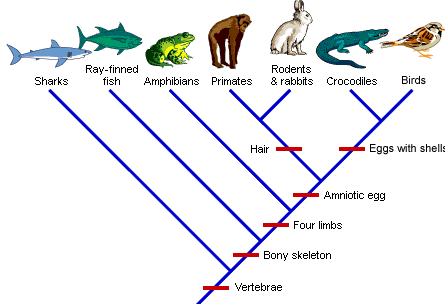
Structures as different as human arms, bat wings, and dolphin flippers contain many of the same bones, these bones having developed from very similar embryonic tissues. How do biologists interpret these similarities?
By identifying the bones as being analogous
By the principle of convergent evolution
By proposing that humans, bats, and dolphins share a common ancestor
By looking at where the animals live
When we say that an individual organism has a greater fitness than another individual, we specifically mean that the organism
lives longer than others of its species.
competes for resources more successfully than others of its species.
mates more frequently than others of its species.
utilizes resources more efficiently than other species occupying similar niches.
leaves more viable offspring than others of its species.
What does a phylogenetic tree show?
shows how living organisms are related to each other using evidences
organizes living organisms by color
shows how living organisms interact with each other in the real world
shows how certain organisms grow based on their genes
a __________ is a segment of DNA that codes for a protein
gene
allele
histone
helix
How many different phenotypes would exist in trait that is controlled by incomplete dominance?
one
two
three
more than four
somatic cells have ______ SET(S) of chromosomes and gametes have ______ SET(S) of chromosomes
one, two
two, one
three, six
four, two

What is the correct analysis for this karyotype?
male with trisomy 21 (down syndrome)
female with trisomy 21 (down syndrome)
male with XXY (klinefelter syndrome)
female with XYY (jacob's syndrome)

nondisjunction would likely result in
a gamete with too few chromosomes
a gamete with too many chromosomes
either of these are possible results
For a population to be in genetic equilibrium this must be true
allelic frequencies in a population remain constant from generation to generation
allelic frequencies in a population change slightly from generation to generation
allelic frequencies in a population vary significantly from generation to generation
none of these are true
natural selection is
survival and reproduction of the largest and strongest organisms
survival and reproduction of the organisms best suited to their environment
the organisms that acquire the best traits to suit the environment
survival and reproduction of the smartest individuals in a population

all of these bird species share a common ancestor that lived in this group of small islands long ago. the descent from a common ancestor in this island setting is referred to as
adaptive radiation
convergent evolution
coevolution
parallel evolution
Which biochemical evidence would suggest that all living organisms share a common ancestor?
all organisms construct protein using RNA, ribosomes, and the genetic code
all organisms use ATP as an energy carrier
all organisms carry genetic information in the form of DNA
all of these
Vestigial structures show
how an ancestor may have lived
how old a fossil is
what the organism is not related to
usefulness in the organism that has it
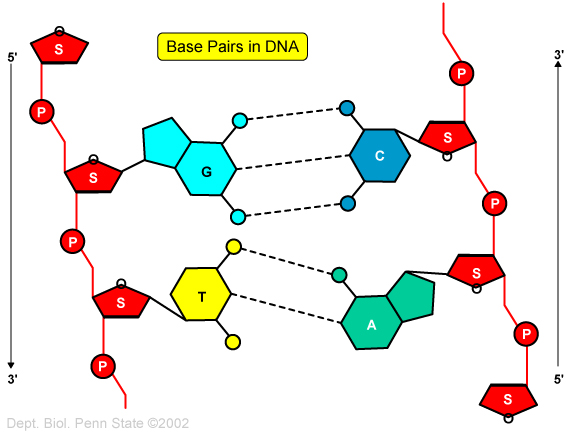
DNA is made up of phosphates, sugars, and
proteins
lipids
bases
iodine
A red flower bred to a white flower produces red and white spotted flowers. This is an example of
incomplete dominance
recessive genes
epistasis
co-dominance

The diagram shows homologous chromosomes during prophase I of meiosis. Which of the following correctly describes the process being illustrated?
Segregation of sister chromatids
Mutation in which the DNA content of the gene is altered
Crossing over in which alleles are exchanged
Condensation and segregation of alleles
A mutation resulting in no change from the original amino acid sequence
substitution-silent
substitution-nonsense
substitution-missense
frameshift
What is the purpose of translation?
to replicate DNA before cell division
to assemble mRNA into a chain
to synthesize amino acids that open up the DNA
to use the genetic code to form a specific sequence of amino acids
When does synthesis of DNA happen?
S phase
G1 phase
M phase
G2 phase
Which of the following processes occurs in the nucleus
DNA Replication and Transcription
DNA Replication and Translation
Transcription and Translation
Translation and Modification
A small cell has a ________ surface area to volume ratio than a larger cell.
larger
smaller
equal

Which of the following has the largest surface area to volume ratio?
A
B
C
D
When organisms are better adapted to their environment they will survive and reproduce more successfully than organisms less adapted. This process is called what?
Selective breeding
Natural Selection
Cloning
Evolution of all species
Which scientist visited the Galapagos Islands and came up with the theory of natural selection?
Theodor Schwann
Gregor Mendel
Charles Darwin
Rudolf Virchow

Scientists have collected millions of fossils of different organisms, and have developed a timeline of life on Earth. What do we call this?
Mutation
Natural Selection
The theory of evolution
Fossil Record

Sometimes bones in the front limbs of animals are very similar in structure. What do we call similar bone structures that indicate a link to a common ancestor?
Adaptations
Gradualism
Homologous Structures
Extinction
A physical or behavioral trait that helps an organism survive and reproduce in its environment is called a what?
An adaptation
A response to a stimulus
A mutation
Evolution
What most likely caused the finches on the Galapagos Islands to have beaks that were different from the finches on the mainland?
There were different types of predators on the island.
There were different types of food available on the island.
The finches had no water to drink.
The finches on the mainland could not fly high enough.
When looking at two birds of the same species, you notice that one has darker feathers than the other one. You also notice that one has a beak that is just a little longer. These slight differences within members of the same species are called.....
Fossils
Extinction
Meiosis
Variations
What is the study of organisms at the early stages of development?
DNA studies
Comparative Embryology
Extinction
Fossil Record
Which Hardy-Weinberg factor represents the frequency of heterozygous individuals in a population?
p2
2pq
q2
p2 + 2pq
If a population experiences no migration, is very large, has no mutations, has random mating, and there is no selection, which of the following would you predict?
The population will evolve, but much more slowly than normal
The makeup of the population's gene pool will remain virtually the same as long as these conditions hold.
The composition of the population's gene pool will change slowly in a predictable manner.
Dominant alleles in the population's gene pool will slowly increase in frequency while recessive alleles will decrease.
The population probably has an equal frequency of A and a alleles.
A chart that displays family relationships indicating traits or disorders
Punnett square
Pedigree
Karyotype chart
Each generation in a pedigree is marked with
Arabic numerals
Names of individuals
Roman numerals


In what process is mRNA synthesized?
Transcription
Translation
DNA Replication
Mitosis
Where does TRANSCRIPTION occur?
Nucleus
Ribosome
Cytoplasm
Mitochondria
Why must transcription occur where DNA can be found?
because DNA can't leave
because ribosomes are in the nucleus
because DNA polymerase is found there
because helicase unzips the DNA
How many codons equals 1 amino acid?
1
2
3
4
How many nucleotides equal 1 amino acid?
1
2
3
4
Which organelle is the location where protein is made?
Ribosome
Nucleus
Cytoplasm
Nucleotide
When these bond together, they form a protein
Amino Acids
Peptide Bonds
Ribose
Nucleotides


In eukaryotes, which organelle is DNA usually found in?
cell membrane
vacuole
chloroplast
nucleus


