wayground logo

Free Printable Worksheets

Font size

S
M
L
XL
Worksheets

Semester 2 Exam Review

Total questions: 100

Worksheet time: 2hrs 5mins

Name
Class
Date
1.
The scientific theory of evolution is supported by different types of evidence. The diagrams below show the skeletons of two different animal species. How does comparing the skeletons of these animals provide support for the scientific theory of evolution?
a)
 It provides information about the organisms' habitats.
b)
 It shows possible common ancestry between organisms.
c)
It provides information to determine the organisms' ages.
d)
It shows possible chromosomal similarities between organisms.
2.
The scientific theory of evolution is supported by different types of evidence. The diagrams below show the skeletons of two different animal species. How does comparing the skeletons of these animals provide support for the scientific theory of evolution?
a)
 It provides information about the organisms' habitats.
b)
 It shows possible common ancestry between organisms.
c)
It provides information to determine the organisms' ages.
d)
It shows possible chromosomal similarities between organisms.
3.
According to fossil records, the horses that lived 50 million years ago were much smaller, weaker and slower than modern horses. Which process is most likely responsible for the changes that have led to the increased size, strength, and speed in horses?
a)
commensalism
b)
inbreeding
c)
migration
d)
evolution by natural selection
4.
The diagram illustrates an embryonic stage of two organisms.Which of the following can be determined by observing the embryos shown in the diagram? 
a)
The organisms share a common ancestry.
b)
The organisms belong to the same genus.
c)
The organisms are native to the same geographic areas.
d)
The organisms will grow into anatomically similar adults.
5.
Scientists have found evidence that about 2.4 million years ago a gene regulating jaw muscles mutated and may have led to the more graceful human jaw we see today. The diagram below shows the skulls of 3 hominid species.Which statement below most closely explains the link between jaw size and hominid evolution? 
a)
The jaws of hominids evolved to be smaller and less protruding over time. 
b)
The jaws of hominids evolved to be smaller and less protruding over time. 
c)
There appears to be no change in the jaws of hominids over time.
d)
The jaws of hominids changed over time due to a change in brain size. 
6.
Scientists are studying the evolutionary history of a group of plants in the United States, and they developed an evolutionary tree, as shown below.Which statement can be inferred from the evolutionary tree?
a)
Species 1 is most closely related to Species 8.
b)
Species 2 is most closely related to Species 3.
c)
Species 3 is most closely related to Species 7.
d)
Species 5 is most closely related to Species 6.
7.
Scientists are studying the evolutionary history of a group of plants in the United States, and they developed an evolutionary tree, as shown below.What information about the organisms best helps the scientists to determine the evolutionary relationships among them?
a)
DNA sequences
b)
 Anatomical features
c)
Habitat types
d)
Reproductive Strategies
8.
One of the accepted scientific theories describing the origin of life on Earth is known as chemical evolution. According to this theory, which of the following events would need to occur first for life to evolve?
a)
 onset of photosynthesis 
b)
 origin of genetic material 
c)
 Synthesis of organic molecules
d)
formation of the plasma membrane
9.
 The diagram represents the relationship between beak structure and food in several species of finches found on the Galapagos Islands. The different beak structures observed in the diagram are evidence of
a)
 different species of finches adapting to different environments over many generations
b)
 finches changing their beak characteristics so that they could feed efficiently
c)
finch species with different beak structures coming to the Galapagos Islands from the mainland
d)
 finches mating with birds of other species and acquiring some of their traits
10.
Natural selection is best described as
a)
a change in an organism in response to a need of that organism
b)
a process of nearly constant improvement that leads to an organism that is nearly perfect
c)
differences in survival rates as a result of different inherited characteristics
d)
inheritance of characteristics acquired during the life of an organism
11.
Which occurrence represents an example of evolution?
a)
 Exposure to radiation reduces the rate of mutation in leaf cells.
b)
A mutation in a liver cell causes a person to produce an enzyme that is less efficient.
c)
 Cells in a zygote eventually change into bone cells or skin cells
d)
Some antibiotics are almost useless, because pathogens have developed a resistance to these antibiotics.
12.
The science of classifying is called
a)
Biology
b)
Taxonomy
c)
Sortology
d)
Phylogeny
13.
Binomial nomenclature is the ____________ system for naming organisms.
a)
Numerical
b)
Symbolical
c)
two word
d)
alphabetical
14.
___ shows the relationship between species
a)
Classification
b)
Visible similarity
c)
Family history
d)
Biology
15.
The written set of choices leading to an organism's name is a(n)
a)
Cladogram
b)
Instructions
c)
Dichotomous key
d)
Binomial nomenclature
16.
Who developed the method of classification in the 18th century?
a)
Aristotle
b)
Plato
c)
Linnaeus
d)
Darwin
17.
Binomial Nomenclature uses the __ and ___ name to identify an organism
a)
Latin & English
b)
Class & order
c)
Kingdom & species
d)
Genus & species
18.
Which of the following scientific names is written correctly? Assume all are in italics!
a)
Homo Sapien
b)
Homo sapien
c)
homo sapien
d)
Homosapien
19.
List the names of classification in order (Letters are given)
a)
K P C F O G S
b)
K F O C G S
c)
K P C O F G S
d)
S G F O C P K
20.
Scientists use the __ __ of organisms because it is always the same
a)
Common name
b)
Scientific name
c)
First name
d)
Nick name
21.
The scientific name for bottle nosed dolphins is tursiops truncates.
a)
TRUE
b)
FALSE
22.
Hermit crab is a scientific name.
a)
TRUE
b)
FALSE
23.
In a dichotomous key, each question contains four choices.
a)
TRUE
b)
FALSE
24.
The grouping, Genus is just before the most specific category.
a)
TRUE
b)
FALSE
25.
Chordata is the name of a phylum
a)
TRUE
b)
FALSE
26.
Which one of these isn't one of the 5 kingdom names?
a)
Animalia
b)
Protista
c)
FUngi
d)
Virusia
27.
Bacteria is included in what type of Kingdom?
a)
Animalia Kingdom
b)
Plant Kingdom
c)
Monera Kingdom
d)
Protista Kingdom
28.
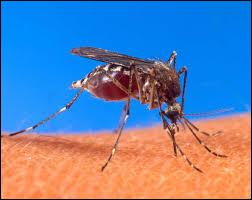
Mosquito  belongs to what kingdom?
a)
Animal Kingdom
b)
Plant Kingdom
c)
Fungi Kingdom
d)
Protista Kingdom
29.
Autotrophs- make their own  food.
Heterotrophs- obtain food from other animals.
Observing the table above, Fungi and Animals are________?
a)
Autotrophs
b)
Heterotrophs
30.
Vertebrates can be classified in......
a)
5 groups: Mammals, Birds, Fish, Reptiles and Amphibians
b)
5 Groups: Dogs, Birds, Fish, Reptiles, and Amphibians
c)
4 Groups: Mammals, Birds, Fish and Ampbibians
31.
Vertebrate have:
a)
Fur and Gills
b)
Cold-Blood
c)
A spine and an internal skeleton
32.
Which of the following pairs is most closely related?
a)
snake & alligator
b)
Kangaroo and snapper fish
c)
Penguin and snake
33.
Which of the following animals is not an invertebrate?
a)
octopus
b)
shrimp
c)
Sea anemone
d)
Pelican
34.
Which of the following vertebrate is not a mammal?
a)
Koala
b)
Kangaroo
c)
Giant Salamander
d)
Whale
35.
Which is statement is false about the classification of the duck-bill platypus?
a)
monotreme
b)
marsupial
c)
mammal
d)
vertebrate
36.
A _______ mammal's young develops inside the mother.
a)
monotreme
b)
cold-blooded
c)
placental
d)
marsupial
37.
The above is an orca whale. which is the correct classification?
a)
monotreme mammal
b)
Bony fish
c)
placental mammal
d)
jawless fish
38.
Snails, clams and slugs belong to what group of invertebrate?
a)
Mollusks
b)
Jellyfish and sea anemones
c)
Echinoderms
d)
Flatworm
39.

The scenario above is best described by the interaction of what three body systems?

a)

X=respiratory system, Y=circulatory system, Z=reproductive system

b)

X=muscular system, Y=nervous system, Z=immune system

c)

X=circulatory system, Y=immune system, Z=muscular system

d)

X=muscular system, Y=digestive system, Z=circulatory system

40.

A deer hears a predator approaching and begins to run for safety. The deer has primarily engaged what body systems to escape?

a)

nervous, respiratory, and muscular systems

b)

muscular, digestive, and immune systems

c)

respiratory, endocrine, and excretory systems

d)

muscular, reproductive, and circulatory system

41.

The table above lists the types of white blood cells found in humans, indicates how abundant they are, and describes their functions. The two most abundant types of white blood cells may both be involved in a response to which of these?

a)

Injury

b)

Heat

c)

Allergens

d)

Bacterial Infection

42.

The diagram above represents an example of how the body regulates itself. This diagram describes what relationship in body systems?

a)

The circulatory system and nervous system interact to absorb nutrients.

b)

The circulatory system and digestive system interact to defend the body from diseases.

c)

The circulatory system and nervous system interact to maintain homeostasis.

d)

The nervous system and immune system interact for reproduction.

43.

Which scenario below best describes the interaction between the endocrine and reproductive system.

a)

Hormones are produced causing ovulation in a female.

b)

Muscles are contracted, pushing food from the stomach into the small intestine.

c)

A male rabbit sees and chases a female rabbit.

d)

A bird lays her eggs, and protects them from possible predators.

44.

Animal body systems often coordinate their actions to carry out specific functions for the whole animal. Which of these correctly describes the interaction of two biological systems for a specific purpose in the human body?

a)
b)
c)
d)
45.

During the final stages of human gestation, receptors for the hormone oxytocin increase on the smooth muscle cells of the uterus. The release of oxytocin during labor stimulates the smooth muscle tissue in the wall of the uterus. The vigorous contraction of the uterine smooth muscle helps push the baby through the birth canal so that delivery can occur. This process involves the interaction of which organ systems?

a)

endocrine and muscular only

b)

endocrine and reproductive only

c)

endocrine, muscular, and reproductive

d)

endocrine, reproductive and excretory

46.

When a person is suddenly cut by a sharp object, a nervous impulse is sent along a sensory neuron to the spinal cord. The impulse is immediately transmitted through motor neurons to produce a response. Which of the following correctly identifies and describes this response?

a)

Conditioned

b)

Learned

c)

Reflex

d)

Voluntary

47.

A person sweats during exercise to maintain a constant internal temperature. This is an example of –

a)

Homeopathic

b)

Stabilization

c)

Equalization

d)

Homeostasis

48.

Based on this diagram, which two systems interact to maintain homeostasis?

a)

The nervous and reproductive systems work together to stimulate the production of insulin.

b)

The circulatory and endocrine systems work together to keep blood sugar levels constant.

c)

The excretory and nervous systems work together to convert glycogen into glucose.

d)

The immune and circulatory systems work together to circulate blood through the pancreas.

49.

Which of the following is an example of the endocrine system directly interacting with the nervous system?

a)

The vertebrae protect the spinal cord from injury.

b)

Hormones provide feedback that affect neuron processing.

c)

Sensory receptors in bones send signals about body position to the brain.

d)

The brain sends signals that control the speed at which food moves through the intestines.

50.

When the level of carbon dioxide in the blood is too high, the excess carbon dioxide reacts with water and produces carbonic acid. The carbonic acid causes the blood pH to become more acidic. When the blood pH becomes too acidic, chemoreceptors in the brain instruct the body to react and maintain homeostasis in blood pH. Which of these responses by the body would eliminate the excess carbon dioxide and help maintain homeostasis in blood pH?

a)

Increasing the body temperature by shivering

b)

Increasing glucose levels in the blood

c)

Breathing more deeply and frequently

d)

Decreasing the heart rate

51.

What type of feedback loop does the diagram represent: positive or negative?

a)

Thermoregulation represents negative feedback because the body is maintaining homeostasis.

b)

Thermoregulation represents positive feedback because the body is maintaining homeostasis.

c)

Thermoregulation represents negative feedback because the body is disrupting homeostasis.

d)

Thermoregulation represents positive feedback because the body is disrupting homeostasis.

52.

Which of the following is NOT a function of the roots?

a)

Store carbs

b)

Absorb water and minerals

c)

Anchor plant to the ground

d)

Photosynthesis

53.

Where in the plant does photosynthesis occur?

a)

Flower

b)

Leaves

c)

Stem

d)

Roots

54.

What type of cells transport water UP the stem?

a)

Xylem cells

b)

Phloem Cells

c)

Epidermal Cells

d)

Root Cells

55.

Which of the following is the correct formula for cellular respiration?

a)

Glucose + Carbon Dioxide > Oxygen + ATP + Sunlight

b)

Sunlight + Carbon Dioxide + Water > Glucose + Oxygen

c)

Glucose + Oxygen > Carbon Dioxide + Water + ATP

d)

Water + Glucose + Oxygen > Carbon Dioxide + ATP

56.

Which structure of the plant is responsible for transport?

a)

Flower

b)

Leaf

c)

Stem

d)

Root

57.

Which of the following is NOT a part of the plant's SHOOT system?

a)

Flower

b)

Leaf

c)

Stem

d)

Root

58.

Which structure of a plant is responsible for anchoring it to the ground?

a)

Flower

b)

Leaf

c)

Stem

d)

Roots

59.

Which of the following is NOT a function of the flower?

a)

Be attractive

b)

Female reproductive parts

c)

Male Reproductive parts

d)

Control Hydration

60.

Another word for balance is--

a)

Hydration

b)

Homeostasis

c)

Autotroph

d)

Absorption

61.

Which of the following responses is a plant growing toward or leaning toward light?

a)

thigmotrophism

b)

phototropism

c)

gravitropism

d)

hydrotropism

62.

Plant's roots grow down, anchoring it into the ground. To what stimulus is the plant responding?

a)

thigmotropism

b)

phototropism

c)

hydropism

d)

gravitropism

63.

A plants roots grow thicker towards the stream than away from the stream. To what stimulus is the plant responding to?

a)

thigmotropism

b)

gravitropism

c)

photoropism

d)

hydrotropism

64.

What term refers to a plant growing or moving away from a stimulus?

a)

Touch

b)

Dormancy

c)

Tropism

d)

Development

65.

How does an organism described as an autotroph obtain resources for energy?

a)

The organism feeds off other organisms.

b)

The organism makes food through photosynthesis.

c)

The organism hunts other organisms.

d)

The organism grazes on grass and other plants.

66.
If a plant experiences a gravitropism, then it will do what?
a)
Grow toward or away from light. 
b)
Grow away from light. 
c)
Grow toward light.
d)
Grow in response to gravity. 
67.
What does it mean if a plant has a POSITIVE phototropism?
a)
That the plant grows toward light.
b)
That the plant grows away from light.
c)
That the plant grows toward gravity.
d)
That the plant grows away from gravity. 
68.
What does it mean if a plant has a NEGATIVE gravitropism?
a)
That the plant grows toward light.
b)
That the plant grows away from light.
c)
That the plant grows toward gravity.
d)
That the plant grows away from gravity. 
69.

Which of these are both male reproductive structures?

a)

Stigma and Style

b)

Anther and Filament

c)

Style and Ovary

d)

Stigma and Anther

70.
The filament___________
a)
holds up the anther
b)
protects the petal
c)
is the male part of the flower
d)
catches pollen
71.
The part of a flower that produces the male reproductive cells (pollen).
a)
anther
b)
style
c)
stigma
d)
filament
72.
The ovary, style, and the stigma make up the female part of a plant called the ?
a)
stamen
b)
petals
c)
stem
d)
carpel (pistil)
73.

In an embryo sac,the cells that degenerate after fertilization are

a)

Synergies and primary endosperm cell

b)

Synergids and antipodal cell

c)

Antipodal cell and primary endosperm cell

d)

Egg and antipodals

74.

Functional megaspore in an angiosperm develops into

a)

ovule

b)

endosperm

c)

embryo sac

d)

embryo

75.

Embryo sac consist of all below except

a)

egg

b)

generative cell

c)

antipodal cell

d)

synergids

76.

Which of the following pair are haploid structures?

a)

nucellus and antipodal cells

b)

antipodal cells and egg cell

c)

antipodal cells and megaspore mother cell

d)

nucellus and primary endosperm nucleus

77.

In angiosperms pollen tube liberate their male gametes into the

a)

central cell

b)

antipodal cells

c)

egg cell

d)

synergids.

78.
What is the order of succession shown in this figure?
a)
A, B, C, D
b)
B, A, D, C
c)
C, D, A, B
d)
D, A, B, C
79.
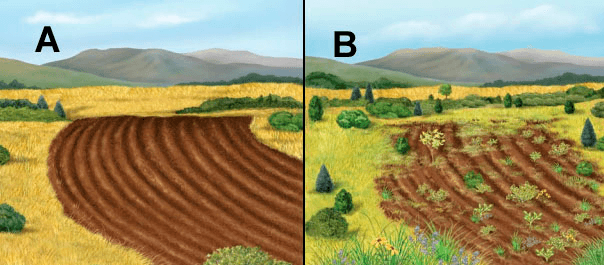
What type of succession is shown going from figure A to figure B?
a)
primary succession
b)
ecological succession
c)
secondary succession
d)
intermediate
80.
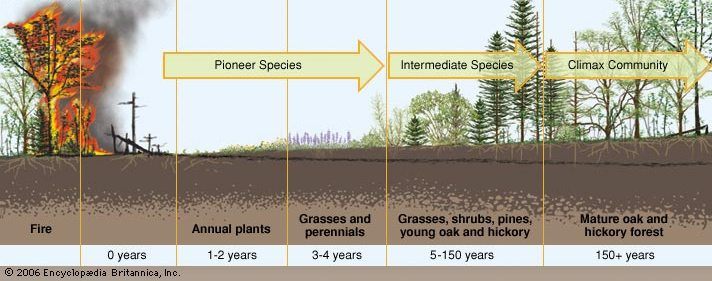
The picture shows what type of succession?
a)
primary
b)
secondary
c)
tertiary
d)
quadanary
81.
The picture shows what type of succession?
a)
primary
b)
secondary
c)
tertiary
d)
quadanary
82.
Reaches a climax community quicker because soil is already present
a)
primary succession 
b)
secondary succession
c)
both types of succession
83.
Succession type?
a)
primary succession
b)
secondary succession
c)
tertiary succession
d)
variable succession
84.
What is a producer?
a)
an organism that gets energy from eating other organisms
b)
an organisms that uses sunlight to make its own food
c)
an organism that gets energy from eating dead organisms, non-living material or waste
d)
an organism that uses chemical energy to make its own food
85.
A community of living and nonliving things in their natural environment makes up a 
a)
food web
b)
ecosystem
c)
food chain
d)
population
86.
An organism that gets energy from eating other organisms is a ______________.
a)
producer
b)
consumer
c)
decomposer
d)
prey
87.
An animal that is hunted and eaten for food is a __________.
a)
predator
b)
prey
c)
population
88.
An animal that gets energy from eating both plants and animals is a(an) _____________.
a)
herbivore
b)
carnivore
c)
omnivore
d)
autotroph
89.
The shrew provides energy for the _______.
a)
cricket
b)
grasshopper
c)
frog
d)
snake
90.
Which of the following is a herbivore?
a)
cricket
b)
frog
c)
hawk
d)
shrew
91.
Which represents the largest group in a food web?
a)
carnivores
b)
omnivores
c)
herbivores
d)
producers
92.
The arrows in a food chain or web represents what?
a)
They point to the organism that is being eaten.
b)
It shows how sunlight flows within an ecosystem.
c)
They show what direction the energy is flowing between organisms. 
d)
They represent how water is transferred within a habitat.
93.
Cattle egrets forage (feed) in fields among cattle. The egret gets easy access to flying insects stirred up by the cattle, and the cattle don't care if they are there or not.
a)
mutualism
b)
commensalism
c)
competition
d)
parasitism
94.
A relationship between two organisms in which one organism benefits and the other is unharmed...
a)
Mutualism 
b)
Competition
c)
Parasitsm 
d)
Commensalism 
95.
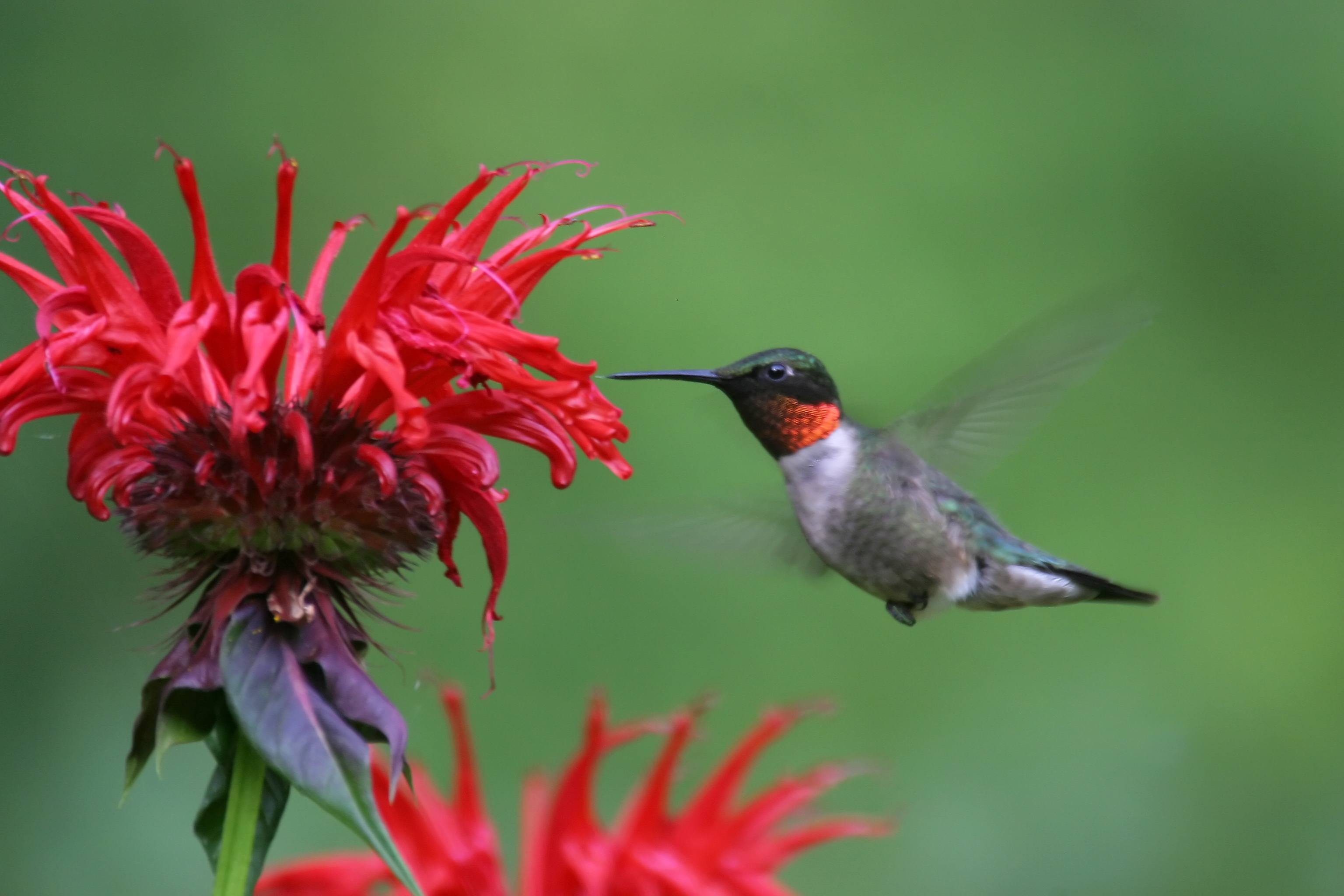
What type of symbiosis?  Hummingbirds feed on nectar from flowers.  The flowers are pollinated by hummingbirds as they move from flower to flower.
a)
commensalism
b)
mutualism
c)
parasitism
d)
predation
96.
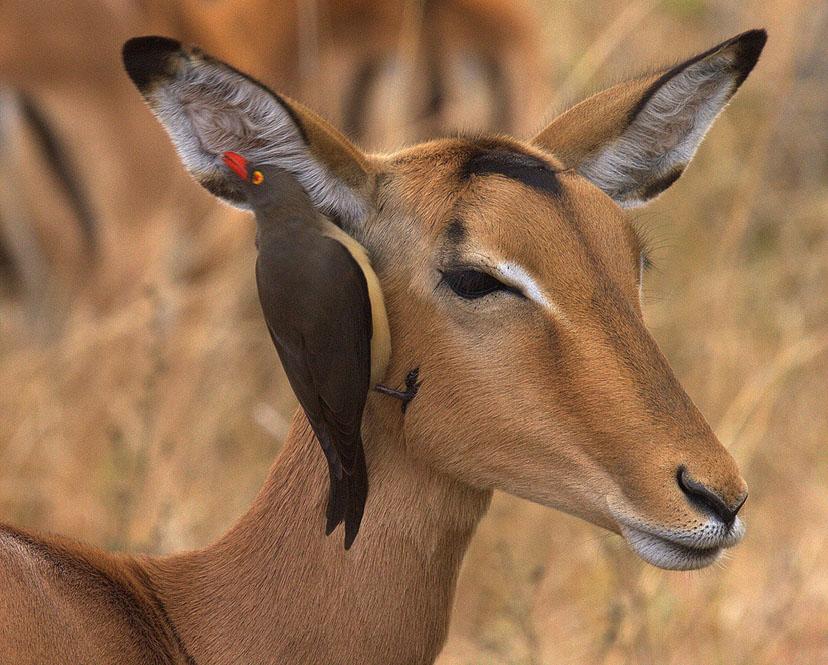
Red-billed oxpeckers are birds that often feed on parasites that infest impala.  This is an example of _______.
a)
commensalism
b)
mutualism
c)
neutralism
d)
competition
97.

Clown fish live among anemones, acting as a lure for the sea anemone's prey. The clown fish get protection and shelter from the anemone. This is an example of which type of symbiosis?

a)

Commensalism

b)

Mutualism

c)

Parasitism

98.

Clown fish live among anemones, acting as a lure for the sea anemone's prey. The clown fish get protection and shelter from the anemone. This is an example of which type of symbiosis?

a)

Commensalism

b)

Mutualism

c)

Parasitism

99.

In the jungles of South America lives a thorn tree call an acacia. A species of ant eats secretions of the acacia, drinks its sap, and raises its young in the hollow thorns. The ants also keep competing vines from growing near the acacia tree and they help repel any insects that would damage the acacia tree.

a)

mutualism

b)

commensalism

c)

parasitism

100.

Lactobacilli are a type of bacteria that live in our lungs and destroy many of the microorganisms that enter our respiratory system. They are highly adapted to living in our lungs and can't survive in many other habitats.

a)

mutualism

b)

commensalism

c)

parasitism