
 Worksheets
APHG Mid Term Review
Total questions: 90
Worksheet time: 1hrs 4mins
Name
Class
Date
1.
Explain Thomas Malthus's population theory.
a)
He concluded that the world's population increase was higher than the development of food supplies.
b)
He concluded that crude birth rates must balance crude death rates.
c)
He concluded that population increased arithmetically while food production increased linguistically.
d)
He concluded that population growth was outpacing available resources in every country, according to algebraic calculations.
2.
Where are people most likely not to live?
a)
places that are too hot
b)
places that are too cold
c)
places that are too high in elevation
d)
All the answers are correct
3.
What is the average number of births women bear in their lifetimes known as?
a)
total increase rate
b)
total fertility rate
c)
crude fertility rate
d)
crude birth rate
4.
What demographic feature has the most significant future implications?
a)
that the less developed countries have the highest combined crude death rate
b)
that the most rapid growth is occurring in the less developed countries
c)
that people are uniformly distributed across Earth
d)
that the natural increase rate is larger every year
5.
In what stage of the demographic transition are most European countries?
a)
1
1
1
b)
2
c)
3
d)
4
6.
The ratio of people who are too young or too old to work compared to the working population is called the
a)
dependency ratio
b)
population pyramid
c)
interconnected ratio
d)
retirement ratio
7.
The annual worldwide natural increase rate is
a)
1.2%
b)
12%
c)
12 million
d)
12 trillion
8.
This caused a jump in the worlds' population in the late 1700's and helped send England into stage 2 of the Industrial Revolution:
a)
the Renaissance
b)
the Industrial Revolution
c)
the Medical Revolution
d)
the Scientific Revolution
9.
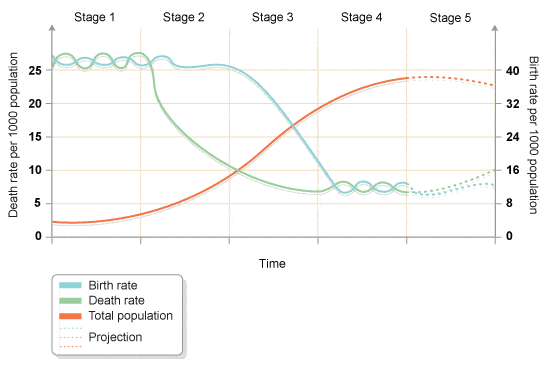
A characteristic of stage 3 of the demographic transition shows
a)
High birth and death rates
b)
Low death and high birth rates
c)
Declining birth and death rates
d)
High death and low birth rates
10.
What is the portion of earth's surface occupied by permanent human settlement?
a)
Ecumene
b)
Census
c)
Cohort
d)
Pandemic
11.
What is the portion of earth's surface occupied by permanent human settlement?
a)
Ecumene
b)
Census
c)
Cohort
d)
Pandemic
12.
Which of the following is a pull factor?
a)
Insufficient Food Supply
b)
High Crime Rate in Native Country
c)
Higher Paying jobs in New Country
d)
High Crime Rate in New Country
13.
Which of the following are part of EG Ravenstein’s (The Beard) Laws of Migration?
a)
most migrants are male
b)
most migrants move short distances
c)
most long distance migrants move to large urban areas
d)
all of the above
14.
According to Ravenstein’s Laws of Migration, which group is most likely to move?
a)
older adults
b)
younger adults
c)
children
d)
families
15.
Which areas of the world generally have net out-migration?
a)
Asia and North America
b)
Africa and Europe
c)
Africa and Asia
d)
Latin America and Europe
16.
According to EG Ravenstein, which of the following is NOT true?
a)
Most migrants are young adults.
b)
Most migration is over very long distance
c)
Migration is most often for economic reasons.
d)
Migration occurs in steps.
17.
The wave of immigrants into America around 1900-1915 was different from earlier waves of migration because most were from what area?
a)
Southern and Eastern Europe
b)
Asia
c)
Africa
d)
Latin America
18.
Since the 1980's, most US In-Migration has come from
a)
Europe
b)
East Asia
c)
Latin America
d)
South Asia
19.
Most migrants move for
a)
economic reasons
b)
cultural reasons
c)
environmental reasons
d)
persecution reasons
20.
If a country's Immigration is LESS than it's Emigration it has
a)
net in-migration
b)
net out-migration
c)
it's population is increasing
d)
it needs to set quota laws
21.
Which of the following is a PULL factor?
a)
A hurricane
b)
failed harvest
c)
increase in taxes
d)
opening a new factory
22.
The ability to move from one place to another is
a)
mobility
b)
migration
c)
net migration
d)
voluntary migration
23.
The most important intervening obstacle preventing Eastern Europeans from leaving their homes between World War 2 and the 1990s was
a)
the Danube River
b)
the Alps
c)
communist control of the region
d)
lack of financial resources
24.
The Atlantic Ocean is an example of
a)
an environmental push factor
b)
an intervening obstacle
c)
an environmental pull factor
d)
an economic factor
25.
Most migrants to the US from 1800-1850 came from which part of Europe?
a)
north and east
b)
north and south
c)
north and west
d)
south and east
26.
According to the 1986 Immigration Reform and Control Act signed by President Reagan, undocumented workers
a)
are immediately arrested
b)
were allowed to pursue citizenship
c)
jailed if caught a third time
d)
no longer able to go to public school
27.
The main PUSH factor for a refugee is
a)
economic
b)
environmental
c)
natural disaster
d)
political
28.
How are Stages 1 and 4 of the demographic transition model similar?
a)
both have low growth rates
b)
both have low life expectancies
c)
both have low dependency ratios
d)
both have low death rates
29.
Globally, the four largest population concentrations are located in
a)
Europe, North America, and East Asia, Latin
America
b)
East Asia, Southeast Asia, South Asia and
Western Africa
c)
Southeast Asia, Southern Africa, East Asia,
Europe
d)
Europe, South Asia, SE Asia and East Asia
30.
Arithmetic density is
a)
the number of people per square mile of inhabitable
land.
b)
the number of people per square
mile of arable land.
c)
the number of farmers per square
mile of arable land.
d)
the
number of people per unit of measurement.
31.
When a country suffers from a “brain drain” it means the country has experienced
a)
an emigration of working age males.
b)
an
emigration of educated professionals
c)
an emigration of political leaders.
d)
an
emigration of female executives
32.
People who quickly flee their country because of violence or fear are considered
a)
illegal immigrants
b)
draft dodgers
c)
refugees
d)
war criminals
33.
The process of migrants moving to a specific location because relatives or members of the same culture have already migrated and settled there is known as
a)
chain migration
b)
emigration
c)
immigration
d)
step migration
34.
According to Ravenstein’s Laws of Migration, which group is most likely to move?
a)
young adults
b)
older adults
c)
children
d)
families
35.
Nearly all the world's population growth is clustered in what areas?
a)
Urban areas
b)
MDC's
c)
LDC's
d)
Suburban areas
36.
There are NO countries in which stage?
a)
Stage 3
b)
Stage 2
c)
Stage 4
d)
Stage 1
37.
Thomas Malthus thought
a)
population would increase at the same rate as farming production
b)
population would eventually decline due to birth control and family planning
c)
population would eventually outgrow food production
d)
moral restraint would lower population growth
38.
Highest population growth occurs during stage
a)
1
b)
2
c)
3
d)
4
39.
The time it takes for the world population to go from 3 billion to 6 billion or 6 billion to 12 billion is called
a)
overpopulation
b)
doubling time
c)
natural increase
d)
life expectancy
40.
Overpopulation is
a)
too many darn people for the world
b)
too many darn people for a country
c)
too many darn people for an area
d)
too many darn people for the resources
41.
ZPG stands for
a)
Zero population growth
b)
Zero pending growth
c)
Zero pollution growth
d)
Zero pounds growth
42.
What is "net migration"?
a)
number of immigrants subtracted by the emigrants in a country in a given year
b)
number of emigrants subtracted by the immigrants in a given year
43.
What is urbanization?
a)
the loss of countryside
b)
the increase and growth of cities
c)
the movement from rural to urban
d)
the migration of urban to rural
44.
What describes people who are leaving the country where they live?
a)
international migration
b)
pull factor
c)
immigrating
d)
emigrating
45.
What describes people who are entering a country to live?
a)
internal migration
b)
push factor
c)
immigrating
d)
emigrating
46.
What are the reasons that people want to leave a country?
a)
push factor
b)
pull factor
c)
immigration
d)
emigration
47.
the birth rate minus the death rate expressed as a percentage
a)
birth rate
b)
death rate
c)
fertility rate
d)
rate of natural increase
48.
On average, since 1950, the world infant mortality rates have
a)
slightly decreased
b)
drastically decreased
c)
stayed the same
d)
incresed slightly
49.
a country with a highly developed economy, including significant industrial and service sectors of the economy
a)
more developed nations
b)
less developed nations
c)
underdeveloped nations
d)
overpopulated nations
50.
The location of a place using the latitude-longitude grid is called:
a)
A. referenced location
b)
A. central location
c)
A. relative location
d)
A. absolute location
51.
The location of a place in relationship to other places or features around it is called:
a)
absolute location
b)
relative location
c)
site
d)
situation
52.
Scale is…
a)
the system used by geographers to transfer
locations from a globe to a map
b)
the extent of spread of a phenomenon over a
given area
c)
the difference in elevation between two
points in an area
d)
the relationship between the length of an
object on a map and that feature on the landscape
53.
The process of the spread of an idea and/or dissemination of an innovation from its source area to other cultures, is the process of cultural:
a)
diffusion
b)
simultaion
c)
adaptation
d)
movement
54.
The physical qualities of the original location for a city is referred to as the
a)
site
b)
situation
c)
relative location
d)
absolute location
55.
The layering of geographic data by computers into data sets is known as:
a)
GPS
b)
GIS
c)
ENSO
d)
OPEC
56.
Geographers usually categorize cultural diffusion into the two broad categories of
a)
Expansion
and hierarchical
b)
Contagious
and stimulus
c)
Expansion
and relocation
d)
Migrant
and hierarchical
57.
The visible imprint put on the environment by people is called?
a)
Cultural Landscape
b)
Place
c)
Location
d)
Human Environment Interaction
58.
What is it called when you take a 3D image and put it onto a 2D surface?
a)
Cartogram
b)
Projection
c)
Globe
d)
Instagram
59.
Asking the question "why is something found in a particular place", is using which theme of geography?
a)
Place
b)
Movement
c)
Human Environment Interaction
d)
Location
60.
Which type of location does not change?
a)
Absolute
b)
Relative
c)
Positive
d)
Negative
61.
If a place has great connections to other places, has dominant political, transportation, and economic structures, it is said to have a high degree of ________.
a)
Location
b)
Place
c)
Landscape
d)
Centrality
62.
If you have not been to a place, but have developed negative feelings about it based off of what you heard in the news or from a friend, you would be using:
a)
Sense of place
b)
Perceptions of place
c)
Movement
d)
Human Environment Interaction
63.
Geographers group like things together into regions in order to make them easier to study. What type of region would a corn field be?
a)
Perceptual
b)
Formal
c)
Functional
d)
Vernacular
64.
Measuring the distance people are willing to travel to shop at a store would be creating what type of region for that store?
a)
Formal
b)
Perceptual
c)
Functional
d)
Uniform
65.
The imprint that humans leave, such as buildings, roads, cemeteries, etc. are all considered to be part of the:
a)
Location
b)
Region
c)
Cultural Landscape
d)
Move
66.
Billy thinks that in the south, everyone eats grits, eats fried chicken and watches football. He would be creating what type of region of the south with these ideas?
a)
Formal
b)
Functional
c)
Perceptual
d)
Uniform
67.
What is it called when you take a 3D image and put it onto a 2D surface?
a)
Cartogram
b)
Projection
c)
Globe
d)
Instagram
68.
Telecommunication networks, whose areas of service radiate outward from central nodes best represent which of the following types of culture?
a)
Vernacular
b)
Formal
c)
Folk
d)
Functional
69.
The spread of ideas, inventions, or patterns of behavior is called ____.
a)
acculturation
b)
innovation
c)
cultural hearth
d)
diffusion
70.
Which of the following divides Earth into Eastern and Western Hemispheres?
a)
Prime Meridian
b)
Hemisphere Line
c)
Equator
d)
Tropic of Capricorn
71.
Which type of map would show the boundaries of countries?
a)
vegetation map
b)
political map
c)
land-use map
d)
elevation map
72.
What is the difference between absolute and relative location?
a)
Absolute location is the exact location of something.
b)
Absolute cannot be identified using lines of latitude or longitude.
c)
Absolute describes where something is compared to another place.
d)
Absolute location describes the characteristics of a place.
73.
Places that share similar characteristics are called
a)
human systems
b)
environments
c)
regions
d)
physical systems
74.
What is remote sensing?
a)
analyzing different types of data
b)
tracking changes on Earth's surface
c)
using software to combine data
d)
getting information from far away
75.
Which of the following is not a use of GPS?
a)
tracking airplanes
b)
determine when a volcano will erupt
c)
help farmers in their fields
d)
provide driving directions to a destination
76.
Which of the following shows places on the Earth's surface the most accurately?
a)
thematic maps
b)
globes
c)
general-purpose maps
d)
physical maps
77.
Imaginary North-South line that passes through Greenwich, England, and has a value of 0 degrees
a)
latitude
b)
longitude
c)
relief
d)
scale
78.
map that shows specialized information, such as a land-use map, or any other physical or human feature
a)
thematic map
b)
general-purpose map
c)
climate map
d)
topographic map
79.
What is one or more features that make an area different from those around it?
a)
formal region
b)
perceptual region
c)
functional region
d)
region
80.
What are the physical and human features of a location?
a)
perception
b)
place
c)
perspective
d)
landscapes
81.
What organizes Earth into geographic areas with one or more shared characteristics?
a)
areas
b)
places
c)
countries
d)
regions
82.
What are lines on a globe drawn in an east-west direction and measured in degrees?
a)
longitude
b)
latitude
c)
grid
d)
equator
83.
Environment influences, but does not strictly determine, how a culture interacts with the environment.
a)
Environmental Determinism
b)
Environmental Possibilism
c)
Cultural Determinism
d)
Cultural Environmentalism
84.
The physical environment causes social and cultural development.
a)
Cultural Environmentalism
b)
Environmental Possibilism
c)
Environmental Determinism
d)
Cultural Possibilism
85.
Culture is spread by...
a)
Movement of people
b)
TV and Internet
c)
War and conquest
d)
All are correct
86.
a particular portion of space, whether of definite or indefinite extent.
a)
Location
b)
Place
c)
Region
d)
formal Region
87.
a large indefinite area or range of something specified; sphere:
a)
Locatioin
b)
Place
c)
Region
d)
Formal Region
88.
defined formally by government or other structures, such as cities, states, and mountain ranges
a)
Location
b)
Place
c)
region
d)
formal region
89.
made up of a central place and surrounding areas affected by it. Often, this is a metropolitan area that consists of a major city and lots of smaller towns or cities that surround it.
a)
functional region
b)
perceptual region
c)
cultural landscape
d)
free enterprise
90.

What region is highlighted?
a)
Africa
b)
Europe
c)
Southeast Asia
d)
Southwest Asia
100 %

