
 Worksheets
Test Review: Carrying Capacity & Limiting Factors
Total questions: 45
Worksheet time: 2hrs 10mins
Name
Class
Date
1.

Soil is made of:
a)
pieces of rock
b)
air and water
c)
matter that was once alive
d)
all of the above
2.

Soils form in layers, or horizons, that collectively make up the soil profile. Which horizon would contain the greatest humus content?
a)
W
b)
X
c)
Y
d)
Z
3.

Which layer of soil is on bottom?
a)
Topsoil
b)
Sand
c)
Bedrock
4.

What is HUMUS made from?
a)
Chick-Peas
b)
The remains of decayed plants and animals
c)
Beans
d)
Cheese
5.
Which word means to rot or decompose?
a)
Decay
b)
Fertile
c)
Growth
d)
Nutrients
6.

Fertile soil is rich in _________.
a)
Conservation
b)
Bedrock
c)
Water
d)
Nutrients
7.
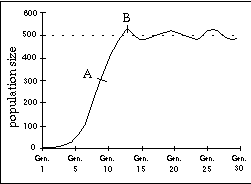
What is the carrying capacity of the graph?
a)
around 500
b)
more than 500
c)
less than 500
d)
around 600
8.

When a population grows past the ecosystem's carrying capacity, what happens to the population?
a)
Continues to grow
b)
The population starts to die off to return to carrying capcity
c)
The population will go extinct due to lack of resources
d)
The population grows then finds a new carrying capacity
9.

If a disease destroying barley plants in a field swept through an ecosystem, what would happen to the barley eating bird population in the the field ?
a)
The bird population would stay the same
b)
The bird population would infinitely increase
c)
The bird population would decrease
10.

In a forest ecosystem, which of the following is the best example of a limiting factor for a rabbit population?
a)
Squirrel Population
b)
Sunlight
c)
Grass available
11.

The parasitic wasp injects its larvae into caterpillars . Acid rain has destroyed the caterpillar population. What will happen to the wasp population?
a)
Stay the same
b)
Increase
c)
Decrease
12.

The largest number of individuals in a species that an environment can support long term
a)
carrying capacity
b)
emigration
c)
immigration
d)
population density
13.

Any thing or organism that regulates the size of a population is known as __________.
a)
a limiting measure
b)
a limiting factor
c)
carrying capacity
d)
biodiversity
14.
Which of the following would INCREASE the carrying capacity of an ecosystem?
a)
increase in predators
b)
disease
c)
increase in available food
d)
drought
15.
Which of the following is an EXAMPLE of a limiting factor?
a)
Water
b)
the color of the sky
c)
Migration
d)
Thick fur
16.
What will happen to the population when the death rate is larger than the birth rate?
a)
grow
b)
shrink
c)
stay the same
17.
Limiting factors are sometimes helpful because they can keep the population from getting to large.
a)
True
b)
False
18.
Living or once living things in the environment
a)
biotic factors
b)
abiotic factors
c)
ecology
d)
population
19.
Nonliving things; air, soil, water, light and temperature
a)
biotic factors
b)
abiotic factors
c)
ecology
d)
population
20.
Different species interacting with each other
a)
ecology
b)
ecosystem
c)
community
d)
biosphere
21.
Occurs when organisms MOVE in from another environment.
a)
Immigration
b)
Emmigration
22.
Occurs when part of the population LEAVES the environment
a)
Immigration
b)
Emmigration
23.
How does the coyote act as a limiting factor in the Mono Lake ecosystem?
a)
Coyotes steal food from birds
b)
Coyotes may eat female birds so the population will not grow as large
c)
Coyotes scare off other predators and keep the birds safe
24.

What level of organization can be seen here?
a)
Species
b)
Population
c)
Community
d)
Ecosystem
25.
Which of the following is the most simple level of ecological organization?
a)
A community
b)
An individual or species
c)
A population
d)
An ecosystem
26.

What level of organization can be observed in the image?
a)
Species
b)
Population
c)
Community
d)
Ecosystem
27.
Which is the thin layer of the earth that supports life and also the largest level of ecological organization?
a)
A community
b)
The biosphere
c)
A population
d)
The biome
28.

The study of organisms and how they interact with one another and their environment is best described as
a)
Biology
b)
Ecology
c)
Zoology
d)
Botany
29.

What is the carrying capacity of the following graph?
a)
1000
b)
8000
c)
800
d)
600
30.

Which graph shows a situation in which the number of predatorss in a population depends on the number of prey?
a)
Graph F
b)
Graph G
c)
Graph H
d)
Graph J
31.
The role of an organism in its habitat, or how it makes its living
a)
Niche
b)
Prey
c)
Competition
d)
Adaptation
32.

What is the carrying capacity of this graph?
a)
600
b)
above 500
c)
below 500
d)
about 500
33.

In what month was carrying capacity reached on this graph?
a)
5
b)
7
c)
4
d)
6
34.

What is the carrying capacity of this graph?
a)
100 deer
b)
80 deer
c)
70 deer
d)
90 deer
35.

What happened to the predator population after the prey population decreased?
a)
the predator population eventually increased
b)
the predator population eventually decreased
36.

What happened to the prey population as the predator population increased?
a)
it started to decrease
b)
it started to increase
37.

What is the carrying capacity of the deer population?
a)
10 deer
b)
98 deer
c)
78 deer
38.

An organism's _________ is defined as the environment in which it lives.
a)
habitat
b)
niche
c)
social structure
d)
ecosystem
39.
What is an organisms “job” or role within an ecosystem?
a)
Trophic Level
b)
Niche
c)
Herbivore
d)
Prey
40.
The range of all conditions in which a species lives and how it gets what it needs to survive and reproduce.
a)
population
b)
ecosystem
c)
niche
d)
biology
41.

This diagram is showing the concept of:
a)
niche
b)
biome
c)
producers and consumers
d)
biosphere
42.
Starfish are probably the most important predator in the shallow ecosystem because they eat basically anything that they can come across. Their feeding activities control the whole ecosystem. This is an example of the starfish ___.
a)
habitat
b)
biotic factors
c)
tolerance level
d)
niche
43.
All wildfires are harmful.
a)
true
b)
false
44.
When groundwater dissolves rock below the surface, the ground can suddenly collapse.
a)
flood
b)
drought
c)
fault
d)
sinkhole
45.

This organism is a(n)...
a)
consumer
b)
producer
c)
decomposer
100 %

