wayground logo

Free Printable Worksheets

Font size

S
M
L
XL
Worksheets

Earth science review part 2

Total questions: 138

Worksheet time: 2hrs 19mins

Name
Class
Date
1.
Which gas in our atmosphere is most abundant?
a)
Argon
b)
Oxygen
c)
Nitrogen
d)
Carbon Dioxide
2.
What percentage of our atmosphere is made up of other gases such as argon, water vapor, and carbon dioxide?
a)
1%
b)
21%
c)
78%
d)
90%
3.
What is the percentage of oxygen in Earth's atmosphere?
a)
1%
b)
21%
c)
78%
d)
90%
4.
What is the percentage of nitrogen in Earth's atmosphere?
a)
1%
b)
21%
c)
78%
d)
90%
5.
In which layer of the atmosphere does weather occur?
a)
Mesosphere
b)
Thermosphere
c)
Stratosphere
d)
Troposphere
6.
What decreases as you go up in the atmosphere?
a)
Altitude
b)
Atmosphere
c)
Meteors
d)
Air Pressure
7.
What is the lowest main layer of Earth's atmosphere?
a)
Thermosphere
b)
Troposphere
c)
Stratosphere
d)
Mesosphere
8.
What is the second lowest main layer of Earth's atmosphere?
a)
Thermosphere
b)
Troposphere
c)
Stratosphere
d)
Mesosphere
9.
Which of the following is the correct order of the atmosphere layers from Earth to space?
a)
troposphere, stratosphere, mesosphere, thermosphere, exosphere
b)
troposphere, mesosphere, thermosphere, exosphere, stratosphere
c)
thermosphere, stratosphere, mesosphere, troposphere, exosphere
d)
troposphere, stratosphere, mesosphere, exosphere, thermosphere
10.
The density of our atmosphere _____________ with an increase in altitude.
a)
Increases
b)
Gets greater
c)
Decreases
d)
Gets heavier
11.
Which layer protects the earth from meteors?
a)
Troposphere
b)
Stratosphere
c)
Mesosphere
d)
Thermosphere
12.
Which layer is the coldest?
a)
Troposphere
b)
Stratosphere
c)
Mesosphere
d)
Thermosphere
13.
Which layer of the atmosphere do most satellites orbit the Earth?
a)
Stratosphere
b)
Mesosphere
c)
Exosphere
d)
Ionosphere
14.
Which layer of the atmosphere contains the ozone layer? 
a)
Mesosphere
b)
Stratosphere
c)
Ionosphere
d)
Exosphere
15.
Which layer has the hottest molecules?
a)
Thermosphere
b)
Mesosphere
c)
Exosphere
d)
Stratosphere
16.
Which layer protects humans from most of the harmful UV radiation received from the sun?
a)
Clouds
b)
Exosphere
c)
Ionosphere
d)
Ozone Layer
17.
The layers of the atmosphere are calssified according to changes in
a)
temperature and air pressure
b)
altitude and air quality
c)
humidity and temperature
d)
air pressure and oxygen
18.
A mixture of gases and particles that surround a planet, held by gravity is called the-
a)
greenhouse effect
b)
atmosphere
c)
jet stream
d)
blanket
19.

The temperature at which air is saturated and condensation forms is ___.

a)

dew point

b)

humidity

c)

relative humidity

d)

precipitation

20.

Precipitation that forms as ice gets carried up in clouds to receive another layer of ice until it becomes too heavy and falls is called ___.

a)

rain

b)

snow

c)

sleet

d)

hail

21.

The amount of water vapor in the air is known as ___.

a)

dew point

b)

humidty

c)

relative humidity

d)

rain

22.

Water in solid or liquid form that falls from air to earth is called ___.

a)

rain

b)

humidity

c)

precipitation

d)

dew

23.

Precipitation that is liquid water is known as ___.

a)

rain

b)

snow

c)

sleet

d)

hail

24.

The amount of water vapor in the air compared to how much more it can hold at a certain temperature is known as ___.

a)

humidity

b)

relative humidity

c)

dew point

d)

saturation

25.

Precipitation that forms as water vapor changes directly to a solid is called ___.

a)

rain

b)

snow

c)

sleet

d)

hail

26.

The condition of the atmosphere at a certain time and place is referred to as ___.

a)

weather

b)

climate

c)

relative humidity

d)

dew point

27.
A severe storm which involves a funnel cloud forming over land is:
a)
hurricane
b)
tornado
c)
thunderstorm
d)
blizzard
28.
A severe storm that involves winds over 119mph and forms over water is:
a)
tornado
b)
thunderstorm
c)
hurricane
d)
blizzard
29.
This severe weather involves low temperatures and snow either falling or drifting
a)
hurricane
b)
thunderstorm
c)
tornado
d)
blizzard
30.
The boundary  between two air masses is known as:
a)
front
b)
storm
c)
climate
d)
flood
31.
When severe weather conditions are present, a _______ is issued
a)
watch
b)
warning
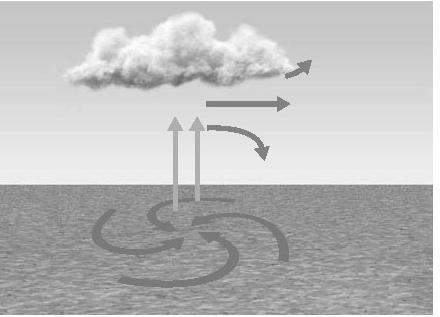
32.
Which type of pressure system is pictured?
a)
high
b)
low
c)
medium
d)
none
33.
Cold air traveling south from Canada is:
a)
continental tropical
b)
continental polar
c)
maritime tropical
d)
maritime polar
34.
Warm air moving upwards from the Gulf of Mexico is:
a)
continental tropical
b)
continental polar
c)
maritime tropical
d)
maritime polar
35.
Warm air mass that does not carry water:
a)
continental tropical
b)
continental polar
c)
maritime tropical
d)
maritime polar
36.
In _________ pressure systems, air sinks:
a)
high
b)
low
c)
medium
d)
none
37.
In _______ pressure systems, air rises
a)
high
b)
low
c)
medium
d)
none
38.
This type of front can bring strong storms
a)
cold
b)
warm
c)
stationary
d)
occluded
39.
This type of front results in the same weather for several days
a)
warm
b)
cold
c)
stationary
d)
occluded
40.
Which weather tool measures the amount of kinetic energy in molecules?
a)
thermometer
b)
barometer
c)
psychrometer
d)
anememeter
41.
Which weather tool measures air pressure?
a)
thermometer
b)
barometer
c)
anemometer
d)
psychrometer
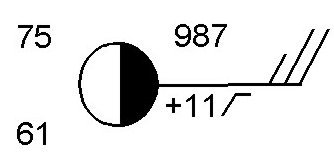
42.
What is the temperature at this station
a)
75 degrees
b)
61 degrees
c)
987 degrees
d)
11 degrees
43.
What is the cloud coverage at this station?
a)
Not cloudy
b)
Partially cloudy
c)
Overcast
d)
Stormy
44.
Warm air _________ and cool air ___________.
a)
rises/sinks
b)
sinks/rises
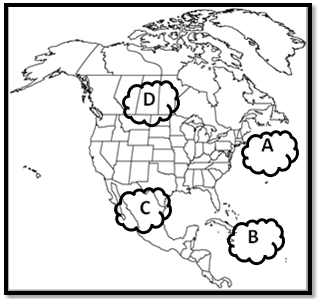
45.
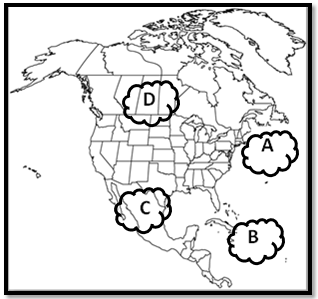
Which type of air would you find at air mass A?
a)
cold, dry
b)
warm, humid
c)
warm, dry
d)
cold, humid
46.
Which type of air would you find at air mass C?
a)
cold, dry
b)
warm, humid
c)
warm, dry
d)
cold, humid
47.
Which front does this image represent ? 
a)
Cold front
b)
Stationary front
c)
Occluded Front 
d)
Warm front
48.
What type of storm front is this?
a)
Warm Front
b)
Cold Front
c)
Occluded Front
d)
Stationary Front
49.
What type of storm front if this?
a)
Warm Front
b)
Cold Front
c)
Stationary Front
d)
Occluded Front
50.
How do we characterize an air mass that forms over the ocean?
a)
Dry
b)
Wet
c)
Cold
d)
Warm
51.
How do we characterize an air mass that forms over land?
a)
Dry
b)
Wet
c)
Cold
d)
Warm
52.
What types of air masses form over oceans?
a)
Maritime
b)
Continental
c)
Polar
d)
Tropical
53.
What does this symbol represent?
a)
High Pressure
b)
Warm Front
c)
Cold Front
d)
Mountains
54.
Which front does this image represent ? 
a)
Cold front
b)
Stationary front
c)
Occluded Front 
d)
Warm front
55.
This weather instrument is an...
a)
wind vane
b)
anemometer
c)
barometer
d)
thermometer
56.
Psychrometer and hygrometer measure ___.
a)
amount of rain
b)
temperature
c)
air pressure
d)
humidity
57.
The sun and everything that revolves around it.
a)
solar system
b)
galaxy
c)
universe
d)
rotation
58.
The star at the center of our solar system.
a)
Sun
b)
moon
c)
orbit
d)
axis
59.
What causes Earth's seasons?
a)
the tilt of Earth's axis
b)
Earth's rotation
c)
the revolution of the Moon
d)
Earth's distance from the Sun
60.
Fixed patterns of stars are called _____.
a)
Constellations
b)
Nebulas
c)
orbits
d)
systems
61.
It takes Earth _________ to make one complete rotation on its axis.
a)
24 hours
b)
365 days
c)
28 days
d)
24 days
62.
It takes Earth _____________ to make one revolution or orbit around the Sun.
a)
365 days
b)
365 hours
c)
28 days
d)
24 hours
63.
A large body made of gas or rock that orbits around a star.
a)
planet
b)
moon
c)
star
d)
super nova
64.
A tool used to make distant objects appear larger, brighter, and sharper.
a)
telescope
b)
planet
c)
moon
d)
microscope
65.
The _________ of a constellation changes during the night.
a)
position in the sky
b)
shape
c)
name 
d)
distance
66.
How long is Earth's rotation?
a)
one day
b)
one year
c)
one decade
d)
one hour
67.
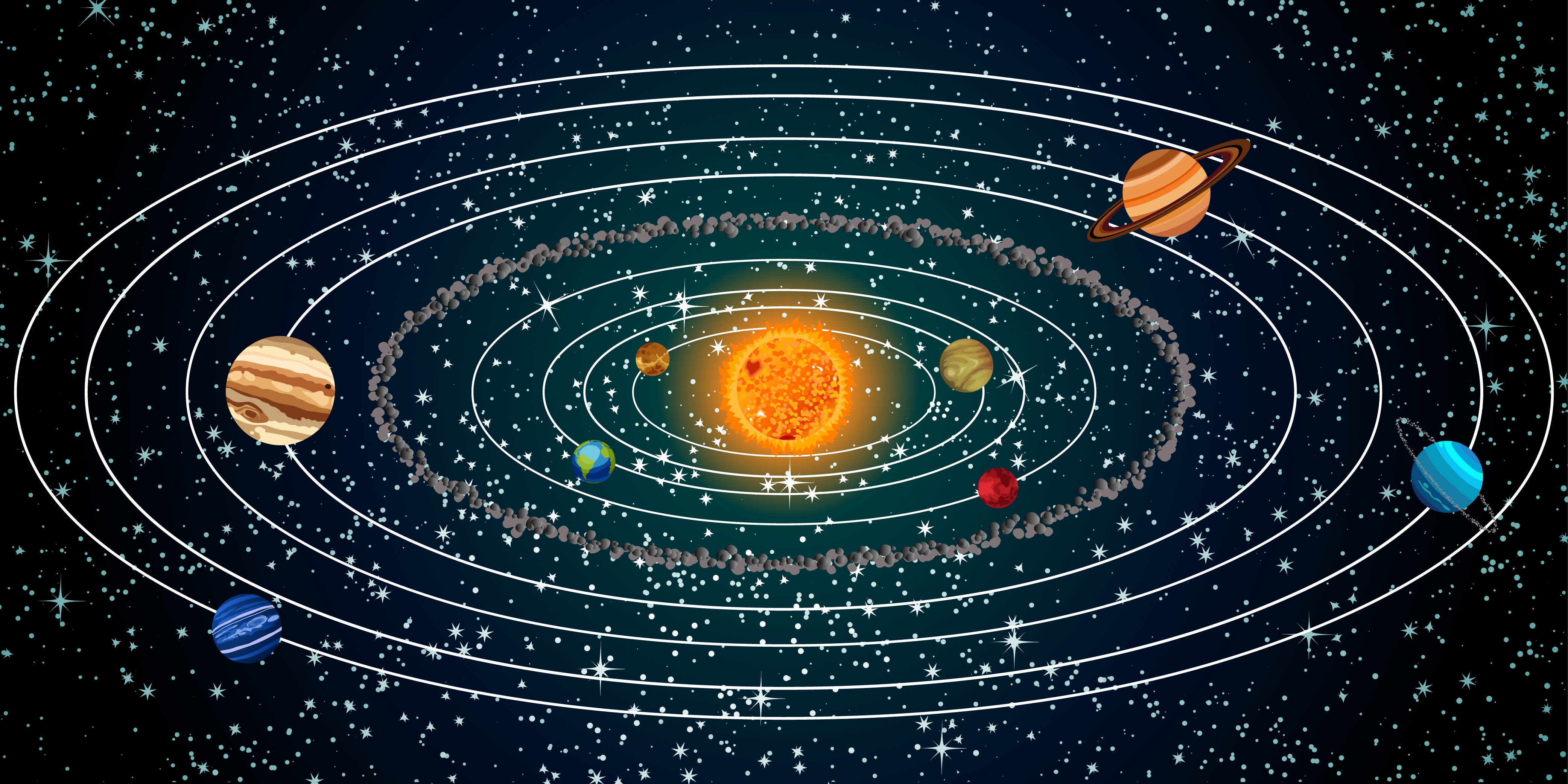
How many planets are there?
a)
6
b)
7
c)
8
d)
9
68.
Why do planets orbit the sun (and not float around in space)?
a)
the moons are keeping them in place
b)
They were hit by an asteroid
c)
they were hit by a comet
d)
the sun's gravity keeps them in place
69.
Fill in the blanks.
The sun rises in the ______ and sets in the ___________.
a)
north, south
b)
south, north
c)
east, west
d)
west, east
70.
A(n) ______________ is a curved path that an object makes around another object. 
a)
rotation
b)
orbit
c)
gravitational pull
d)
none of the above
71.
Scientist measure distances in space in 
a)
light-years
b)
yards
c)
feet 
d)
kelvin
72.
a light year is the distance
a)
light travels in two years
b)
light travels in one year
c)
humans can travel in one year in space
d)
none of the above
73.
What do we use astronomical units to measure?
a)
distances in our solar system
b)
How far our solar system is from others in our galaxy.
c)
The distances between galaxies. 
d)
The distance from one side of the universe to the other. 
74.
How many galaxies are in the universe?
a)
hundreds
b)
thousands
c)
millions
d)
billions
75.
What is a collection of stars, gas and dust bound together by gravity?
a)
Planet
b)
Earth
c)
Galaxy
d)
Universe
76.
Which part of the EM Spectrum is the most dangerous?
a)
Radio waves
b)
Gamma Waves
c)
X-Rays
d)
Microwaves
77.
Earth is part of the _____.
a)
Oort Cloud
b)
Milky Way
c)
Kuiper Belt
d)
Asteroid Belt
78.
One astronomical unit equals _____.
a)
the average distance from Earth to the Sun.
b)
the amount of time it takes Earth to orbit the Sun.
c)
the distance to the nearest star.
d)
the amount of time it takes light to travel from the Sun to Earth.
79.
Earth's nearest neighboring planets are _____.
a)
Venus and Mars
b)
Mars and Jupiter
c)
Mercury and Venus
d)
Mercury and Jupiter
80.
150 million km
a)
light-year
b)
orbit
c)
lunar eclipse
d)
Astronomical
81.
the regular, curved path in which Earth moves 
a)
light-year
b)
orbit
c)
lunar eclipse
d)
Astronomical Unit (AU)
82.
True or False
The Earth is the center of the solar system.
a)
True
b)
False
83.
What is a common characteristic of the inner planets?
a)
Large
b)
Gaseous
c)
Rings
d)
Rocky Surface
84.
Which planet has a thick atmosphere and is the hottest planet?
a)
Mercury
b)
Venus
c)
Earth
d)
Mars
85.
Which planet has no atmosphere and looks like our moon?
a)
Mercury
b)
Venus
c)
Earth
d)
Mars
86.
What is in between the inner planets and the outer planets?
a)
Asteroid belt
b)
Kuiper belt
c)
Sun
d)
Moon
87.
Which planet is the largest?
a)
Jupiter
b)
Saturn
c)
Uranus
d)
Neptune
88.
Which planet has the biggest rings?
a)
Jupiter
b)
Saturn
c)
Uranus
d)
Neptune
89.
Which planet rotates on its side?
a)
Jupiter
b)
Saturn
c)
Uranus
d)
Neptune
90.
Which planet has a Great Dark Spot?
a)
Jupiter
b)
Saturn
c)
Uranus
d)
Neptune
91.
Which planet has hurricanes and one large one that makes up the Great Red Spot?
a)
Jupiter
b)
Saturn
c)
Uranus
d)
Neptune
92.
One of the Four Large Objects That Orbits Jupiter
a)
Galilean Planet
b)
Triton 
c)
Galilean Moon
d)
Galilean Moons
93.
What planet has the biggest volcano?
a)
Mars
b)
Jupiter
c)
Earth
d)
Venus
94.
A ______ telescope uses a mirror to focus light onto a small area.
a)
reflecting
b)
refracting
c)
radio
d)
spectrum
95.
What is the MAJOR problem with trying to see stars in or near a city?
a)
Not as many people with telescopes
b)
Light pollution
c)
Clouds
d)
The stars are too far away.
96.
The speed of light is
a)
3.0 x 10^5 km/s
b)
3.0 x 10^8 m/s
c)
1.86 and 10^5 mi/ s
d)
all of the above
97.
Select the correct order of waves on the Electromagnetic Spectrum
a)
Radio, Micro, Infra, Visible, Ultra, X-ray, Gamma
b)
Gamma, X-ray, Ultra, Vis, Infra, Micro, Radio
c)
Vis, Micro, Infra, Ultra, X-ray, Gamma, Radio
d)
Micro, Radio, Vis, Infra, Ultra, X-ray, Gamma
98.
About 99% of all matter contained in the solar nebula now exists in
a)
planets.
b)
asteroids.
c)
space
d)
the sun
99.
Which of the following do scientists NOT consider a major planet?
a)
Saturn
b)
Neptune
c)
Earth
d)
Pluto
100.
Small bodies that orbit planets are called
a)
planetesimals
b)
protoplanets
c)
moons
d)
comets
101.
When the visible (lit) portion of the moon is increasing, the moon is:
a)
waning
b)
full
c)
waxing
d)
new
102.
When the Earth is between the moon and sun, it is most likely a:
a)
new moon
b)
full moon
c)
waxing crescent
d)
waxing gibbous
103.
Changes in the moon's appearance are
a)
phases
b)
eclipses
c)
stages
d)
cycle
104.
As the moon moves from a new moon to a full moon, you see:
a)
the moon appearing increasingly lighter
b)
The amount of light the moon is receiving decreasing
c)
the amount of light the moon gets staying constant
d)
more light and then less light
105.
How long does it take the moon to complete an orbit around Earth?
a)
23 days
b)
29 days (1 month)
c)
2 weeks (half a month)
d)
365 days (a year)
106.
The phase of the moon that occurs between the sun and Earth
a)
Full moon
b)
Waxing crescent
c)
Waning Crescent
d)
New Moon
107.
When only a small part of the moon is visible, it is probably in what phase?
a)
waxing or waning crescent
b)
first quarter
c)
new moon phase
d)
waxing or waning gibbous phase
108.
What is the main element in a stars composition? 
a)
Hydrogen 
b)
Helium 
c)
Lithium 
d)
Heavy Elements 
109.
Is the sun a star?
a)
yes
b)
no
110.
The color of the star tells us its 
a)
composition
b)
Temperature
c)
Luminosity 
d)
Mass
111.
The hottest color star is 
a)
Blue
b)
White
c)
Yellow
d)
Red
112.
Our star is a 
a)
yellow/ large star
b)
yellow/ small star
c)
yellow/ medium star
113.
What do we use to classify the temperature, brightness, and size of stars?
a)
Color
b)
The star's shape
c)
H-R Diagram
114.
Which measurements allows astronomers to compare the brightness of stars?
a)
parallax
b)
red shift
c)
absolute magnitude
d)
apparent magnitude
115.
Which statement describes stars from coolest to hottest?
a)
blue, white, red, orange
b)
white, yellow, orange, red
c)
orange, yellow, blue white
d)
red, orange, yellow, white, blue
116.
Galaxies are composed of 
a)
millions of stars
b)
trillions of stars
c)
billions of stars, dust and gas
117.
True or False:
Star patterns are called constellations.
a)
T
b)
F
118.
True or False:
The North Star is called POLARIS?
a)
T
b)
F
119.
Which star is considered a Main Sequence Star?
a)
A
b)
B
c)
C
d)
D
120.
The main elements in a star's composition are _______ and ________.
a)
hydrogen, helium
b)
carbon, helium
c)
hydrogen, iron
d)
helium, dark matter
121.
A less bright star can seem to be brighter because it is
a)
really huge
b)
far away
c)
cooler in temperature
d)
closer
122.
The sun is in the ________ of its _____ billion year life cycle. 
a)
middle, 100
b)
middle, 10
c)
beginning, 10
d)
end, 5
123.
What is the earliest stage of a star's life cycle?
a)
protostar
b)
white dwarf
c)
neutron
d)
red giant
124.
Which stage of its life cycle does a star spend most of its time in?
a)
nebulae
b)
red giant
c)
protostar
d)
main sequence
125.
______ is a force that causes dust particles to stick together in a nebula.
a)
nuclear fusion
b)
gravity
c)
hydrogen
d)
friction
126.
What will the Sun become at the end of its lifecycle?
a)
red giant
b)
red dwarf
c)
white dwarf
d)
super nova
127.

Which term best describes conditions a few seconds after the Big Bang took place?

a)

Frigid

b)

Scorching

c)

Liquid

d)

Placid

128.

According to the Big Bang theory, how old is the universe?

a)

6,000 years

b)

65 million years

c)

4.5 billion years

d)

14.5 billion years

129.

What is one major piece of evidence that the Big Bang theory is correct?

a)

Astronomers have detected leftover radiation from the Big Bang

b)

Everything in the universe has remained in the same location for billions of years

c)

Astronomers have discovered that the universe is no longer expanding

d)

Astronomers have discovered evidence that the universe will soon begin contracting in a "Big Crunch"

130.

The light from a star moving away from us would be experiencing:

a)

Redshift

b)

Blueshift

c)

Greenshift

d)

Whiteshift

131.

Which of the following represents an elliptical galaxy?

a)
b)
c)
d)
132.
90% of the universe is made up of 
a)
stars
b)
planets
c)
galaxies
d)
dark matter
133.
which galaxy shape is similar to a pinwheel?
a)
spiral
b)
elliptical
c)
irregular
d)
all shapes
134.
which galaxy shape has no distinctive or regular shape
a)
spiral
b)
elliptical
c)
irregular
d)
all shapes
135.
the universe is composed of matter and 
a)
mass
b)
volume
c)
energy
d)
stars
136.
as stars get older or age, the amount of hydrogen in the star...
a)
increases
b)
decreases
c)
stays the same
d)
does not change
137.
What type of galaxy is this?
a)
Spiral
b)
Elliptical
c)
Irregular 
d)
Irrational
138.
What type of galaxy is this? 
a)
Spiral
b)
Odd Shaped
c)
Irregular
d)
Elliptical