
Font size
S
M
L
XL
 Worksheets
5.3 Negative Feedback
Total questions: 18
Worksheet time: 11mins
Name
Class
Date
1.
Homeostasis
a)
allows for a wildly fluctuating internal environment
b)
is impossible in vertebrates
c)
is the maintenance of a relatively stable internal environment and often incorporates a form of feedback regulation
d)
is the maintenance of a relatively stable external environment and often incorporates a form of feedback regulation
2.
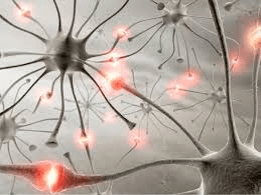
a body system that controls and coordinates all body activities through electric impulses/messages between brain, spinal cord and nerves.
a)
endocrine system
b)
nervous system
c)
nerve
d)
neuron
3.
If the environment gets cold, we will often shiver in order to:
a)
keep body temperature the same as the external temperature
b)
decrease body temperature
c)
increase body temperature
d)
regulate blood pressure
4.
The "cause" for something to happen is the
a)
response
b)
effect
c)
stimulus
d)
homeostasis
5.
The "effect" of a given stimulus is the...
a)
response
b)
stimulus
c)
cause
d)
result
6.
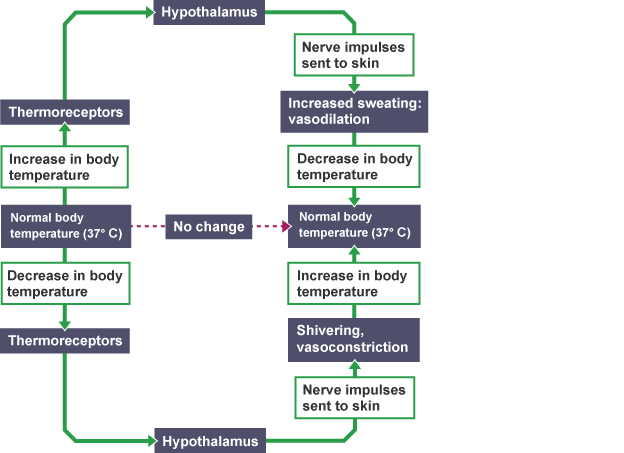
What type of feedback loop is shown?
a)
Positive
b)
Neutral
c)
Negative
7.
Failure to maintain homeostasis could result in:
a)
lack of internal balance
b)
eventual death
c)
difficulty carrying on metabolism
d)
all three
8.
Negative Feedback Loops:
a)
amplify processes
b)
prevent small changes from getting larger
c)
are initiated during childbirth
d)
are found only in plants
9.
Maintaining body temperature is an example of a:
a)
negative feedback loop
b)
positive feedback loop
10.
When glucose levels in the blood rise, your brain sends a signal to your pancreas. The pancreas releases insulin, which opens channels in cell membranes to allow glucose to enter the cell, lowering blood sugar levels.
a)
Positive Feedback Response
b)
Negative Feedback Loop
11.
What is another word that can be used to describe "homeostasis"?
a)
STABLE
b)
EQUAL
c)
COMPLETE
d)
CORRECT
12.
Maintaining body temperature is an example of a:
a)
negative feedback loop
b)
positive feedback loop
13.
What is a negative feedback mechanism?
a)
The initial signal is amplified to a climax.
b)
The initial signal is canceled out.
14.
As you get dehydrated, your blood becomes thicker and harder to pump. Your kidneys will respond by stopping urine production, sending the water from urine into your bloodstream to thin your blood back to normal level.
a)
Positive Feedback Response
b)
Negative Feedback Loop
15.
How are Thyroxine levels controlled
a)
Positive Feedback
b)
Negative Feedback
16.
Where is Thyroxine made?
a)
The thyroid gland
b)
The heart
c)
The adrenal gland
d)
The kidneys
17.
What does Thyroxine do?
a)
warms you up
b)
stimulates the basal metabolic rate.
c)
cools you down
d)
makes you sweat
18.
Name 2 hormones controlled by negative feedback (tick 2)
a)
Thyroxine
b)
Anti diuretic hormone
c)
Testosterone
d)
Lipase
Reset

