Wayground logo

Free Printable Worksheets

Font size

S
M
L
XL
Worksheets

8th grade review test

Total questions: 92

Worksheet time: 4hrs 53mins

Name
Class
Date
1.
a)
4N 
b)
6N 
c)
10 N 
d)
14 N 
2.
a)
40,000 N
b)
100 N
c)
100 m/s^2
d)
10,000 kg
3.
a)
The cart was stationary with a velocity of 0 m/s for the entire 7 seconds. 
b)
The cart was stationary except for a short burst of acceleration of 0.5 m/s^2 . 
c)
The cart moved at a constant velocity of 0.5 m/s for the entire 7 seconds.
d)
The cart accelerated at a constant rate of approximately 0.8 m/s^2 . 
4.
a)
The book, the ball, and the car 
b)
The ball, the car, and the bird 
c)
The can, the swing, and the bird 
d)
The book, the ball, the can, and the swing 
5.
a)
Procedures 1, 2, and 3 
b)
Procedures 4 and 5 
c)
Procedures 3 and 4 
d)
Procedures 1, 3, and 5 
6.
a)
As the fuel burns, gases push against the rocket, moving it upward. 
b)
As the fuel burns, gases move out of the rocket and reduce air resistance. 
c)
As the fuel burns, the mass of the rocket decreases. 
d)
As the fuel burns, the rocket moves faster. 
7.
a)
Activity 3 required more work than Activity 1, but Activity 3 did not require more work than Activity 2. 
b)
Activity 1 required the same amount of work as Activity 3. 
c)
Activity 2 required the most work. 
d)
Activity 1 was the only activity that required work. 
8.
a)
The toy train speeds up while going forward and then slows down. 
b)
The toy train slows down while going forward and then moves backward. 
c)
The toy train moves forward at a constant speed, slows down, and then stops. 
d)
The toy train moves forward at an increasing speed, stops, and then moves forward. 
9.

Both primary and secondary succession begin with pioneer species that -----

a)

change the area and make it safer from predatory organisms

b)

invade the area so that new organisms cannot be established

c)

modify the area and allow larger and more complex organisms to appear

d)

use up all the existing resources and prevent establishment of non-native organisms

10.

Some students collected leaf samples. The students used the leaf identification key shown to identify a leaf sample. Based on the identification key, which type of tree is this sample from?

a)

Ginkgo

b)

Honey locust

c)

Horse chestnut

d)

Black maple

11.

Which list of characteristics describes organisms classified as animals?

a)

Unicellular, prokaryotic, autotrophic

b)

Multicellular, eukaryotic, heterotrophic

c)

Unicellular, eukaryotic, heterotrophic

d)

Multicellular, eukaryotic, autotrophic

12.

The diagram shows a hot air balloon rising. Propane gas tanks are seen at the bottom of the balloon. What energy transformations occur when propane gas is used to life the balloon?

a)

Mechanical to light to chemical

b)

Chemical to mechanical to thermal

c)

Thermal to chemical to light

d)

Chemical to thermal to mechanical

13.

A hobbyist collected data about the motion of a toy train on a straight track and then recorded the data in the graph. Which of these accurately describes the motion of the toy train?

a)

The toy train speeds up while going forward and then slows down.

b)

The toy train slows down while going forward and then moves backward.

c)

The toy train moves forward at a constant speed, slows down, and then stops.

d)

The toy train moves forward at an increasing speed, stops, and then moves forward.

14.
What season is the Northern Hemisphere experiencing at position 3?
a)
summer
b)
winter
c)
spring
d)
fall
15.
What type of star is hot and dim?
a)
main sequence
b)
supergiants
c)
giants
d)
white dwarfs
16.
What type of geological feature will be found at a divergent boundary in the ocean?
a)
valley
b)
volcanic islands
c)
trench
d)
mid ocean ridge
17.
What type of geological feature will form at a convergent boundary in the ocean?
a)
mid ocean ridge
b)
volcanic Islands
c)
fault
d)
mountains
18.
What determines an element's identity?
a)
electrons
b)
valence electrons
c)
protons
d)
neutrons
19.
What determines how chemically reactive an element is?
a)
electrons
b)
valence electrons
c)
protons
d)
neutrons
20.
Unbalanced forces describe objects that ___________
a)
travel at a constant speed
b)
travel at a constant velocity
c)
change speed/direction
21.
Balanced forces would describe objects that_____
a)
move at a constant speed
b)
change speed
c)
travel at a slower speed
d)
change direction
22.
Organisms who receive energy from dead or decaying matter.
a)
Prokaryotic
b)
Omnivore
c)
Heterotrophic
d)
Decomposers
23.
What is the formula for density?
a)
density = mass x volume
b)
density = mass / volume
c)
density = mass + volume
d)
density = mass - volume
24.
Tectonic plates are:
a)
largest section of Earth's layers - composed of three layers
b)
Earth's crust and part of the upper  mantle that are broken into sections
c)
lowest or deepest layer of the mantle - semi rigid
d)
landmass in which all continents were once joined together
25.
What makes it possible for you to see the surface of the moon from Earth?
a)
 The moon gives off its own light.
b)
Light from Earth is reflected by the moon's surface.
c)
Light from Sun is reflected by the moon's surface.
d)
The moon absorbs sunlight during the day and glows at night.
26.

A student graphed the position of a cart during a 7-second time interval. Which statement best describes the cart?

a)

The cart was stationary with a velocity of 0 m/s for the entire 7 seconds

b)

The cart was stationary except for a short burst of acceleration of 0.5 m/s2

c)

The car moved at a constant velocity of 0.5 m/s for the entire 7 seconds

d)

The cart accelerated at a constant rate of approximately 0.8 m/s2

27.

The masses of four vehicles and the net force acting on them as they enter the highway are recorded in the table. Which vehicle has the greatest acceleration as it enters the highway?

a)

Sedan

b)

Coupe

c)

SUV

d)

Truck

28.

The moon reflects different amounts of sunlight onto Earth at different times. This reflected sunlight is commonly called moonlight. The graph shows the intensity of moonlight at different times in a lunar cycle. Which moon phase most likely occurs at the time in the cycle represented by an X on the graph?

a)
b)
c)
d)
29.

The diagram shows a model of the movement of two tectonic plates. When the plates collide, one plate often moves below the other plate. The rising magma that can result from this type of plate movement may produce--

a)

fossil layers

b)

volcanic islands

c)

deep-sea sediment

d)

seafloor spreading

30.

The satellite photo below shows San Francisco, California, which has many miles of coastline and an inland bay. Which area of the coastline has most likely experienced the greatest effect of erosion from waves over hundreds of years?

a)

Area N

b)

Area P

c)

Area S

d)

Area T

31.

A scientist added bacteria and a nutrient medium that could support the growth of the bacteria to a sterilized petri dish. No other materials were added. The graph models growth of the bacteria over time. Which of these most likely explains why the bacterial population stopped growing?

a)

The bacteria competed for nutrients and died after all the nutrients were consumed

b)

The bacteria did not reproduce in the system, and eventually each individual died at the end of its life cycle

c)

The bacteria mutated from photosynthetic to carnivorous organisms and consumed one another until all the individuals were dead

d)

The bacteria became diseased and were unable to survive in the closed system

32.
Michael eats a cookie at lunch. Which of the following actions during the digestive process is a chemical change? 
a)
Michael chewing the cookie before swallowing. 
b)
Enzymes in Michael’s saliva breaking down the sugar compounds. 
c)
Michael abdominal muscles pushing the cookie through the small intestines. 
d)
Small amounts of water being absorbed from the cookie in the large intestine. 
33.
What is the best title for the chart below? 
a)
Characteristics of Metals in the Periodic Table 
b)
Items that Conduct Electricity
c)
Highly Reactive Elements
d)
Organic Compounds 
34.
What geographic feature can be indicated by the arrow on the map?
a)
Gradual Drop
b)
Flat Land
c)
Cliff
d)
Depression
35.
What kind of plate boundary is shown here?
a)
divergent
b)
convergent
c)
transform
d)
subducting
36.
Which of the following is a compound?
a)
Co
b)
Fe
c)
H
d)
CO
37.
CH4 +2O2  →  CO2 +2H2O 
How many different elements are involved in this reaction? 
a)
two 
b)
three 
c)
four
d)
five
38.

What is the difference in the number of electrons in an atom of selenium (Se) and the number of electrons in an atom of aluminum (Al)?

a)

13

b)

23

c)

34

d)

21

39.

How many protons, neutrons and electrons are present in an atom of hafnium, Hf, with a mass number of 178?

a)

72 protons, 178 neutrons, 106 electrons

b)

72 protons, 106 neutrons, 72 electrons

c)

178 protons, 250 neutrons, 72 electrons

d)

106 protons, 72 neutrons, 106 electrons

40.

An atom of a certain element has 36 protons, 36 electrons, and a mass number of 84. At room temperature this element is a very stable gas. How many neutrons are in this atom?

a)

36

b)

48

c)

84

d)

120

41.

In the early 1900's many scientist thought that an atom consisted of a positive substance with negative charges throughout. Then Rutherford completed an experiment that changed the concept of an atom. His discovery led to the understanding that an atom consist mostly of empty space with-

a)

protons orbiting a dense nucleus made of electrons and neutrons

b)

electrons orbiting a dense nucleus made of protons and neutrons

c)

neutrons and protons orbiting a cloud of electrons

d)

electrons and protons orbiting a cloud of neutrons

42.

What is the mass number of a potassium (K) atom that has 20 neutrons?

a)

18

b)

19

c)

20

d)

39

43.

What type of particles are found in the cloud surrounding the atom's nucleus?

a)

positively charged particles and negatively charged particles

b)

negatively charged particles only

c)

neutral particles and positively charged particles

d)

positively charged particles only

44.

Which of the following best describes an electron

a)

It has no charge and about the same mass as a proton

b)

it has a negative charge and much less mass than a proton

c)

it has a positive charge and much more mass than a neutron

d)

it has a negative charge and about the same mass as a neutron

45.

An atom has 25 protons, 30 neutrons, and 25 electrons. What is the charge of the atom's nucleus?

a)

+25

b)

+30

c)

-25

d)

-30

46.
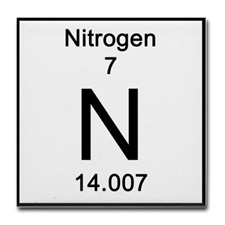
What is the number of protons that the element in this image contain?
a)
14
b)
7
c)
15
d)
18
47.
In general what is the most dense form of matter?
a)
Solid
b)
Liquid
c)
Gas
d)
Plasma
48.
What is the formula for density?
a)
density = mass x volume
b)
density = mass / volume
c)
density = mass + volume
d)
density = mass - volume
49.
The positive particles of an atom are called:
a)
electrons 
b)
positrons 
c)
neutrons 
d)
protons 
50.
Which answer best fits a description of why Alfred Wegener is famous?
a)
German meteorologist that proposed the idea of continental drift
b)
proposed sea floor spreading
c)
Canadian geophysicist who combined sea floor spreading and continental drift into Plate Techtonics Theory
d)
theory that new seafloor is formed when magma is forced upward toward the surface at a mid ocean ridge
51.
Subduction is:
a)
process by which ocean crust is taken into the trenches and back to the mantle
b)
theory that new seafloor is formed when magma is forced upward toward the surface at a mid ocean ridge
c)
plates slide past each other in opposite directions
d)
a gradual movement of the continents across the Earth's surface over time
52.
Tectonic plates are:
a)
largest section of Earth's layers - composed of three layers
b)
Earth's crust and part of the upper  mantle that are broken into sections
c)
lowest or deepest layer of the mantle - semi rigid
d)
landmass in which all continents were once joined together
53.
Mantle is:
a)
molten and is composed of iron and nickle
b)
largest section of Earth's layers - composed of three layers
c)
smallest section of Earth's layers
d)
solid, dense and is composed of iron and nickle
54.
Asexual reproduction that produces two identical daughter cells is called what?
a)
Meiosis
b)
Mitosis
c)
biotechnology
d)
cellular respiration
55.
Sexual reproduction that produces four genetically different gametes (sperm and egg). 
a)
Meiosis 
b)
Cancer 
c)
Mitosis 
d)
Virus
56.
The genetic make-up of an organism is known as:
a)
Heredity
b)
Phenotype
c)
Genotype
d)
Genetics
57.
The physical appearance of an organism is known as:
a)
Heredity
b)
Phenotype
c)
Genotype
d)
Genetics
58.
What makes it possible for you to see the surface of the moon from Earth?
a)
 The moon gives off its own light.
b)
Light from Earth is reflected by the moon's surface.
c)
Light from Sun is reflected by the moon's surface.
d)
The moon absorbs sunlight during the day and glows at night.
59.
A _______ is a reflecting surface that curves outward like the back of a spoon.
a)
convex mirror
b)
concave
c)
cracked mirror
d)
concave lens
60.
Which type of reaction does the following equation represent?
CO2 → C + O2
a)
Synthesis
b)
Decomposition
c)
Single Displacement
d)
Double Displacement
61.
A _______ is a reflecting surface that curves outward like the inside of a spoon.
a)
convex mirror
b)
concave mirror
c)
cracked mirror
d)
concave lens
62.
Which type of reaction does the following equation represent?
Zn +2HCl →  ZnCl2 + H2
a)
Synthesis
b)
Decomposition
c)
Single Displacement
d)
Double Displacement
63.
What is a substance with a pH of 7 most likely to be?
a)
water
b)
soda
c)
bleach 
d)
ammonia
64.
2H2O + 2N → 4H + 2NO
The chemical symbols on the RIGHT are called:
a)
products
b)
reactants
c)
yields/produces
65.
A change in pitch or frequency that occurs when a source of sound is moving away from or toward a listener is known as?
a)
Doppler effect
b)
Dapple effect
c)
Digger effect
d)
Big Bang theory
66.
The path of food energy from the sun to the producer then transferred to a series of consumers is known as a?
a)
Food Web
b)
Food Chain
c)
Energy Line
d)
Energy Transformation
67.
Which best explains what happens when a solid changes into a liquid?
a)
Molecules move closer together and give off heat.
b)
Slower moving molecules cause a chemical change.
c)
As energy increases, temperature decreases.
d)
As molecules absorb heat, they move faster and spread apart.
68.
How many producers are in this food web?
a)
1
b)
2
c)
3
d)
4
69.
What does the rotation of Earth on its axis cause?
a)
seasons
b)
day and night
c)
equinox
d)
solstice
70.
Star A is _________ and __________.
a)
dim and cool
b)
bright and hot
c)
bright and cool
d)
dim and hot
71.
A basketball with a mass of 0.60 kg is accelerated with a force of 10.8 N. If resisting forces are ignored, what is the acceleration of the basketball to the nearest m/s2?
a)
16 m/s2
b)
17 m/s2
c)
18 m/s2
d)
19 m/s2
72.
a)
2
b)
3
c)
5
73.
a)
12
b)
7
c)
8
d)
14
74.
This number is  the top number in the box on the periodic table and ALWAYS equals the number of protons
a)
Neutrons
b)
Atomic Mass Number
c)
Group
d)
Atomic Number
75.
Which subatomic particle(s) surround(s) the nucleus of an atom?
a)
Electrons
b)
Neutrons
c)
Protons and Electrons
d)
Neutrons and Electrons
76.
Organisms who receive their energy by consuming other organisms.
a)
Chloroplast
b)
Heterotroph
c)
Autotroph
d)
Phototropism
77.
The part of a cell that contains the chromosomes (wound up DNA) in eukaryotic cells.
a)
Chloroplasts
b)
Cell Wall
c)
Nucleus
d)
Homeostasis
78.
The genetic code for all of your traits.
a)
Nucleus
b)
DNA
c)
Chloroplast
d)
Recessive gene
79.
The organelle inside a plant cell that converts sunlight into energy.
a)
Chloroplast
b)
Photosynthesis
c)
Parasite
d)
Cell Wall
80.
The part of a plant cell that is rigid & permeable.
a)
Chloroplast
b)
Turgor Pressure
c)
Cell Wall
d)
Phototropism 
81.
The term used to define a cell that has a nucleus containing DNA.
a)
Prokaryote
b)
Eukaryote
c)
Autotroph
d)
Homeostasis
82.
The building up of an ecosystem after lava or glaciers have left nothing but rock.
a)
Secondary Succession
b)
Primary Succession 
c)
Natural Selection
d)
Adaptation
83.
A cell without a nucleus.
a)
Eukaryotic
b)
Prokaryotic
c)
Heterotroph
84.
Organisms who receive energy from dead or decaying matter.
a)
Prokaryotic
b)
Omnivore
c)
Heterotrophic
d)
Decomposers
85.
Rebuilding an ecosystem after a catastrophic event has occurred and soil is present.
a)
Primary Succession
b)
Secondary Succession
c)
Natural Selection
d)
Adaptations
86.
The trait that is always expressed.  It will hide or mask the other trait.
a)
Recessive
b)
Dominant
c)
Natural Selection
d)
Homeostasis
87.
Rebuilding an ecosystem after a catastrophic event has occurred and soil is present.
a)
Primary Succession
b)
Secondary Succession
c)
Natural Selection
d)
Adaptations
88.
The trait that is hidden or masked by the other trait. 
a)
Dominant
b)
Eukaryotic
c)
Recessive 
d)
Homeostasis
89.
Successful traits are passed onto offspring through natural circumstances. 
a)
Natural Selection
b)
Primary Succession
c)
Secondary Succession
d)
Dominant
90.
Organisms who make their own energy by taking in light or chemicals.
a)
Heterotroph
b)
Phototropism
c)
Autotroph
d)
Heterotroph
91.
The response of a plant due to the stimuli of light energy.
a)
Parasitic
b)
Chloroplast
c)
Photosynthesis
d)
Phototropism 
92.
This type of organism feeds on a host organism, causing harm to the host. 
a)
Decomposer
b)
Parasite
c)
Heterotroph
d)
Carnivore