wayground logo

Free Printable Worksheets

Font size

S
M
L
XL
Worksheets

EOC Review

Total questions: 121

Worksheet time: 1hrs 12mins

Name
Class
Date
1.
A ____________ breaks down waste or dead organisms and recycles nutrients.
a)
consumer
b)
producer
c)
decomposer
d)
omnivore
2.

An organism that makes its own food

a)

consumer

b)

predator

c)

prey

d)

producer

3.

An organism that eats other organisms for energy

a)

consumer

b)

producer

c)

tree

d)

leaf

4.

What are the inputs of photosynthesis?

a)

water

b)

glucose

c)

radiant energy

d)

carbon dioxide

e)

oxygen

5.

Symbiosis. Which two living things interact in a way that is considered mutualism?

a)

fleas and a dog

b)

flowers and bees

c)

a hawk and a mouse

d)

a person and mosquitos

6.

Mistletoe grows on an oak tree in a forest ecosystem. The mistletoe gets all of its nutrients from the oak tree weakening it. The mistletoe is a _________________ and the oak tree is its ______________.

a)

host, parasite

b)

producer, consumer

c)

consumer, producer

d)

parasite, host

7.

What is the name for all the animals of the same species living in an ecosystem?

a)

Population

b)

Community

c)

Ecosystem

8.

All ecosystems derive (get) their energy from the

__________.

a)

animals

b)

renewable resource

c)

plants

d)

sun

9.
When organisms need the same limited resources, there is ______________ .
a)
an extra resource
b)
competition
c)
extinction
d)
mutation
10.

Choose the complete and logical food chain.

a)

sun->plant->rabbit-> eagle

b)

deer - >squirrel-> plant->sun

c)

sun ->deer->plant-> eagle

d)

eagle-> squirrel->rabbit->plant-> eagle

11.

How do adaptations help animals?

a)

To hide from predators

b)

to hunt for food

c)

to survive in their habitats

d)

All of these are correct

12.
Why do some animals hibernate?
a)
The cold weather makes them sleepy.
b)
Their food supply is smaller in the winter.
c)
They have no one to play with.
d)
They have low energy in the winter
13.

Beak shape depends on...

a)

where birds live

b)

who they hang out with

c)

diet (fish or seeds)

d)

courtship displays

14.
It is very common for yellow labs to have bad hips. This is because owners want purebred yellow labs who are good hunting dogs.  This is an example of 
a)
Natural Selection
b)
Selective breeding
c)
Mitosis
d)
Fossil Record
15.
Some lizards have different size legs.  Lizards with longer legs are able to better access food.  Overtime Lizards with short legs became less common.
What is this an example of?
a)
Short Term Environmental Change
b)
Long Term Environmental Change
c)
Natural Selection
d)
Selective Breeding
16.

The process of humans selecting a few organisms with desired traits to serve as parents of the next generation.

a)

Gene Therapy

b)

Genome

c)

Selective Breeding

d)

Pedigree

17.

An adaption is:

a)

a characteristic that helps a population of species survive and reproduce

b)

a characteristic of one male that allows him to become the dominant animal of the herd

c)

When one organism lives longer than any other organism in its population

d)

a change that occurs quickly within a species

18.

All of the following statements are true EXCEPT:

a)

An adaptation must be common among the entire population

b)

an Adaptation can involve just a few individuals

c)

an adaptation happens over time

d)

an adaptation can either be physical or behavioral

19.

The guppy is a species of small freshwater fish. Scientists observed that the average size of guppies in the pond decreased after many years after a guppy predator was introduced into the pond. Which of the following best explains the change in guppy size?

a)

Selective Breeding

b)

Genetic mutations

c)

Natural Selection

d)

Learned behavior

20.

All rabbits, grasses and insects living in a particular area would be an example of a(n)

a)

population

b)

species

c)

community

d)

ecosystem

21.

Where does the PHYTOPLANKTON get its energy?

a)

The sun

b)

The Zooplankton

c)

The small fish

d)

The killer whale

22.

According to this food chain, which is the SECONDARY CONSUMER?

a)

Bee

b)

Dog

c)

Frog

d)

Chicken

23.

True or False. In this Food Web Pyramid Which type of consumer gets only 10% of the energy stored in plants?

a)

Herbivore

b)

Carnivore

c)

Omnivore

d)

Secondary Consumer

24.
In the energy pyramid here, which organisms have the most energy available?
a)
Producers
b)
Carnivores
c)
Herbivores
d)
Top Predator
25.
In the energy pyramid below, which organism has the least amount of energy available?
a)
Producers
b)
Herbivores
c)
Carnivores
d)
Top Predator
26.
Only 10 percent of the energy stored in an organism can be passed on to the next trophic level. Of the remaining energy, some is used for the organism’s life processes, and the rest is
a)
Used in reproduction
b)
Stored as body fat
c)
Stored as body tissue
d)
Eliminated as heat
27.
The diagram is intended to show relationships in an ecosystem. What do the arrows represent?
a)
The direction of population migration
b)
Differences in dietary habits
c)
Progressively smaller organisms
d)
The direction of the energy flow
28.
A third-level consumer has to be which type?
a)
Carnivore.
b)
Decomposer.
c)
Producer.
d)
Herbivore.
29.

What would happen to the ecosystem if the biomass of primary consumers was higher than the biomass of producers?

a)

The primary consumers will eat all of the producers...no more organisms to convert light energy to chemical energy (glucose)

b)

The primary consumers will become the producers and perform photosynthesis

c)

The producers will become primary consumers

d)

All of the above.

30.
Which organelle performs PHOTOSYNTHESIS?
a)
Chloroplast
b)
Mitochondria
31.
What is the ultimate ORIGINAL source of energy for living things
a)
Sugar
b)
Sun
c)
Moon
d)
Carbon Dioxide
32.
Which organisms perform Photosynthesis?
a)
Only Autotrophs
b)
Only Heterotrophs
c)
Autotrophs and Heterotrophs
33.

What are the products of photosynthesis?

a)

water and carbon dioxide

b)

oxygen and glucose

c)

oxygen and carbon dioxide

d)

oxygen and water

34.

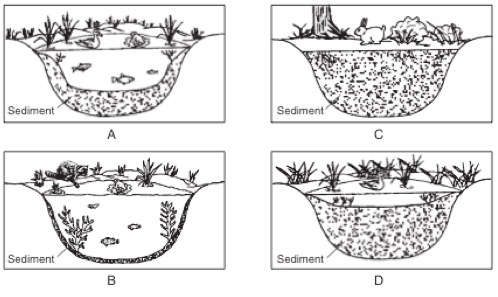
What is the order of succession shown in this figure?

a)

A, B, C, D

b)

B, A, D, C

c)

C, D, A, B

d)

D, A, B, C

35.

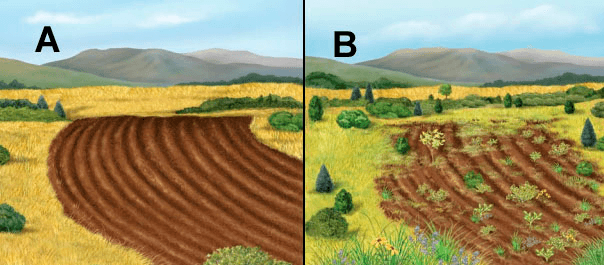
What type of succession is shown going from figure A to figure B?

a)

primary succession

b)

ecological succession

c)

secondary succession

d)

intermediate

36.

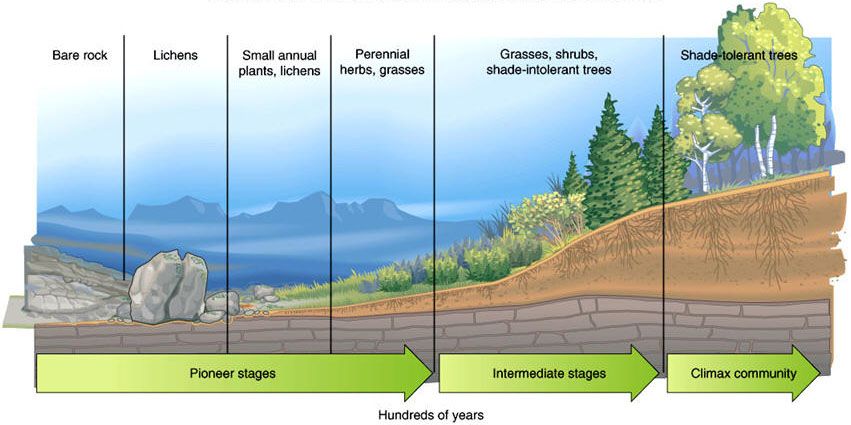
What is the goal of the pioneer species in Primary Succession?

a)

To kill the dead materials after a disaster

b)

To form soil

c)

To grow trees

d)

To put fresh oxygen into the air

37.

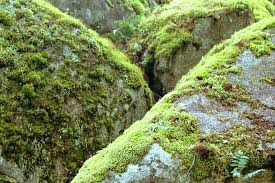
The picture shows what type of succession?

a)

primary

b)

secondary

c)

tertiary

d)

quadanary

38.

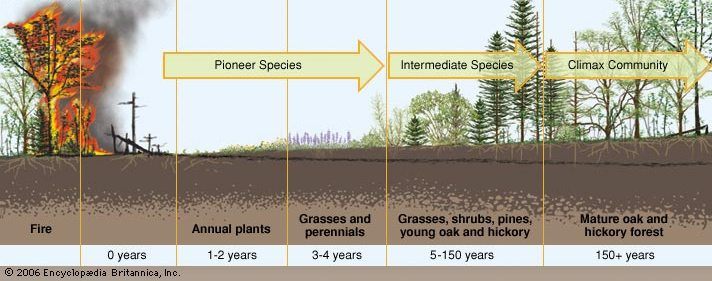
The picture shows what type of succession?

a)

primary

b)

secondary

c)

tertiary

d)

quadanary

39.

What are examples of pioneer species in a primary succession?

a)

Bushes and Shrubs

b)

Oak trees

c)

Mossess and Lichens

d)

Weeds and Grasses

40.
After a volcanic eruption, lava covers the land. What is the order that plants grow to repopulate the area?
a)
Lichens → Shrubs → Grasses → Trees
b)
Lichens → tree → shrubs→Grasses
c)
Grasses → Lichens → Shrubs → Trees
d)
Lichens → Grasses → Shrubs → Trees
41.
What is the correct order from oldest (happened first) to youngest (happened last) in this pond succession?
a)
A, B, C, D
b)
D, C, B, A
c)
B, A, D, C
d)
C, D, A, B
42.
Reaches a climax community quicker because soil is already present
a)
primary succession 
b)
secondary succession
c)
both types of succession
43.
A consumer that hunts is called:
a)
a producer.
b)
an omnivore.
c)
a predator.
d)
a herbivore.
44.
What might happen if you remove a primary consumer from the ecosystem?
a)
There would be more food for secondary consumers.
b)
The number of primary consumers would increase.
c)
The number of plants would increase.
d)
The number of secondary consumers would increase.
45.
The unique position that a species has in the physical use of its habitat and in its function (job) within an ecosystem  
a)
producer
b)
biotic factors
c)
ecosystem
d)
niche
46.
In a grassland ecosystem, lions prey on wildebeest. The population of lions has declined steadily because of illegal hunting. What will most likely happen to the population of wildebeest?
a)
The wildebeest population will increase
b)
The wildebeest population will decrease
c)
The wildebeest population will remian the same
47.
If the population of prey increases, the population of predators will ________because of the availability of food.
a)
decrease
b)
stay the same
c)
increase
48.
Examples of how humans negatively affect local ecosystems are
a)
Building dams, deforestation (cutting down trees), adding point sources to nearby streams to allow for run-off, building roads and structures, and salting roads.
b)
Creating laws to prohibit fishing from local streams.
c)
Planting trees and other plants to attract native species.
d)
Removing non-native species from the environment.
49.

A series of predictable changes that occur in a community over time

a)

succession

b)

equilibrium

c)

carrying capacity

d)

climax community

50.
Sunlight, water, oxygen, temperature, and soil are all
a)
biotic factors
b)
abiotic factors
c)
living things
d)
homeostasis
51.
Logging, mining, farming, and construction will result in 
a)
primary succsession
b)
secondary succession
c)
tertiary succession
52.
Male giraffes fighting for a female giraffe is an example of 
a)
competition
b)
predation
c)
symbiosis
d)
craziness!
53.
Limiting factors limit the growth of a population. Limiting factors include:
a)
Food and water
b)
Space to live
c)
Weather
d)
All of these
54.
Organisms interact with biotic and abiotic factors in an
a)
ecosystem
b)
ecology
c)
ecologist
55.
Increased industrialization will most likely
a)
Decrease available habitats 
b)
Increase environmental carrying capacity 
c)
Increase the stability of ecosystems 
d)
Decrease global warming
56.
Deforestation of areas considered to be rich sources of genetic material could limit future agricultural and medical advances due to
a)
The maintenance of dynamic equilibrium 
b)
The loss of biodiversity 
c)
An increase in the ecosystem’s carrying capacity
d)
The depletion of the ozone layer
57.
Approximately 75 percent of the Earth's surface is covered in water. So why is water considered such a precious resource?
a)
The greenhouse effect is causing most of the world's freshwater to be trapped in the atmosphere
b)
Only a small fraction of the Earth's water is freshwater available for drinking and irrigation
c)
Each year, more freshwater is being trapped in icecaps located at the North and South Poles
d)
Global warming caused by greenhouse gas emissions will likely cause Earth's oceans to evaporate
58.
The northern elephant seal was almost hunted to extinction in the 1800s. By the late 1890s, approximately only one hundred seals were left, reducing the gene pool of the population. What will be the consequence of this reduction?
a)
Competition within the population will increase.
b)
The surviving elephant seals will be better able to adapt.
c)
 Inbreeding will be less frequent among the remaining population.
d)
The elephant seals will be more vulnerable to environmental change.
59.

When fertilizers run off farmland into streams and ponds, the nitrogen content of the water increases. This can lead to rapid growth of algae. When the algae die, they sink to the bottom and decompose in a process that removes oxygen from the water. How can this process affect other organisms in the water?

a)

Because the oxygen is removed from the water, this reduces the amount available to other organisms.

b)

The water becomes better able to support aerobic organisms.

c)

The algae provide food for fishes and other organisms, leading to decreased algae populations.

d)

The extra nitrogen provides additional food for the other organisms, increasing their population.

60.
Adaptations can help a species
a)
Reproduce
b)
Defend
c)
Find food
d)
All of the above
61.
During the winter months when resources such as food and water may be scarce, some animals
a)
go into estivation
b)
ignore their circadian rhythms
c)
go into hybernation
d)
use warning colorations
62.
Researchers have found that many human activities produce carbon dioxide gas.  Most scientists think that increased levels of carbon dioxide gas in the atmosphere will
a)
block thermal energy from the sun, resulting in an ice age
b)
Lead to an increased greenhouse effect and global warming
c)
reduce the greenhouse effect, resulting in milder climates
d)
result in warmer, drier conditions that will aid crop yields
63.
Which of the following statements is true about variation in a species?
a)
variation is caused by genes 
b)
variation is caused by the environment 
c)
variation can caused by both genes and the environment 
d)
none of the above
64.
If there is a shift in the environment, organisms will respond by __________ or they will become extinct.
a)
migrating
b)
adapting
c)
dying
d)
starving
65.
Where are the instructions for traits found?
a)
in meiosis
b)
in DNA
c)
in cell membranes
d)
in lysosomes
66.
Chromosomes are found in
a)
the nucleus of prokaryotic cells
b)
plant cells only
c)
the nucleus of eukaryotic cells
d)
animal cells only
67.
The hereditary units in cells are called
a)
genes
b)
nuclei
c)
characteristics
d)
traits
68.
A sequence of DNA that codes for a specific trait is a 
a)
gamete
b)
phenotype
c)
gene
d)
heterozygous
69.
Gregor Mendel crossed a true-breeding tall plant (TT) with a true-breeding short plant (tt).  What are the possible phenotypes for the offspring?
a)
all tall
b)
all short
c)
50% tall, 50% short
d)
75% tall, 25% short
70.
Cross a heterozygous brown furred rabbit with a white furred rabbit.  What is the probability that an offspring will have white fur?
a)
100%
b)
50%
c)
25%
d)
0%
71.
Two cats carry heterozygous, long-haired traits.  When these cats are crossed, what will be the probability of one of their offspring having short hair?
a)
100%
b)
50%
c)
25%
d)
0%
72.
If having cystic fibrosis is a recessive disease, then what would be the genotype of someone that has cystic fibrosis?
a)
AA
b)
Aa
c)
aa
d)
none of these
73.
What is an advantage of asexual reproduction?
a)
biodiversity
b)
unique mating behaviors
c)
organisms can be large
d)
amount of offspring produced
74.
Which type of reproduction creates the greatest biodiversity, and therefore the ability to survive changing environments?
a)
fragmentation
b)
asexual
c)
sexual
d)
cloning
75.
Natural selection causes
a)
species to change over time
b)
mutations to occur
c)
extinction
d)
species to become weaker over time
76.
The measure of how well an organism survives in its habitat is called
a)
fitness
b)
mutation
c)
carrying capacity
d)
equilibrium
77.
Use the dichotomous key to determine the scientific name for Bird W.
a)
Geospiza
b)
Camarhynchus
c)
Certhidea
d)
Platyspiza
78.
Which of the following statements is TRUE about prokaryotes?
a)
They do NOT have a nucleus or other membrane bound organelles.
b)
DNA is stored inside their nucleus.
c)
Fungi are prokaryotes.
d)
Prokaryotes contain a nucleus and membrane bound organelles.
79.
An organism is considered to be sexual if it reproduces in which of the following ways? 
a)
Binary fission:  one cell dividing into 2 cells.
b)
Pollen from one plant fertilizing the ovum(egg) of another plant.
c)
Budding:  a new organism forms from the original organism.
d)
Regeneration:  a part of an organism is removed from an organism and grows into a new independent organism.
80.
What Kingdom does an organism belong to if it is unicellular, has its genetic material contained in a nucleus and has cilia to help it capture food?
a)
Eubacteria
b)
Fungi
c)
Protista
d)
Archaebacteria
81.
True or False:  Most scientists agree that viruses are alive.
a)
True
b)
False
82.
What is contained inside a nucleus?
a)
Cytoplasm
b)
Chlorophyll
c)
Genetic Material
d)
Carbon Dioxide
83.
All of the following characteristics are true of organisms in Kingdom Animalia EXCEPT which one?
a)
They are heterotrophic.
b)
They are aerobic.
c)
They are eukaryotic.
d)
They have some members that are unicellular.
84.
The Kingdom Eubacteria has members that do 3 of the following.  Which behavior/characteristic does not describe Eubacteria?
a)
Decompose decaying material.
b)
Make people sick.
c)
Live in symbiosis with other organisms.
d)
Live in extreme environments.
85.
What 2 structures are used by Protista for transportation?
a)
Vacuole & Cilia
b)
Flagellum & Cilia
c)
Flagellum & Chloroplasts
d)
Cytoplasm & Nucleus
86.
Fill in the levels of organization from largest to smallest?
Biosphere-Ecosystem-_____________-_____________-___________
a)
Population-Organism-Community
b)
Community-Population-Organism
c)
Organism-Population-Community
d)
Community-Organism-Population
87.
Into what Kingdom would the organism in this image be classified, if it is eukaryotic and unicellular?
a)
Protista
b)
Eubacteria
c)
Archaebacteria
d)
Fungi
88.
What is the main function of the Excretory System?
a)
To excrete saliva
b)
Get rid of waste products from your cells
c)
Break down food for digestion
d)
Circulate oxygen
89.
Which element makes a substance organic?
a)
Oxygen
b)
Hydrogen
c)
Helium
d)
Carbon
90.
Which of the following is NOT true concerning homeostasis?
a)
it is used to regulate body conditions such as calcium and glucose levels 
b)
it is maintained spontaneously in the body
c)
it prevents major fluctuations in body conditions
d)
it is the maintenance of constant internal conditions
91.
What is the name of the following process and where does it happen?    
6OC6H12O6 ---> Energy + 6H2O + 6CO2
a)
photosynthesis, chloroplast
b)
protein synthesis, nucleus
c)
aerobic respiration, mitochondria
d)
photosynthesis, mitochondria
92.
The energy found in food is called ______.
a)
sugar
b)
fat
c)
calorie
d)
kinetic
93.
Which correctly follows the pathway of food through the digestive tract?
a)
Mouth – stomach – esophagus – small intestines – large intestines - rectum
b)
Mouth – esophagus– stomach– small   intestines – kidneys - large intestines – rectum
c)
Mouth – esophagus– stomach– large   intestines – small intestines – rectum
d)
Mouth – esophagus– stomach– small   intestines – large intestines – rectum 
94.
Which of the following are the nutrients the body can use for energy?
a)
carbohydrates, protein, vitamins
b)
protein, fiber and glucose
c)
fats, protein and vitamins
d)
fats, protein and carbohydrates
95.
The number of chromosome in the gametes of organisms that reproduce sexually is always 
a)
¼ of the body cells 
b)
½ of the body cells
c)
The same as the body cells
d)
2x the body cells
96.
The circulatory system is the ______.
a)
breathing system
b)
system of nerves
c)
food-processing system
d)
transporting system
97.
The sole function of the endocrine system is to maintain _______.
a)
homeostasis
b)
energy storage
c)
anxiety
d)
growth patterns
98.
One of the skins functions is to _______.
a)
respond to digestion by producing enzymes
b)
regulate white blood cells
c)
control the heart
d)
provide protection from environment & disease
99.
The respiratory system is responsible for which vital process?
a)
exchanging nutrients between cells
b)
flow of blood through the body
c)
exchanging O2 and CO2  
d)
determining hormone levels 
100.
Which system gives your body shape, structure and support?
a)
muscular system
b)
nervous system
c)
skeletal system
d)
integumentary system
101.
Which system is responsible for moving body parts by contracting?
a)
skeletal
b)
muscular
c)
urinary
d)
integumentary
102.
Which of the following is NOT a task performed by the digestive system?
a)
respiration
b)
chemical breakdown
c)
mechanical breakdown
d)
absorption
103.
Which organ is responsible for eliminating protein by-products and excess water?
a)
Kidney
b)
Bladder
c)
Rectum
d)
Small Intestines
104.
What is the name of the compound whose chemical formula is:  C6H12O6  ?
a)
Carbon Dioxide
b)
Glucose
c)
Complex Carbohydrate
d)
Protein
105.
In what organelle is the genetic material found inside?
 
a)
Endoplasmic Reticulum
b)
Golgi Complex
c)
Nucleolus
d)
Nucleus
106.
What organelle is called the "powerhouse" of a cell?

a)
Endoplasmic Reticulum
b)
Nucleus
c)
Mitochondria
d)
Nucleolus
107.
What is the function of the mitochondria?
a)
Structure that manufactures ribosomes
b)
Structures that converts nutrients to energy
c)
Stack of membranes that packages chemicals
d)
Structure that contains DNA and directs the cell
108.
What is the function of the vacuole?
a)
Sac that stores water, nutrients, and waste products
b)
Sac filled with digestive chemicals
c)
Jelly-like substance within the plasma membrane
d)
stack of membranes that packages chemicals
109.
What is the function of nucleus?
a)
Structure that organizes motion of chromosomes. 
b)
Structure that contains DNA and directs the cell 
c)
Membrane that surrounds and protects the cell 
d)
Stack of membranes that packages chemicals
110.
Where does photosynthesis occur?
a)
mitochondria
b)
stomata
c)
xylem
d)
chloroplast
111.
I store water in both plant and animal cells. What am I?
a)
cytoplasm
b)
ribosomes
c)
vacuole
d)
lysosomes
112.
I make proteins for the cell. What am I?
a)
ribosome
b)
mitochondria
c)
chloroplast
d)
lysosome
113.
What can only be found in plant cells?
a)
Cell membrane
b)
Vacuole
c)
Chloroplast
d)
Mitochondrion
114.
The two kinds of cells are Prokaryotes and Eukaryotes. How are they different?
a)
Prokaryotes have a nucleus.
b)
Eukaryotes have a nucleus.
c)
Prokaryotes are plant cells.
d)
There is no difference.
115.
What cell part is NOT found in all cells?
a)
Cell Wall
b)
Cell Membrane
c)
Cytoplasm
d)
Genetic Material
116.
Complex cell. Can be plant or animal. Contains membrane bound organelles. 
a)
Eukaryotic Cell
b)
Prokaryotic Cell
c)
Bacteria
d)
Blood cell
117.
This organelle takes food and turns it into ENERGY for plant and animal cells.
a)
Chloroplast
b)
Mitochondria
c)
Lysosome
d)
Ribosome
118.
Which part of the cell is often called "the brain of the cell"?
a)
nuclear membrane
b)
endoplasmic reticulum
c)
nucleus
d)
mitochondria
119.
A rigid layer that lies outside the cell's  membrane is...
a)
Cytoskeleton
b)
Cilia
c)
Cell Wall
d)
Flagella
120.
Only eukaryotic cells have....
a)
membrane-bound organelles 
b)
DNA
c)
ribosomes
d)
cell membranes 
121.
A nucleus is found in what type of cell?
a)
Prokaryotic
b)
Eukaryotic
c)
Both prokaryotic and eukaryotic
d)
Neither prokaryotic or eukaryotic