
 Worksheets
Not done yet Real Test Unit 12 - Part 1 - Electricity
Total questions: 47
Worksheet time: 41mins
Name
Class
Date
1.
The ____________ is the energy that flows from the battery, through the wire in it’s path through the circuit.
a)
Electric Current
b)
Conductor
c)
Electromagnet
d)
Insulator
2.

What kind of circuit is this?
a)
series
b)
parallel
3.

What kind of circuit is this?
a)
Series
b)
Consecutive
c)
Parallel
d)
Training
4.
A material in which electrons are able to move easily
a)
Circuit
b)
Insulator
c)
Resistance
d)
Conductor
5.
A material in which electrons are not able to move easily
a)
Circuit
b)
Insulator
c)
Resistance
d)
Conductor
6.
Two types of circuits are
a)
parallel and magnetic
b)
electromagnetic and series
c)
series and parallel
7.
An example of a parallel circuit is
a)
the wiring in a house
b)
a flashlight
c)
a single circular path
8.
measure of resistance
a)
watt
b)
ohm
c)
volt
d)
amp
9.
measure of electric current
a)
watt
b)
ohm
c)
volt
d)
amp
10.
measure of power
a)
watt
b)
ohm
c)
volt
d)
amp
11.
Electricity is the flow of ______.
a)
electrons
b)
protons
c)
neutrons
d)
atoms
12.
What it the formula to find voltage.
a)
I= V/R
b)
R=V/I
c)
V= I x R
13.

What kind of picture does the picture show?
a)
Closed/Complete
b)
Open/Incomplete
14.
What is static electricity?
a)
the flow of electric charges
b)
the build-up of an electrical charge on a surface.
c)
the opposition of current flow.
15.
What types of charges attract?
a)
Positive and Positive
b)
Positive and Neutral
c)
Negative and Neutral
d)
Positive and Negative
16.
Electric charges that are different _______ each other.
a)
Attract
b)
Repel
17.
What charge does a proton have?
a)
negative (-)
b)
positive (+)
c)
neutral or no charge (0)
18.
What charge does an electron have?
a)
negative (-)
b)
positive (+)
c)
neutral or no charge (0)
19.
If a substance has a higher number of electrons than protons on its surface, what type of charge does it have?
a)
A positive charge.
b)
A negative charge.
c)
A neutral charge
d)
No charge at all
20.
What is the major difference between static electricity and current electricity?
a)
Current electricity involves a continuous flow of neutrons; static electricity is a sudden transfer of protons
b)
Current electricity can be deadly; static electricity is almost always safe
c)
In current electricity, there's a single transfer of electrons; in static electricity, there's a steady flow of electrons
d)
Current electricity involves a flow of electrons; static electricity involves a single transfer of electrons
21.
What happens when you touch a metal doorknob after rubbing your shoes on the carpet?
a)
The doorknob sends a burst of electric current into your body
b)
Millions of electrons go from your finger into the doorknob
c)
The doorknob sends millions of electrons into your finger
d)
our finger becomes negatively charged
22.
True or False, Lighting is a form of static electricity.
a)
True
b)
False
23.
How many Volts would it take to push 1 Amp through a resistance of 1 Ohm
a)
10 volts
b)
1 volt
c)
48 volts
d)
5 volts
24.
What is the Voltage of a circuit that has a resistance of 5 Ω and a current of 2 A?
a)
25 V
b)
10 V
c)
2.5 V
d)
0.4 V
25.
The mathematical relationship among Voltage, Current, and Resistance
a)
Faraday's Law
b)
Tesla's Law
c)
Edison's Law
d)
Ohm's Law
26.
What size resistor would produce a current flow of 5 Amps with a battery voltage of 12.6 volts
a)
60 Ohms
b)
2.52 Ohms
c)
1.71 ohms
d)
5.04 Ohms
27.
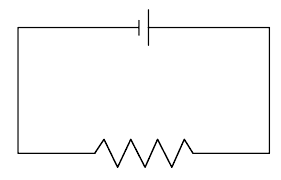
This circuit has a 24 volt battery and the resistor is 8 ohms. How many amps are running through the circuit?
a)
3 Amps
b)
192 Amps
c)
2 Amps
d)
4 Amps
28.
With the engine running the charging system produces 14.5 Volts what would the current flow be if a resistance of 6 Ohms was present
a)
2.41 Ohms
b)
2.52 Ohms
c)
2.1 Ohms
d)
0.3333 Ohms
29.
A Charging system producing 14.5 Volts with a current flow of 43.5 Amps, what is the circuit resistance
a)
58 Amps
b)
0.33 Amps
c)
13 Amps
d)
1 Amp
30.
A HID lighting circuit operates at 75 Volts what is the circuit current flow if the resistance is 5 Ohms
a)
375 Amps
b)
30 Amps
c)
15 Amps
d)
1.33 Amps
31.
Electrical power can be calculated using
a)
Resistance x Voltage
b)
Voltage x Current
c)
Voltage ÷ Current
32.

The voltage supplied to a circuit is 17 V and the current running through is 10 A. What is the power generated?
a)
170 W
b)
170 A
c)
1.7 V
d)
1.7 W
33.

What will be the current drawn by an electric bulb of 1000 W when it is connected to a source of 220 V?
Remember: I = P/V
Remember: I = P/V
a)
4.55 A
b)
28800 J or 28.8 KJ
c)
80 W
d)
200 W
34.
The current in an appliance is 3 A and the voltage difference is 120 V. How much power is being supplied to the appliance?
a)
10000 v
b)
220 v
c)
420 v
d)
360 v
35.

A heating element resistance is 24 ohms. The current measures 10 Amps. What is the power?
a)
240 watts
b)
1,200 watts
c)
1,000 watts
d)
2,400 watts
36.
Watts is the unit of...
a)
Power
b)
Current
c)
Voltage
d)
Resistance
37.
What is current measured in?
a)
Ω (Ohms)
b)
V (Volts)
c)
A (Amps)
d)
W (Watts)
38.
If the battery produced 12.6 Volts what would be the current flow for a 6 Ohm resistor?
a)
2.1 Amps
b)
2.4 Amps
c)
1.71 Amps
d)
15 Amps
39.
How many Volts would we need to produce a current flow of 8 Amps through a 6 Ohm resistor
a)
12 volts
b)
24 volts
c)
1.3333
d)
48 volts
40.
What are three good electrical conductors?
a)
Copper, Gold, Rubber
b)
Gold, Silver, Wood
c)
Gold, Silver, Copper
d)
Copper, Aluminum, Paper
41.
What does an electrical insulator do?
a)
Lets electricity flow in one direction.
b)
Does not let electricity flow through it.
c)
Lets electricity flow through it when light shines on it.
d)
Lets electricity flow through it.
42.

The plastic covering is there to:
a)
Provide a conductor for electrical energy to flow.
b)
Provide an insulator so that electrical energy will not pass outside of the wires.
c)
Provide a conductor so that electrical energy can NOT flow.
d)
Provide an insulator so that electrical energy can flow.
43.
To complete a circuit the switch must be
a)
unattached
b)
open
c)
closed
d)
It depends
44.
If the lights are off, the circuit is
a)
closed
b)
open
c)
electrified
d)
in trouble
45.
Electricity that flows in a closed path is called a
a)
path
b)
current
c)
circuit
d)
light
46.

This is an example of a ______ circuit
a)
Series
b)
Parallel
c)
Open
d)
Dihexihedral
47.

This is an example of a _______ circuit
a)
open
b)
series
c)
parallel
d)
square
100 %

