wayground logo

Free Printable Worksheets

Font size

S
M
L
XL
Worksheets

Electromagnetic Waves Review NO OPTICS

Total questions: 44

Worksheet time: 11hrs 46mins

Name
Class
Date
1.
_______ carry the greatest amount of energy. 
a)
x-rays
b)
gamma rays
c)
infrared rays
d)
visible light
2.

Satellites use_____________waves with long wavelengths to transmit information long distances through space.

a)

Infrared

b)

Gamma

c)

XRays

d)

Radio

3.

#4 represents the only area of the EM Spectrum that humans can see.

#4 represents which type of wave?

a)

radio

b)

UV

c)

Visible Light

d)

X-ray

4.
All EM waves travel at  
a)
different speeds
b)
the speed of sound
c)
the speed of light
d)
the speed of a vacuum
5.
Infrared rays are important for
a)
Warming the Earth
b)
Providing visible light for plants
c)
Taking X-rays
6.
EM waves have the same speed but different:
a)
frequency & medium 
b)
wavelength & frequency
c)
medium & wavelength
d)
color & medium
7.

_____________ are used to kill micro-organisms and disinfecting air

a)

infrared

b)

visible

c)

ultra violet

d)

X-ray

8.

_________________ can penetrate matter to see denser objects like bones

a)

infrared

b)

visible

c)

ultra violet

d)

X-ray

9.
The _______ rays in sunlight can cause sunburn and cancer.
a)
infrared
b)
x-rays
c)
UV
d)
gamma
10.
The range of electromagnetic waves placed in a certain order is called the
a)
EM spectrum
b)
EM wavelength
c)
EM frequency
d)
EM field
11.

When a wave strikes an object and bounces off. (example echo)

a)

medium

b)

refraction

c)

reflection

d)

interference

12.

When a wave bends as it passes from one medium to another (example: when light passes from the air into a glass of water with a straw in it, making the straw look "bent").

a)

medium

b)

refraction

c)

reflection

d)

interference

13.
light passes from one type of medium into another medium at an angle.
a)
polarization
b)
regular reflection
c)
refraction
d)
diffuse reflection
14.
What is a vacuum? 
a)
A space with only air in it
b)
A space with NO matter at all present
c)
A machine you use to do your chores
15.
Wave with the longest wavelength
a)
microwave
b)
radio
c)
gamma
d)
visible light
16.
Which of these lists the EM waves from Highest to lowest frequency?
a)
Radio -  Micro - Gamma - Visible light - UV - Xrays - Infrared - Xrays
b)
Radio - Micro - Infrared - Visible light - UV - X - Gamma waves
c)
Gamma - Xray - UV - Visible light - Infrared - Micro - radio
17.
The relationship between wavelength and frequency is λ=c/f.  Calculate the wavelength of light that has a frequency of 5.2 x 10¹² 1/s. The speed of of light is 3.0x 10⁸ m/s.
a)
5.8 x 10 -5 m
b)
5.8 x 10 -7 m
c)
5.19 x 10 14 m
d)
1.56 x 10 23 m
18.
High frequency waves have _________ wavelengths.
a)
varying
b)
long
c)
the same
d)
short
19.

Solve this problems using the equation:

C = λν

If an AM radio station broadcasts at 9.95 x 10⁵ Hz, what is the wavelength of this radiation?

a)

6.59 x 10⁻²⁸ m

b)

1.01 x 10⁻⁶ m

c)

3.32 x 10⁻³ m

d)

302 m

20.
The distance between two crests or two troughs of a wave is called:
a)
frequency
b)
amplitud
c)
wavelength
d)
hertz
21.
A microwave oven emits radiation at a wavelength of 0.005 m. What is the frequency of this radiation?
a)
6.67 x 10⁻⁷ Hz
b)
2.00 Hz
c)
1.50 x 10⁶ Hz
d)
6.00 x 10¹⁰ Hz
22.

Frieda the fly flaps its wings back and forth 121 times each second. The period of the wing flapping is

a)

0.008 Hz

b)

0.008 s

c)

121 Hz

d)

121 s

23.
What is the frequency of a photon whose energy is 3.4x10⁻¹⁹J?
a)
8.8x1026 Hz
b)
5.1x10¹⁴ Hz
c)
1.9x10⁻¹⁵ Hz
d)
2.3x10-52 Hz
24.
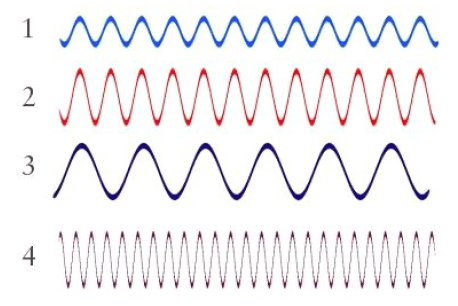
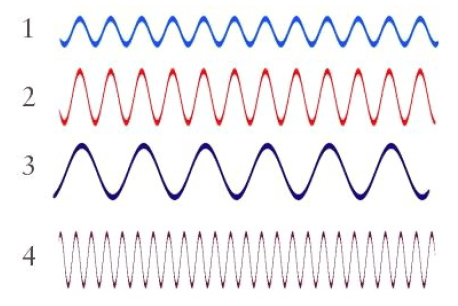
Which wave in the diagram has the greatest wavelength?
a)
1
b)
2
c)
3
d)
4
25.
Which wave in the diagram has the greatest frequency?
a)
1
b)
2
c)
3
d)
4
26.

What is the energy of light whose wavelength is 4.06 x 10⁻¹¹ m?

a)

4.89988x10⁻¹⁴ J

b)

4.89988x10⁻¹³ J

c)

4.89988x10⁻¹² J

d)

4.89988x10⁻¹⁵ J

27.
What is the frequency of UV light that has an energy of 2.39 × 10 -18 J? 
a)
2.32 x 10Hz
b)
3.60 x 10¹⁵ Hz
c)
1.58 x 10-51 Hz
d)
3 x 10⁸  m/s
28.
The equation that shows the relationship between the energy of light and frequency is: 
a)
c= λ⋅f
b)
E=h⋅f
29.
According to the Law of reflection, a light ray striking a mirror
a)
continues moving through the mirror in the same direction
b)
moves into the mirror at a slightly different angle
c)
bounces off the mirror toward the direction it came from
d)
bounces off the mirror at the same angle it hits.
30.
The fact the two angles are the same is an example of....
a)
Refraction
b)
Angle of Incidence
c)
Law of reflection
d)
Magnification
31.
The bouncing of light is known as
a)
Mirror
b)
Refraction
c)
Index of refraction
d)
reflection
32.
What is this image showing?
a)
Reflection
b)
Refraction
c)
The law of reflection
d)
Concave Mirror
33.

What do we call a material that light can travel through?

a)

air

b)

water

c)

medium

d)

pathway

34.
a)
Reflection
b)
Refraction
35.
All waves carry
a)
energy
b)
light 
c)
matter
d)
particles
36.
What kind of wave is pictured below?
a)
compressional wave
b)
transverse wave
c)
sound wave
d)
mechanical wave
37.

how does diffraction work

a)

it goes through water and air

b)

is a beam of light stopping at a wall

c)

it bounces off of light

d)

is the bending of light as it passes around the edge of an object

38.
This image is representing what wave interaction?
a)
Refraction
b)
Diffraction
c)
Reflection
d)
Interference
39.
What is the frequency of UV light that has an energy of 2.39 × 10 -18 J? 
a)
2.32 x 10Hz
b)
3.60 x 10¹⁵ Hz
c)
1.58 x 10-51 Hz
d)
3 x 10⁸  m/s
40.
Find the energy, in joules per photon, of microwave radiation with a frequency of 7.91 × 10 10 1/s.
a)
6.63 x 10⁻³⁴ J
b)
5.25 x 10¹⁴ J
c)
5.24 x 10⁻²³ J
d)
1.19 x 1044 J
41.
A joule is: 
a)
A SI unit of measurement for distance
b)
a SI unit of measurement for energy
c)
a SI unit of measurement for speed
d)
something shiny
42.

Wavelength = 3.00x10⁻⁸ m

Frequency = ___________

What is the *Energy* = ?

a)

9.99x10¹⁵ J

b)

1.00x10⁻¹⁶ J

c)

6.62x10⁻¹⁸ J

d)

1.51x1049 J

43.
What is the line MN called in the given diagram
                               
a)
incident ray
b)
reflected ray
c)
reflecting surface
d)
normal
44.
What is A?
a)
Angle of incidence
b)
Angle of reflection
c)
Incident ray
d)
Reflected ray