wayground logo

Free Printable Worksheets

NEW

Font size

S
M
L
XL
Worksheets

Chapter 2: Mechanical waves

Total questions: 40

Worksheet time: 23mins
Name
Class
Date
1.
Waves are a transfer of what?
a)
Heat
b)
Light
c)
Energy
d)
Food
2.
Amplitude reflects the amount of ____________________ in a wave.
a)
energy
b)
compression
c)
rarefaction
d)
speed
3.
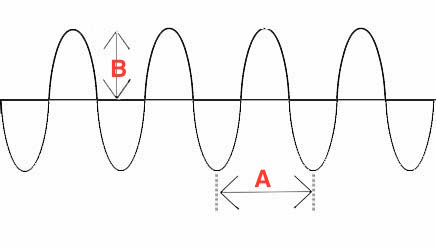
What property of this wave is represented by the letter "A"
a)
amplitude
b)
crest
c)
trough
d)
wavelength
4.
The highest point on a wave is:
a)
the crest
b)
the trough
c)
the top
d)
the coast 
5.
The lowest point on a wave is the:
a)
Amplitude
b)
Crest
c)
Trough
d)
Wavelength
6.
The type of waves that require medium to pass:
a)
Mechanical Waves
b)
Electromagnetic Waves
7.
When the frequency of a wave increases, what happens to the wavelength?
a)
The wavelength is not directly affected by the frequency of a wave.
b)
The wavelength increases.
c)
The wavelength decreases.
d)
More specific information is needed to form a conclusion about the wavelength.
8.
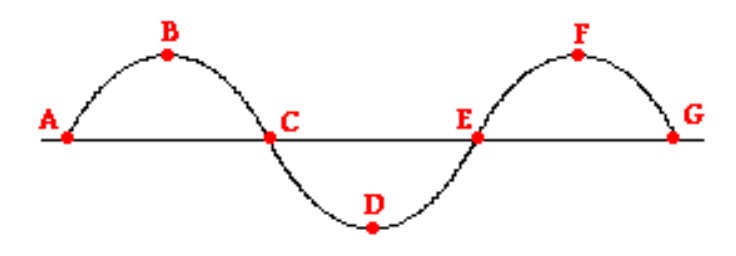
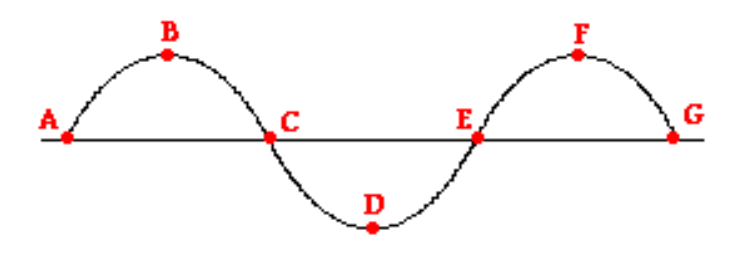
Which letter(s) represent the trough of the wave?
a)
A
b)
B & D
c)
D
d)
C & G
9.
Which letter(s) represent the crest of the wave?
a)
A
b)
B & D
c)
B & F
d)
F
10.
Which of the following can sound travel through?
a)
solid
b)
liquid
c)
gas
d)
all of the above
11.
What is the speed of a sound wave that has a frequency of 250 hertz and a wavelength of 8 meters? 
a)
31 m/s
b)
250 m/s
c)
2000 m/s
d)
5280 m/s
12.
A wave in which the particles of the medium move perpendicularly to the direction the wave is traveling
a)
A. surface wave
b)
B. transverse wave
c)
C. electromagnetic  wave
d)
D. longitudinal wave
13.
A wave in which the particles of the medium vibrate parallel to the direction of the wave motion
a)
A. mechanical wave
b)
B. surface wave
c)
C. longitudinal wave
d)
D. wave
14.
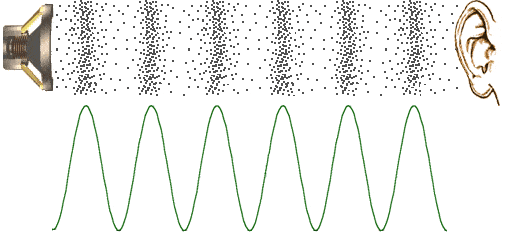
How many waves are in this wave chain?
a)
6
b)
3
c)
4
d)
5
15.
 A wave has frequency of 50 Hz and a wavelength of 10 m. What is the speed of the wave?
a)
500 m/s
b)
50 m/s
c)
5 m/s
d)
0.5 m/s
16.
A wave has wavelength of 10 m and a speed of 340 m/s. What is the frequency of the wave?
a)
34 m/s
b)
3400 Hz
c)
3400 m/s
d)
34 Hz
17.
What happens when a mechanical wave travels through a medium?
a)
Waves are transferred
b)
Energy is transferred
c)
Mass is transferred
d)
Particles are transferred
18.
Energy can be transferred from one medium to another through _________.
a)
vibrations
b)
stacking objects
c)
an ordered sequence
d)
colors
19.
Which of these waves cannot travel in a vacuum?
a)
light wave
b)
sound wave
c)
electromagnetic wave
d)
microwave
20.
Which is true of a mechanical wave?
a)
It must have a medium
b)
It must travel in empty space.
c)
It can travel in a vacuum.
d)
Both sound and light are examples.
21.
What is the amplitude of a wave?
a)
the amount of time that occurs in one full cycle
b)
the distance traveled by the wave during one full cycle
c)
the amount of cycles that occur in a given time
d)
the size of the disturbance
22.
What is the wavelength of a wave?
a)
the size of the disturbance
b)
the amount of time that occurs in one full cycle
c)
the distance between two crests of a wave
d)
the amount of cycles that occur in a given time
23.
What is the speed of a wave if the wavelength is 100 m and the period is 20 s?
a)
2,000 m/s
b)
120 m/s
c)
80 m/s
d)
5 m/s
24.
What is the period of a wave if the wavelength is 100 m and the speed is 200 m/s?
a)
200,000 s
b)
0.5 s
c)
2 s
d)
100 s
25.

What kind of wave is light?

a)

longitudinal waves

b)

transverse waves

c)

medium-sized waves

d)

electromagnetic

26.

What is a rarefaction in a longitudinal wave?

a)

The region in a longitudinal wave where the particles are closest together.

b)

The entire wave.

c)

The region in a longitudinal wave where the particles are furthest apart.

27.

1. What is the amplitude of the wave shown above?

a)

0 m

b)

2 m

c)

4 m

d)

0.4 m

28.

Which of the following is true for sound waves?

a)

They require a medium.

b)

They are unrelated to vibrations.

c)

They cannot travel through liquids

d)

They can travel in a vacuum

29.

How do electromagnetic and mechanical waves compare?

a)

Mechanical waves can only travel through a vacuum, but electromagnetic waves can travel through a solid, liquid, or gas.

b)

Mechanical waves can travel through a solid, liquid, or gas, but electromagnetic waves can only travel through a gas.

c)

Mechanical waves can only travel through a solid, liquid, or gas, but electromagnetic waves can travel through a vacuum.

d)

Mechanical waves can travel through a solid, liquid, or gas, but electromagnetic waves can only travel through a solid.

30.

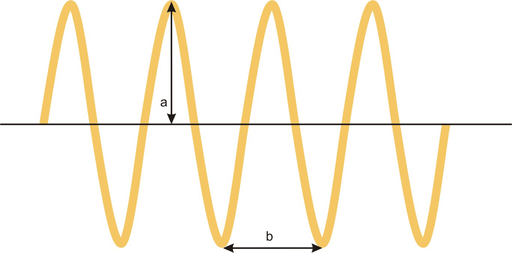
Which distance represents the wavelength?

a)

W

b)

X

c)

Y

d)

Z

31.

Which distance represents the amplitude?

a)

W

b)

X

c)

Y

d)

Z

32.
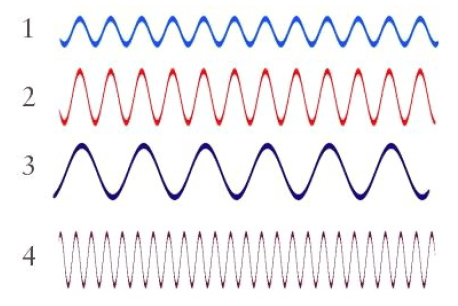
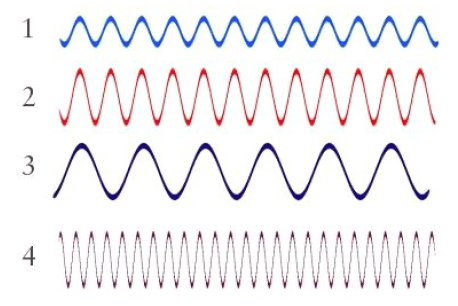
Which wave in the diagram has the greatest frequency?
a)
1
b)
2
c)
3
d)
4
33.
Which wave in the diagram has the greatest wavelength?
a)
1
b)
2
c)
3
d)
4
34.
crest to crest or trough to trough
a)
crest
b)
trough
c)
amplitude
d)
wavelength
35.

As you increase the the amplitude of a wave, you also increase the

a)

Frequency

b)

Wavelength

c)

Speed

d)

Energy

36.
What do waves carry from place to place?
a)
Energy, but not matter or particles
b)
Energy and matter or particles
c)
Matter or particles but not energy
d)
Neither energy nor matter or particles
37.
Which wave is pictured?
a)
Transverse
b)
Longitudinal
c)
Both
d)
Neither
38.
What kind of wave is pictured below?
a)
compressional wave
b)
transverse wave
c)
sound wave
d)
mechanical wave
39.
What is an area where the particles in a medium are spaced close together?
a)
Rarefaction
b)
Togetherness
c)
Expansion
d)
Compression
40.
Transverse and longitudinal waves both
a)
transfer energy through a mechanical wave
b)
transfer energy in a motor boat
c)
transfer energy through a medium
d)
transfer energy with the help of the Avengers