
 Worksheets
Benchmark 4 17-18
Total questions: 51
Worksheet time: 43mins
Name
Class
Date
1.
Which sequence of DNA bases would pair with this partial strand
ATG TGA CAG
ATG TGA CAG
a)
ATG TGA CAG
b)
TAC ACT GTC
c)
GTA AGT GAC
d)
CAT TCA CTG
2.
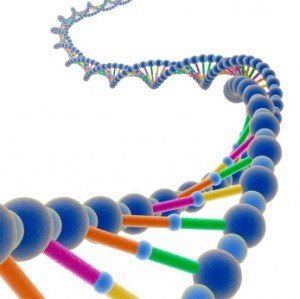
Which of the following best describes a DNA molecule?
a)
double helix
b)
contains ribose
c)
made of amino acids
d)
contains Uracil
3.
What scientific technique allows the insertion of a gene from one organism into another?
a)
genetic recombination
b)
genetic replication
c)
cloning
d)
genetic engineering
4.
Making changes in the DNA of an organism is
a)
selective breeding
b)
artificial selection
c)
genetic engineering
d)
genetic transformation
5.

Glowing cats that contain jellyfish biolumenesence genes inserted into their DNA are an example of?
a)
neon dye
b)
Genetic engineering
c)
cloning
d)
gene therapy
6.

Gametes have haploid or diploid number of chromosomes?
a)
Haploid
b)
Diploid
7.

diploid cell is to body cell, as haploid is to ___________________
a)
egg cell
b)
chromosome
c)
sex chromosome
d)
out of body cell
8.

Which of the following is NOT a somatic cell?
a)
sperm
b)
skin cell
c)
blood cell
d)
bone cell
9.

female sex cell
a)
zygote
b)
egg
c)
sperm
d)
meiosis
10.

male sex cell
a)
egg
b)
zygote
c)
sperm
d)
diploid cell
11.
Small grains that contain a plant's male reproductive cells.
a)
stamen
b)
pollen
c)
anther
d)
stigma
12.
The cells produced via meiosis are called:
a)
sex cells
b)
somatic cells
c)
body cells
d)
skin cells
13.
This produces 2 identical cells.
a)
mitosis
b)
meiosis
14.
What is it called when a sperm and egg meet?
a)
meiosis
b)
fertilization
c)
cell division
d)
mitosis
15.

Meiosis makes sperm and egg cells. In humans, sperm and egg cells each have _____ chromosomes. Therefore a fertilized human egg cell (sperm and egg cell combined) would create a cell with _____ chromosomes.
a)
23, 46
b)
46, 23
c)
2, 4
d)
50, 100
16.
What causes genetic variation in meiosis?
a)
chromosomes lining up
b)
crossing over of chromosomes
c)
separation of chromosomes
d)
chromosomes pulling apart
17.
Unlike mitosis, meiosis in male mammals results in the formation of
a)
one haploid gamete
b)
three diploid gametes
c)
four diploid gametes
d)
four haploid gametes
18.

When an area of a chromatid is exchanged with the matching area on a chromatid of its homologous chromosome, _________________ occurs
a)
crossing over
b)
mutagenesis
c)
hybridization
d)
fertilization
19.
Goes through P.M.A.T two rounds
a)
Mitosis
b)
Meiosis
c)
Osmosis
d)
Transcription
20.
The process of crossing over occurs in what phase of meiosis?
a)
anaphase 1
b)
prophase 1
c)
prophase 2
d)
telophase 1
21.
Which of these cells would be produced through meiosis?
a)
skin cells
b)
liver cells
c)
brain cells
d)
sperm cells
22.
Crossing over helps promote
a)
male genotype
b)
genetic variation
c)
DNA replication
d)
mitosis
23.
Which of the following cell divisions is responsible for cellular growth and repair?
a)
mitosis
b)
meiosis
c)
miosis
d)
myeosis
24.
How can the cells that result from a meiotic division II be genetically described?
a)
Two new genetically identical cells
b)
Four new genetically identical cells
c)
Four new genetically different cells
d)
Four genetically identical & different cells
25.
What is an advantage of asexual reproduction?
a)
It produces more offspring
b)
It produces fewer offspring
c)
It requires a mate
d)
It produces identical offspring
26.
What is a disadvantage to asexual reproduction?
a)
It produces more offspring
b)
It produces fewer offspring
c)
They are all the same and do not have diversity
d)
They are all different and have diversity
27.
What is a disadvantage of sexual reproduction?
a)
It produces fewer offspring
b)
it produces more offspring
c)
It generate genetically diverse offspring
d)
It generates identical offspring
28.
Which of the following is an advantage of sexual reproduction for a species.
a)
It produces more offspring
b)
Offspring can better adapt to changing environments because they are diverse
c)
Off spring are more likely to die because they are all 100% identical to their parent.
d)
It produces fewer offspring
29.
Which of the following accurately pairs the type of reproduction with an organism that uses it to produce offspring?
a)
Asexual - Human
Sexual - Flowering plant
b)
Asexual - Bacteria
Sexual - Flowering plant
c)
Asexual - Dogs
Sexual - Bacteria
30.
What is another name for natural selection?
a)
survival of the smartest
b)
survival of the fastest
c)
survival of the biggest
d)
survival of the fittest
31.
What is a change in an organism that allows for it to survive in its environment?
a)
homologous
b)
vestigial
c)
variation
d)
adaptation
32.
What is an organism that has similar characteristics and can reproduce?
a)
species
b)
organism
c)
embryology
d)
vestigial
33.

What is this an example of?
a)
diversity of species
b)
variation
c)
vestigial structures
d)
DNA studies
34.
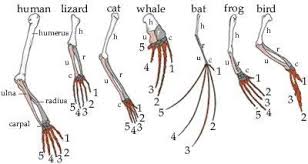
What is this an example of?
a)
vestigial structures
b)
embryology
c)
homologous structures
d)
fossil record
35.
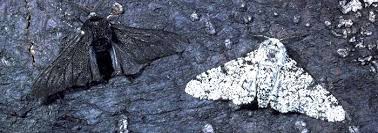
Predict which moth would increase in population
a)
light
b)
dark
36.
Which term refers to the process by which individuals that are better suited to the environment survive and reproduce therefore passing down their genes to their offspring?
a)
Evolution
b)
Variation
c)
Adaptation
d)
Natural Selection
37.

Which species’ DNA is most similar to the DNA of the toothed whale?
a)
Hippopotamus
b)
Baleen Whale
c)
Grazing Mammals
d)
Camels
38.

Which of the following is a term for a group of similar organisms that can reproduce fertile offspring?
a)
individual
b)
population
c)
species
d)
fossil
39.

Darwin wrote that organisms with traits that are best suited to the environment will ________________
a)
increase in number
b)
become extinct
40.
The struggle for existence against other members of an organisms species is
a)
Competition
b)
Natural Selection
c)
gene flow
d)
genetic drift
41.
Which of the following is NOT an example of natural selection?
a)
People selectively breeding hamsters.
b)
Insect populations developing resistance to certain pesticides.
c)
Bacteria becoming resistant to antibiotics.
d)
Male birds of certain species developing colorful feathers to attract female mates.
42.

a bird that can easily outcompete other birds for food and that can produce many eggs has a high
a)
life expectancy
b)
mutation rate
c)
fitness
d)
adaptability
43.

the hind leg bones in a whale are examples of
a)
homologous structures
b)
analogous structures
c)
fossils
d)
vestigals
44.
The scientific name for an organism is made from the:
a)
class and family name
b)
genus and species name
c)
domain and kingdom name
d)
kingdom and phylum name
45.
The 8 levels of classification, most broad to most specific.
a)
Domain, Genus, Family, Order, Class, Phylum, Kingdom, Species
b)
Domain, Species, Kingdom, Genus, Phylum, Family, Class, Order
c)
Domain, Kingdom, Phylum, Class, Order, Family, Genus, Species
d)
Order, Kingdom, Species, Domain, Phylum, Family, Class, Genus
46.
Term given to describe the 2 name naming system is:
a)
dichotmous key
b)
binomial nomenclature
c)
2 scientific names
d)
binomial key
47.
An organisms scientific name is made of (in order) ...
a)
species, class
b)
genus, kingdom
c)
genus, species
d)
species
48.
Fill-in-the-blank:
Domain--Kingdom--Phylum--____________
Domain--Kingdom--Phylum--____________
a)
Order
b)
Family
c)
Class
d)
Species
49.

Which organisms are closely related?
a)
American badger and leopard
b)
coyote and gray wolf
c)
european otter and leopard
d)
coyote and american badger
50.
For most living things, this characteristic of life means to multiply or add more of itself:
a)
Reproduce
b)
Eliminating Waste
c)
Exchanging Gases
d)
Made of Cells
51.
For most living things, this characteristic of life could mean to move?
a)
Reproduce
b)
Exchanging gases
c)
Responds to environment
d)
Needs Water
100 %

