
 Worksheets
Climate and Interactions
Total questions: 45
Worksheet time: 33mins
Name
Class
Date
1.
What are the two main factors that determine the climate of an area?
a)
precipitation and humidity
b)
temperature and air pressure
c)
wind conditions and humidity
d)
temperature and precipitation
2.
Which BEST describes why latitudes closest to the equator have warmer climates?
a)
they are at lower elevations
b)
they receive more solar energy
c)
they are nearer to ocean currents
d)
they get more winds that carry energy in the form of heat
3.
What is the measure of distance in degrees north and south from the equator?
a)
latitude
b)
longitude
c)
elevation
d)
topography
4.
What is the height of an area above sea level?
a)
elevation
b)
topography
c)
latitude
d)
longitude
5.
Which sentence best describes how latitude and temperature are related?
a)
LOWER latitude = COLDER air temperature
b)
HIGHER latitude = COLDER air temperature
c)
HIGHER latitude = WARMER temperatures
6.
What is the weather conditions in an area over a long period of time?
a)
climate
b)
temperature
c)
elevation
d)
precipitation
7.
Which is not a factor that affects climate?
a)
altitude
b)
latitude
c)
lakes and oceans
d)
living organisms
8.
What do seasons, El Nino, and Ice Ages have in common?
a)
they all alternate between northern and southern hemispheres
b)
they all occur on the same time scales
c)
they are all climate cycles
d)
they all depend on Earth's distance from the Sun
9.
How does Earth's past climates compare to today's?
a)
the same
b)
the past has been warmer
c)
the past has been colder
d)
climates have been warmer at some times and colder at other times
10.

By what amount did carbon dioxide in Earth's atmosphere increase between 1960 and 2000?
a)
40 -50 ppm
b)
60 -70 ppm
c)
110 -120 ppm
d)
360 -370 ppm
11.

In what year was the average global temperature lowest between 1880 and 2000?
a)
1880
b)
1900
c)
1940
d)
2000
12.
Which is a natural source of greenhouse gases?
a)
aerosols
b)
deforestation
c)
volcanic eruptions
d)
burning fossil fuels
13.
What do greenhouse gases do?
a)
absorb Earth's outgoing infrared radiation
b)
reflect Earth's incoming infrared radiation
c)
magnify ultraviolet radiation in the atmosphere
d)
block the Sun's infrared radiation
14.
Which is not a source of carbon dioxide?
a)
forest fires
b)
volcanoes
c)
glaciers
d)
use of fossil fuel
15.
Which of these negative effects is most likely to occur because of global warming?
a)
rising sea levels
b)
shorter growing seasons
c)
increased volcanic eruptions
d)
falling sea levels
16.
Which natural process removes carbon dioxide from the atmosphere?
a)
forest fires
b)
volcanic eruptions
c)
cellular respiration
d)
photosynthesis
17.
Compared with weather patterns, climate patterns are more _____.
a)
severe
b)
long term
c)
local
d)
unusual
18.
Volcanoes can cool the climate by_____
a)
increasing wind speeds
b)
using up Earth's energy
c)
releasing gas and particles
d)
increasing air pressure.
19.
The sun’s rays are least direct
a)
near the poles
b)
near the equator
c)
at high altitudes
d)
far from the ocean
20.
The climate on the leeward side of a mountain differs from that on the windward side mostly in
a)
the strength of the winds
b)
the direction of the winds
c)
angle of sunlight
d)
the amount of rainfall
21.
Because of its high _______________, Mount Kilimanjaro has a cool climate all year.
a)
Altitude
b)
Latitude
c)
Water level
d)
level of snow
22.

Which zones are polar zones?
a)
A and E
b)
B and D
c)
C
d)
B, C and D
23.

Which continent lies almost completely within the tropical zone?
a)
North America
b)
Antarctica
c)
Australia
d)
Africa
24.

What is weather?
a)
What's happening in space at a time and place.
b)
What's happening in our atmosphere at a time and place.
c)
The average weather over many years
d)
The average temperature over many years.
25.

Which of the following does NOT have an affect on a region's climate?
a)
Large bodies of water
b)
Latitude
c)
Mountains
d)
Longitude
26.

Which of the following is NOT a natural cause of climate change?
a)
pollution
b)
meteorite collisions
c)
solar spots
d)
Volcanic eruptions
27.

Which of the following is a greenhouse gas?
a)
carbon monoxide
b)
oxygen
c)
nitrogen
d)
carbon dioxide
28.

All of the following are causes of Global Warming except
a)
Rotation of the Earth
b)
Deforestation
c)
Increases in Greenhouse Gases
d)
Burning Fossil Fuels
29.

The gradual increase in the average temperature of our planet Earth is called
a)
Greenhouse Effect
b)
Global Warming
c)
Greenland Effect
d)
Ice Age
30.

Which of the following would help decrease Global Warming?
a)
drive hybrid/fuel efficient cars
b)
burn fossil fuels
c)
deforestation
d)
use aerosol cans
31.

All of the following are effects of Global Warming EXCEPT
a)
increase in hurricanes
b)
lower sea levels
c)
increase in disease
d)
melting polar ice caps
32.
Which of the following gases DOES NOT trap heat?
a)
carbon dioxide
b)
nitrogen
c)
water vapor
d)
methane
33.
Visible light reaches Earth’s surface while infrared light is trapped as heat. Which characteristic of Earth’s atmosphere causes this to happen?
a)
the hole in the ozone
b)
the greenhouse effect
c)
atmospheric pressure
d)
the inversion layer
34.
Which is a primary energy source used by power plants to generate electricity?
a)
coal
b)
wood
c)
gasoline
d)
batteries
35.

Which of the following is the best conclusion that can be made from this graph?
a)
atmospheric carbon dioxide levels have been decreasing since 1960
b)
Hawaii has a lot of carbon dioxide
c)
humans have been working hard to decrease carbon dioxide levels
d)
atmospheric carbon dioxide levels have increased steadily since 1960
36.
What absorbs ultraviolet rays in the atmosphere?
a)
troposphere
b)
stratosphere
c)
ozone layer
d)
greenhouse gases
37.
How many oxygen atoms does a molecule of ozone contain?
a)
1
b)
2
c)
3
d)
4
38.
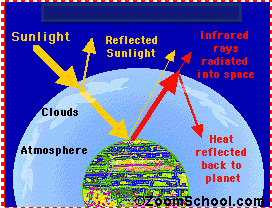
What does this diagram illustrate?
a)
Ozone Layer
b)
The Greenhouse Effect
c)
Ultraviolet Radiation
d)
Layers of the atmosphere
39.
What chemical is responsible for breaking up the ozone?
a)
CFCs
b)
Carbon Dioxide
c)
Nitrogen
d)
Oxygen
40.
This protects us from harmful UV rays from the sun
a)
Troposphere
b)
Stratosphere
c)
Greenhouse Effect
d)
Ozone Layer
41.
Without the Greenhouse Effect the Earth would be
a)
warm
b)
cold
c)
dead
42.
In a climate graph, what does the line graph represent?
a)
high temperatures
b)
amount of precipitation all year
c)
average temperatures
d)
average amount of precipitation
43.
In a climate graph, what does the bar graph represent?
a)
high temperatures
b)
amount of precipitation all year
c)
average temperatures
d)
average amount of precipitation
44.

Which zone is the city in the climate graph most likely located in?
a)
polar
b)
temperate
c)
tropical
45.

Which zone is the city in the climate graph most likely located in?
a)
polar
b)
temperate
c)
tropical
100 %

