wayground logo

Free Printable Worksheets

NEW

Font size

S
M
L
XL
Worksheets

Environmental Science Final Exam 2018

Total questions: 40

Worksheet time: 34mins
Name
Class
Date
1.
Which of the following removes carbon from the atmosphere?
a)
Combustion
b)
Respiration
c)
Photosynthesis
d)
Death
2.
Organisms that do not decompose can be buried and become what?
a)
water
b)
nutrients
c)
air
d)
fossil fuels
3.
If the plant population decreased, the amount of carbon would _________.
a)
Stay the same
b)
Increase
c)
Decrease
4.
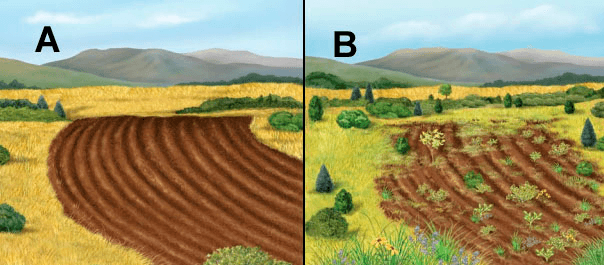
What type of succession is shown going from figure A to figure B?
a)
primary succession
b)
ecological succession
c)
secondary succession
d)
intermediate
5.
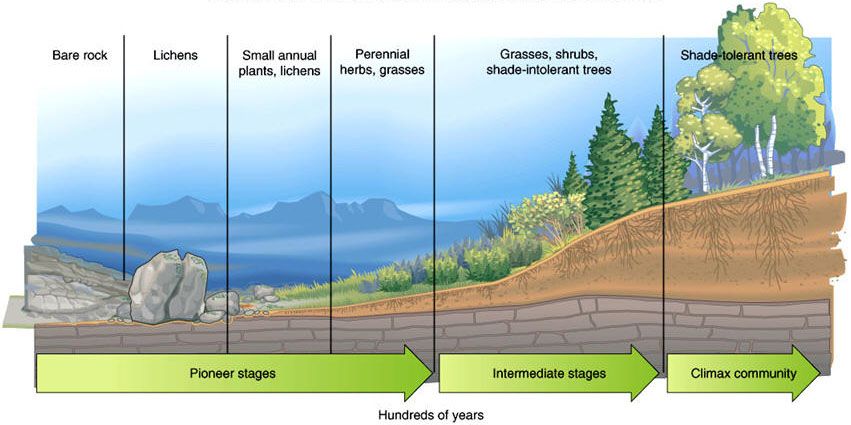
The picture shows what type of succession?
a)
primary
b)
secondary
c)
tertiary
d)
quadanary
6.
An organism that hunts and feeds on another organism is a ______________________.
a)
prey
b)
producer
c)
predator
d)
decomposer
7.
An animal that is hunted as food
a)
prey
b)
predator
c)
decomposer
d)
producer
8.
An inherited trait that helps those organisms that have it to survive
a)
niche
b)
structure
c)
characteristic
d)
adaptation
9.
A group of organisms of the same species
a)
ecosystem
b)
community
c)
population
d)
group
10.
All the populations in a specific area or region
a)
community
b)
ecosystem
c)
population
d)
species
11.
Survival of the Fittest and Evolution were proposed by what scientist?
a)
Charles Darwin
b)
Albert Einstein
c)
Steven Hawking
d)
Isaac Newton
12.
Why are advantageous traits more likely to be passed onto offspring?
a)
Because they are more likely to survive and reproduce.
b)
Because they come from dominant alleles.
c)
Because they come from recessive alleles.
d)
Because the trait is an acquired phenotype.
13.
Energy can be classified into..
a)
Renewable and non renewable
b)
Natural and non renewable
c)
Renewable and Natural
d)
All of them
14.
What is the disadvantage of coal?
a)
Air Pollution
b)
Not much left
c)
World does not use much
d)
It is only used to roast hot dogs
15.
Which of the following is a renewable energy source?
a)
Wind Energy
b)
Oil
c)
Coal
d)
Natural Gas
16.
Which of these is a non-renewable energy source?
a)
Wind Energy
b)
Coal
c)
Solar Energy
d)
Hydro Power
17.
Coal, oil, and natural gas are made from the remains of creatures that lived a long time ago. This makes them _____ .
a)
Fossil Fuels
b)
Renewable Energy Sources
c)
Sustainable Energy Sources
d)
Ores
18.
Most of our electricity (in the US) comes from ....
a)
Burning gasoline
b)
Burning coal and Natural Gas
c)
Burning Nitrogen
d)
Burning Petroleum
19.

Coal is

a)

Renewable

b)

Non Renewable

20.

Solar Energy

a)

Renewable

b)

Non Renewable

21.

Wind Power is

a)

Renewable

b)

Non Renewable

22.

Nuclear Energy is

a)

Renewable

b)

Non Renewable

23.
Which biomolecule contains pastas and breads?
a)
Lipid
b)
Protein
c)
Nucleic Acid
d)
Carbohydrate
24.
Which biomolecule helps form muscles?
a)
Nucleic Acid
b)
Carbohydrate
c)
Protein
d)
Lipids
25.
Which biomolecule is responsible for insulation and energy storage?
a)
Protein
b)
Nucleic Acid
c)
Lipid
d)
Carbohydrate
26.
Which biomolecule is made of amino acids?
a)
Nucleic Acid
b)
Carbohydrate
c)
Protein
d)
Lipid
27.
Which biomolecule is your main source of energy?
a)
Nucleic Acid
b)
Protein
c)
Lipid
d)
Carbohydrate
28.
Which biomolecule contains fats, oils, and waxes?
a)
Proteins
b)
Nucleic Acid
c)
Lipids
d)
Carbohydrate
29.
Which biomolecule contain your genetics?
a)
Carbohydrate
b)
Lipid
c)
Nucleic Acid
d)
Protein
30.
What does the word organic mean?
a)
has nitrogen
b)
has sulfur
c)
has carbon
d)
has oxygen
31.
The more bonds a molecule has, the more....
a)
water is stored
b)
force is stored
c)
energy is stored
d)
oxygen is stored
32.
What is the name for the mechanism of enzyme activity?
a)
Lock and key
b)
jigsaw puzzle
c)
hammer and nail
d)
two hands pattern
33.

Which process occurs inside the mitochondria of all eukaryotic cells, including plants and animals?

a)

Cellular Respirtation

b)

Photosynthesis

c)

Chemosynthesis

34.

Which process PRODUCES oxygen?

a)

Cellular Respiration

b)

Photosynthesis

c)

Chemosynthesis

35.

Which process uses glucose as a

primary source of chemical energy?

a)

Cellular Respiration

b)

Photosynthesis

c)

Chemosynthesis

36.

Which process occurs inside

of chloroplasts?

a)

Cellular Respiration

b)

Photosynthesis

c)

Chemosynthesis

37.

Which process uses carbon dioxide

and water to produce sugars?

a)

Cellular Respiration

b)

Photosynthesis

c)

Chemosynthesis

38.

What process PRODUCES glucose (sugar)?

a)

Cellular Respiration

b)

Photosynthesis

c)

Chemosynthesis

39.

Which process USES glucose?

a)

Cellular Respiration

b)

Photosynthesis

c)

Chemosynthesis

40.

Reactants are on the ______ side of the chemical equation.

a)

Left

b)

Right