
 Worksheets
Electrostatics and Circuits Unit Test
Total questions: 45
Worksheet time: 35mins
Name
Class
Date
1.
In a parallel circuit if one light bulb goes OUT; then they ALL go out. TRUE OR FALSE?
a)
TRUE
b)
FALSE
2.
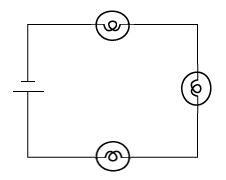
The picture shows an electrical circuit. This circuit is a series circuit because:
a)
It has 3 light bulbs.
b)
The same current flows through all three light bulbs.
c)
It uses a single battery.
d)
The electrical current has more than one path to flow through
3.
In a Series circuit the more lightbulbs you add the brighter they get
a)
False
b)
True
4.
What is a Parallel circuit?
a)
Has only one path
b)
Has more than one path
c)
Allows energy to travel through easily
d)
Has only one light bulb
5.
What is a switch's function in a circuit?
a)
to make the current hotter or colder
b)
turn on and off the flow of current
c)
the pathway that current flows
d)
to add more power to the circuit
6.
Which best describes a simple series circuit?
a)
Electricity flows along one pathway.
b)
The flow of electricity comes from the switch.
c)
Electricity flows along many pathways.
d)
The flow of electricity comes from the light bulb.
7.
wood is a _____?
a)
conductor
b)
insulator
8.
water is a______?
a)
conductor
b)
insulator
9.
Silver is a _____?
a)
insulator
b)
conductor
10.
A material in which electrons are able to move easily
a)
Circuit
b)
Insulator
c)
Resistance
d)
Conductor
11.
This circuit has more than one loop. When one light goes out, the others stay on.
a)
closed circuit
b)
series circuit
c)
parallel circuit
d)
open circuit
12.

What kind of circuit is this?
a)
series
b)
parallel
13.

What type of circuit is show in the image?
a)
Series Circuit
b)
Parallel Circuit
14.
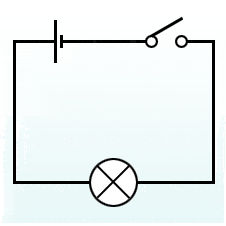
this circuit is .....?
a)
open
b)
parallel
c)
closed
d)
The cutest little circuit evah!
15.
A circuit must be closed for electrons to travel.
a)
true
b)
false
16.

If you replace the paper clip with a plastic spoon, what happens?
a)
The bulb doesn't light
b)
The bulb is dimmer
c)
The wires get hot
d)
There is no change
17.

Which statement is true?
a)
The light bulb will light up because the circuit is complete.
b)
The light bulb will light up because the circuit is broken.
c)
The light bulb will not light up because the circuit is complete.
d)
The light bulb will not light up because the circuit is broken.
18.

Would would best complete this circuit?
a)
A wire
b)
A switch
c)
A battery
d)
A light bulb
19.
Electricity is the flow of _________.
a)
Protons
b)
Neutrons
c)
Electrons
20.

What kind of circuit is this?
a)
Series
b)
Consecutive
c)
Parallel
d)
Training
21.
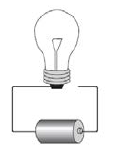
Which of these best completes the circuit?
a)
rubber band
b)
metal nail
c)
leather shoelace
d)
wooden toothpick
22.
what is the scientific formula for ohm's law
a)
V=IR
b)
I=VR
c)
R=IV
d)
None of the above
23.
A Charging system producing 14.5 Volts with a current flow of 43.5 Amps, what is the circuit resistance
a)
58 Amps
b)
0.33 Amps
c)
13 Amps
d)
1 Amp
24.
A HID lighting circuit operates at 75 Volts what is the circuit current flow if the resistance is 5 Ohms
a)
375 Amps
b)
30 Amps
c)
15 Amps
d)
1.33 Amps
25.
What would the circuit resistance be if a 7.5 Amp draw was present with the engine running and the charging system producing 15 Volts
a)
15 Ohms
b)
4 Ohms
c)
0.3333 Ohms
d)
2 Ohms
26.
With the engine running the charging system produces 14.5 Volts what would the current flow be if a resistance of 6 Ohms was present
a)
2.41 Ohms
b)
2.52 Ohms
c)
2.1 Ohms
d)
0.3333 Ohms
27.
What size resistor would produce a current flow of 5 Amps with a battery voltage of 12.6 volts
a)
60 Ohms
b)
2.52 Ohms
c)
1.71 ohms
d)
5.04 Ohms
28.
How many Volts would we need to produce a current flow of 8 Amps through a 6 Ohm resistor
a)
12 volts
b)
24 volts
c)
1.3333
d)
48 volts
29.
12 Volt battery with two resistors in series 3 Ohms & 4 Ohms what would the current draw be
a)
2.1
b)
1.71 Amps
c)
2.4 Amps
d)
15 Amps
30.
If the battery produced 12.6 Volts and what would be the current flow be for a 6 Ohm resistor
a)
2.1 Amps
b)
2.4 Amps
c)
1.71 Amps
d)
15 Amps
31.
What direction are the electric field lines around an electron?
a)
towards the charge
b)
away from the charge
32.
When a glass rod is rubbed with silk and the glass rod becomes positively charged, what happens to the electrons?
a)
they are removed from the rod
b)
they are added to the rod
33.
What do you call the process of charging a conductor by bringing it near another charged object?
a)
induction
b)
polarization
c)
neutralization
d)
conduction
34.
Which of the following is not a good conductor of electricity?
a)
copper
b)
silver
c)
Glass
d)
aluminum
35.
Which of the following is not a good insulator?
a)
Copper
b)
Glass
c)
rubber
d)
wool
36.
The law of conservation of charge states that...
a)
all atoms have more protons than electrons
b)
only protons can be rubbed off of an atom
c)
charge cannot be created or destroyed
d)
charge cannot be transferred
37.
assume a rubber rod is rubbed against a rabbit fur and gains 5 electrons. which of the following is true?
a)
The fur lost 5 electrons
b)
the fur gained 5 electrons
c)
the fur gained 5 protons
d)
The fur lost 2 electrons
38.
What object allowed John Tra"voltage" to discharge his electrons?
a)
The rug
b)
The wall
c)
The door
d)
The metal doorknob
39.
If two balloons have the same charge, what will happen if you place them close to each other?
a)
Nothing
b)
They will be attracted
c)
They will pop
d)
They will push each other away.
40.
During a physics lab, a plastic strip was rubbed with cotton and became positively charged. The correct explanation for why the plastic strip becomes positively charged is that ...
a)
the plastic strip acquired extra protons from the cotton.
b)
the plastic strip acquired extra protons from the charging process
c)
protons were created as the result of the charging process
d)
the plastic strip lost electrons to the cotton during the charging process
41.
A negatively charged plastic comb is brought close to, but does not touch, a small piece of paper. If the comb and the paper are attracted to each other, the charge on the paper
a)
must be positive
b)
must be negative
c)
may be neutral or negative
d)
may be neutral or positive
42.

Two electrically neutral metal spheres, A and B, on insulating stands are placed in contact with each other. A negatively charged rod is brought near, but does not touch the spheres, as shown in the diagram below. How are the spheres now charged?
a)
A is positive and B is positive.
b)
A is negative and B is positive.
c)
A is positive and B is negative.
d)
A is negative and B is negative.
43.
Metal sphere A has a charge of +12 elementary charges and identical sphere B has a charge of +16 elementary charges. After the two spheres are brought into contact and separated, the charge on sphere A is
a)
+14 elementary charges
b)
+28 elementary charges
c)
+2 elementary charges
d)
-2 elementary charges
44.
Electrostatic force F exists between two point charges. If the both charges are doubled, the force between the charges will be
a)
F
b)
4F
c)
2F
d)
F/4
45.
An electrostatic force of magnitude F exists between two metal spheres having identical charge q. The distance between their centers is r. Which combination of changes would produce no change in the electrostatic force between the spheres?
a)
doubling q on both spheres while halving r
b)
doubling q on one sphere while halving r
c)
doubling q on one sphere while doubling r
d)
doubling q on both spheres while doubling r
100 %

