wayground logo

Free Printable Worksheets

NEW

Font size

S
M
L
XL
Worksheets

4th Six Weeks Exam Review

Total questions: 44

Worksheet time: 11hrs 46mins

Name
Class
Date
1.

Two like charges

a)

neutralize each other.

b)

repel each other.

c)

must be neutrons.

d)

attract each other.

2.

When a balloon is rubbed on clothes it acquires a charge by ___________

a)

Induction

b)

reduction

c)

friction

d)

concuction

3.

When a glass rod is rubbed with silk and the glass rod becomes positively charged, what happens to the electrons?

a)

they are removed from the rod

b)

they are added to the rod

4.

Which of the following is not a good conductor of electricity?

a)

copper

b)

silver

c)

Glass

d)

aluminum

5.

The law of conservation of charge states that...

a)

all atoms have more protons than electrons

b)

only protons can be rubbed off of an atom

c)

charge cannot be created or destroyed

d)

charge cannot be transferred

6.

assume a rubber rod is rubbed against a rabbit fur and gains 5 electrons. which of the following is true?

a)

The fur lost 5 electrons

b)

the fur gained 5 electrons

c)

the fur gained 5 protons

d)

The fur lost 2 electrons

7.

If each of the charges doubles, what happens to the electric force?

a)

Quadruples

b)

Doubles

c)

Stays the same

d)

Reduced by half

8.

If the distance between 2 charges doubles, what happens to the electrostatic force?

a)

Reduced by half

b)

Reduced by 1/4

c)

Stays the same

d)

Quadruples

9.

If the distance between two electric charges is reduced by half, what happens to the electrostatic force?

a)

Quadruples

b)

Doubles

c)

Triples

d)

Reduces by half

10.

Electrostatic force F is directly proportional to:

a)

r^2 (distance squared)

b)

q1

c)

q2

d)

both q1 and q2

11.

When distance increases, electrostatic force ____________; we call this relationship ____________ proportional

a)

decreases;directly

b)

decreases;inversely

c)

increases;inversely

d)

increases;directly

12.

Calculate the force exerted between two charged objects separated by a distance of 0.6 m. One object has a charge of -5 C and the other has a charge of +2.0 C.

a)

-1.5E-11 N

b)

2.5E-11 N

c)

-2.5E11 N

d)

-7.5E-10 N

13.

The distance between two charges doubles at the same time that the charge on each also doubles. What happens to the electric force?

a)

doubles

b)

quadruples

c)

cut in half

d)

no change

14.

The reason a charged balloon will stick to a wall is that

a)

the charge is slightly sticky and acts like glue

b)

electrons transfer back and forth between the wall and the balloon

c)

The wall becomes polarized making the opposite charges in the wall closer than other wall charges

d)

balloon material simply sticks to walls

15.

Two equal charges separated by a distance of 8 m experience a repulsive force of 83.2 N. What is the strength in coulombs of each charge?

a)

2.72 x 10⁻⁴ C

b)

5.92 x 10⁻⁷ C

c)

7.40 x 10⁻⁸ C

d)

7.69 x 10⁻⁴ C

16.

While the spheres are touching, the right sphere is:

a)

neutral

b)

positive

c)

negative

d)

zero

17.

A woman's hair stands out when she is in contact with a charged Van de Graaff generator. The reason her hair stands out is because

a)

hair strands are at high voltage.

b)

she is in a strong electric field.

c)

like charges repel.

d)

hair is a good conductor.

18.

Two balloons are charged with an identical quantity and type of charge: -0.0025 C. They are held apart at a separation distance of 8 m. Determine the magnitude of the electrical force of repulsion between them.

a)

8.79 x 10² N

b)

9.77 x 10⁸ N

c)

7.03 x 10³ N

d)

7.98 x 10⁻² N

19.
A person weighing 600 N gets on an elevator. The elevator lifts the person 6 m in 10 seconds.  How much power was used?
a)
360 W 
b)
60 W
c)
3600 W
d)
600 W
20.
How much work is done in holding a 15 N sack of potatoes while waiting in line at the grocery store for 3 minutes?
a)
15 J
b)
45 J
c)
0 J
d)
5 J
21.
Two factors that determine work are
a)
size of the force, and distance
b)
size of the force, and type of force
c)
mass, and distance
22.
Which of the following is the best example of work being done. 
a)
doing homework
b)
lifting a box
c)
pushing a stationary box
d)
holding a box
23.
On a roller coaster, where is maximum potential energy?
a)
At the bottom of a big hill
b)
When going around a corner
c)
When going upside down
d)
At the top of a big hill
24.
What is the average power generated by Peter Quill aka Star Lord (m = 100 kg) running up a flight of stairs rising vertically 6 .0 m in 5.0 s?
a)
0.03 W
b)
817 W
c)
1176 W
d)
1993 W
25.
Groot rescues Rocket from the bottom of a deep pit. Groot expends 1000 J of energy lifting Rocket who has a mass of 50 kg out of the pit. How deep is the pit?
a)
0.5 m
b)
2 m
c)
4 m
d)
10 m
26.
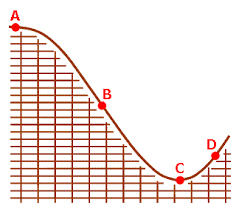
At which point(s) on the roller coaster is the kinetic energy at its maximum?
a)
A
b)
B
c)
C
d)
D
27.
You drop a 5 kg ball from a height of 2 m. Just before it reaches the ground, what type of energy does it have?
a)
Potential Energy
b)
Kinetic Energy
c)
Nuclear Energy
d)
Chemical Energy
28.
Gravitational potential energy depends on the ________ and ________ of the object. 
a)
Height and mass
b)
Friction and movement
c)
Mass and Movement
d)
Height and Friction 
29.
Which graph BEST shows the relationship of kinetic energy to potential energy as a book sits on the edge of a desk?
a)
A
b)
B
c)
C
d)
D
30.
True or False: A man would do more work if he pushes a box up a ramp faster.
a)
True
b)
False
31.
A boy HOLDS a book.
a)
Work
b)
No Work
32.
A girl LIFTS a bag. 
a)
Work
b)
No Work
33.
As energy transformations occur within a system, the total energy (Mechanical Energy) of the system ___.
a)
increases
b)
decreases
c)
is transferred out of the system
d)
remains constant
34.
What is the kinetic energy of a 4 kg shot-put thrown with a velocity of 13 m/s
a)
676 J
b)
3.25 J
c)
17J
d)
338 J
35.
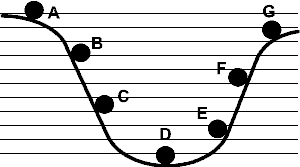
Which point has the greatest potential energy (GPE)?
a)
A
b)
G
c)
D
d)
C
36.
A bike rider approaches a hill at a speed of 5.5 m/s. The combined mass of the bike and rider is 87kg. Find the initial kinetic energy of the system. 
The rider coasts up the hill. Ignoring friction, at what height will the bike come to rest?
a)
1316J
 1.5m
b)
1316J
 2.5m
c)
1457J
 3.5m
d)
none of the above
37.
You drop a 5 kg ball from a height of 2 m. Just before it reaches the ground, how much kinetic energy does it have?
a)
9.8 J
b)
98 J
c)
10 J
d)
120 J
38.
You drop a 5 kg ball from a height of 2 m. Just before it reaches the ground, how fast is it going just before hitting the ground?
a)
6.26 m/s
b)
39.2 m/s
c)
98 m/s
d)
2 m/s
39.
How do you find mechanical energy?
a)
weight x height
b)
potential + kinetic
c)
energy + weight
d)
none of these
40.
A 60. kilogram student climbs a ladder a vertical distance of 4.0 meters in 8.0 seconds. Approximately how much total work is done against gravity by the student during the climb?
a)
2.4 x 10³ J
b)
3.0 x 10³ J
c)
2.9 x 10² J
d)
2.4 x 10⁴ J
41.
If a cannonball flies at a speed of 15 m/s and has 675J of kinetic energy, what is its mass?
a)
90 Kg
b)
6 Kg
c)
350 Kg
d)
22.5 Kg
42.
Belly-Flop Bennie dives from atop a tall flagpole into a swimming pool below. His potential energy at the top is 10,000 J. What is his kinetic energy when his potential energy reduces to 9.7 J?
a)
9.81J
b)
10,000J
c)
9.7J
d)
9,990.3J
43.
A car travels at a constant speed v up a hill from point A to point B. As the car travels from A to B, its gravitational potential energy
a)
increases and its kinetic energy remains the same
b)
remains the same and its kinetic energy decreases
c)
increases and its kinetic energy decreases
d)
remains the same and its kinetic energy remains the same. 
44.
What would be the effect on the particles if more heat is supplied to the system?
a)
They would slow down
b)
They would stop moving
c)
They would speed up
d)
There would be no effect