wayground logo

Free Printable Worksheets

Font size

S
M
L
XL
Worksheets

AP Macroeconomics Unit 6

Total questions: 50

Worksheet time: 1hrs 24mins

Name
Class
Date
1.
The U.S. can produce 10 ipads or 20 phones.  China can produce 20 ipads or 30 phones. Who should produce what?
a)
U.S.-ipads
China- phones
b)
U.S. phones
China- ipads
c)
both should produce ipads
d)
they should not specialize
2.
The US can produce 1 ton of sugar using 4 acres of land, or they can produce 1 ton of avocados using 6 acres. 
Ecuador can produce 1 ton of sugar using 5 acres of land or 1 ton of avocados using 4 acres. 
Which country should produce avocados? 
a)
Ecuador
b)
US
c)
not enough information
3.
The US can produce 200 airplanes or 400 trucks. Japan can produce 300 trucks or 100 airplanes. 
Which country has the absolute advantage in producing airplanes? 
a)
Japan
b)
US
4.
Country X can manufacture a particular product better and at a lower cost than country Y can.
What conclusion can be drawn from this situation?
a)
Country X has solved the problem of scarcity.
b)
Country X should discontinue making that product.
c)
Country Y should try to produce the same product. 
d)
Country X should sell that product to Country Y.
5.
Suppose that in one week Sam can knit 5 sweaters or make 4 blankets and Rob can knit 10 sweaters or make 6 blankets. Which of the following is true?
a)
Sam has an absolute advantage in making blankets
b)
Sam has neither a comparative nor an absolute advantage in knitting sweaters or making blankets
c)
Sam has a comparative advantage in making blankets
d)
Sam has a comparative advantage in knitting sweaters
6.
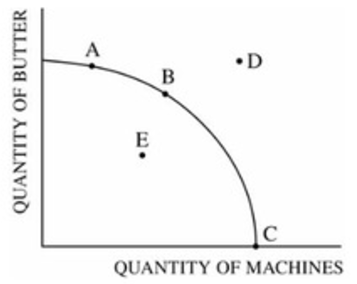
The diagram shows the production possibilities curve for Country Y. Which of the following statements is true?
a)
If Country Y is producing at point C, it is using all its resources efficiently
b)
The opportunity cost of producing more machines is constant
c)
Country Y cannot produce at point E
d)
The most efficient point of production is point D
7.
The simplified production possibilities curves for country A and B are shown. Which one of the following statements is correct?
a)
Country A has the comparative advantage in both goods
b)
Country A has the comparative advantage in chairs & Country B has the comparative advantage in shirts
c)
Country B has the absolute advantage in shirts only
d)
Country A has the comparative advantage in shirts & Country B has the comparative advantage in chairs
8.
Improvements in technology for producing all goods must result in:
a)
An inward shift in the production possibilities curve 
b)
A flatter production possibilities curve 
c)
An outward shift in the production possibilities curve 
d)
A steeper production possibilities curve 
9.
If nations specialize according to their comparative advantage and engage in trade with each other, each nation can:
a)
Consume outside its production possibilities curve 
b)
Produce outside its production possibilities curve 
c)
Shift its production possibilities curve to the right 
d)
Produce more of all goods 
10.
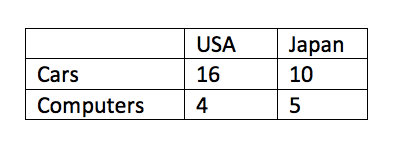
Based on the table provided, which one of the following statements is correct?
a)
Japan has the absolute advantage in producing cars
b)
Japan has the comparative advantage in producing cars
c)
The United States has the absolute advantage in producing both cars and computers
d)
The opportunity cost of producing a car in Japan is 1/2 a computer
11.
The more valuable currency has
a)
depreciated
b)
appreciated
c)
depleted
d)
amortizes
12.
When a country's currency appreciates, its exports ____
a)
double
b)
become cheaper
c)
become more expensive
d)
Drop by at least 1/2
13.
Difference between sale of assets to foreigners and purchases of assets from foreigners is called_____
a)
financial account
b)
exchange account
c)
international trade
d)
current account
14.
A country's ____ accounts are a summary of their transactions with other countries
a)
Exchange
b)
Balance of payment
c)
Income statement
d)
line of credit
15.
The price of one nation's currency expressed in terms of another's currency is called
a)
world price
b)
exchange rate
c)
purchasing power parity
d)
terms of trade
16.

What is a 'Fixed Exchange Rate'

a)

the government/central bank entirely or predominantly determines the exchange rate.

b)

the forex market entirely or predominantly determines the exchange rate.

c)

the trading partners entirely or predominantly determines the exchange rate.

d)

the importing countries entirely or predominantly determines the rate.

17.

A floating exchange rate is a regime where the currency price is set by the

a)

forex market based on demand for the currency compared with other currencies.

b)

forex market based on supply and demand compared with other currencies.

c)

central banking authority

d)

the country who is trading with our country

18.

What is the difference between a fixed and a floating exchange rate?

a)

A fixed exchange rate is set by the monetary authority with respect to a foreign currency or a basket of foreign currencies, a floating exchange rate is determined in foreign exchange markets depending on demand and supply, and it generally fluctuates constantly.

b)

There is no difference between them, both determined by the central bank.

c)

A fixed exchange rate is better than the floating exchange rate in determining the exchange rate of a particular country's currency.

d)

All of the answers above.

19.
if 1 $ = Rs. 50, and if rises to 1 $ = Rs. 60 it will be called
a)
appreciation
b)
depreciation
c)
revaluation
d)
all the above
20.
If 1 $ = Rs. 50 and now it becomes 1 $ = Rs 40 it will be called 
a)
Depreciation
b)
appreciation
c)
devaluation
d)
none of the above
21.

The graph shows a(n)

a)

depreciation of the dollar and appreciation of the Euro.

b)

appreciation of the dollar and depreciation of the Euro.

c)

appreciation of the dollar and appreciation of the Euro.

d)

depreciation of the dollar and depreciation of the Euro.

22.

The shift in the graph could be caused by

a)

an increase in the Supply of Euros.

b)

an increase in the Demand for Euros.

c)

a decrease in the Supply of Euros.

d)

the crowding out effect.

23.

The shift in the graph could be caused by

a)

an increase in the Supply of dollars.

b)

deflation in Europe.

c)

people in Europe become wealthier.

d)

inflation in the US.

e)

European companies launch new popular products.

24.

The shift in the graph could be caused by

a)

interest rates rising in Mexico.

b)

an increase in American tariffs.

c)

speculators demanding more pesos.

d)

the launch of a popular product by an American company.

e)

inflation in the US.

25.

All of the following could cause the shift in the graphs for the Japanese Yen and US Dollar except:

a)

an increase in interest rates in the US.

b)

the release of hot new video game console by Japanese producer Nintendo.

c)

speculators desiring Japanese currency.

d)

inflation in the US.

e)

an increase in GDP in the US.

26.

What could cause the shift in the graphs for the Japanese Yen and US Dollar?

a)

deflation in the US.

b)

inflation in Japan.

c)

Japanese company Sony creates a holographic TV system.

d)

a decrease in Japenese interest rates.

e)

an increase in the Japanese GDP.

27.

The shift in the graph would cause

a)

a US trade deficit.

b)

an increase in American tariffs.

c)

speculators demanding more pesos.

d)

an appreciation of the dollar.

e)

inflation in the US.

28.

An increase in interest rates in the US would cause

a)

D for the $ to increase and D for the Real to increase

b)

D for the $ to increase and S for the Real to increase.

c)

S for the $ to increase and D for the Real to increase.

d)

S for the $ to increase and S for the Real to increase.

29.

A recession in the US would cause

a)

D for the $ to increase and D for the Real to increase

b)

D for the $ to increase and S for the Real to increase.

c)

S for the $ to increase and D for the Real to increase.

d)

S for the $ to increase and S for the Real to increase.

30.

Speculators for-see a future increase in the Brazilian GDP we would expect

a)

D for the $ to increase and D for the Real to increase

b)

D for the $ to increase and S for the Real to increase.

c)

S for the $ to increase and D for the Real to increase.

d)

S for the $ to increase and S for the Real to increase.

31.

Brazilians decide to travel in massive tours at Orlando area theme parks, we expect the following in the ForEx market

a)

D for the $ to increase and D for the Real to increase

b)

D for the $ to increase and S for the Real to increase.

c)

S for the $ to increase and D for the Real to increase.

d)

S for the $ to increase and S for the Real to increase.

32.

Massive inflation strikes the US, we expect

a)

D for the $ to increase and D for the Real to increase

b)

D for the $ to increase and S for the Real to increase.

c)

S for the $ to increase and D for the Real to increase.

d)

S for the $ to increase and S for the Real to increase.

33.

A large increase in the value of real estate occurs in Brazil making Brazilians feel wealthier. We expect

a)

D for the $ to increase and D for the Real to increase

b)

D for the $ to increase and S for the Real to increase.

c)

S for the $ to increase and D for the Real to increase.

d)

S for the $ to increase and S for the Real to increase.

34.

Real incomes rise in the US, we expect

a)

D for the $ to increase and D for the Real to increase

b)

D for the $ to increase and S for the Real to increase.

c)

S for the $ to increase and D for the Real to increase.

d)

S for the $ to increase and S for the Real to increase.

35.
Will the following scenario affect the current account or capital account, and will the transaction be a debit or credit?
The U.S. increase imports of tractor wheels from Canada. 
a)
current account; debit.
b)
current account; credit.
c)
capital account; debit.
d)
capital account; credit.
36.
Will the following scenario affect the current account or capital account, and will the transaction be a debit or credit?
A Ukrainian businesswoman buys a majority share of ownership in a U.S. clothing company.
a)
current account; debit.
b)
current account; credit.
c)
capital account; debit.
d)
capital account; credit.
37.
Will the following scenario affect the current account or capital account, and will the transaction be a debit or credit?
An American working in Saudi Arabia sends his wife, who lives in Atlanta, money so she can buy a new car.
a)
current account; debit.
b)
current account; credit.
c)
capital account; debit.
d)
capital account; credit.
38.
Will the following scenario affect the current account or capital account, and will the transaction be a debit or credit?
An American receives quarterly dividend payments (profits) from stock she owns in a German company.

a)
current account; debit.
b)
current account; credit.
c)
capital account; debit.
d)
capital account; credit.
39.
An increase in price level in the U.S. relative it its trading partners will cause the U.S. dollar to __________ on the foreign exchange market, and Americans will __________ the purchase of foreign made goods.  
a)
appreciate, increase
b)
appreciate, decrease
c)
depreciate, decrease
d)
depreciate, increase
40.
If Americans want to purchase more South Korean cars, the supply of dollars in the foreign exchange market will __________ and demand for the Won, the South Korean currency, will __________.
a)
increase, decrease
b)
increase, increase
c)
decrease, decrease
d)
decrease, increase
41.
An increase in stock market profits in Europe will cause the dollar to ______________ and the euro, the currency of the European Union, to __________.
a)
depreciate, depreciate
b)
depreciate, appreciate
c)
appreciate, appreciate
d)
appreciate, depreciate
42.
An increase in US deficit spending will cause a(n) __________ in domestic U.S. business investment and a(n) __________ of the U.S. dollar in foreign exchange markets. 
a)
increase, appreciation
b)
decrease, depreciation
c)
decrease, appreciation
d)
increase, depreciation
43.
The sale of U.S. treasury bonds on the open market will cause a(n) __________ in the U.S. price level and a(n) __________ of the U.S. dollar in the foreign exchange market.
a)
decrease, appreciation
b)
decrease, depreciation
c)
increase, appreciation
d)
increase, depreciation
44.
Imports involve
a)
Goods in, money in, positive in Current Account
b)
Goods in, money out, negative in Current Account
c)
Goods in, money in, positive in Financial Account
d)
Goods in, money out, negative in Financial Account
45.
Exports involve
a)
Goods out, money out, positive in Current Account
b)
Goods out, money in, positive in Current Account
c)
Goods out, money in, positive in Financial Account
d)
Goods out, money out, negative in Current Account
46.
Financial Account transactions include items such as
a)
Imports
b)
Exports
c)
Transfers & Remittances
d)
Purchase and sale of stocks and bonds
47.
Currency depreciation could be caused by
a)
Supply Increase or Demand Increase
b)
Supply Increase or Demand Decrease
c)
Supply Decrease or Demand Decrease
d)
Supply Decrease or Demand Increase
48.
Currency appreciation could be caused by
a)
Supply Increase or Demand Increase
b)
Supply Increase or Demand Decrease
c)
Supply Decrease or Demand Decrease
d)
Supply Decrease or Demand Increase
49.
Currency appreciation results in
a)
Increased exports, increased imports
b)
Decreased exports, decreased imports
c)
Increased exports, decreased imports
d)
Decreased exports, increased imports
50.
Currency depreciation results in
a)
Increased exports, increased imports
b)
Decreased exports, decreased imports
c)
Increased exports, decreased imports
d)
Decreased exports, increased imports