Wayground logo

Free Printable Worksheets

Font size

S
M
L
XL
Worksheets

Platetectonics

Total questions: 34

Worksheet time: 26mins

Name
Class
Date
1.
Which type of plate boundary occurs at Y?
a)
divergent
b)
convergent
c)
transform
d)
sea floor spreading
2.
Name the boundary
a)
convergent boundary
b)
divergent boundary
c)
transform boundary
d)
sergent boundary
3.
Name the boundary
a)
convergent boundary
b)
divergent boundary
c)
transform boundary
d)
sergent boundary
4.
Name the boundary
a)
convergent boundary
b)
divergent boundary
c)
transform boundary
d)
sergent boundary
5.
What landform is created when two continental plates collide? 
a)
Ocean Basin
b)
Volcano
c)
Canyon
d)
Mountain Range 
6.
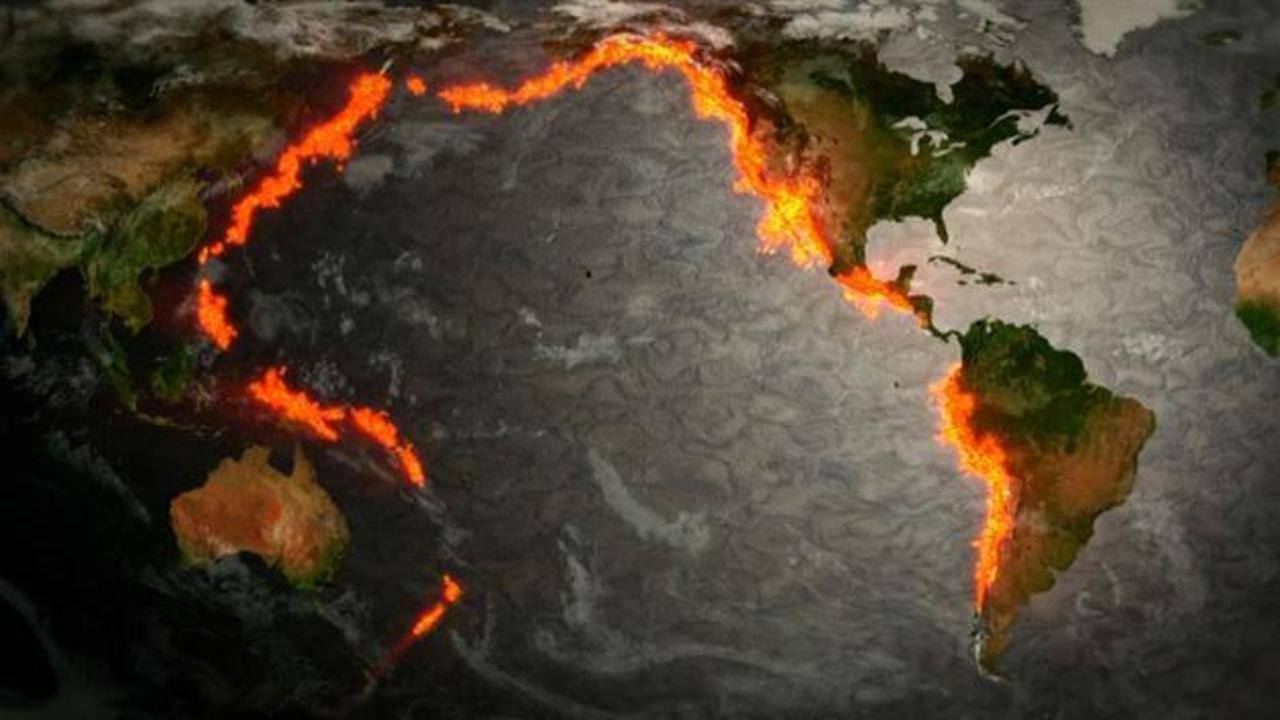
The Pacific Ring of Fire is where most of the earth's  ____ are found.
a)
earthquakes
b)
volcanoes
c)
earthquakes and volcanoes
7.
A rift valley forms at this type of plate boundary.
a)
convergent
b)
divergent
c)
transform
8.
The three types of plate boundaries are
a)
basaltic, granitic and andesitic
b)
continental, oceanic, and spreading
c)
convergent, divergent and transform
9.
A plate boundary where two plates move away from each other is called
a)
Divergent Boundary
b)
Convergent Boundary
c)
Transform Boundary
d)
Subduction
10.
Scientists hypothesize that a super continent existed 200 million years ago.  This continent is called
a)
America
b)
Super Earth
c)
Pangea
d)
Eurasia
11.
A Plate Boundary where two plates move toward each other is called
a)
Convergent Boundary
b)
Divergent Boundary
c)
Transform Boundary
d)
Subduction
12.
When pressure builds between two tectonic plates, it can suddenly release causing a (an) ______________________
a)
Earthquake
b)
Volcano
c)
Convection Current
d)
Gravitational Pull
13.

Theory that explains how all the land was joined together and drifted apart.

a)

Theory of evolution

b)

Theory of earth science

c)

Theory of Continental drift

d)

Theory of Divergence

14.
Earthquakes and volcanoes are most likely found in which locations?
a)
At plate boundaries
b)
in oceans
c)
in the middle of continents
d)
in the middle of plates
15.
Transform boundaries are most likely to produce what phenomenon?
a)
volcanoes
b)
deep sea trenches
c)
underwater mountain ranges
d)
earthquakes
16.
Which ocean in the world is also known as the "Ring of Fire"
a)
Atlantic
b)
Indian
c)
Arctic
d)
Pacific
17.
What is the name of the geologic process when one plate slips underneath another plate?
a)
Subduction
b)
Subway
c)
Convergence
d)
Slip
18.
What are the two types of crust
a)
continental and oceanic
b)
ocean and upper
c)
lower and upper
d)
pizza and subway
19.
subduction zones in the ocean can create which features?
a)
islands
b)
volcanoes
c)
earthquakes
d)
all of the above
20.
New ocean floor is most likely to form as movement occurs at which type of plate boundary?
a)
a divergent boundary
b)
a transform
c)
a subducting boundary
d)
a convergent boundary
21.
What feature forms when two continental lithospheric plates collide?
a)
Rift Valley
b)
Folded Mountains
c)
Volcanic Mountains
d)
Mid Ocean Ridges
22.
What feature forms at a divergent boundary between two oceanic lithospheric plates?
a)
Rift Valley
b)
Folded Mountains
c)
Deep Sea Trench
d)
Mid Ocean Ridge
23.
What feature is formed at a subduction zone?
a)
Deep Sea Trench
b)
Folded Mountains
c)
Rift Valley
d)
Mid Ocean Ridge
24.
Who was the German scientist who first developed the idea that the continents were once joined in a single landmass that broke apart?
a)

Albert Einstein

b)
Alfred Wegener
c)
Charles Darwin
d)
Dmitri Meneleev
25.

a deep valley along the ocean floor beneath which oceanic crust slowly sinks toward the mantle

a)

deep ocean trench

b)

mid-ocean ridge

c)

plate

d)

rift valley

26.
hypothesis explaining how the ocean floor forms and how continents can drift
a)
trenching
b)
contiental rifting
c)
divergent plate movement
d)
seafloor spreading
27.

The process that molten material adds new crust to the ocean floor.

a)

rift valley

b)

sea floor spreading

c)

mid ocean ridge

d)

deep ocean trench

28.

A plate boundary where two plates move toward each other.

a)

trench

b)

ridge

c)

fault

d)

split

29.

The 7 major tectonic plates.

a)

Eurasian, Indo-Australian, Pacific, North American, African, South American, Antarctic

b)

Eurasian, Nazca, Atlantic, North American, African, South American, Antarctic

c)

Eurasian, Indo-Australian, Pacific, North American, Arabian, South American, Phillippine

30.

During a convergent boundary, when both edges are oceanic crust what land or seafloor feature is created?

a)

volcanic islands

b)

trenches

c)

mountains

d)

rift valleys

31.

During a convergent boundary, when both edges are continental crust what land or seafloor feature is created?

a)

trenches

b)

volcanoes

c)

valleys

d)

mountains

32.

During a divergent boundary, when both edges are oceanic crust what land or seafloor feature is created?

a)

mountains

b)

mid-ocean ridge

c)

rift valley

d)

earthquakes

33.

During a transform boundary, when both edges are contonental crust what land or seafloor feature is created?

a)

mid-ocean ridge

b)

volcanoes

c)

earthquakes

d)

faults

34.
Which piece of evidence did Wegener use to prove continental drift?
a)
The shape of the continents
b)
Similar fossils found on separate continents
c)
Tree fossils found in odd places
d)
All of the above