
NEW
Font size
S
M
L
XL
 Worksheets
THE FINAL QUIZZ
Total questions: 76
Worksheet time: 1hrs 12mins
Name
Class
Date
1.
What do we call the the amount of force exerted on a certain area?
a)
fluid
b)
pressure
c)
buoyant
2.
When pressure is applied to a confined fluid, the increase in pressure is transmitted equally to all parts of the fluid. This fact is called________.
a)
Pascal's Principle
b)
Newton's Principle
c)
Archimedes' Principle
d)
Bernoulli's Principle
3.

Water pressure increases as depth increases.
a)
True
b)
False
4.
Liquids take the same ________ and _________ as their container.
a)
shape and size
b)
shape and volume
c)
size and color
d)
size and temperature
5.
This is a measurement of the amount of matter, or 'stuff', in an object or substance.
a)
volume
b)
density
c)
mass
d)
length
6.
What was the principle Archimedes discovered?
a)
Volume
b)
Density
c)
Buoyancy
d)
Gravity
7.

Which box has a higher density?
a)
Box A
b)
Box B
c)
cannot be determined
d)
they are the same
8.

The upward force exerted by a fluid is called the...
a)
buoyancy force
b)
air force
c)
fluidity principal
d)
Harry Potter's law
9.

Buoyancy is the tendency for objects to float in a fluid. Buoyancy pushes the opposite direction of...
a)
waves push.
b)
magnetic pull.
c)
the wind.
d)
gravity's pull
10.
To generate lift, a blade is angled so the _________ pressure air moves under the blade.
a)
high
b)
low
c)
not enough information
d)
None of the above
11.

If you blow air between these two balloons, the pressure between the balloons would_________.
a)
Increase
b)
Decrease
c)
Stay the same
12.

The faster a fluid moves, the lower the pressure is in the moving fluid compared to the fluid not moving as fast. This is called
a)
Archimedes' Principle
b)
Bernoulli's Principle
c)
Pascal's Principle
d)
Vice Principle Snyder
13.

Whose Principle is used to describe why flight is possible?
a)
Newton
b)
Descartes
c)
Bernoulli
d)
Pascal
14.
Why is the top of an airplane wing curved?
a)
To create an area of low pressure above the wing
b)
To create an area of high pressure above the wing
c)
To create equal pressure above and below the wing
d)
To make the wing look really cool
15.
According to Bernoulli's Principle, when the wind speed is high, wind pressure is ________
a)
high
b)
low
c)
not enough information
d)
None of the above
16.
A flat sloping surface that connects lower and higher elevations. It makes raising objects easier.
a)
wedge
b)
screw
c)
lever
d)
inclined plane
17.
An inclined plane wrapped around a rod forms this simple machine
a)
lever
b)
pulley
c)
screw
d)
wedge
18.
A simple machine that consists a rigid bar that pivot about a fixed point
a)
lever
b)
pulley
c)
wheel and axle
d)
fulcrum
19.
An axe is an example of a
a)
pulley
b)
inclined plane
c)
screw
d)
wedge
20.
A device that has two or more simple machines working together
a)
fulcrum
b)
pulley
c)
compound (complex) machine
d)
motor
21.

Lightbulb
a)
wedge
b)
pulley
c)
incline plane
d)
screw
22.
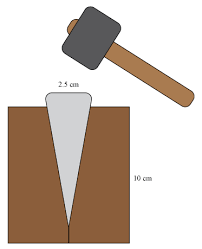
This device
a)
wedge
b)
lever
c)
incline plane
d)
wheel and axle
23.
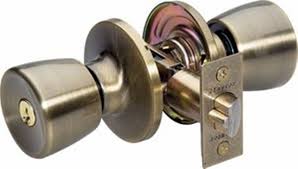
What type of simple machine is this?
a)
wheel and axle
b)
gear
c)
lever
d)
inclined plane
24.
Which of the following does a simple machine do?
a)
allows the users to apply less force over a longer distance
b)
reduce the amount of force needed to do work
c)
change the direction of the applied force
d)
all of the above
25.
The unit used to measure work is the
a)
Watt
b)
Newton
c)
Joule
d)
meter
26.
A force exerted over a distance to move an object is ______________________.
a)
power
b)
work
c)
momentum
d)
Watt
27.
Which of the following is the best example of work being done.
a)
doing homework
b)
lifting a box
c)
pushing a stationary box
d)
holding a box
28.
A 5000N block is lifted 10 m. How much work was done?
a)
50000 J
b)
5000 J
c)
500 J
d)
50 J
29.
In which of these cases is work being done?
a)
A student sleeps
b)
A student pushes a locked door that does not move
c)
a student carries his chair into another room
d)
A student sits on the carpet
30.
What is the unit for mass?
a)
Kilogram (Kg)
b)
Newton (N)
c)
Joule (J)
d)
Watt (W)
31.
Work done = Force x _________
a)
a. distance
b)
b. acceleration
c)
c. velocity
d)
d. speed
32.

What type of energy is in this picture?
a)
Kinetic
b)
Potential
c)
Electromagnetic
33.
When plants convert the sun's energy into food, which type of energy does the sun energy become?
a)
kinetic
b)
chemical
c)
thermal
34.

What form of energy?
a)
Mechanical (kinetic) energy
b)
Chemical (kinetic) energy
c)
Sound (potential) energy
d)
Sound (kinetic) energy
35.

What kind of energy?
a)
Thermal (kinetic) energy
b)
Thermal (potential) energy
c)
Nuclear (kinetic) energy
d)
Mechanical (kinetic) energy
36.

What form of energy?
a)
Thermal
b)
Electrical
c)
Mechanical
d)
Radiant
37.

What kind of energy?
a)
Radiant
b)
Electrical
c)
Thermal
d)
Chemical
38.

What kind of energy?
a)
Thermal (kinetic) energy
b)
Chemical (kinetic) energy
c)
Chemical (potential) energy
d)
Mechanical (kinetic) energy
39.

What form of energy is stored in the bonds between molecules of matter?
a)
chemical energy
b)
heat energy
c)
kinetic energy
d)
mechanical energy
40.
the ability to do work
a)
energy
b)
Matter
c)
photons
d)
potential energy
41.
Stored energy that results from the position or shape of an object is called...
a)
Thermal
b)
Potential
c)
Kinetic
d)
Gravitational
42.

Lightning during a thunderstorm is an example of what form of energy?
a)
Radiant (potential) energy
b)
Radiant (kinetic) energy
c)
Electrical (potential) energy
d)
Electrical (kinetic) energy
43.

This would be
a)
Nuclear (kinetic) energy
b)
Nuclear (potential) energy
c)
Chemical (kinetic) energy
d)
Chemical (potential) energy
44.
The Law of Conservation of Energy states:
a)
Energy can created or destroyed but not transformed
b)
Energy cannot be created or destroyed, it can only transformed
c)
Energy can't be created, destroyed or transformed
45.
Potential or kinetic?
Running?
Running?
a)
potential
b)
kinetic
46.
Potential or kinetic?
Stretched bow and arrow?
Stretched bow and arrow?
a)
kinetic
b)
potential
47.
This particle is found in the nucleus and has no charge
a)
Neutron
b)
Proton
c)
Electron
48.
This particle is found in the nucleus and has a positive charge
a)
Electron
b)
Proton
c)
Neutron
49.
The first person to ever talk about an atom was
a)
Democritus
b)
Rutherford
c)
Dalton
50.
All matter is made of what?
a)
energy
b)
atoms
c)
electrons
d)
compounds
51.
How did Rutherford discover the proton?
a)
Cathode tube ray experiment
b)
Gold Foil Experiment
c)
Planetary Model
d)
Plum Pudding Model
52.
Who stated that all atoms of the same element are excacty alike?
a)
Democritus
b)
Dalton
c)
Thomson
d)
Borh
53.

What scientist is best known for his "Plum Pudding" model of the atom?
a)
J.J. Tomson
b)
Ernest Rutherford
c)
John Dalton
d)
Democritus
54.

What contribution did John Dalton make to atomic theory?
a)
He discovered that every atom was positively charged.
b)
He discovered that every element consisted of one type of atom.
c)
He discovered that atoms had nuclei.
d)
He discovered that atoms could be divided into smaller parts.
55.

J.J. Thomson provided evidence that an atom...
a)
is the smallest particle of matter
b)
contains negatively charged particles
c)
has an overall negative charge
d)
has an overall positive charge
56.
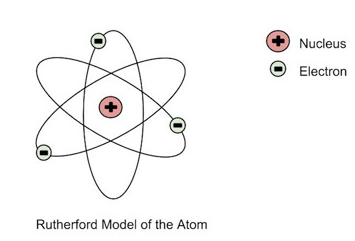
Rutherford's gold foil experiment provided evidence that...
a)
negative and positive charges are spread evenly throughout the atom.
b)
alpha particles have a positive charge.
c)
gold is not a dense as previously thought.
d)
there is a dense positively charged nucleus at the center of an atom.
57.
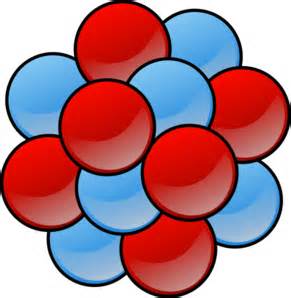
What does the nucleus of an atom contain?
a)
Electrons and neutrons
b)
Protons and neutrons
c)
Neutrinos and positrons
d)
DNA and RN
58.

Who came up with this model of an atom?
a)
J.J. Thompson
b)
Ernest Rutherford
c)
Neils Bohr
d)
James Chadwick
59.
True or False: The majority of an atom is made up of empty space
a)
True
b)
False
60.
Contributes basically no mass to an atom.
a)
protons
b)
neutrons
c)
electrons
d)
protons and neutrons
61.
The majority of an atom's mass exists where?
a)
In the nucleus
b)
In the electron cloud
c)
In the space between the nucleus and the electrons
d)
In the neutrons
62.
Neon has an atomic number of 10 and an atomic mass of 20.180. How many protons, electrons, and neutrons will it have?
a)
P=10 E=10 N=11
b)
P=5 E=5 N=10
c)
P=10 E=10 N=10
d)
P=10 E=5 N=5
63.
The atomic number for Oxygen is 8, so
a)
there are 8 protons in the atom
b)
the atomic mass is less than 8
c)
the mass of the atom is 8
d)
the atom is decaying
64.
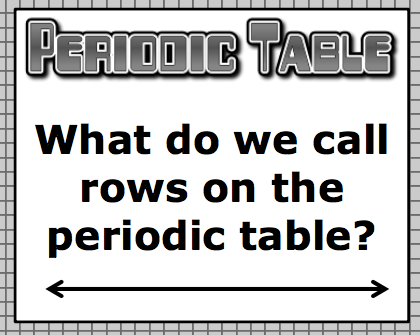
a)
Periods
b)
Groups
65.
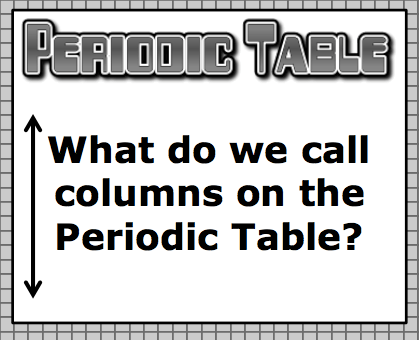
a)
Periods
b)
Groups
66.
a)
energy levels
b)
valence electrons
c)
protons
d)
neutrons
67.
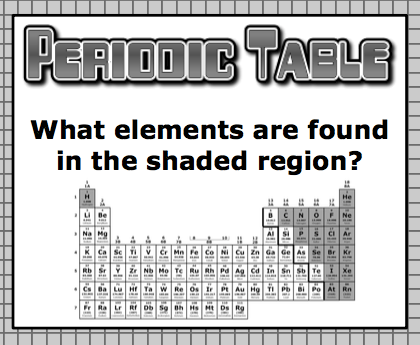
a)
Metals
b)
Nonmetals
c)
Metalloids
68.
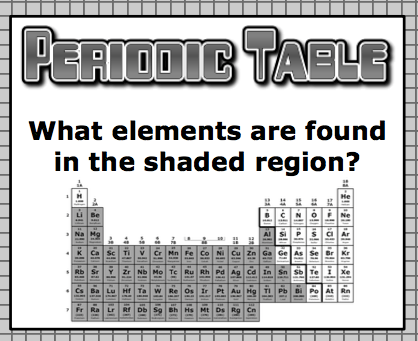
a)
Metals
b)
Nonmetals
c)
Metalloids
69.
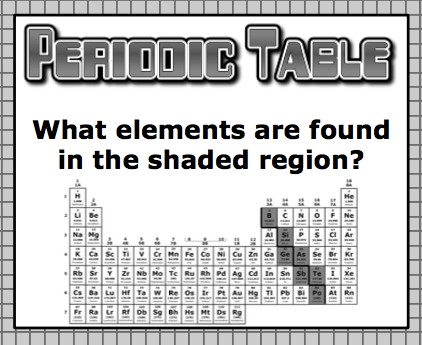
a)
Metals
b)
Nonmetals
c)
Metalloids
70.
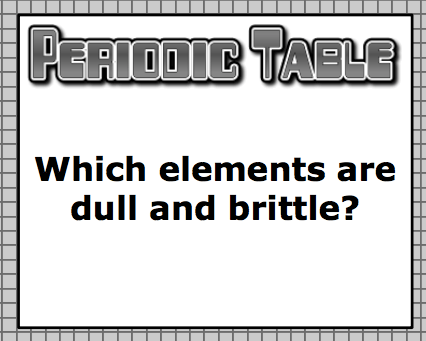
a)
Metals
b)
Nonmetals
c)
Metalloids
71.

How did Mendeleev arrange the elements?
a)
alphabetical
b)
density
c)
melting point
d)
atomic mass
72.

Which of the following is the most metallic element in period 3?
a)
Boron (B)
b)
Sodium (Na)
c)
Argon (Ar)
d)
Silicon (Si)
73.

What group of elements don't have individual names?
a)
Alkaline-earth Metals
b)
Transition Metals
c)
Alkali Metals
d)
Halogens
74.

Most of the elements on the periodic table are classified as _____.
a)
Metals
b)
Nonmetals
c)
Metalloids
d)
Periods
75.
Which is a halogen?
a)
Helium
b)
Chlorine
c)
Oxygen
d)
Neptune
76.
Which is an alkali metal?
a)
Magnesium
b)
Iron
c)
Sodium
d)
Europium
Reset

