
 Worksheets
ecology final exam
Total questions: 110
Worksheet time: 2hrs 50mins
Name
Class
Date
1.
If you accidentally wear contact lenses in the lab, what should you do?
a)
A. Not tell anyone
b)
B. Not wear goggles
c)
C. Tell the teacher
d)
D. Borrow someone else's glasses
2.
If a lab fire erupts, immediately:
a)
A. Notify (or tell) your teacher
b)
B. Run and scream
c)
C. Throw water at the fire
d)
D. Open the windows
3.
Why are approved eye protection devices (such as goggles) are worn in the lab?
a)
A. To improve your vision
b)
B. To make you look like a bug
c)
C. To give you headaches
d)
D. To protect eyes around chemicals, heat, or glassware
4.
You are working in the lab using glassware. Your partner drops a glass beaker and it shatters. A piece of glass gets in his eyes. What should he have been wearing?
a)
A. Gloves
b)
B. Sun glasses
c)
C. Safety Goggles
d)
D. A lab aporn
5.
You are in lab and your partner accidentally gets their hair stuck in a triple beam balance. What should have your partner done?
a)
A. Worn a hat in class
b)
B. Skipped class
c)
C. Got a hair cut
d)
D. Tied/pulled their hair back
6.
Flammable materials should never be dispensed (or used) near:
a)
A. An open door
b)
B. An open flame
c)
C.Another student
d)
D. A sink
7.
After completing an experiment in the lab, all chemical wastes should be:
a)
poured down the sink.
b)
disposed of according to the teacher's directions.
c)
thrown at other students.
d)
taken home to play with.
8.

You are heating a piece of glass and now want to pick it up. You should...
a)
pour cold water on it.
b)
use tongs.
c)
pick up the end that looks cooler.
d)
use a rag or paper towels.
9.
what does MSDS stand for
a)
Mechanical safety data worksheets
b)
Material safety data worksheets
10.
Safety Data Sheets provide some basic health information in addition to information about chemicals.
a)
True
b)
False
11.
A material safety data sheet tells the user the level of _________________ needed
a)
Protective gear
b)
medical care
c)
hygiene
d)
management
12.
The acronym MSDS stands for _____________________________________
a)
Medical Supplies Data Sheet
b)
Material Safety Data Sheet
c)
Medical Safety Data Sheet
d)
Material Supplies Data Sheet
13.
Where is the oxygen we breathe produced?
a)
in the rocks
b)
decaying organisms
c)
during photosynthesis
d)
as water evaporates
14.
How is carbon added to the atmosphere?
a)
evaporation
b)
forest fires
c)
photosynthesis
d)
snow
15.
How do plants get nitrogen?
a)
from animal proteins
b)
from decaying matter
c)
nutrients in the soil
d)
nitrogen fixing bacteria
16.
What element contributes the most to the greenhouse effect?
a)
nitrogen
b)
oxygen
c)
carbon
d)
iron
17.
Which of the following is a way carbon dioxide can be removed from the air?
a)
building dams
b)
fertilizing crops
c)
mining coal
d)
planting trees
18.
Which is not involved in the oxygen cycle?
a)
photosynthesis
b)
decomposition
c)
cellular respiration
d)
plants and animals
19.
Which biome covers most of the land mass near the Earth's equator?
a)
tundra
b)
desert
c)
grassland
d)
tropical rainforest
20.
Which biome is characterized by low temperatures and low amounts of rainfall?
a)
tundra
b)
desert
c)
temperate deciduous forest
d)
tropical rain forest
21.
One characteristic feature of tundra is that only the surface thaws in the summer and refreezes in the winter, leaving a layer of permanently frozen subsoil. This characteristic is known as
a)
glaciation
b)
permafrost
c)
crystallization
d)
soilfrost
22.
Which biome, because of its climate, has the largest number of species of plants and animals?
a)
tundra
b)
desert
c)
tropical rainforest
d)
pine forest
23.
Which major biome is home to cacti, mesquite, white thorn, pack rats, small reptiles, and coyotes?
a)
desert
b)
taiga
c)
tundra
d)
grassland
24.
Which biome receives between 0 to 25 centimeters of rain per year, has a temperature range of 0 to 50 degrees Celsius, has poor soil, and is home to lizards, scorpions, and snakes?
a)
desert
b)
mountain
c)
taiga
d)
tundra
25.
Which biome receives between 0 and 25 centimeters of precipitation each year, has a temperature range from -27 to 5 degrees Celsius, has frozen soil, and is home to hares, caribou, and wolves?
a)
desert
b)
mountain
c)
savannah
d)
tundra
26.
Which of the following habitats probably has the greatest number of plant and animal species?
a)
the African savannah
b)
a rainforest in Brazil
c)
a temperate forest in China
d)
a temperate grassland in Kansas
27.
Which biome contains large populations of grazing herbivores, few species of birds, and deep, rich soil?
a)
taiga
b)
tundra
c)
deciduous forest
d)
grassland
28.

True or False. In this Food Web Pyramid Which type of consumer gets only 10% of the energy stored in plants?
a)
Herbivore
b)
Carnivore
c)
Omnivore
d)
Secondary Consumer
29.

In the energy pyramid here, which organisms have the most energy available?
a)
Producers
b)
Carnivores
c)
Herbivores
d)
Top Predator
30.

In the energy pyramid here, how much of the energy in each level gets lost as heat or used by the organism for survival?
a)
80%
b)
90%
c)
10%
d)
20%
31.
What is a decomposer?
a)
Organism that makes its own energy
b)
Organism that breaks down dead organisms
c)
Organism that eats other organisms for food & energy
32.
What is a producer?
a)
Organism that makes its own energy
b)
Organism that breaks down dead organisms
c)
Organism that eats other organisms for food & energy
33.
What is an omnivore?
a)
An organism that only eats plants for energy
b)
An organism that eats animals for energy
c)
An organism that eats both plants and animals for energy.
34.
What are "trophic levels"?
a)
Levels in a food web/food chain
b)
Levels of land in a mountain
c)
Animal diets
35.
Which of the following is a "primary energy source"?
a)
Grass
b)
Sun
c)
Bacteria
d)
Soil
36.

What is a herbivore?
a)
an animal that gets energy from eating other animals
b)
an organism that gets energy from eating only plants
c)
an animal that gets energy by eating both plants and other animals
d)
an animal that eats only herbs
37.

What is a producer?
a)
an organism that gets energy from eating other organisms
b)
an organisms that uses sunlight to make its own food
c)
an organism that gets energy from eating dead organisms, non-living material or waste
d)
an organism that uses chemical energy to make its own food
38.
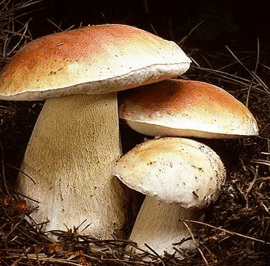
An organism that gets energy from breaking down dead organisms, non-living material or waste
a)
producer
b)
consumer
c)
decomposer
d)
autotroph
39.
The arrows in a food chain or web represents what?
a)
They point to the organism that is being eaten.
b)
It shows how sunlight flows within an ecosystem.
c)
They show what direction the energy is flowing between organisms.
d)
They represent how water is transferred within a habitat.
40.
A living or once-living organisms in an ecosystem is a
a)
population
b)
biotic factor
c)
abiotic factor
d)
community
41.
A nonliving element in an ecosystem is an
a)
animal
b)
abiotic factor
c)
biotic factor
d)
organism
42.
Which of the following is not an abiotic factor?
a)
sun
b)
temperature
c)
soil
d)
grass
43.
Which of the following is not a biotic factor?
a)
mushroom
b)
air
c)
elephant
d)
coyote
44.

A system made up of organisms interacting with one another
a)
biology
b)
abiotic
c)
biotic
d)
ecosystem
45.
Any thing or organism that regulates the size of a population of another organism is known as __________.
a)
a limiting measure
b)
a limiting factor
c)
factorization
d)
materialization of precipitation
46.

A group of the same type of organisms living in the same place at the same time.
a)
threatened species
b)
populations
c)
community
d)
limiting factor
47.
An ecosystem is made up of all the ________________ and _________________ factors in an area.
a)
species and organisms
b)
abiotic and species
c)
biotic and species
d)
abiotic and biotic
48.
A living or once-living organisms in an ecosystem is a
a)
population
b)
biotic factor
c)
abiotic factor
d)
community
49.
Which of the following is NOT a level of organization in ecosystems?
a)
community
b)
species
c)
population
d)
organism
50.
The largest number of individuals of the same species that an area can support is its
a)
limiting factor
b)
organisms
c)
carrying capacity
d)
community
51.
What limits the number of individuals that can live in an ecosystem?
a)
limiting factor
b)
population
c)
carrying capacity
d)
community
52.
Which of the following is not a biotic factor that limits other organisms in its environment?
a)
Competition
b)
Predator-prey relationships
c)
Temperature
d)
Disease
53.

What is the order of succession shown in this figure?
a)
A, B, C, D
b)
B, A, D, C
c)
C, D, A, B
d)
D, A, B, C
54.
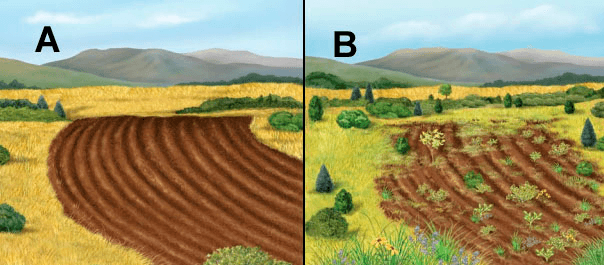
What type of succession is shown going from figure A to figure B?
a)
primary succession
b)
ecological succession
c)
secondary succession
d)
intermediate
55.
What is the goal of the pioneer species in Primary Succession?
a)
To kill the dead materials after a disaster
b)
To rebuild soil
c)
To feed Johnny
d)
To put fresh oxygen into the air
56.
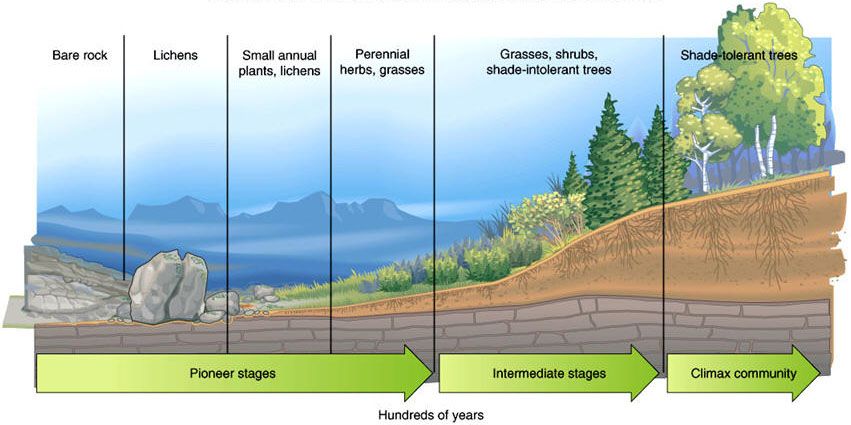
The picture shows what type of succession?
a)
primary
b)
secondary
c)
tertiary
d)
quadanary
57.
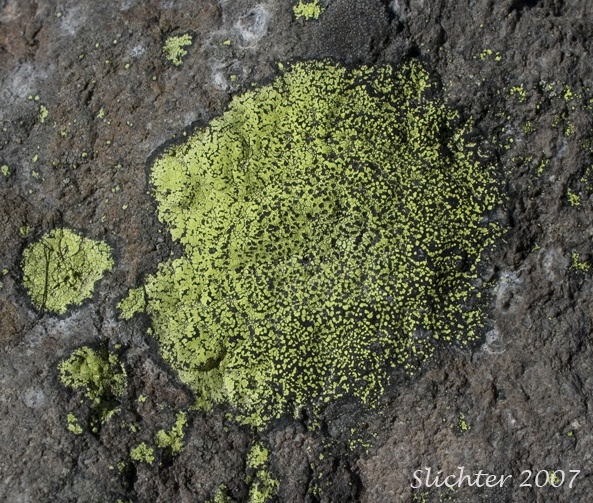
What is the name given to lichen or algae after a primary succession?
a)
pioneer species
b)
volunteer species
c)
founder species
d)
conqueror species
58.
After a volcanic eruption, lava covers the land. What is the order that plants grow to repopulate the area?
a)
Lichens → Shrubs → Grasses → Trees
b)
Lichens → tree → shrubs→Grasses
c)
Grasses → Lichens → Shrubs → Trees
d)
Lichens → Grasses → Shrubs → Trees
59.
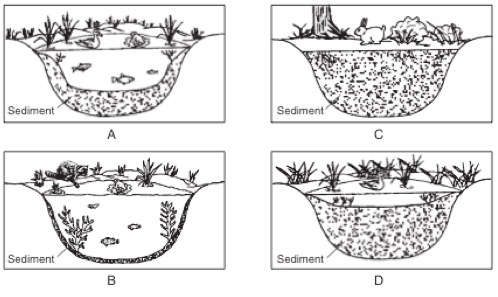
What is the correct order from oldest (happened first) to youngest (happened last) in this pond succession?
a)
A, B, C, D
b)
D, C, B, A
c)
B, A, D, C
d)
C, D, A, B
60.

What is the role of the pioneer species in Primary Succession?
a)
To kill any remaining organisms from before the disturbance
b)
To break down rock and rebuild soil
c)
To provide food for large animals
d)
To put fresh oxygen into the air
61.
What kind of organisms can become invasive?
a)
Lions, Tigers, Bears
b)
Plants, Animals, or Pathogens
c)
Animals
d)
Plants
62.
1. What makes a species invasive?
a)
Moving to a new ecosystem and taking resources from natives
b)
Not having papers
c)
Species that can't adapt
d)
Plants that take up too much space
63.
Does every species have the means to become invasive?
a)
Depends on the abiotic factors
b)
es, if the food web can support another organism
c)
Yes, if they are determined enough
d)
No, only species that pose a threat to ecosystem
64.
What is evaporation?
a)
The part of the water cycle when the sun heats up water, turning it from a liquid into water vapor or steam. It rises from the ground into the air.
b)
The part of the water cycle when the water vapor in the air gets cold. The water turns back into a liquid and forms clouds.
c)
The part of the water cycle when clouds get heavy and can no longer hold the liquid water. This causes the water to fall from the sky to the earth as rain, snow, sleet, or hail.
65.
What is condensation?
a)
The part of the water cycle when the sun heats up water, turning it from a liquid into water vapor or steam. It rises from the ground into the air.
b)
The part of the water cycle when the water vapor in the air gets cold. The water turns back into a liquid and forms clouds.
c)
The part of the water cycle when clouds get heavy and can no longer hold the liquid water. This causes the water to fall from the sky to the earth as rain, snow, sleet, or hail.
66.
What is precipitation?
a)
The part of the water cycle when the sun heats up water, turning it from a liquid into water vapor or steam. It rises from the ground into the air.
b)
The part of the water cycle when the water vapor in the air gets cold. The water turns back into a liquid and forms clouds.
c)
The part of the water cycle when clouds get heavy and can no longer hold the liquid water. This causes the water to fall from the sky to the earth as rain, snow, sleet, or hail.
67.

What is it called when plants give off water vapor as a waste product?
a)
condensation
b)
evaporation
c)
sublimation
d)
transpiration
68.
How much of our planet is estimated to be covered with water?
a)
68%
b)
50%
c)
97%
d)
75%
69.
LD50 is defined as
a)
The amount of toxin that causes the first symptom in people
b)
The amount of toxin that kills 50% of the population in 4 hrs
c)
The amount of toxin that kills 100% of the population in 4 hrs
d)
The amount of toxin that kills 50% of the population in 2 hrs
70.

Which toxin is the most lethal?
a)
Toxin A
b)
Toxin B
71.

What is the threshold dose of Toxin B?
a)
13 mg
b)
50 mg
c)
25 mg
d)
35 mg
72.

What is the LD50 for Toxin B?
a)
10 mg
b)
13 mg
c)
25 mg
d)
50 mg
73.
When you step out into the cold, your body shivers in order to keep its temperature at 98.6F.
a)
All living things use energy
b)
All living things contain cells
c)
All living things maintain homeostasis
d)
All living things grow
74.
Green plants produce their own food through the process of photosynthesis.
a)
All living things use energy
b)
All living things contain cells
c)
All living things maintain homeostasis
d)
All living things grow
75.
A baby song bird hatches from its egg with both parent songbirds watching.
a)
All living things reproduce
b)
All living things maintain homeostasis
c)
All living things use energy
d)
All living things grow
76.
A pill bug (roly poly) eats a carrot.
a)
All living things contain cells
b)
All living things use energy
c)
All living things maintain homeostasis
d)
All living things grow
77.
A camel has eyelashes that work to keep the dust and sand out of its eyes.
a)
All living things adapt to their environment
b)
All living things grow
c)
All living things have cells
d)
All living things use energy
78.
A caterpillar hibernates in a cocoon and emerges as a butterfly.
a)
All living things adapt to their environment
b)
All living things use energy
c)
All living things respond to their environment
d)
All living things grow
79.
An amoeba is a unicellular organism. Which characteristic of life is this?
a)
All living things use energy
b)
All living things contain cells
c)
All living things respond to their environment
d)
All living things grow
80.
A tulip opens in the morning at sunrise and closes in the evening at sunset.
a)
All living things have cells
b)
All living things use energy
c)
All living things respond to their environment
d)
All living things grow
81.
Over three years, Tim's height has increased from 5'4" to 5'11".
a)
All living things contain cells
b)
All living things maintain homeostasis
c)
All living things use energy
d)
All living things grow
82.
A cat is an organism that has a respiratory system that contains lungs and a trachea.
a)
All living things contain cells
b)
All living things maintain homeostasis
c)
All living things have different levels of organization
d)
All living things grow
83.
A sea worm drops its tail and the tail becomes a new worm.
a)
All living things contain cells
b)
All living things grow
c)
All living things have different levels of organization
d)
All living things reproduce
84.
A place where an organism lives.
a)
Terrain
b)
Habitat
c)
Community
d)
Population
85.
A collection of organisms that belong to different populations but all live in the same area and interact with one another.
a)
Population
b)
Ecosystem
c)
Community
d)
Ecosphere
86.
A collection of organisms that make up a community as well as all of the nonliving aspects of the environment.
a)
Population
b)
Community
c)
Habitat
d)
Ecosystem
87.
The role or function or job of a species in a community.
a)
habitat
b)
diet
c)
niche
d)
ecosystem
88.
Two organisms that are so similar they can interbreed in nature and produce fertile offspring
a)
biotic factor
b)
herbivore
c)
ecosystem
d)
species
89.
Which of the following is a population?
a)
hawks, barred owls, and eagles on NC coast
b)
mountain stream
c)
all the frogs in a pond
d)
blue-tailed skinks (lizards) around a barn
90.
Which best describes a diurnal animal?
a)
hawk that hunts in day
b)
barn owl hunting at night
c)
opossum feeding at night
d)
bats roosting during the day
91.
Which of the following best describes a community?
a)
sharks, groupers, anemones and shrimp on a coral reef
b)
decorator crabs on the seafloor
c)
loggerhead sea turtles in Atlantic
d)
prairie grassland in Wyoming
92.
Which term describes the stomach?
a)
cell
b)
organ
c)
tissue
d)
organ system
93.
Margie is studying the levels of structural organization of an animal's body. Which level would describe a dog's eye?
a)
organ
b)
tissue
c)
oranism
d)
organ system
94.
A cactus is covered with a waxy layer to prevent water loss. Which type of tissue is this?
a)
nervous
b)
skeletal
c)
protective
d)
connective
95.
Which is a type of tissue that both plants and animals have?
a)
nerve
b)
ground
c)
protective
d)
connective
96.
Cells must be able to perform certain functions in order to survive. Which of the following must all cells do to survive?
a)
obtain energy
b)
absorb wastes
c)
utilize oxygen
d)
continue growing
97.
In order from smallest to largest, what are the five levels of organization in the body?
a)
organism, organ system, organ, tissue, cell
b)
cell, organ, organ system, tissue, organism
c)
cell, tissue, organ, organ system, organism
d)
cell, tissue, organ system, organ, organism
98.
In the following analogy, what is a tissue most similar to?
a)
student
b)
class
c)
grade level
d)
school
99.
What is the difference between a cell and a tissue?
a)
cell is basic unit of life; tissue is group of cells that work as one
b)
cell is group of tissues; tissue is basic unit of life
c)
cell is basic unit of life; tissue is groups of different cells
d)
cell is group of organs; tissue is group of different cells
100.
In the following analogy, what is an organ most similar to?
a)
student
b)
class
c)
grade level
d)
school
101.
Tissue that works together to perform a function
a)
organ
b)
cell
c)
organ system
d)
organism
102.
A group of cells that work together
a)
organ system
b)
organism
c)
organ
d)
tissue
103.
The heart contains different types of tissue. What level is the heart?
a)
cell
b)
organ system
c)
organ
d)
tissue
104.
The digestive system includes the stomach. What level is the stomach?
a)
organ
b)
tissue
c)
cell
d)
organism
105.
Margie is studying the levels of structural organization of an animal's body. Which level would describe a dog's eye?
a)
organ
b)
tissue
c)
oranism
d)
organ system
106.

a relationship that occurs when two or more organims of the same species need the same resource at the same time
a)
competition
b)
symbiosis
c)
predation
107.

an interaction between different species in which one species (predator) hunts, kills, and eats the other (prey)
a)
competition
b)
symbiosis
c)
predation
108.
a symbiotic relationship in which one organism benefits at the expense of the other organism
a)
Parasitism
b)
Commensalism
c)
Mutualism
109.
a symbiotic relationship in which both organisms benefit
a)
Parasitism
b)
Commensalism
c)
Mutualism
110.
a symbiotic relationship in which one organism benefits and the organism is not affected
a)
Parasitism
b)
Commensalism
c)
Mutualism
100 %

