wayground logo

Free Printable Worksheets

Font size

S
M
L
XL
Worksheets

5.30.18 REVIEW

Total questions: 100

Worksheet time: 2hrs 36mins

Name
Class
Date
1.

During the French Revolution, where did members of the French National Assembly take an oath to pledge to meet until a constitution was established?

a)

A restaurant

b)

A tennis court

c)

An opera house

d)

A theater

2.
Where did the Industrial Revolution begin?
a)
Britain
b)
France
c)
United States
d)
Italy
3.
What occurred from September 1793 to July 1794 in France and was led by Maximilen Robespierre?
a)
Reign of Terror
b)
French Revolution
c)
Age of Robespierre
d)
March on Versailles
4.
Where did the British army begin to crumble during the Revolutionary War when Cornwallis and his troops were forced to surrender?
a)
Philadelphia, Pennsylvania
b)
Concord, New Hampshire
c)
Yorktown, Virginia
d)
Gettysburg, Pennsylvania
5.
What was the name of the doctrine created by Napoleon that embodied Enlightenment principles like the equality of all citizens before the law, religious toleration, and the abolition of feudalism?
a)
Bonaparte's Bible
b)
Napoleon's Doctrine
c)
Napoleonic Code
d)
Bonaparte's Articles of Enlightenment
6.
What machine was introduced during the French Revolution as a quicker, less painful form of execution?
a)
Hangman's noose
b)
Guillotine
c)
Electric chair
d)
Steel sword
7.
Popular sovereignty states that all government power comes from the what?
a)
Government itself
b)
Rulers (monarchs)
c)
People
d)
Judicial system
8.
What U.S. document was the Declaration of the Rights of Man modeled after, which gave ALL French citizens (especially men) more rights than they had ever had before?
a)
Articles of Confederation
b)
Constitution
c)
Monroe Doctrine
d)
Declaration of Independence
9.
Who wrote the book "The Wealth of Nations" that argued free market should be allowed to regulate business activity?
a)
Rene Descartes
b)
Thomas Paine
c)
Adam Smith
d)
Noah Johnson
10.

This person is famous for his 95 Theses

a)

Martin Luther

b)

John Calvin

c)

King Henry VIII

d)

Johannes Gutenberg

11.

These were certificates issued by the Pope to reduce a person's sin

a)

Seminary

b)

Denomination

c)

Excommunication

d)

Indulgences

12.

What were the two key features of the Renaissance?

a)

Love of knights and hearldry

b)

Love of weapons and warfare

c)

Love of art and learning

d)

Love of travel and exploration

13.

What did Queen Isabella do for Christopher Columbus?

a)

sponsored his exploration

b)

married him

c)

made him royalty

d)

pardoned his son for piracy

14.

Two things that conquistadors (Spanish soldiers who invaded & conquered Central & South America) had that the Native Americans did not: horses and _______

a)

families

b)

gold

c)

guns

d)

land

15.
Enlightened thinkers based their philosophical beliefs on what two things?
a)
power and privilege
b)
money and fame
c)
good looks and charm
d)
reason and logic
16.
Which of these is NOT an example of a primary source?
a)
Original uniforms worn at a time in history
b)
Diaries written at the time of an event
c)
Film footage of a historical event
d)
A poem about World War II from your classmate
17.

Who was the Portuguese sailor whose crew completed the first voyage around the world?

a)

Ferdinand Magellan

b)

Vasco de Gama

c)

Christopher Columbus

d)

Henry Hudson

18.

How did the opening of the Panama Canal change global trade and interaction?

a)

It made shipping U.S. goods to new markets more efficient.

b)

It increased the costs of trading between distant nations.

c)

It gave the Spanish control of Latin American trade.

d)

It led to peace in Central America.

19.

UN Declaration on the Elimination of Discrimination against Women, Article 6, November 7, 1967

2. All appropriate measures shall be taken to ensure the principle of equality of status of the husband and wife, and in particular:

(a) Women shall have the same right as men to free choice of a spouse and to enter into marriage only with their free and full consent

; (b) Women shall have equal rights with men during marriage and at its dissolution. In all cases the interest of the children shall be paramount;

(c) Parents shall have equal rights and duties in matters relating to their children. In all cases the interest of the children shall be paramount.


What does the document promote for women concerning marriage?

a)

Women must obey their husbands

b)

Women will freely decide who they shall marry.

c)

Women have no rights when it comes to marriage.

d)

Women will have sole custody of children in the case of divorce.

20.
The spark that started World War One was:
a)
The assassination of Archduke Ferdinand. 
b)
Germany's invasion of Poland. 
c)
Sinking of the Lusitania
d)
The Zimmerman Telegraph
21.
This country was targeted by the Treaty of Versailles:
a)
Russia
b)
Austria Hungary
c)
France
d)
Germany
22.
Which of the following was not one of the MAIN causes of World War One?
a)
Isolationism 
b)
Imperialism
c)
Alliances
d)
Militarism
23.
This organization was created after World war Two in order to keep a lasting peace in the World. 
a)
The United Nations
b)
The League of Nations
c)
The Group at Versailles
d)
The Justice League 
24.
The third amendment in the United States Constitution says: "No Soldier shall, in time of peace be quartered in any house, without the consent of the Owner, nor in time of war, but in a manner to be prescribed by law." This addition to the amendment would have been added in reaction to which of the following Acts?
a)
The Quartering Acts
b)
The Intolerable Acts
c)
The Stamp Act
d)
The Sugar Act
25.
One important result of the french revolution was that
a)
The French middle class (bourgeoisie) gained more power
b)
The church was restored to it's former role and power in the french government
c)
The revolution achieved it's goal of establishing peace, democracy, and justice for all
d)
France lost it's spirit of nationalism
26.
Karl Marx believed that members of the working class should do what in order to assert their political and economic rights?
a)
Form peaceful unions
b)
Build businesses of their own
c)
Petition the government for better wages
d)
Rebel against the government and capitalism
27.
Safe working conditions, child labor laws, overtime pay, safety regulations, and standard minimum wage are all issues that _________ _________ fought for during the Industrial Revolution.
a)
collective farms
b)
slum communities
c)
trade guilds
d)
labor unions
28.
Which is NOT an example of natives fighting imperialist
a)
Boxer Rebellion
b)

Sepoy Mutiny

c)
Boer War
d)
World War II
29.
Diplomatic hostility between the United States and the Soviet Union after World War II was known as:
a)
the Truman Doctrine
b)
the Warsaw Pact
c)
the Cold War
d)
the Marshall Plan
30.
After World War II, the major foreign policy goal of the United States was:
a)
the division of Asia
b)
the containment of communism
c)
to promote world peace
d)
to promote decolonization
31.
What was the goal of the U.S. policy that became known as the Truman Doctrine?
a)
To help European countries rebuild their military after the war
b)
To aid countries worldwide in the fight against Communist aggression
c)
To supply weapons and other military aid to postwar Western Europe
d)
To appease totalitarian aggression in order to avoid another war
32.
What is Globalization?
a)
a term that refers to the flow or trade, people, investment, technology, and culture around the world.
b)
using a globe to fine something on a map.
c)
the connection that does not exit between difference countries
33.
What caused countries to elect radical dictators like Hiter in the 1930's?
a)
Great Depression
b)
Expand Democracy
c)
Enlightnemnt
d)
Reformation
34.
What does appeasement mean?
a)
give in to avoid conflict
b)
compromise to avoid conflict
c)
fight to the end
d)
to sign a treaty
35.
Which is NOT a types of economic systems?
a)
Traditional/Barter
b)
Command/Communism
c)
Free Market/Capitalism
d)
Supply and Demand
36.
What historical period does this graph refer too?
a)
Triangular Trade
b)
European Exploration
c)
Industrial Revolution
d)
Rectangular Trade
37.
This map best shows what concept of the Industrial Revolution? 
a)
Scabs
b)
Mechanization
c)
Child Labor Maps 
d)
Urbanization 
38.
What statement is true about WWI?
a)
It was a cause of WWII.
b)
It was fought in trenches. 
c)
It had new weapons never used before.
d)
All answers choices are correct. 
39.
Which era of history does Rousseau's quotes come from?
a)
Industrial Revolution
b)
European Imperialism
c)
Enlightenment
d)
French Revolution
40.
What world changing revolution did Martin Luther lead?
a)
The French Revolution
b)
The Protestant Reformation
c)
The Russian Revolution 
d)
The Enlightenment
41.
Which of the following are ways that human action and development affect the environment?
a)
deforestation
b)
pollution
c)
desertification
d)
all of the above
42.
What is the main reason countries have used imperialism throughout history?
a)
start wars
b)
train military
c)
help uncivilized people
d)
get natural resources
43.
How did European countries justify the "Scramble for Africa" imperialism?
a)
They were making lots of money off of them.
b)
They were helping them by adding government and technology.
c)
They did not care what other countries thought.
d)
They were stopping wars.
44.
There are two ways of countering injustice. One way is to smash the head of the man who perpetrates injustice and to get your own head smashed in the process. All strong people in the world adopt this course. Everywhere wars are fought and millions of people are killed. The consequence is not the progress of a nation but its decline . . . it brings disaster to both belligerents. . . . Similarly, no State is possible without two entities, the rulers and the ruled. You are our sovereign, our Government, only so long as we consider ourselves your subjects. When we are not subjects, you are not the sovereign either . . . Shower what sufferings you like upon us; we will calmly endure all and not hurt a hair of your body. We will gladly die and will not so much as touch you. But so long as there is yet life in these our bones, we will never comply with your arbitrary laws.
Mohandas Gandhi, 1916
Which statement summarizes Gandhi’s views about how a government should rule its people? 
a)
Violence is the best way for a government to rule its people. 
b)
Fair laws bring the decline of nations and their governments. 
c)
Governments should have many arbitrary rules for their people. 
d)
Governments bring the decline of their nations by enforcing rules with violence. 
45.
A political and economic theory of social organization that advocates that the means of production, distribution, and exchange should be owned and regulated by the community as a whole.
a)
democracy
b)
communism 
c)
socialism
d)
lassez faire
46.
A political theory derived from Karl Marx, advocating class war and leading to a society in which all property is publicly owned and each person works and is paid according to their abilities and needs.
a)
communism
b)
socialism
c)
democracy
d)
Methodism 
47.
The domination of one country over another. This happened in Africa when European countries tried to come in and take over. 
a)
Imperialism
b)
Communism
c)
Methodism
d)
Socialism
48.
Germany sent this note to Mexico asking for Mexico to invade the U.S.
a)
Zimmerman Note
b)
Love Note
c)
Federal Papers
d)
Wesley Note
49.

king who established the Church of England

a)

Thomas More

b)

Henry VIII

c)

John Calvin

d)

Michelangelo

50.

government run by church leaders

a)

Medici

b)

Utopian

c)

Michelangelo

d)

Theocracy

51.

wealthy banking family from Italy who were patrons of the arts

a)

Utopian

b)

Medici

c)

Theocracy

d)

Henry VIII

52.

author who wrote about how to be a ruthless ruler

a)

Niccolo Machiavelli

b)

Thomas More

c)

John Calvin

d)

Michelangelo

53.
Diseases from the Old World animals included measles, yellow fever, chicken pox, and _____.
a)
Cancer
b)
Smallpox
c)
Heart diseases
d)
Ebola
54.
What were the main negative consequences of the Columbian Exchange?
a)
many Native Americans died, diseases were spread, slavery began
b)
new foods and resources
c)
the Old World brought terrible music to the New World
d)
none - it was all good
55.
The United States got involved in conflicts like Korea and Vietnam because they were afraid of the domino theory. What is the domino theory?
a)
If one country fell to democracy, others would follow
b)
If one country fell to communism, others would follow
56.
How did the Marshall plan try to stop the spread of communism in Western Europe after WWII?
a)
by providing government housing for refugees
b)
by providing military assistance to Vietnam
c)
by providing money to stop poverty
57.
Why was the United States involved in the Berlin Airlift?
a)
to airlift food to the people of West Berlin
b)
to bomb East Berlin
c)
to demolish the Berlin Wall
d)
to transport people out of East Berlin
58.
Why did the United States become involved in the Korean War?
a)
to contain communism
b)
to colonize Korea
c)
to spread communism
d)
to Christianize Koreans
59.
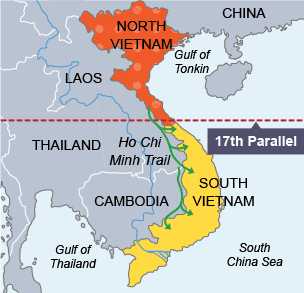
In the 1950s, the United States became involved in the Vietnam War. Why did the United States become involved in this war?
a)
to prevent the collapse of the government of North Vietnam
b)
to stop Vietnam from taking over Hong Kong
c)
to stop the spread of communism to South Vietnam
d)
to prevent attacks against United States shipping
60.
How did the US respond to finding out that the Soviets had missiles in Cuba?
a)
They sent the Air Force to bomb Cuba
b)
They began placing missiles in the Soviet Union.
c)
They placed a naval blockade around Cuba.
d)
They invaded Cuba and the Soviet Union.
61.
a)

Sputnik

b)

Landing on the Moon

c)

The Berlin Wall

d)

Vietnam conflict

62.
Who was the very first astronaut to ever step foot on the moon?
a)
Yuri A. Gagarin
b)
Alan B. Shepard
c)
John Glenn
d)
Neil Armstrong
63.
The first Russian and American satellites in orbit
a)
Sputnik 1 (Russian), Explorer 1 (American)
b)
Vostok 1 (Russian), Sputnik 1 (American)
c)
Sputnik 1 (Russian), Redstone 2 (American)
d)
Vostok 1 (Russian), Explorer 1 (American)
64.
What was "apartheid" ?    
a)
Nelson Mandela's middle name
b)
An african country
c)
a fatal disease
d)
Racial segregation
65.

What is Apartheid?

a)

Official policy of segregation in South Africa

b)

Segregation of people based on their gender

c)

Equal rights for all people

d)

Segregation in southern United States

66.
How does Mary Tudor earn her title "Bloody Mary."
a)
Because they killed her mom
b)
She burned hundreds of Protestants for not practicing Catholicism 
c)
Because Henry used the Protestant relgion to divorce Catherine of Aragon
d)
She killed 300 Spaniards for invading England
67.

What was the Spanish Armada?

a)

Spain's Army

b)

A fleet of ships who fought against England in 1588

c)

a Disease which started in Spain

d)

a group of WWII soldiers from Spain

68.

What two cultures were devastated by the Spanish explorers in the New World?

a)

Aztec & Inca

b)

Cherokee & Apaaho

c)

Carib & Arawak

d)

Seminole & Apache

69.
Choose the answer that most accurately completes the chart above. 
a)
Triangular Trade
b)
Balance of Trade
c)
Northwest Passage
d)
Treaty of Tordesillas
70.

What group controlled most Muslim territory in the Middle East and NW Africa from 1500 - 1900?

a)

Ottoman Empire

b)

Roman Empire

c)

Greek Empire

d)

British Empire

71.
What was the name of the head MILITARY leader of Japan?
a)
Daimyo
b)
Samurai
c)
Shogun
d)
Zaibatsu
72.
3. The Samurai could best be described as ______________________.
a)
common people
b)
government administrators
c)
rulers
d)
warriors
73.
What was the strict Samurai code of rules called?
a)
Ming
b)
Bushido
c)
han rules
d)
the covenent
74.
The belief that power was granted by god.
a)
Divine Right
b)
Declaration of Right
c)
Dying Right
d)
Dead Right
75.
This is a ruler with complete authority over the government and lives of the people.
a)
Supreme Monarch
b)
Absolute Monarch
c)
Monarch
d)
Queen
76.
Divine Right of Kings is the theory that . . . 
a)
Kings are Gods and all people must worship the king
b)
Kings rule because God chose them to rule
c)
Kings should only be advised by clergy
d)
Kings should be running the churches in their kingdoms
77.

Which of the following was NOT a political (government) idea of the Enlightenment?

a)

government should protect natural rights (life, liberty, property) of the people

b)

separation of powers in government

c)

government is a social contract between the people and the government

d)

religious toleration & separation of Church and State

e)

judicial review of unjust laws

78.

The Enlightenment fueled revolutions in

a)

America & France

b)

England & France

c)

India & America

d)

Spain & Portugal

79.
"The Liberator" that led independence movements in Venezuela, Colombia, Peru, and Ecuador
a)
Simon Birch
b)
Simon Cowell
c)
Toussaint Loverture
d)
Simon Bolivar
80.
Led Mexico to independence
a)
Miguel Hidalgo
b)
Lionel Messi
c)
Christiano Ronaldo
d)
Simon Bolivar
81.
US president whose Doctrine tells European powers to stay away from Latin America
a)
Roosevelt
b)
Jackson
c)
Lincoln
d)
Monroe
82.
Which scientific theory of Darwin is known as "survival of the fittest"?
a)
evolving
b)
laws of motion
c)
relativity
d)
natural selection
83.
What inventor made a more productive steam engine?
a)
Watt
b)
Hargreaves
c)
Edison
d)
Ford
84.
The slave who led a revolt against Napoleon for the independence of Haiti
a)
Frederick Douglass
b)
Toussaint Loverture
c)
Simon Bolivar
d)
Creole
85.
The French people welcomed Napoleon because…
a)
they hoped he would fix the famine that France was experiencing
b)
he completely disagreed with the ideas of the French Revolution
c)
he was the son of King Louis XVI
d)
he promised to bring law and order to France after the chaos of the Reign of Terror
86.
After Napoleon escaped from Elba Island and regained control of his armies and rallied his allies, where was he finally defeated for the last time?
a)
Madrid, Spain
b)
Waterloo, Belgium
c)
Moscow, Russia
d)
Paris France
87.
When Napoleon became the supreme leader in France what popular legal system did he enact (put in place)?
a)
Napoleonic Code
b)
Catholic Code
c)
French Bill of Rights
d)
Equal Rights Legislation
88.

Who invented the famous cotton gin in the early 20th century?

a)

Eli Whitney

b)

Eli Young

c)

Abraham Lincoln

d)

Benjamin Franklin

89.
The Bessemer process, invented by Henry Bessemer, was created to produce...
a)
cotton
b)
peanuts
c)
steel
d)
electricity
90.

Louis Pasteur created a process of heating food to kill germs that was called...

a)

sanitation

b)

chemistry

c)

germ theory

d)

pasteurization

91.
Scottish Professor who believed that the successful market economy is based on competition.
a)
Adam Smith
b)
Bourgeoisie
c)
Capital
d)
Capitalism
92.

A government policy or attitude of letting economics take their own course, without interfering.

a)

Laissez-faire

b)

Law of supply and demand

c)

Proletariat

d)

Socialism

93.
Communist dictator of the Soviet Union who ordered the Great Purge and started the Five Year Plans-
a)
Hitler
b)
Stalin
c)
Tojo
d)
Mussolin
94.
A radical form of socialism is called __________________________
a)
communism
b)
socialism
c)
utilitarianism
d)
capitalism
95.

Who was the "Father of Communism"?

a)

Vladimir Lenin

b)

Karl Marx

c)

Samuel Clemons

d)

Leo Trotsky

96.
Which is an example of an economic sanction?
a)
 Refusing to import goods from a nation
b)
Replacing the government of a nation
c)
Refusing to recognize the existence of a nation
d)
 Re-drawing the borders of a nation
97.
What was the relationship between the League of Nations and the United Nations?
a)
The League of Nations was eventually re-named the United Nations 
b)
The League of Nations became the United Nations when America decided to join
c)
The League of Nations inspired the creation of the United Nations
d)
The League of Nations re-formed as the United Nations after World War II
98.

What can you infer about the reason why the U.S. followed an isolationist foreign policy and did not join the League of Nations during the 1920's?

a)

America's involvement in World War I had been costly and deadly

b)

The U.S. had very poor relations with the governments of Britain and France

c)

It was the height of the Great Depression, and the U.S. needed to focus on its own economy

d)

The U.S. had never been involved in a war or treaty with European countries, and wanted to keep it that way

99.
Which term means prejudice against or hatred of Jews?
a)
Semitism
b)
Anti-semitism
c)
ghetto 
d)
Holocaust
100.

The Khmer Rogue, led by Pol Pot, seized control of _______________________in the 1970's and killed all intellectuals, gov officials, teachers and military personnel

a)

Rwanda

b)

Vietnam

c)

Yugoslavia

d)

Cambodia