Wayground logo

Free Printable Worksheets

Font size

S
M
L
XL
Worksheets

Moon Quiz (June 1)

Total questions: 54

Worksheet time: 2hrs 44mins

Name
Class
Date
1.
What part of the moon do we see from Earth?
a)
all of it
b)
the same side
c)
none of it
d)
only one quarter
2.
As the moon's shape appears to get smaller, we say that the moon is _.
a)
swelling
b)
waxing
c)
waning
d)
disappearing
3.
Which moon phase is when you can't see the moon at all?
a)
Waning crescent
b)
Full moon
c)
Waxing gibbous
d)
New moon
4.
Phases of the moon in which the moon appears to be getting larger are referred to as _.
a)
waxing
b)
waning
c)
new
d)
eclipse
5.
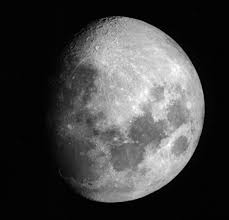
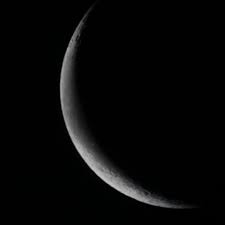
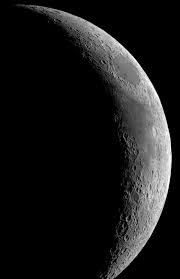
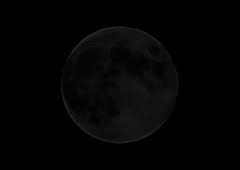
Name the moon phase
a)
waning crescent
b)
waxing crescent
c)
waning gibbous
d)
waxing gibbous
6.
Name the moon phase
a)
waning crescent
b)
waxing crescent
c)
waning gibbous
d)
waxing gibbous
7.

Name the moon phase

a)

waning crescent

b)

waxing crescent

c)

waning gibbous

d)

None of these

8.
Name the moon phase
a)
waning crescent
b)
waxing crescent
c)
waning gibbous
d)
waxing gibbous
9.
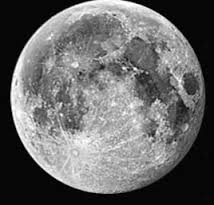
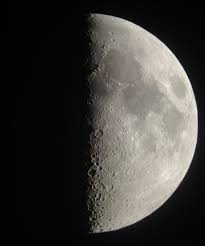
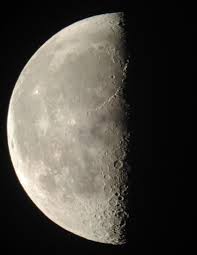
Name the moon phase
a)
First Quarter
b)
Last Quarter
c)
New Moon
d)
Full Moon
10.
Name the moon phase
a)
First Quarter
b)
Last Quarter
c)
New Moon
d)
Full Moon
11.
Name the moon phase
a)
First Quarter
b)
Last Quarter
c)
New Moon
d)
Full Moon
12.
Name the moon phase
a)
First Quarter
b)
Last Quarter
c)
New Moon
d)
Full Moon
13.
Name the moon phase that would come AFTER this moon.
a)
waning crescent
b)
waxing crescent
c)
waning gibbous
d)
waxing gibbous
14.
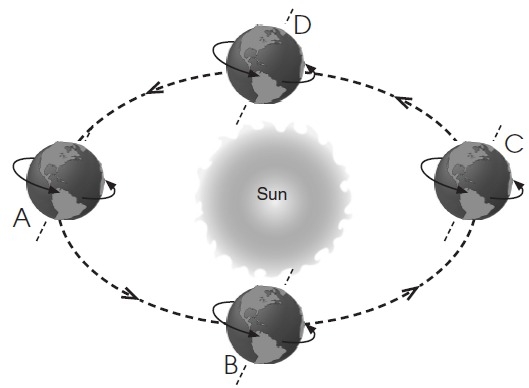
What season is letter A?
a)
Winter
b)
Summer
c)
Spring
d)
Fall
15.
When the Northern Hemisphere is pointing towards the sun, what season is the Southern Hemisphere?
a)
Winter
b)
Spring
c)
Fall
d)
Summer
16.

How long after a new moon will it take to see another new moon?

a)

12.5 days

b)

29.5 days

c)

27.3 days

d)

56 days

17.
Tides are caused by ___________
a)
wind
b)
gravitational pull of moon
c)
waves gravitation toward land
d)
rain
18.

What is illuminating the Moon?

a)

Nuclear Fusion

b)

Sunlight

c)

Mirrors

d)

The moon itself

19.
How many phases does the moon go through?
a)
4
b)
8
c)
10
d)
16
20.
The moon ____________ around the Earth.
a)
revoloves
b)
rotates
c)
up
d)
down
21.

What is true of a new moon?

a)

The moon appears invisible

b)

You can see about half the moon

c)

The moon looks like a pizza pie

d)

It's the second phase of the moon

22.

Which phase of the moon is shown in the picture?

a)

full

b)

gibbous

c)

quarter

d)

crescent

23.

Which phase of the moon is shown in the picture?

a)

new

b)

crescent

c)

quarter

d)

gibbous

24.
To spin on an axis; a 24-hour period for Earth
a)
orbit
b)
rotation
c)
axis
d)
night
25.
A line, real or imaginary, around which something spins
a)
moon
b)
orbit
c)
axis
d)
crater
26.

What does the Earth's rotation cause?

a)

Days and nights

b)

High and low tides

c)

Seasons

d)

None of these

27.
The earth orbits around...
a)
the sun.
b)
the moon
c)
other planets
d)
the Milky Way
28.

How many days does it take the Earth to go around the sun?

a)

29.5 days

b)

365 days

c)

365 1/4 days

29.

How long does earth's rotation last?

a)

365 days

b)

23 hours and 56 minutes

c)

24 hours and 56 minutes

d)

365 1/4 days

30.

Seasons are caused by the ______________ of the Earth

a)

tilt of the axis

b)

rotation on it's axis

c)

revolution around the sun

31.

It may be cool or warm, but when the day and night are equal in length it is known as ______________.

a)

equinox

b)

solstice

32.
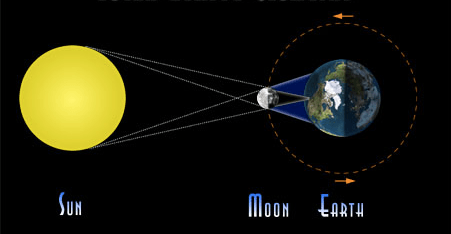
During a solar eclipse...
a)
The sun is blocked by the moon
b)
The Earth is blocked moon
c)
The moon is blocked by the sun
d)
You are blocked
33.
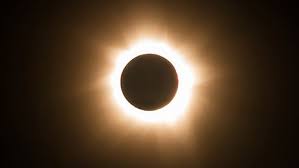
Which type of eclipse is shown in this picture?
a)
Solar Eclipse
b)
Orbit
c)
Lunar Eclipse
d)
Total Eclipse
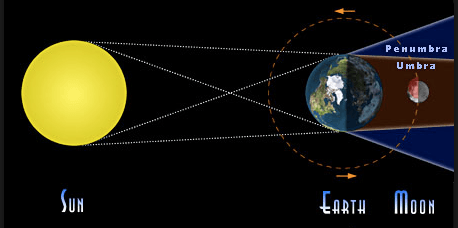
34.
Which type of eclipse is shown in the diagram?
a)
Solar Eclipse
b)
Lunar Eclipse
c)
Total Eclipse
d)
Partial Eclipse
35.
What causes day and night cycles?
a)
mars
b)
seasons
c)
earths rotation
d)
moon phases
36.
The term equinox means....
a)
equal amount of day light and equal amount of night
b)
Equal amount of winter and summer
c)
Equal amounts of hot dogs for everyone
d)
The longest day of the year
37.
Occurs in March or September
a)
solstice
b)
equinox
38.

The Earth's axis is tilted _____ degrees.

a)

23.5

b)

25.3

c)

90

d)

none of these

39.
What do June 21 and December 21 have in common?
a)
equinox dates
b)
the moon is full
c)
solstice dates
d)
the cold fronts blow in
40.
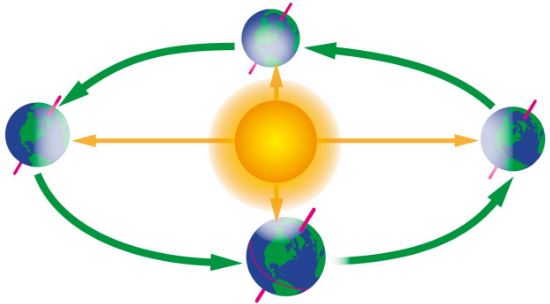
Which season is taking place in the Southern Hemisphere in Position 1?
a)
Winter
b)
Spring
c)
Summer
d)
Fall
41.
In spring/summer, the axis of the earth is pointed away or toward the sun?
a)
towards
b)
Neither away or toward
c)
away
42.
Which season is taking place in the Northern Hemisphere in Position 1?
a)
Winter
b)
Spring
c)
Summer
d)
Fall
43.
Which season is taking place in the Northern Hemisphere in Position 2?
a)
Winter
b)
Spring
c)
Summer
d)
Fall
44.
Which season is taking place in the Northern Hemisphere in Position 4?
a)
Winter
b)
Spring
c)
Summer
d)
Fall
45.
In general, tides occur...
a)
each hour
b)
2 times a day
c)
each month
d)
twice a month
46.
Waning phases are when the light is being:
a)
Gained
b)
Lost
47.
Waxing phases are when the light is being:
a)
Gained
b)
Lost
c)
Staying the same
d)
Neither
48.

How many days does it take for the moon to complete a full cycle?

a)

27.5

b)

29.5

c)

28

d)

20

49.
Appears after a new moon; you can see less than half of the light on the right side of the moon.
a)
Waxing Crescent
b)
Waning Crescent
50.
Appears after a full moon; you can see 3/4 of the light on the left.
a)
Waxing Gibbous
b)
Waning Gibbous
51.
a)
Crescent
b)
Gibbous
c)
New
d)
Full
52.

Earth does a complete revolution every _______

a)

29.5 days

b)

12 hours

c)

24 hours

d)

365.25 days

53.

The earth rotates every

a)

29.5 days

b)

15 hours

c)

365 days

d)

23 hours and 56 minutes

54.

What is a Blue Moon?

a)

When the blue ocean reflects on the moon.

b)

The moon is closer to the ocean.

c)

When there are 2 Full Moons in the same month (the second one is a blue moon).

d)

When there is an eclipse in the same month.