
 Worksheets
NYS Required Labs
Total questions: 14
Worksheet time: 19mins
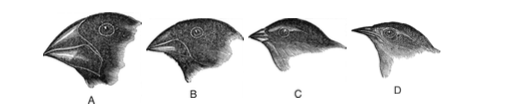
The four different types of beaks shown are most likely the result of

In members of a bird species living on a remote island, the greatest number of beak variations in the population would most likely be found when
there is a high level of competition for limited resources
homeostasis is limited by a severe climate
they have a large and varied food supply
they are prey for a large number of predators

What did the beak type of finches on different islands tell Darwin?
Finch populations evolved over time to favor beaks based on food type
Finch populations had not evolved over time
The finch beaks had no relationship to the available food on the islands
Humans artificially selected finches based on their desired beak type
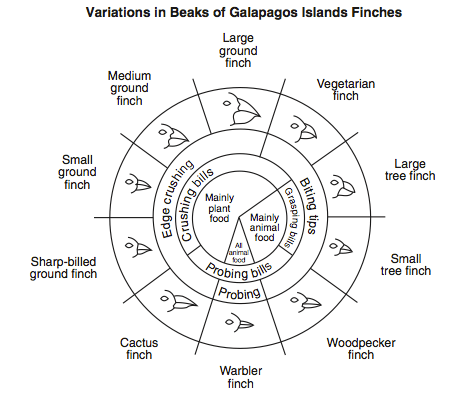
Base your answer(s) to the following question(s) on the diagram below that shows variations in the beaks of finches in the Galapagos Islands and on your knowledge of biology.
The diversity of species seen on the Galapagos Islands is mostly due to
gene manipulation by scientists
gene changes resulting from mitotic cell division
natural selection
selective breeding

Red onion cells undergo the change represented in the diagram below. This change is most likely caused by the cell being transferred from
distilled water to starch indicator
distilled water to salt water
salt water to tap water
salt water to distilled water

Cell membranes are said to be selectively permeable. Which statement best explains what selectively permeable means?
The cell membrane prevents any harmful substance from entering the cell.
The cell membrane lets certain substances enter the cell and keeps certain substances out of the cell.
The cell membrane allows only large molecules to diffuse into the cell.
The cell membrane has pores that let only water and glucose into the cell and carbon dioxide out.

Diffusion is the movement of molecules from an area of _____ concentration to an ______ concentration
High, low
Low, high
Low, low,
High, high

Which is true about active transport?
It requires energy
it does not require energy
It moves substances down the concentration gradient
it moves material from high to low concentration

Which molecule is too large to cross the cell membrane?
water
glucose
O2
starch


Scientists attempted to determine the evolutionary relationships between three different finch species, A , B , and C . In order to do this, they examined the physical characteristics and DNA of these species. DNA was extracted from all three species and analyzed using gel electrophoresis. The results are shown in the diagram. Which statement best describes the method used above to determine the evolutionary relationships between three species of finches?
Examine the structure of the beaks and compare them.
Observe behavioral and physical characteristics of all the finches and group them by similarities.
Obtain molecular evidence from all three species and identify similarities.
Compare common ancestors of all three of the species to see if they are the same.

Which chemicals are used to cut DNA into fragments for a gel electrophoresis procedure?
molecular bases
enzymes
hormones
ATP molecules

Ink can be separated by a method of -----------------------------------------------
distillation
filtration
chromatography
sedimentation

This laboratory procedure is known as
CLONING
gel electrophoresis
chromatography
use of a dichotomous key

