
 Worksheets
Breathing (LC)
Total questions: 19
Worksheet time: 9mins

What gas do we breath out as waste?
Nitrogen
Oxygen
Hydrogen
Carbon Dioxide

What is another name for the voice-box?
Trachea
Oesophagus
Bronchus
Larynx

What keeps the windpipe open?
Cartilage
Bone
Tendons
Muscle

What are the tiny air-sacs where gas exchange takes place?
Lungs
Alveoli
Bronchus
Broncioli

The way gases move between the capillaries and alveoli is called...?
Osmosis
Diffusion
Atmosphere
Pressure

What is the muscle under the lungs called?
Intercostal
Diaphragm
Bronchus
Cardiac
What is the flap of tissue which prevents food entering the trachea called?
(a)
The red pigment (a) carries about 97% of the oxygen in our red blood cells
Breathing rate is controlled by the concentration of ................... dissolved in blood?
Oxygen
Carbon dioxide
Nitrogen
Water vapour
Where in the body is the concentration of carbon dioxide monitored?
(a)
What is the function of the "Bronchi"
They are infinte braches of the trachea and carry air to the lungs
They are one braches of the trachea and carry air to the lungs
They are three braches of the trachea and carry air to the lungs
They are two braches of the trachea and carry air to the lungs
Air is moistened, warmed and (a) as it passes through the nose
The numerous alveoli and capillaries are particularly suited to gas exchange because their (a) are thin
The ribs move up and out while the diaphragm contracts. This active action causes.............?
inhalation
exhalation
diffusion
During (a) the thorax/chest cavity gets smaller causing an increase in pressure and air to be forced out.
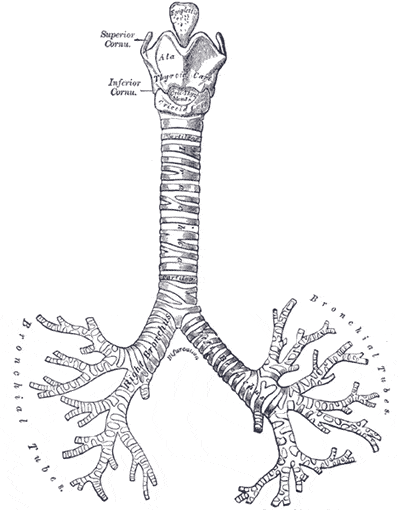
The two main branches from the trachea are called the __________________.
bronchi
alveoli
capillaries
bronchioles
The parts of the respiratory system that allows air to enter the body are ...........
Nose and Pharynx
Diaphragm & lung
Lung and Alveoli
Nose and Mouth

The part of the respiratory system labelled E is the _____________.
trachea
alveoli
pharynx
diaphragm

The part of the diagram labeled F is the __________________.
diaphragm
alveoli
epiglottis
larynx

