Wayground logo

Free Printable Worksheets

Font size

S
M
L
XL
Worksheets

Final Exam Review

Total questions: 65

Worksheet time: 46mins

Name
Class
Date
1.

The study of how people satisfy their needs and wants is called?

a)

Economics

b)

Government

c)

Supply and Demand

d)

Production Possibility

2.

What type of economic system is where prices are determined by unrestricted competition between privately owned businesses?

a)

Free Market

b)

Mixed economy

c)

Command Economy

d)

Traditional Economy

3.

What is limited quantities of resources to meet unlimited wants?

a)

Scarcity

b)

Shortage

c)

Demand

d)

Resource cost

4.

What sector of the economy that is controlled by the government?

a)

Public

b)

Private

c)

Free

d)

Control

5.

What is an advantage of command markets?

a)

Provides basic necessities for little to no cost

b)

Controls the means of production

c)

Offers a variety of goods to the people

d)

There are no advantages

6.

What is the law of demand?

a)

As price increases quantity demanded decrease

b)

As price increases quantity demanded increases

c)

As price increases demanded decrease

d)

As price increases demanded increases

7.

What is the consumers or producers reaction to a change in price?

a)

demand

b)

supply

c)

elasticity

d)

there is no reaction

8.

The maximum price that can be charged for a good or service?

a)

Price floor

b)

Price ceiling

c)

Demand curve

d)

Equilibrium

9.

If there is a decrease in subsidies provided what happens to price and quantity?

a)

Price up Quantity down

b)

Price up Quantity up

c)

Price down Quantity down

d)

There is no correlation

10.

What type of market structure has same, same product?

a)

Perfectly Competitive

b)

Monopolistically Competitive

c)

Oligopoly

d)

Monopoly

11.

What are the two barriers to entry?

a)

Start- up cost

b)

Technology

c)

Demand

d)

Consumer Taste

12.

What is the least competitive market structure?

a)

Perfectly Competitve

b)

Monopolistically Competitive

c)

Oligopoly

d)

Monopoly

13.

What is government backed money called?

a)

Fiat

b)

Representative

c)

Commodity

14.

Gift cards and checks are an example of what type of money?

a)

Fiat

b)

Representative

c)

Commodity

15.

What is the general rise of prices of goods called?

a)

Inflation

b)

Deflation

c)

Scarcity

d)

Shortage

16.

What does the government attempt to do with the business cycle?

a)

Limit the swings of expansion and recession

b)

Promote wild swings of expansion and recession

c)

Let the free market decide

d)

They have no control over the business cycle

17.

What is the expansion/contraction of the money supply in order to influence the cost and availability of credit?

a)

Monetary policy

b)

Fiscal policy

c)

Federal reserve

d)

We didn't learn this

18.

What type of externalities does the government encourage?

a)

Positive

b)

Negative

c)

Neutral

d)

None

19.

Households sending the factors of production to business is what type of market?

a)

Factor

b)

Product

c)

Demand

d)

Supply

20.

What is full employment?

a)

Everyone is working

b)

There is 0% unemployment

c)

There is no cyclical unemployment

d)

There is no structural unemployment

21.

What role does technology play in economics?

a)

Supply shifter

b)

Increase production possibility curve

c)

Causes structural unemployment

d)

All of these

e)

None of these

22.
If a drought severely reduces the amount of asparagus available to consumers, what would you expect to happen?
a)
The demand for asparagus will go down.
b)
The price of asparagus will go up.
23.
Produces a variety of goods and services, as well as supports new ideas, services and goods.
a)
Advantages of a Market Economy
b)
Advantages of Command Economy
24.
An ______  is someone who takes a risk to start a business (usually small business). Why do they take risk? Enjoy taking risk. ·Want to work for themselves. Ex. Bill Gates who started Microsoft.
a)
Loan Officer
b)
Investor
c)
Entrepreneur
25.
Scarcity arises because all societies have
a)
limited productive resources to satisfy unlimited wants
b)
unlimited productive resources to satisfy limited wants
c)
limited needs and unlimited wants
d)
unlimited needs and limited wants
26.
An economic system in which decisions on productions and consumption are made by a central government:
a)
Command
b)
Market
c)
Traditional
d)
Mixed
27.
A supply curve and a demand curve are usually parallel. 
a)
True
b)
False
28.
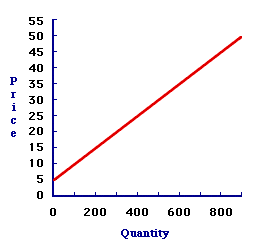
What does this curve represent?
a)
demand
b)
supply
c)
equilibrium
d)
shortage
29.
For the law of supply, as price rises, what happens to quantity supplied?
a)
it goes up
b)
it goes down
c)
it stays the same
d)
it is not effected
30.
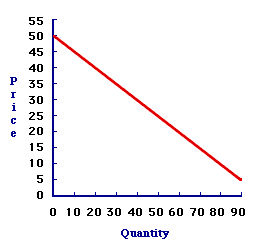
What does this curve represent?
a)
supply
b)
equilibrium
c)
demand
d)
surplus
31.
The point where supply and demand are balanced is?
a)
product
b)
demand
c)
surplus
d)
equilibrium
32.
Which of the following would be an example of human capital? 
a)
The amount of workers who work in a Nike factory
b)
The skills of the shoe designers at Nike 
c)
Philip Knight, the CEO of Nike 
d)
The land that the Nike headquarters is located on in Beaverton Oregon
33.
The four types of economic systems are: 
a)
Traditional, Command, Mixed, & Market
b)
Traditional, Command, Combined, & Market
c)
Communism, Capitalism, Free Market, and Macroeconomics
d)
Microeconomics, Macroeconomics, Individual, and Traditional.
34.
Which of the following is NOT one of the three basic questions of economics when looking at economic systems? 
a)
What goods should be produced ?
b)
What is the price of the goods? 
c)
How should the goods be produced? 
d)
Who gets to consume the goods? 
35.
In a command economy, who holds power over the economy?
a)
The people
b)
The government
c)
Beyonce
d)
The traditions of your ancestors
36.
What are the three economic questions?
a)
What to produce? How to produce? For whom to produce?
b)
Who to produce? Why you produce? Like to produce?
c)
Why to produce? Tell who to produce? Things to produce?
37.
True or False: The basic questions of economics differ based on each economic system.
a)
True
b)
False
c)
Not enough info
38.
This is the rise in the general level of prices.
a)
fixed income
b)
inflation
c)
minimum wage increase
d)
all the answers are correct
39.
Income that does not increase over time.
a)
fixed income
b)
adjustable income
c)
medicaid
d)
minimum wage
40.
Characteristics of free enterprise capitalism include voluntary exchange, private property and these two.
a)
competition & profit motive
b)
competition & involuntary exchange
c)
profit motive & opportunity cost
d)
opportunity cost & competition
41.
Benefits of free enterprise capitalism include individual freedom, a variety of goods, creating wealth and...
a)
promoting progress & opportunity cost
b)
opportunity cost & adapting to change
c)
adapting to change & promoting progress
d)
increasing the gap between rich and poor & unemployment
42.
Which group lists the key principles of the free enterprise system?
a)
private property, taxation, public interest, patriotism
b)
profit motive, legal equality, consumer protection, public interest
c)
profit motive, private property, eminent domain, voluntary exchange
d)
profit motive, legal equality, private property, voluntary exchange
43.
Which are the government's three goals for promoting economic strength? 
a)
steady growth, high prices, and innovation
b)
high employment, steady growth, and stability
c)
high employment, increased spending, low taxes
d)
low unemployment, low prices, and low taxes
44.
What is one way the government might try to promote economic growth? 
a)
raise taxes
b)
increase spending
c)
reduce prices
d)
produce more goods
45.
Someone who benefits without paying for a good or service.
a)
free loader
b)
free rider
c)
freedom fighter 
d)
free fallin'
46.
What does this curve represent?
a)
demand
b)
supply
c)
equilibrium
d)
shortage
47.
What does this curve represent?
a)
supply
b)
equilibrium
c)
demand
d)
surplus
48.
Printers and ink cartridges are typically purchased together.  Economists would call these
a)
Stubstitues
b)
Complements
c)
Elastic
d)
Inelastic
49.
If the price of printers goes down, what happens in the market for ink cartridges?
a)
Supply increases.
b)
Supply decreases.
c)
Demand increases.
d)
Demand decreases
50.
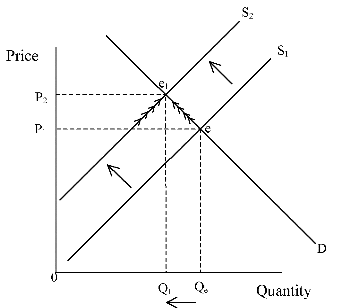
Assume the image is showing the market for apples.  Which of the headlines could indicate the pictured shift is occurring in the market?
a)
Pesticides on apples linked to mouth cancer.
b)
Storms destroy apple orchards.
c)
An apple a day really does keep the doctor away.
d)
New genetic strain leads to apple trees that produce twice as many apples.
51.
A government payment made to a business is a
a)
tax
b)
regulation
c)
subsidy
d)
resource
52.
The following is a factor that will not cause the demand curve to shift:
a)
Advertising
b)
Population
c)
Price
d)
Consumer expectations
53.
A change in quantity demanded is shown
a)
at various points on the demand curve
b)
with a new demand curve drawn above or below the original demand curve
c)
with a vertical line
54.
If a consumer knows that a product will be going on sale this week, how will his/her CURRENT demand be affected?
a)
it will go up
b)
it will go down
c)
it will stay the same
d)
what does this have to do with the price of tea in China?
55.
For the law of supply, as price rises, what happens to quantity supplied?
a)
it goes up
b)
it goes down
c)
it stays the same
d)
it is not effected
56.

Equilibrium in a market means which of the following?

a)

the point at which quantity supplied and quantity demanded are the same and a price point is set

b)

the point at which unsold goods begin to pile up

c)

the point at which suppliers begin to sell supplies

57.

When quantity supplied exceeds quantity demanded.

a)

shortage

b)

fad

c)

search costs

d)

surplus

58.
When quantity demanded exceeds quantity supplied at a certain cost
a)
shortage
b)
fad
c)
search costs
d)
surplus
59.
The picture illustrates
a)
an increase in demand
b)
a decrease in demand
c)
an increase in quantity demanded
d)
a decrease in quantity demanded
60.
The picture illustrates
a)
an increase in supply
b)
a decrease in supply
c)
an increase in quantity supplied
d)
a decrease in quantity supplied
61.
The Central Bank of the United States is called the
a)
Federal Reserve System
b)
Government Reserve System
c)
National Reserve System
d)
State Reserve System
62.
To implement expansionary fiscal policy, the government is likely to
a)
cut both taxes and spending
b)
increase both taxes and spending
c)
cut taxes and increase spending
d)
increase taxes and cut spending
63.
To implement contractionary fiscal policy, the government is likely to
a)
cut both taxes and spending
b)
increase both taxes and spending
c)
cut taxes and increase spending
d)
increase taxes and cut spending
64.
A plan to increase the amount of money in circulation is called
a)
expansionary fiscal policy
b)
expansionary monetary policy
c)
contractionary monetary policy
d)
contractionary fiscal policy
65.
A plan to reduce the amount of money in circulation is called
a)
expansionary monetary policy
b)
expansionary fiscal policy
c)
contractionary monetary policy
d)
contractionary fiscal policy