wayground logo

Free Printable Worksheets

Font size

S
M
L
XL
Worksheets

Life Science Final Exam Review

Total questions: 130

Worksheet time: 2hrs 31mins

Name
Class
Date
1.

Jack makes a hypothesis: Acid rain prevents corn seeds from sprouting. To test this, he waters one corn seed with tap water and a second corn seed with acidic water. How should Jack improve his experiment?

a)

He should determine what his independent variable is.

b)

He should determine what his dependent variable is.

c)

He should make a larger sample size.

d)

He should make a control group.

2.

Jack makes a hypothesis: Acid rain prevents corn seeds from sprouting. To test this, he waters one corn seed with tap water and a second corn seed with acidic water. Identify the independent variable in this experiment.

a)

tap water

b)

corn seeds

c)

sprouting

d)

acidic water

3.

Jack makes a hypothesis: Acid rain prevents corn seeds from sprouting. To test this, he waters one corn seed with tap water and a second corn seed with acidic water. Identify the dependent variable.

a)

tap water

b)

corn seeds

c)

sprouting

d)

acidic water

4.

Jack makes a hypothesis: Acid rain prevents corn seeds from sprouting. To test this, he waters one corn seed with tap water and a second corn seed with acidic water. Identify the control group in this experiment.

a)

The corn seed given tap water

b)

The corn seed given acidic water

5.
What step does every scientific experiment begin with?
a)
hypothesis
b)
question/problem
c)
procedures
d)
conclusion
6.
If plants are exposed to sunlight, then they will grow taller.
What part of the scientific method is this an example of?

a)
Procedure
b)
Hypothesis
c)
Question
d)
Results
7.
Why do scientists use the scientific method?
a)
To make sure they get credit for their discoveries.
b)
To make sure their results are valid and can be performed by other scientists.
c)
So that other scientist don't get mad at them
8.
The summary at the end of an experiment that explains the results. 
a)
conclusion
b)
procedures
c)
materials
d)
hypothesis
9.
Observations made during an experiment are considered:
a)
data
b)
problems
c)
conclusions
d)
questions
10.
What is a hypothesis?
a)
an educated guess stating what you believe will be the result of your experiement
b)
a random guess
c)
a statement of the outcome of your experiment
d)
step by step directions for your experiment
11.
What are the procedures step in the  experiment?
a)
the conclusion to your experiment
b)
the materials needed to complete experiment 
c)
step by step directions of how to complete your experiment
d)
an educated, best guess
12.
What are the materials in your scientific method? 
a)
your favorite markers and lucky eraser
b)
everything you will need to complete your experiment
c)
a hypothesis
d)
step by step directions to complete an experiment
13.
The independent variable is the ONE thing you _____.
a)
change on purpose
b)
control or keep constant
c)
measure
14.
Anything that can change in an experiment.  There are three types of these in an experiment.
a)
variables
b)
constant
c)
independent
d)
dependent
15.
The variable that is being measured or observed is called the _______________. Hint: this is the variable that is the result or effect 
a)
independent variable
b)
dependent variable
c)
control variable
16.
An experiment is performed on plants to see how different liquids affect plant growth. Each plant in the experiment is given a different liquid: water, apple juice, or milk. What variables should be kept constant/controlled? 
a)
type of plant, flower pot,  soil, and amount of sunlight
b)
water, apple juice, milk
c)
only the amount of sunlight
d)
type of plant only
17.
Why do we want to test one variable at a time?
a)
Because it is hard to setup a data table with more
b)
To know what is causing the changes. This helps us understand cause and effect.
c)
It is what has always been done
18.
Should experiments be repeated over and over to see if the results are the same each time?
a)
yes
b)
no
19.
A series of steps used by scientists to solve a problem or answer a question. 
a)
scientific method
b)
recipe
c)
data collection
d)
metric system
20.
In a controlled experiment, how many variables can be worked with at a time? 
a)
one
b)
none
c)
two or more
d)
how ever many makes sense.
21.
The part of the experiment that remains the same for the control and experimental group.
a)
constants
b)
control
c)
independent
d)
dependent
22.
Mr. S. sets up an experiment to see how the mass of a ball affects the distance it rolls off a ramp.  Identify the independent variable.
a)
distance traveled by the ball
b)
height of the ramp
c)
mass of the ball
d)
weight of the ball
23.
Mr. S. sets up an experiment to see how the mass of a ball affects the distance it rolls off a ramp.  Identify the dependent variable.
a)
height of the ramp
b)
 distance traveled by the ball
c)
mass of the ball
d)
weight of the ball
24.
All living things are composed of cells. 
a)
True
b)
False
25.
In order for something to be considered a living organism, it must display _____ of the eight characteristics of living things.
a)
one
b)
some
c)
all
d)
more than half
26.
Temperature and sunlight would be examples of ____________ factors within an environment.
a)
biotic
b)
abiotic
27.
Define BIOLOGY.
a)
The study of life and living organisms.
b)
The study of animals.
c)
They study of matter.
d)
The study of earth and its atmosphere.
28.
All living things ____ to make more living things.
a)
adapt
b)
develop
c)
grow
d)
reproduce
29.
Light, smell, sound, and temperature are all examples of what? 
a)
Cells
b)
Stimuli
c)
Fungi
d)
Reactions
30.
Which of the following is the smallest unit of life that can carry out all life functions?
a)
the mitochondria
b)
the vacuoles
c)
the nucleus
d)
the cell
31.
Which structures are found in every living cell?
a)
cell membrane and cytoplasm
b)
chloroplasts and mitochondria
c)
a cell wall and nucleus
d)
chloroplasts and cell wall
32.
Which cell structure is found in plant and animals cells and controls what can come into or leave a cell?
a)
cell membrane
b)
cytoplasm
c)
nucleus
d)
vacuole
33.
Cell organelles that are responsible for digesting food, worn out organelles and other cellular wastes are called ___________________.
a)
Mitochondria
b)
Vacuoles
c)
Lysosomes
d)
Chlororplasts
34.
What is one basic function of the vacuoles?
a)
circulating oxygen
b)
producing food
c)
controlling cell processes
d)
storing water
35.
Chloroplasts in plant cells allow the plant to perform a function that animal cells cannot do.  What is the main function of the chloroplasts found in plant cells?
a)
to absorb light energy and manufacture food
b)
to remove waste materials by active transport
c)
to manufacture chemical energy from food
d)
to control the shape of the cell
36.
All cells need energy to function.  Which cell organelle is responsible for producing energy in the cell?
a)
chloroplasts
b)
mitochondria
c)
nucleus
d)
vacuoles
37.
What is the function of a cell wall?
a)
to protect and support the cell
b)
to perform different functions in each cell
c)
to prevent water from passing through it
d)
to prevent oxygen from entering the cell
38.
In what part of the plant cell does the process of photosynthesis take place?
a)
nucleus
b)
mitochondria
c)
chloroplasts
d)
vacuoles
39.
Cells with a nucleus and membrane-bound organelles are called ____________________.
a)
prokaryotes
b)
eukaryotes
c)
bacteria
d)
protists
40.
Which of the following is not part of the cell theory?
a)
cells must contain DNA 
b)
all living things are made from cells
c)
cells can only come from other cells
d)
cells are the basic unit of life
41.
He discovered that all plants are made of cells:
a)
Anton van Leeuwenhoek
b)
Theordor Schwann
c)
Robert Hooke
d)
Mattias Schleiden
42.
Who was the first  person to see cells under the microscope and give them their name?
a)
Mattias Schleiden
b)
Robert Hooke
c)
Theordor Schwann
d)
Anton van Leeuwenhoek
43.
The diffusion of WATER across a semi-permeable membrane is
a)
osmosis
b)
diffusion
c)
endocytosis
d)
exocytosis
44.
What is diffusion
a)
active transport
b)
passive transport
c)
cell division
d)
cell mutation
45.
The movement of molecules from higher concentration to lower concentration is
a)
diffusion
b)
cell division
active transport
c)
active transport
d)
tonicity
46.
Active transport requires
a)
energy
b)
the nucleus
c)
chloroplasts
d)
lysosomes
47.
What organelles are only found in PLANT cells
a)
lysosomes & centrioles
b)
cell wall & chloroplasts
c)
nucleus & nucleolus
d)
mitochondria & ribosomes
48.
What organelles is NOT found in a PROkaryote
a)
nucleus
b)
cell membrane
c)
Chromosomes (DNA)
DNA
d)
ribosomes
49.
What is the membrane around the NUCLEus called?
a)
nuclear membrane
b)
mitochondria
c)
cell membrane
cell emmbrane
d)
nucleolus
50.
how are chloroplasts and mitochondria similar? They both...
a)
produce energy products
b)
are found in animal cells
c)
are found in prokaryotes
d)
destroy cell products
51.
The cell membrane
a)
regulates what enters/leaves cell
b)
helps maintain homeostasis
c)
keeps contents of cell in place
d)
all of the above
52.
What organelle PRODUCES proteins?
a)
ribosomes
b)
centrioles
c)
lysosomes
d)
nucleus
53.
What is on the same level of organization as the brain?
a)
stomach
b)
nervous system
c)
protein molecule
d)
flower
54.
All living things do which of the following?
a)
Chemosynthesis
b)
Respiration
c)
photosynthesis
d)
all of the answers
55.
What is one of the reactants of cellular respiration?
a)
energy
b)
glucose
c)
carbon dioxide
d)
water
56.
Which organ excretes carbon dioxide?
a)
Lungs
b)
Liver
c)
Heart
d)
Kidney
57.
What are the products of aerobic respiration?
a)
Glucose and oxygen
b)
Carbon dioxide and water
c)
Lactic acid
d)
Carbon monoxide
58.
What type of respiration requires oxygen?
a)
Aerobic
b)
Anaerobic
59.
How many ATP are produced in aerobic respiration?
a)
2
b)
33
c)
4
d)
36
60.
Cellular Respiration's goal is to
a)
make water
b)
make ATP
c)
make glucose
d)
make  oxygen
61.
Which type of organisms perform photosynthesis?
a)
Only Autotrophs
b)
Only Heterotrophs
c)
Autotrophs and Heterotrophs
62.
Plants need ________ for photosynthesis
a)
Oxygen
b)
Soil
c)
Carbon dioxide
d)
Sugar
63.
How does water get into the leaves of a plant?
a)
It goes into the stomata
b)
The roots absorb it and then it travels up the xylem
c)
It's made during a chemical reaction in the stem
d)
The flowers capture water and deliver it to the leaves
64.
Why do plants conduct photosynthesis?
a)
To make light
b)
To make mitochondria
c)
To make glucose
d)
To release carbon dioxide
65.
What major energy transformation occurs during photosynthesis?
a)
Thermal --> Chemical
b)
Kinetic --> Radiant
c)
Chemical --> Radiant
d)
Radiant --> Chemical
66.
Which organelle in the plant cell performs photosynthesis?
a)
Chloroplast
b)
Mitochondria
c)
Nucleus
d)
Cytoplasm
67.
What are the products of photosynthesis (what is made)?
a)
Glucose and Chlorophyll
b)
Glucose and Oxygen
c)
Water and Light
d)
Carbon dioxide and Water
68.
What is the source of energy for photosynthesis?
a)
Carbohydrates (chemical energy)
b)
Light (radiant energy)
c)
Heat (thermal energy)
d)
Wind (kinetic energy)
69.
Which of these conditions would decrease the rate of photosynthesis in a plant?
a)
Above average precipitation
b)
Changing the daylight hours from 14 hrs to 10 hrs
c)
Changing the CO2 concentration from 380 ppm to 410 ppm
d)
All of these choices
70.
What do plant cells do with glucose?
a)
Send it to the mitochondria to make usable energy (ATP)
b)
Store it as starch or simple sugars like fructose and sucrose
c)
Use it to make cellulose for building cell walls, stems, and leaves
d)
All of these choices
71.
An organism that needs to eat other organisms to obtain energy is known as a:
a)
Autotroph
b)
Producer
c)
Consumer
d)
Mutualist
72.
Consumer that eats plants
a)
heterotroph
b)
herbivore
c)
producer
d)
community
73.
What does a food web represent?
a)
All connections of energy flow throughout all organisms in a habitat.
b)
The specific ways that mutualism is carried out.
c)
A single pathway or energy flow between organisms. 
d)
How carnivores get their food. 
74.
relationship in which two species live closely together
a)
resource
b)
mutualism
c)
succession
d)
symbiosis
75.
The rabbit in this food web would be considered a:
a)
Decomposer
b)
Producer
c)
Secondary Consumer
d)
Primary Consumer
76.
Where an organism lives
a)
habitat
b)
niche 
c)
heterotrogh
d)
biosphere
77.
In this Food Web Pyramid Which type of consumer gets only 10% of the energy stored in plants?
a)
Herbivore
b)
Carnivore
c)
Omnivore
d)
Secondary Consumer
78.
The nonliving aspects of an ecosystem.
a)
Abiotic factors
b)
Biotic factors
79.
The living portions of the ecosystem.
a)
Biotic factors
b)
Abiotic factors
80.
The living portions of the ecosystem.
a)
Biotic factors
b)
Abiotic factors
81.
A collection of organisms that make up a community as well as all of the nonliving aspects of the environment.
a)
Population
b)
Community
c)
Habitat
d)
Ecosystem
82.
 plants that convert energy from the sun
a)
decomposer
b)
primary consumer
c)
secondary consumer
d)
producer
83.
What are the Abiotic factors in this image? 
a)
water, sunlight, dirt, air
b)
birds and plants
c)
birds, water, dirt
d)
plants, water
84.
Which of these is the ultimate source of energy in the energy pyramid
a)
water
b)
air 
c)
sunlight
d)
soil
85.
The science of the environment, its components, and the interactions between these components is called
a)
geology
b)
ecology
c)
biology
d)
physiology
86.
Sometimes a population cannot grow to its biotic potential due to environmental factors. What are these environmental factors called?
a)
limiting factors
b)
biomes
c)
ecological pyramids
d)
carrying capasity
87.
What is made up of all populations in an area?
a)
niche
b)
habitat
c)
community
d)
ecosystem
88.
What is the symbiotic relationship called in which the organism is helped and the other organism is harmed?
a)
mutualism
b)
parasitism
c)
commensalism
d)
consumer
89.
What is the symbiotic relationship called which one organism is helped and the other organism is unharmed?
a)
mutualism
b)
parasitism
c)
commensalism
d)
consumer
90.
Which of the following organisms are typical decomposers?
a)
grasses and ferns
b)
bacteria and mushrooms
c)
mice and deer
d)
lions and snakes
91.
An organism's specific role in its habitat is called its
a)
consumer
b)
niche
c)
birth right 
d)
mutalism
92.
Who is the father of evolution?
a)
Darwin
b)
Mendel
c)
Newton
d)
Einstein
93.
When all of the organisms of a species have died it is called
a)
evolution
b)
extinction
c)
adaptation
d)
natural selection
94.
Which layer is the oldest?
a)
1
b)
2
c)
3
d)
4
95.
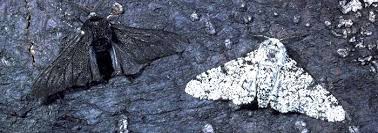
Predict which moth would increase in population
a)
light 
b)
dark
96.
When the DNA of an organism is altered it is referred to as…
a)
Mutation
b)
Gene Flow
c)
Genetic Drift
d)
Sexual Selection
97.
Darwin wrote that organisms with traits that are best suited to the environment will ________________
a)
increase in number
b)
become extinct
98.
Which term refers to the process by which individuals that are better suited to the environment survive and reproduce therefore passing down their genes to their offspring? 
a)
Evolution 
b)
Variation 
c)
Adaptation
d)
Natural Selection 
99.
Inherited trait that helps an organism survive is a(n) __________.
a)
Fossil
b)
Adaptation
c)
Ancestor
d)
Natural selection
100.
The scientific name for an organism is made from the:
a)
class and family name
b)
genus and species name
c)
domain and kingdom name
d)
kingdom and phylum name
101.
Term given to describe the 2 name naming system is:
a)
dichotmous key
b)
binomial nomenclature
c)
2 scientific names
d)
binomial key
102.
The 8 levels of classification, most broad to most specific.
a)
Domain, Genus, Family, Order, Class, Phylum, Kingdom, Species
b)
Domain, Species, Kingdom, Genus, Phylum, Family, Class, Order
c)
Domain, Kingdom, Phylum, Class, Order, Family, Genus, Species
d)
Order, Kingdom, Species, Domain, Phylum, Family, Class, Genus
103.
What is the most specific level of classification?
a)
Family
b)
Domain
c)
Species
d)
Carolus Linnaeus
104.
Which domain includes all animals and plants?
a)
Archaea
b)
Eukarya
c)
Bacteria
105.
Almost all bacteria are...
a)
Unicellular
b)
Multicellular
106.
Which two kingdoms are entirely multicellular?
a)
Animalia and Plantae
b)
Animalia and Protista
c)
Protista and Plantae
107.
Organisms whose cells have NO nucleus are classified as...
a)
Eukaryotic
b)
Prokaryotic
c)
Dead
108.
True or False: All cells have DNA.
a)
True
b)
False
109.
True or False: All living things are made of one or more cells.
a)
True
b)
False
110.
What is the genus name here:
Canis lupus
a)
Canis
b)
lupus
111.
Scientists classify organisms to ____________.
a)
Count the organisms quicker
b)
Catch the organisms in the wild
c)
Train the organisms to behave
d)
See how organisms are alike and different from each other
112.
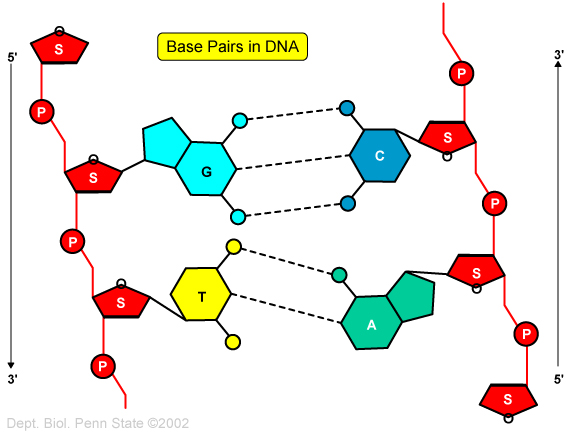
Which sequence of DNA bases would pair with this partial strand
ATG TGA CAG
a)
ATG TGA CAG
b)
TAC ACT GTC
c)
GTA AGT GAC
d)
CAT TCA CTG
113.
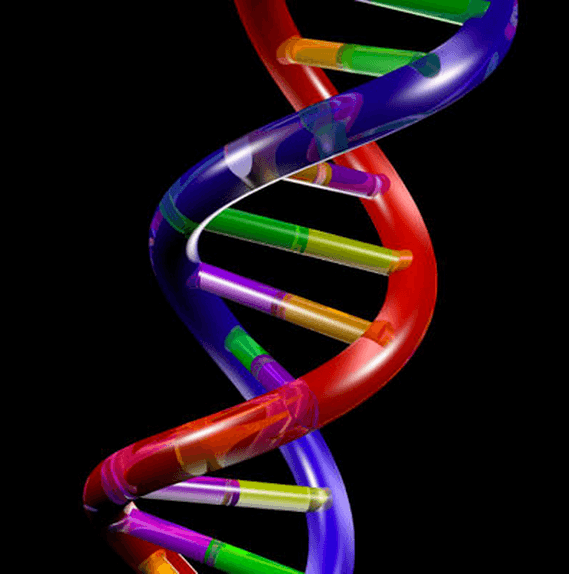
Which of the following best describes a DNA molecule?
a)
double helix
b)
contains ribose
c)
made of amino acids
d)
contains Uracil
114.
Which of the following units are repeatedly joined together to form a strand of DNA?
a)
amino acids
b)
nucleotides
c)
fatty acids
d)
polysaccharides
115.
In a molecule of double-stranded DNA, the amount of Adenine present is always equal to the amount of
a)
cytosine
b)
guanine
c)
thymine
d)
uracil
116.
Guanine bonds with ______________.
a)
Adenine
b)
Guanine
c)
Cytosine
d)
Thymine
117.
What determines the code, or information, of a DNA molecule?
a)
the shape (structure) of the nitrogen bases
b)
the order (sequence) of the nitrogen bases
c)
the color of the nitrogen bases
d)
the frequency (number) of nitrogen bases
118.
Which 2 molecules form the sides (backbone) of the DNA ladder?
a)
deoxyribose sugar and adenine
b)
deoxyribose sugar and a hydrogen bond
c)
deoxyribose sugar and the nucleus
d)
deoxyribose sugar and phosphate
119.
Which organelle is DNA usually found in?
a)
cell membrane
b)
vacuole
c)
chloroplast
d)
nucleus
120.
Nitrogenous bases are joined by which type of bond?
a)
polar bonds
b)
ionic bonds
c)
covalent bonds
d)
hydrogen bonds
121.
The enzyme that unzips the DNA to prepare for replication
a)
helicase
b)
replicase
c)
polymerase
d)
synthase
122.
DNA replication results in two DNA molecules,
a)
each one with two original strands
b)
each one with two new strands
c)
each one with one new strand and one original strand
d)
one with two new strands and the other with two original strands
123.
A process in which DNA has the unique ability to make an exact copy of itself.
a)
Replication
b)
Translation
c)
Transcription
124.
What are the three components of a nucleotide?
a)
sugar, hydrogen, nitrogen base
b)
sugar, oxygen, nitrogen base
c)
sugar, phosphate, nitrogen base
d)
sugar, phosphate, protein
125.
Which of the following statements best explains the overall purpose of MITOSIS?
a)
Asexual reproduction of body cells
b)
To produce gametes (sex cells)
126.
Which of the following statements best explains the overall purpose of MEIOSIS?
a)
Asexual reproduction of body cells
b)
To produce gametes (sex cells)
127.
Daughter cells are genetically identical to the parent and each other. 
a)
mitosis
b)
meiosis
c)
both
128.
A cell with 10 chromosomes go through meiosis. What is the end result of the process
a)
4 cells with 10 chromosomes each
b)
2 cells with 10 chromosomes each
c)
4 cells with 5 chromosomes each
d)
2 cells with 5 chromosomes each
129.
Another name for a sex cell is a:
a)
gamete
b)
embryo
c)
bone cell
d)
muscle cell
130.
If a parent cell has 24 chromosomes, following MEIOSIS, the daughter cells will have ___ chromosomes.
a)
12
b)
24
c)
48
d)
0