wayground logo

Free Printable Worksheets

Font size

S
M
L
XL
Worksheets

7th grade Final Review

Total questions: 115

Worksheet time: 2hrs 31mins

Name
Class
Date
1.

What is a primary source?

a)

Something from the time period being studied

b)

Something created after the time period being studied.

c)

Something that is guaranteed to be true.

d)

An unreliable source

2.

What is a secondary source?

a)

Something from the time period being studied

b)

Something created after the time period being studied.

c)

Something that is guaranteed to be true.

d)

An unreliable source

3.
A people's way of life, including beliefs, customs, food, dwellings, and clothing.
a)
club
b)
organization
c)
culture
4.
Useful material found in nature, including water, vegetation, animals, and minerals.
a)
garden
b)
natural resources
c)
community
5.
To move from one place and establish a home in a new place.  A move of a large number of people is called a migration, and people are called migrants.
a)
ride
b)
migrate
c)
happen
6.
Which group of people migrated from Asia to North America during the Ice Age? 
a)
Native Americans
b)
Russians
c)
Pritchardville Students
d)
Indians
7.
The word MIGRATE means...
a)
To stay
b)
To move
c)
To fight
d)
To sleep
8.
The land that once was under water became exposed and created a long land bridge that connected
a)
Asia/Africa
b)
Asia/Europe
c)
North America/South America
d)
North America/Asia
9.
What is the best title for the above map, which shows how the New World could have been settled over 10,000 years ago?
a)
The Transcontinental Railroad
b)
The Middle Passage 
c)
The Columbian Exchange 
d)
The Landbridge Theory 
10.
What two continents were connected by Beringia?
a)
Africa and Asia 
b)
Asia and North America
c)
Asia and Australia 
d)
South America and North America
11.

In Iroquois tradition, the Three Sisters are

a)

crops grown for food

b)

Hiawatha's daughters

c)

the sun, moon, and Earth

d)

lakes Huron, Erie, and Ontario

12.
Abraham Lincoln was the president for which side?
a)
North
b)
South
13.
Robert E. Lee was the general for which side?
a)
North
b)
South
14.
Ulysses S. Grant was the general for which side?
a)
North
b)
South
15.
What was the Civil War originally fought over?
a)
Secession
b)
Slavery
c)
Exports
d)
Taxes
16.
Which of the following was an advantage that the Confederacy had?
a)
More Troops
b)
Home Field Advantage
c)
Better Weapons
d)
Better Transportation
17.
The name give to the north was what?
a)
Confederacy
b)
Rebels
c)
Union
d)
Revolutionaries
18.
Which waterway was important to both the North and the South?
a)
Ohio River
b)
Tennessee River
c)
Missouri River
d)
Mississippi River
19.
What event freed the slaves?
a)
Gettysburg Address
b)
Bill of Rights
c)
Emancipation Proclamation
d)
Declaration of Independence
20.
What Union general is known for his march to the sea?
a)
Grant
b)
Sherman
c)
Lee
d)
Jackson
21.
Who won the Civil War?
a)
Union
b)
Confederates
22.
Where did the south finally surrender unconditionally?
a)
Antietam
b)
Gettysburg
c)
Richmond
d)
Appomatox
23.
This was a book that was written by Harriet Beecher Stowe that showed the evils of slavery. 
a)
Harriet's Cabin
b)
Uncle Tom's Cabin
c)
Slavery 
d)
State's Rights
24.
This man led a raid at Harper's Ferry to show people they could use violence to try and end slavery. 
a)
Abraham Lincoln
b)
Jefferson Davis
c)
Robert E. Lee 
d)
John Brown
25.
Which one of  the following was NOT a cause to the Civil War?
a)
Farming
b)
Slavery
c)
State's Rights
d)
Uncle Tom's Cabin
26.
This was the main cause that caused the South to secede because they said they did not have to follow the Federal laws 
a)
Harriet Beecher Stowe's Uncle Tom's Cabin
b)
John Brown's Raid
c)
State's Rights
d)
Fort Sumter
27.
Abolish means to....
a)
separate
b)
get rid of
c)
make more of
d)
bring together
28.
This was one of the main causes that led to the Civil War. The North did not want this and the South did. The  South depended on this for their economy and to make a profit. 
a)
State's Rights
b)
Uncle Tom's Cabin
c)
Slavery
d)
John Brown's Raid
29.
Where was John Brown's Raid?
a)
Montgomery, Alabama
b)
Gettysburg, Pennsylvania
c)
Charleston, South Carolina
d)
Harper's Ferry, West Virginia
30.
Where was the Battle of Fort Sumter?
a)
Pennsylvania
b)
South Carolina
c)
Georgia
d)
Virginia
31.
This law said Americans could NOT help runaway slaves.
a)
Missouri Compromise
b)
Fugitive Slave Act
c)
Kansas Nebraska Act
d)
Dred Scott Case
32.
This law allowed slavery to expand in the West through popular sovereignty.
a)
Missouri Compromise
b)
Fugitive Slave Act
c)
Kansas Nebraska Act
d)
Dred Scott Case
33.
What woman led escaped slaves to freedom using the Underground Railroad?
a)
Harriet Beecher Stowe
b)
Clara Barton
c)
Harriet Tubman
d)
Mary Lincoln
34.
What did the Fugitive Slave Law do?
a)
The underground railroad was ended
b)
Slaves that ran-away would be jailed
c)
Made it illegal for slaveholders to recapture their slaves
d)
Made it easier for slaveholders to find and reclaim runaway slaves
35.
The term means that people in the state would VOTE to make decisions about being a free state or a slave state.
a)
independent choice
b)
popular sovereignty
c)
popular election
36.
What was the main purpose of the of the Monroe Doctrine?
a)
Limit European influence in the Americas
b)
Stake a claim to Mexican territory
c)
Establish full control over Canada
37.
In the Missouri Compromise, what state was allowed to enter as a slave state?
a)
Missouri
b)
Maine
c)
Kentucky
d)
Ohio
38.
In the Missouri Compromise, what state was allowed to enter as a free state?
a)
Missouri
b)
Maine
c)
Kentucky
d)
Alabama
39.
When was the Missouri Compromise reached?
a)
1820
b)
1850
c)
1776
d)
1803
40.
Who came up with the idea of the Missouri Compromise?  
a)
James Monroe
b)
George Washington
c)
Thomas Jefferson
d)
Henry Clay
41.
What is an abolitionist?
a)
Someone who wants to abolish or end slavery.
b)
Someone who wants to end voting for slaves.
c)
Someone who doesn't want to work with slaves.
d)
Someone who wants to never wear jeans.
42.
Harriet Beecher Stowe wrote a book to show the cruelties of slavery. What was it called?
a)
Uncle Bob's Stories
b)
Uncle Tom's Hotel
c)
Uncle Joe's Best Recipes
d)
Uncle Tom's Cabin
43.
What is the Seneca Falls Convention ?
a)
A womans rights movement because woman were not treated fairely.
b)
A Civil War
c)
A Constitution
d)
A Right
44.
Why is the Seneca Falls Convention important ?
a)
It was the first womens rights movement.
b)
It was a war that helped indians.
c)
it is important because it is a theme park were you can ride rides and eat cotton candy.
d)
A is becuase of the end.
45.
Manifest Destiny was the belief that...
a)
The US should stop expanding 
b)
The US should expand to the Mississippi River
c)
The US should expand to the Pacific Ocean
d)
The US should respect Mexico's land claim
46.
Utah, California, Colorado, New Mexico, Arizona, Wyoming, and Nevada were all states that joined the US as a result of what?
a)
The Treaty of Guadalupe Hidalgo
b)
The Annexation of Texas
c)
The Mexican Cession
d)
The Joint Resolution
47.
Jackson's practice of rewarding political supporters with government jobs became known as
a)
the spoils system.
b)
Jacksonian democracy.
c)
mudslinging.
d)
a corrupt bargain.
48.
What was the name of the journey made by Cherokee Indians after they were removed from their land?
a)
Indian Removal Act
b)
Trail of Sorrows
c)
Trail of Tears
d)
Nullification Act
49.
The Indian Removal Act was responsible for what event?
a)
The Relocation of Andrew Jackson to the West
b)
The break up of Rachel and Andrew
c)
The removal of native Americans to Oklahoma Territory
d)
The burning of The White House
50.
 Jackson fired many federal employees and replaced them with his supporters.  This is known as what?
a)
Spoils System
b)
Friending
c)
Following
d)
Supporting employees
51.
The two people Jefferson sent to explore the Louisiana Territory after it was purchased?
a)
Sacagawea & John Smith
b)
York & Daniel Boone
c)
Franklin & MAason
d)
Lewis & Clark
52.
Which of the following describes the area of the Louisiana Purchase?
a)
From the Atlantic Ocean to the Mississippi River
b)
From the Mississippi River to the Rocky Mountains
c)
From the Appalachian Mountains to the Rocky Mountains
d)
from the Rocky Mountains to the Pacific Ocean
53.
Judicial power is shared between what levels of gov.
a)
Federal; local
b)
City; state
c)
Local; state
d)
Federal; state
54.
Ability of each branch to oversee the activities of other branches-
a)
Federalism
b)
Separation of powers
c)
Jurisdiction
d)
Checks and balances
55.
What power was given to the Supreme Court in the court case Marbury v. Madison?
a)
Judicial Review
b)
Make Laws
c)
Supremacy Clause
d)
Execute Laws
56.
What is the main duty of the Supreme Court?
a)
make laws
b)
interpret laws
c)
enforce laws
57.
Which court is the highest in the land?
a)
U.S. Court of Appeals
b)
Virginia Supreme Court
c)
U.S. Supreme Court
d)
U.S. District Court
58.
This case established JUDICIAL REVIEW
a)
US v. Nixon
b)
Miranda v. Arizona
c)
Gideon v. Wainwright
d)
Marbury v. Madison 
59.

How did the American System propose to pay for infrastructure improvements?

a)

tariffs, taxes, and subsidies

b)

bank, loans, and investments

c)

government spending

d)

state responsibility

60.

How was money to be controlled in the American System?

a)

National Bank

b)

Loan houses

c)

States

d)

Mints

61.

Tariffs, National Bank, infrastructure improvement were all designed to aid in economic growth and expansion in what program designed by Clay?

a)

Era of Good Feelings

b)

Better Deal

c)

Monroe Doctrine

d)

American System

62.
What did Washington consider a serious danger to the new nation?
a)
settlers moving west
b)
national taxes
c)
growth of political parties
d)
France's influence
63.
What are the first ten amendments that were added to the Constitution?
a)
Proclamation of Neutrality
b)
Bill of Rights
c)
Judiciary Act of 1789
d)
Declaration of Independence
64.
In his Farewell Address, George Washington advised against what?
a)
Forming alliances with other countries
b)
Angering Native Americans
c)
Going to war with Spain
d)
Electing Thomas Jefferson
65.
Washington crushed an uprising over whiskey taxes using the new federal army
a)
Judiciary Act of 1789
b)
Farewell Address
c)
Whiskey Rebellion
d)
Battle of Fallen Timbers
66.
Who was the first president of the United States?
a)
Abraham Lincoln
b)
George Washington
67.
What does the word precedent mean?
a)
to set an example
b)
to buy something
68.
One weakness of the Articles of the Confederation was ____________. 
a)
The ability of Congress to tax.
b)
The inability of Congress to tax.
c)
The ability of Congress to declare war.
d)
The ability of Congress to create courts.
69.
The Articles of Confederation created a _________________ type of government.
a)
strong
b)
average
c)
weak
d)
federal
70.
The weaknesses of the Articles of the Confederation led to an effort to create a new _____________.
a)
Proclamation of 1763
b)
Constitution
c)
Declaration of Independence
d)
Treaty of Paris 1783
71.
The Articles of Confederation were replaced with the U.S. Constitution because ...
a)
they were to much like England's government
b)
they were too amazing
c)
failed to protect the country
d)
MAGIC
72.
Congress never had any money because under the Articles they did NOT have the power to ____.
a)
print money
b)
sell items to other countries
c)
tax
d)
spend money
73.
Which of these is the Branch of Government that enforces the laws? 
a)
Judicial
b)
Legislative
c)
Executive
74.
The U.S. Constitution organized our government fairly by creating: 
a)
Fair laws
b)
3 separate branches
c)
Splitting Congress into 2 houses
d)
Federal taxes
75.
What is the branch of the government that interprets the laws and includes the supreme court?
a)
Legislative Branch
b)
Executive Branch
c)
Judicial Branch
76.
What system prevents any branch from having too much power? 
a)
Power Balance
b)
Checks and Balances
c)
Constitutional Convention
d)
Power Checks 
77.
The President can______a law passed by Congress.
a)
Debate
b)
Veto
c)
Override
d)
Impeach
78.
Name the 2 parts of Congress.
a)
President & Supreme Court
b)
House of Representatives & Senate
c)
Supreme Court & Senate
d)
House of Representatives & Supreme Court
79.
The beginning part of the Constitution
a)
Article I
b)
Amendments
c)
Bill of Rights
d)
Preamble
80.
______ is the belief that the government gets its power from the people.
a)
Rule of Law
b)
Popular Sovereignity
c)
Checks and balances
d)
Federalism
81.
The first ten Amendment to the Constitution are called the  _______.
a)
Bill of Rights
b)
Preamble
c)
Articles
d)
Naturalization
82.
What is the name for a change or addition to the Constitution?
a)
Federalism
b)
Amendment
c)
Ratification
d)
Veto
83.
The central government of the United States is called the 
a)
federal government
b)
executive branch
c)
constitution
d)
congress
84.
The division of power between a central government and state governments is called
a)
The United States
b)
the Supremacy Clause
c)
the Necessary and Proper Clause
d)
federalism
85.
The document that replaced the Articles of Confederation
a)
Declaration of Independence
b)
Preamble
c)
Supremacy Clause
d)
Constitution
86.
Make rules about trade between states and nations
a)
Federal
b)
State
c)
Shared
87.
This was a tax on molasses and sugar to reduce smuggling.
a)
Stamp Act
b)
Sugar Act
c)
Townshend Act
d)
Tea Act
88.
Finish this American Colonist Motto, "No Taxation without..."
a)
Transportation
b)
Relaxation
c)
Representation
d)
Sensation
89.
What was this poster's meaning?
a)
The Colonies needed to be united
b)
Serpents can grow back together
c)
Colonies need to be independent
d)
Ben Franklin didn't know why he made this
90.
This event broke tensions between the colonist and the British troops where shots were fired. Crispus Attucks was the first to be killed.
a)
Lexington and Concord
b)
Boston Tea Party
c)
Boston Massacre
d)
Bloody Valentine
91.
How did the colonist protest against the tea tax?
a)
Dressed up like Native Americans
b)
Boston Massacre
c)
Dumped tea into Boston harbor
d)
Didn't pay the tax on the East India Tea
92.
This type of colonist was ready for rebellion and the fight for independence.
a)
Loyalist
b)
Patriot
c)
Neutral
d)
British 
93.
Which phrase became popular after passage of the Stamp Act?
a)
“The rights of Englishmen”
b)
“Give me liberty or give me death”
c)
“Life, liberty, and the pursuit of happiness”
d)
“No taxation without representation“
94.
Where were the first armed conflicts of the American Revolution?
a)
Yorktown
b)
Saratoga
c)
Lexington and Concord
d)
Bunker Hill
95.
A secret organization made up of merchants and journalists formed to protest unfair taxes was called the ____________. 
a)
Minutemen
b)
Loyalists
c)
Patriots
d)
Sons of Liberty 
96.
The first armed conflict of the Revolutionary War took place at_______________. This is known as the shot heard around the world. 
a)
Philadelphia
b)
Lexington
c)
Washington D.C. 
d)
None of the answers 
97.
The American Troops defeated the British in New York during the  _____________ in the fall of 1777. 
a)
Boston Massacre
b)
Battle of Lexington
c)
Battle of Saratoga
d)
None of the answers 
98.
According to the Declaration of Independence, what truth was "self-evident"?
a)
All men are created equal
b)
Rights are given by good kings
c)
Government exists to protect us from ourselves
d)
Only a democracy can protect our rights
99.
What are our natural rights according to Jefferson?  (He got the idea from John Locke, but he changed the last right.)
a)
Freedom of speech, religion, and press
b)
Life, liberty, and property
c)
Life, liberty, and the pursuit of happiness
d)
Voting, rebelling, and health
100.
According to the Declaration of Independence, where does government get its power?
a)
From the King
b)
From the Supreme Court
c)
From God
d)
From the people
101.
Why was the Declaration of Independence written?
a)
To stop taxes from the British Empire.
b)
To make a United States army.
c)
To gain independence from the British Empire
d)
To install their own king in America
102.
The ________ was the first formal proposal to unite the colonies.
a)
Albany Plan of Union
b)
Great Awakening
c)
English Bill of Rights
d)
Magna Carta
103.
A war that took place from 1754 to 1763 that led to the end of French power in North America
a)
The French and Indian War
b)
World War II
c)
The Civil War
d)
The Shadow War
104.
Proposal by Benjamin Franklin to create one central government for the 13 colonies
a)
Albany Plan of Union
b)
Declaration of Unity
c)
Declaration of Independence
d)
Federation Charter
105.
To refuse to buy or use certain goods or services
a)
Boycott
b)
Salutory Neglect
c)
Patriot
d)
Boldly Go
106.
 Why did the Pilgrims create the Mayflower Compact?
a)
 to show that they opposed representative government.
b)
to establish an orderly community
c)
 to reinforce the laws of England in the new colony
d)
 to guarantee universal religious tolerance in the colony
107.
How was the agreement which bonded Pilgrims called?
a)
Mayflower Compact
b)
Declaration of Independence
c)
Napoleonic Code
d)
Geneva Conventions
108.
An indentured servant is...
a)
a person who works in the colonies.
b)
a person who works for someone for 4-7 years.
c)
a poor person in England during the 1600s.
d)
someone who owned land in America.
109.
Jamestown was located on a peninsula in ...
a)
Virginia
b)
North Carolina
c)
Florida
d)
New York
110.
What plant or crop did the settlers of Jamestown plant?
a)
Corn
b)
Maize
c)
Tobacco
d)
Squash
111.
What's the BEST definition of the Columbian Exchange?
a)
The trading of goods and resources between the New World and the Old World.
b)
Everyone from Columbia has to exchange presents.
c)
It was the worst event in the history of the world - there was no good that came from it.
d)
We want to honor Columbus because he discovered America.
112.
What were the main negative consequences of the Columbian Exchange?
a)
many Native Americans died, diseases were spread, slavery began
b)
new foods and resources
c)
the Old World brought terrible music to the New World
d)
none - it was all good
113.
How did the Iroquois live?
a)
Longhouse
b)
Teepee
c)
Hut
d)
House
114.
What are the three sister crops?
a)
Beans, Corn, Broccoli
b)
Corn, Squash, Bananas
c)
Cotton Candy, Ice Cream, Chocolate Milk
d)
Beans, Squash, Corn
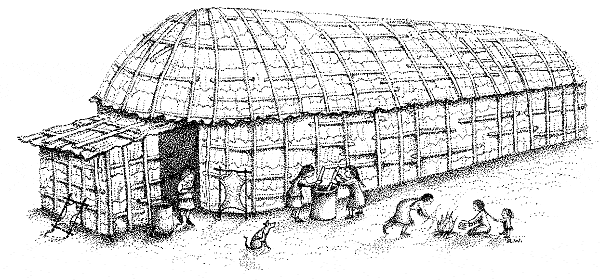
115.
What Native American group settled in New York State and organized a Confederacy?
a)
Cherokee
b)
Seminoles
c)
Iroquois
d)
Sioux