wayground logo

Free Printable Worksheets

Font size

S
M
L
XL
Worksheets

Bio Regents Review

Total questions: 176

Worksheet time: 3hrs 57mins

Name
Class
Date
1.
An organism that gets energy from eating other organisms is a ______________
a)
producer
b)
consumer
c)
decomposer
d)
prey
2.
A connection of food chains with many food energy paths in an ecosystem is a ____________
a)
ecosystem
b)
food web
c)
environment
d)
population
3.
An animal that is hunted and eaten for food is a 
a)
predator
b)
prey
c)
population
4.
Directs all cell activities "Brain or Control Center of cell"
a)
Lysosomes
b)
Nucleus
c)
ribosomes
d)
Mitochondria
5.
Jelly-like substance found inside cell that acts as a medium for chemical reactions within the cell
a)
Nuclear Membrane
b)
Golgi Body
c)
Cytoplasm
d)
Ribosome
6.
"powerhouse of the cell" breaks down sugar molecules to release energy, site of cellular respiration, double membrane, self-replicating, contains own DNA, cristae
a)
Mitochondria
b)
Chloroplast
c)
Cell Wall
d)
Vesicle
7.
"Storage tanks" Can hold food, water or waste for the cell
a)
Ribosomes
b)
Vacuole
c)
Chloroplast
d)
Nucleolus
8.
"Gatekeeper" Separates the cell from the rest of the environment and helps control what passes in and out of the cell.  Semi-permeable: allows some materials to pass through but not all
a)
Cell Wall
b)
Cytoplasm
c)
Mitochondria
d)
Cell Membrane
9.
Rigid outer layer made of cellulose that supports and protects the cell (plant, fungi, and bacterial cells)
a)
Nucleolus
b)
Golgi Body
c)
Cell Wall
d)
Cytoskeleton
10.
gives support and shape to the cell, made of proteins
a)
Cell Wall
b)
Cytoskeleton
c)
Cell Membrane
d)
Nuclear Membrane
11.
The organelle that uses the energy of sunlight to make food for the cell.
a)
Chloroplast
b)
Ribosome
c)
Mitochondria
d)
Nucleus
12.
Contains the Cell's DNA and is a part of the processes of growth, metabolism, and reproduction.
a)
Downy
b)
Nucleus
c)
Cell Wall
d)
Golgi Complex
13.
Which number is the arm in the image?
a)
3
b)
6
c)
9
d)
12
14.
Which number is the ocular lens in the image?
a)
1
b)
7
c)
8
d)
12
15.
Which number is the stage clips in the image?
a)
9
b)
10
c)
11
d)
12
16.
Which number is the light source in the image?
a)
9
b)
10
c)
11
d)
12
17.
Which number is the fine course adjustment knob in the image?
a)
3
b)
4
c)
5
d)
6
18.
Which number is the base in the image?
a)
3
b)
4
c)
5
d)
6
19.
Organelles that convert food into energy that a cell can use
a)
Nucleus
b)
Mitochondria
c)
Chloroplast
d)
Stomach
20.
Which is NOT an abiotic factor:
a)
soil
b)
air
c)
bacteria;
d)
water
21.
What is the definition of Prokaryote? 
a)
cell without a nucleus
b)
cell with a nucleus
c)
makes its own food
d)
one cell
22.
What is the definition of Eukaryote 
a)
cell without a nucleus
b)
cell with a nucleus 
c)
get its food
d)
many cells
23.
Which is known as the "bad" fat?
a)
Unstaurated
b)
saturated
c)
steroid 
24.
Holds a water molecule together
a)
glycongen
b)
hydrogen bond
c)
monosaccharide
d)
glucose 
25.
Water is a...
a)
polarmolecule
b)
non-polar molecule
26.
What is the pH level of a base?
a)
7-14
b)
0-7
c)
14-21
27.
What is the pH level of an acid?
a)
7-14
b)
14-21
c)
0-7
28.
If we would like to make a chicken lay larger eggs which method would be more apropriate?
a)
Selective breeding
b)
Natural Selection
c)
Invasive
d)
Biome
29.
Which biome has the greatest biodiversity
a)
Rainforest
b)
Forrest
c)
Desert
d)
Mars
30.
When energy is used to move molecules in or out of a cell, usually against a concentration gradient
a)
active transport
b)
passive transport
31.
When no energy is requires to move molecules across a membrane, the molecules move down a concentration gradient
a)
active transport
b)
passive trasport
32.
The two types of nucleic acids are
a)
Chlorophyll and Halitosis
b)
DNA & RNA
c)
Lipids and Sugars
d)
Glucose and Glycogen
33.
Which in NOT a Lipid?
a)
Saturated Fats
b)
Starch
c)
Cholesterol
d)
Earwax
34.
Which of the following is a large molecule of many simple sugars?
a)
Monosaccharide
b)
Disaccharide
c)
Polysaccharide
d)
Googlesaccharide
35.
Which of the following is a large molecule of one sugar?
a)
Monosaccharide
b)
Disasacchairde
c)
Polysaccharide
d)
Googlesaccharide
36.
Which of the following is a large molecule of two sugars?
a)
Monosaccharide
b)
Disasacchairde
c)
Polysaccharide
d)
Googlesaccharide
37.
The two strands of a DNA molecule are held together by:
a)
Ionic bonds
b)
Strong hydrogen bonds
c)
Weak hydrogen bonds
d)
Glue
38.
Which of the following is an example of: AB --> A+B
a)
Synthesis Reactions
b)
Decomposition Reactions
39.
Protein molecules are composed of long chains of __________________
a)
DNA
b)
amino acids
c)
RNA
d)
ribosomes
40.
Which of the following foods contain mostly lipids?
a)
fruit
b)
butter
c)
chicken
d)
carrots
41.
A student is preparing to run in a school track competition. For the quickest source of energy, the student should eat a food that contains a high percentage of...
a)
carbohydrates
b)
fat
c)
proteins
d)
sodium
42.
What is one way that fatty acids (lipids) are used in the body?
a)
for storing energy
b)
for encoding genetic information
c)
as the building blocks of antibodies
d)
as the building blocks of hemoglobin
43.
Which macromolecule contains genetic information?
a)
Proteins
b)
Carbohydrates
c)
Nucleic Acids
d)
Lipids
44.
Which macromolecule includes structural molecules & enzymes?
a)
Proteins
b)
Carbohydrates
c)
Nucleic Acids
d)
Lipids
45.
Which organic molecule?
a)
Proteins
b)
Carbohydrates
c)
Nucleic Acids
d)
Lipids
46.
Which organic molecule?
a)
Proteins
b)
Carbohydrates
c)
Nucleic Acids
d)
Lipids
47.
Which organic molecule?
a)
Proteins
b)
Carbohydrates
c)
Nucleic Acids
d)
Lipids
48.
Identify the type of building block (monomer) that makes up the polymer. 
a)
Monosaccharide
b)
Triglycerides
c)
Amino Acids
d)
Nucleotide
49.
When two monosaccharides are joined to make a disaccharide a ____________________ reaction occurs and water is _______________.
a)
hydrolysis; added
b)
hydrolysis; removed
c)
dehydration synthesis; added
d)
dehydration synthesis; removed
50.
What is this molecule?
a)
glucose
b)
polypeptide
c)
steroid
d)
triglyceride
51.
This picture is of which organic molecule
a)
nucleotide
b)
monosaccharide
c)
glycerol
d)
ATP
52.
What kind of chemical bond is formed when one atom gives electrons to another atom?
a)
magnetic
b)
ionic
c)
hydrate
d)
covalent
53.
What is the total number of atoms in the compound Ca(NO3)2?
a)
2
b)
9
c)
3
d)
5
54.
Is this substance acidic, basic, or neutral?
a)
Acidic
b)
Basic
c)
Neutral
55.
Is this substance acidic, basic, or neutral?
a)
Acidic
b)
Basic
c)
Neutral
56.
What does pH measure?
a)
Amount of Oxygen Ions
b)
Amount of Hydrogen Ions
c)
The amount of salt in a solution
d)
The density
57.
All organic compounds contain the element
a)
carbon
b)
nitrogen
c)
phosphorus
d)
sulfur
58.
The purpose of nucleic acids is to store
a)
Water
b)
Minerals
c)
Genetic Information
d)
Energy
59.
Enzymes are also known as
a)
organisms
b)
catalysts
c)
amino acids
d)
nucleic acids
60.
Who is the father of evolution?
a)
Darwin
b)
Mendel
c)
Newton
d)
Einstein
61.
What is another name for natural selection?
a)
survival of the smartest
b)
survival of the fastest
c)
survival of the biggest
d)
survival of the fittest
62.
When all of the organisms of a species have died it is called
a)
evolution
b)
extinction
c)
adaptation
d)
natural selection
63.
Which layer is the oldest?
a)
1
b)
2
c)
3
d)
4
64.
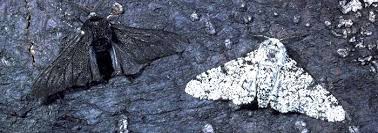
Predict which moth would increase in population
a)
light 
b)
dark
65.
When the DNA of an organism is altered it is referred to as…
a)
Mutation
b)
Gene Flow
c)
Genetic Drift
d)
Sexual Selection
66.
Which of the following is NOT an example of natural selection? 
a)
People selectively breeding hamsters.
b)
Insect populations developing resistance to certain pesticides.
c)
Bacteria becoming resistant to antibiotics.
d)
Male birds of certain species developing colorful feathers to attract female mates.
67.
A remnant or trace of an organism from the past is called a _______.
a)
Ancestor
b)
Skeleton
c)
Fossil
d)
Imprints
68.
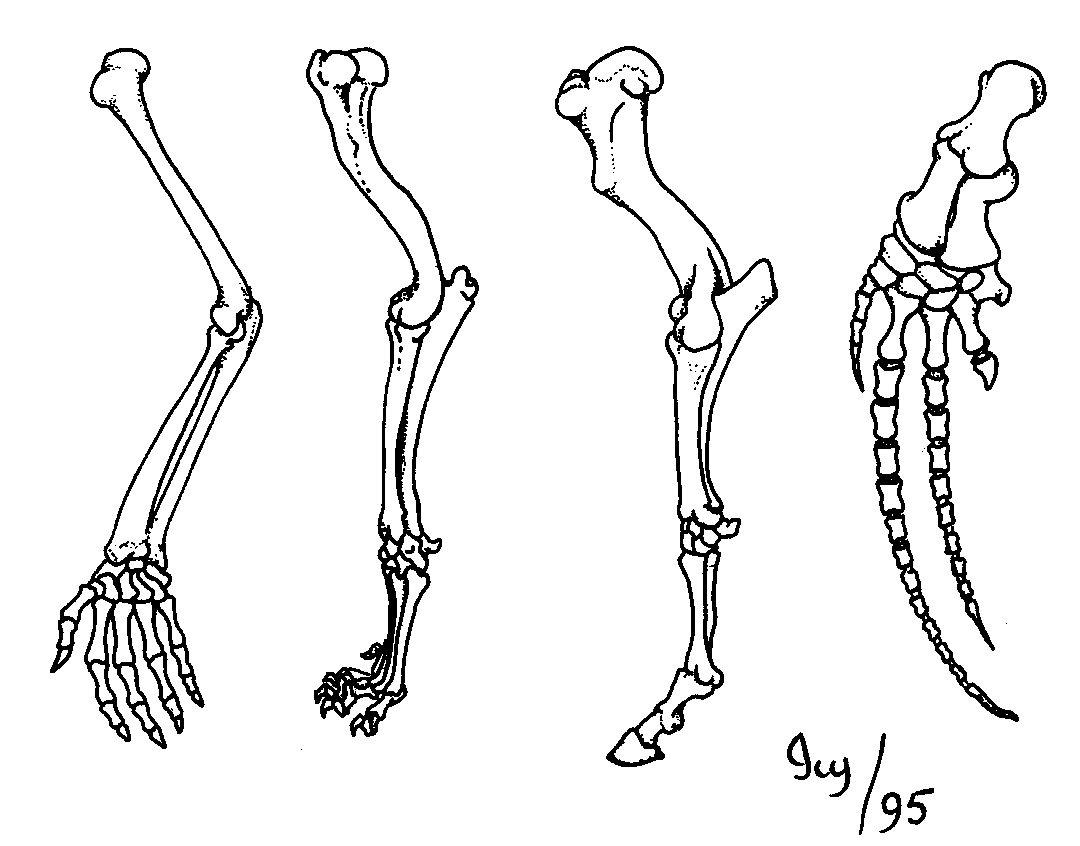
Structures with the same parts have different functions; suggests that organisms share a common ancestry
a)
vestigial structures
b)
homologous structures
c)
adaptive radiation
d)
fossil
69.
The ability of an organism to survive and reproduce in its specific environment 
a)
diversity.
b)
evolution
c)
adaptation
d)
 fitness
70.
What characteristic did Darwin observe about the finches on the Galapagos Islands?
a)
Their feathers 
b)
Genotypes 
c)
Their beaks
d)
Their body sizes
71.
Which of the following is NOT a factor that affects the process of natural selection?
a)
Overpopulation
b)
Fossils
c)
Competition
d)
Variations
72.
A well-tested concept that explains a wide range of observations is called a(an):
a)
hypothesis
b)
experiment
c)
cause and effect
d)
scientific theory
73.
In natural selection, the selective agent is the
a)
humans
b)
mutations
c)
breeders
d)
environment
74.
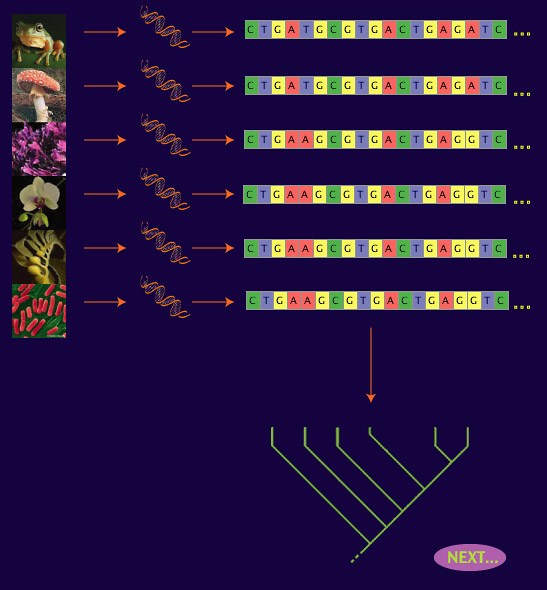
Two organisms that are closely related would have
a)
very similar DNA sequence
b)
exactly the same DNA sequences
c)
no proteins in common
d)
completely different DNA sequence
75.
How many parents do you have in asexual reproduction?
a)
1
b)
3
c)
2
d)
4
76.
How many parents do you have in sexual reproduction
a)
1
b)
2
c)
3
d)
4
77.
How much DNA do you receive from one parent in asexual reproduction?
a)
25%
b)
50%
c)
75%
d)
100%
78.
How much DNA do you receive from one parent in sexual reproduciton
a)
25%
b)
50%
c)
75%
d)
100%
79.
In sexual reproduction offspring look___________from their parent.
a)
Identical
b)
different
c)
the opposite 
d)
happy
80.
In asexual reproduction the offspring look ________ as their parent.
a)
identical
b)
different
c)
the opposite
d)
as happy
81.
Ivy and her grandmother both love shopping. Is her love of shopping an inherited or an acquired trait?
a)
inherited
b)
acquired
82.
Jasper and his dad both have very thick hair. Is Jasper's thick hair acquired or inherited?
a)
acquired
b)
inherited
83.
What is an advantage of asexual reproduction?
a)
It produces more offspring
b)
It produces fewer offspring
c)
It requires a mate
d)
It produces identical offspring
84.
Which of the following is a characteristic of a  disadvantage of Sexual Reproduction?
a)
diverse offspring
b)
identical to parent
c)
time and energy 
d)
adaptability 
85.
which of the following does not occur by mitosis?
a)
growth
b)
production of gametes
c)
repair
d)
development in the embryo
86.
Which of the following best describes meiosis?
a)
It is carried out in all tissues theat require cell replacement
b)
It occurs only in cells in the reproductive structures of an organism
c)
It happens in all of the tissues except the brain and spinal cord
d)
It is the first stage of mitosis
87.
function of mitosis
a)
genetic diversity though sexual reproduction
b)
cell reproduction and general growth and repair
88.
A male shark has 40 chromosomes in each of its sex cells. How many would be present in its body cells?
a)
20
b)
40
c)
80
d)
160
89.
How many daughter cells are produced in meiosis?
a)
4 daughter cells
b)
none of these
c)
3 daughter cells
d)
2 daughter cells
90.
How many daughter cells are produced in mitosis?
a)
4 new cells
b)
2 new cells
c)
One new cell
d)
none of these
91.
Meiosis produces ___________ while mitosis produces __________.
a)
Sex cells, body cells
b)
Body cells, sex cells
92.
Which process and type of resulting cells are represented?
a)
mitosis, gametes
b)
mitosis, body cells
c)
meiosis, gametes
d)
meiosis, body cells
93.
True or false: Even though I look identical to my mother, I only have half of her DNA.
a)
True
b)
False
94.
In mitosis, the two resulting cells are
a)
different from the starting cell and identical to each other.
b)
different from the starting cell and different from each other.
c)
identical to the starting cell and different from each other.
d)
identical to the starting cell and identical to each other.
95.
The passing of traits from parent to offspring 
a)
Heredity 
b)
Genetics 
c)
Hybrid 
d)
Probability 
96.
Who was the father of genetics 
a)
Sagan 
b)
Issac Newton 
c)
Gregor Mendel 
d)
C.jenkins 
97.
 which is heterozygous ?  
a)
Tt
b)
TT
98.
Which is homozygous ?
a)
Zz
b)
SS
99.
the genetic makeup of an organism
a)
heterozygous
b)
punnet square
c)
genotype
100.
what predicts the outcome
a)
genetic engineering
b)
punnet square
c)
probability
101.
Which of the following is a phenotype?
a)
BB
b)
Bb
c)
bb
d)
Blue eyes
102.
An allele whose trait only shows up when no dominant allele is present.
a)
hidden allele
b)
dominant allele
c)
recessive allele
d)
present allele
103.
G = green, g = yellow
The genotype for a yellow plant is...
a)
GG
b)
Gg
c)
gg
d)
all of the choices result in yellow
104.
Which answer best describes codominant alleles?
a)
Both are equally dominant
b)
Both are equally recessive
c)
Neither are dominant or recessive
105.
The maintenance of an organism’s internal environment is called:
a)
compensating
b)
homeostasis
c)
balancing
d)
routine
106.
The "cause" for something to happen is the
a)
response
b)
effect
c)
stimulus
d)
homeostasis
107.
a body system that controls and coordinates all body activities through electric impulses/messages between brain, spinal cord and nerves.
a)
endocrine system 
b)
nervous system
c)
nerve
d)
neuron
108.
brain cell /
nerve cell
a)
Dr. Suess tree
b)
neuron
c)
skin cell
d)
red blood cell
109.
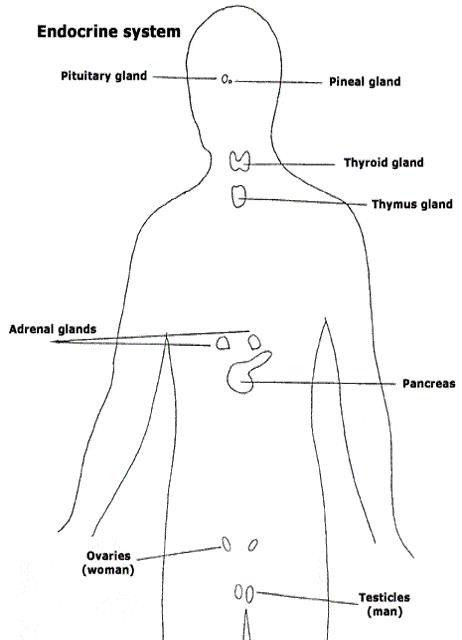
a body system that controls growth and homeostasis by secreting hormones from glands.
a)
skeletal system
b)
nervous system
c)
endocrine sytem
d)
integumentary system
110.
organ of the endocrine system that secretes hormones.
a)
heart
b)
gland
c)
brain
d)
skin
111.
chemical made by glands that tell cells to make something or respond in some way.
a)
acid
b)
enzyme
c)
perspiration
d)
hormone
112.
What is the largest outer defense of the body?
a)
Stomach Acid 
b)
Mucous Membranes
c)
Cilia
d)
Skin
113.
Which of these is NOT an outer defense?
a)
Stomach acid
b)
Mucus membrane 
c)
White blood cells
d)
Tears
114.
Which cells allow the body to to remember and recognize previous invaders?
a)
White Blood Cells
b)
Antigens 
c)
Phagocytes
d)
Lymphocytes
115.
What do white blood cells create to fight infections?
a)
Antibiotics
b)
Antigens
c)
Antibodies
d)
Leukocytes
116.
The coordination of activities in an organism that maintain homeostasis in a constantly changing environment is called:
a)
regulation 
b)
digestion
c)
synthesis
d)
respiration
117.
Name the levels of organization in the human body in order from smallest to largest:
a)
Tissue, organ, organ system
b)
Organ system, tissue, organs, cells
c)
Cells, tissue, organs, organ system
d)
Cells , organs, tissue, organ system
118.
When a threatening situation appears, what is the name of the instinctive mechanism used by animals to protect themselves?
a)
Flight or Run
b)
Hide and Seek
c)
Fight or Flight
d)
Run and Fight
119.
One basis for placing organisms into different domains is
a)
the chemical makeup of their cells.
b)
color.
c)
name. 
d)
habit.
120.
Which group of organisms includes only multicellular heterotrophs?
a)
protists
b)
animals
c)
bacteria
d)
plants
121.
A new one-celled organism is found by a scientist.  This organism is said to be 
a)
multicellular.
b)
prokaryotic.
c)
eukaryotic.
d)
unicellular.
122.
Which domain(s) include(s) only prokaryotes?
a)
Bacteria only
b)
Bacteria and Archaea
c)
Eukarya only
d)
Archaea only
123.
The source of energy for most autotrophs is
a)
heterotrophs.
b)
the sun.
c)
water.
d)
other autotrophs. 
124.
Based on this food chain, which of these organisms would use photosynthesis to get energy?
a)
blue crabs
b)
green algae
c)
gulls
d)
bacteria
125.
Which of these is a product of photosynthesis?
a)
sunlight
b)
carbon dioxide
c)
sugar
d)
water
126.
An ameba, a one-celled organism, can move, ingest, and transport materials within the cell, because it has 
a)
systems
b)
organelles
c)
tissues 
d)
 organs
127.
The diagram below represents a cell and some molecules in its environment. Which molecule would require the use of energy in order to be brought into the cell? 
a)
1
b)
2
c)
3
d)
4
128.
What is it called when cells specialize, and "choose" an identity?
a)
variation
b)
differentiation
c)
biodiversity
d)
abiotic factors
129.
after a zygote is formed, what happens next?
a)
meiosis
b)
mitosis
c)
differentiation
d)
fertilization
130.
Nicotine is only one of the many toxic chemicals inhaled while smoking. What effect can such toxic chemicals have on the body?
a)
they stimulate an increase in height
b)
they stimulate uncontrolled cell division
c)
they eliminate carbon dioxide from cells
d)
they eliminate chromosomes from many cells
131.
The inability of an organism to produce certain proteins can occur when an organism is lacking an enzyme needed to combine
a)
oxygen molcules
b)
simple sugars
c)
amino acids
d)
biological catalyts
132.
Riding a bicycle requires balance and constant adjustment and monitoring by the rider in order to continue cycling. Successfully riding a bicycle most directly results from the ability to
a)
 sexually reproduce
b)
 grow and develop
c)
detect and respond to change
d)
 metabolize food for energy
133.
 The first successful transplant of insulin producing cells from a living donor pancreas was completed in April 2000 in Japan. This enabled the body of the recipient to
a)
regulate fat concentration by a feedback mechanism
b)
provide protection against an infectious disease
c)
 slow down the heart rate after a period of activity ends
d)
 maintain blood sugar levels throughout the day
134.
Caffeine is a compound found in the seeds of many different plants, such as coffee beans, cola nuts, and cacao beans (the source of chocolate). The presence of this chemical in all three types of plants suggests that these plants
a)
inherited identical mutations
b)
share a common ancestry
c)
were exposed to the same type of radiation in the past 
d)
were cloned from a caffeine plant
135.
The corn we eat today is larger and has more kernels than the corn people first grew thousands of years ago. Which process is most likely responsible for the changes that have occurred? 
a)
mitosis
b)
direct harvesting
c)
succession
d)
selective breeding
136.
The chart below lists substances involved in the process of photosynthesis.
Which statement best describes how these substances interact in photosynthesis? 
a)
A and B combine to produce C and D.
b)
 C and D combine to produce A and B. 
c)
B and C combine to produce A and D. 
d)
A and C combine to produce B and D.
137.
Which substance is an inorganic molecule?
a)
water
b)
starch
c)
DNA
d)
fat
138.
Which substance is an organic molecule?
a)
water
b)
oxygen
c)
starch
139.
Students in a science class took their pulse rates before and after they ran in place for one minute. The class data showed that pulse rates increased with exercise. A graph of the data would look most like (SEE DIAGRAM)
a)
1
b)
2
c)
3
d)
4
140.
The technique used to separate the DNA for analysis is 
a)
genetic engineering
b)
chromatography
c)
electrophoresis
d)
protein synthesis
141.
Which molecules are needed to cut and copy segments of DNA?
a)
reproductive hormones
b)
carbohydrates
c)
antibodies
d)
biological catalysts
142.
 Evolution can occur at different rates; however, for evolution to occur, there must be
a)
variations within a species
b)
extinction of the species
c)
 asexual reproduction
d)
 no change in the genes of an organism
143.
 Farmers may someday clone their best milkproducing cow into a whole herd. What potential disadvantage might be important to consider in having such a large group of clones on one farm?
a)
It may be difficult to tell the animals apart.
b)
 Lack of variation may limit survival in the herd
c)
The cows could be fertilized by only one type of bull.
d)
 The cows could be mated only with each other.
144.
DNA replication occurs in preparation for
a)
mitosis, only
b)
 meiosis, only
c)
 both mitosis and meiosis
d)
 neither mitosis nor meiosis
145.
 Which occurrence represents an example of evolution?
a)
 Exposure to radiation reduces the rate of mutation in leaf cells.
b)
A mutation in a liver cell causes a person to produce an enzyme that is less efficient.
c)
Cells in a zygote eventually change into bone cells or skin cells.
d)
 Some antibiotics are almost useless, because pathogens have developed a resistance to these antibiotics.
146.
The paramecium is a single-celled organism that reproduces asexually. The offspring of a paramecium usually contain
a)
 only half of the genes of the parent cells
b)
 more DNA than the parent cell
c)
 genetic material identical to that of the parent cell
d)
 fewer mutations than the parent cell
147.
A mutation occurring in a human can be passed from parent to offspring when it occurs in a
a)
lung cell, due to exposure to a toxic gas
b)
 gamete formed in the ovary
c)
 body cell undergoing mitosis
d)
 heart cell with chromosome damage
148.

A tool that allows the user to identify an organism by choosing between two choices until the identity of the organism can be determined

a)

dichotomous key

b)

cladogram

c)

pedigree

d)

Punnett Square

149.

Growth and development of a plant.

a)

germination

b)

meiosis

c)

fermentation

d)

photosynthesis

150.

A TOOL THAT ALLOWS SCIENTISTS TO SEPARATE MIXTURES OF DNA MOLECULES ACCORDING TO SIZE

a)

gel electrophoresis

b)

graduated cylinder

c)

balance

d)

microscope

151.

A SUBSTANCE THAT CHANGES COLOR WHEN IT ENCOUNTERS CERTAIN CHEMICAL CONDITIONS

a)

indicator

b)

mood ring

c)

pigment

d)

chlorophyll

152.

A CHEMICAL USED TO MAKE CELL STRUCTURES MORE VISIBLE WHEN VIEWED UNDEER A MICROSCOPE

a)

stain

b)

indicator

c)

acid

d)

base

153.

The production of genetically identical organisms.

a)

cloning

b)

sexual reproduction

c)

selective breeding

d)

meiosis

154.

sperm and egg

a)

gamete

b)

body cell

c)

somatic cells

d)

cloned cells

155.

An iron containing red pigment which aids in the transport of oxygen by the blood.

a)

hemoglobin

b)

melanin

c)

enzyme

d)

catlayst

156.

A recessive genetic disease in which the hemoglobin is abnormal and the red blood cells have an abnormal sickle shape; found most frequently in individuals of African descent

a)

sickle cell anemia

b)

malaria

c)

Huntington's

d)

achondroplasia

157.

The main energy carrying molecule in the cell.

a)

ATP

b)

DNA

c)

RNA

d)

Sun

158.

The maximum number of organisms that an ecosystem

can support without deteriorating

a)

carrying capacity

b)

exponential growth

c)

mitosis

d)

photosynthesis

159.

of the cell, made of lipids and protein. It

controls what goes in and out of the cell

a)

cell membrane

b)

ribosome

c)

nucleus

d)

endoplasmic reticulum

160.

The production of genetically identical organisms.

a)

cloning

b)

meiosis

c)

gene splicing

d)

sexual reproduction

161.

All the plant and animal populations in a given area

a)

community

b)

population

c)

ecosystem

d)

biome

162.

Organisms of decay which convert organic compounds

into inorganic compounds

a)

decomposers

b)

carnivores

c)

herbivores

d)

omnivores

163.

The movement of molecules from an area of high

concentration to an area of low concentration without

the use of energy

a)

diffusion

b)

active transport

c)

photosynthesis

d)

mitosis

164.

A series of interconnecting food chains in an

ecosystem. Arrows show the direction that energy is

moving in.

a)

food web

b)

food chain

c)

energy pyramid

d)

biomass pyramid

165.

The process of change in living things through time

a)

evolution

b)

meiosis

c)

mitosis

d)

cloning

166.

The organelle that is the site of protein synthesis in the

cell

a)

ribosome

b)

nucleus

c)

Golgi body

d)

chloroplast

167.
In an experiment testing the effects of various brands of fertilizer on sunflower growth, the growth of the sunflower plant would be
a)
the independent variable
b)
the dependent variable
c)
a controlled variable (aka- a constant)
168.
In an experiment testing the effects of various brands of fertilizer on sunflower growth, the type of fertilizer would be
a)
the independent variable
b)
the dependent variable
c)
a controlled variable (aka- a constant)
169.
The nonliving aspects of an ecosystem.
a)
Abiotic factors
b)
Biotic factors
170.
The living portions of the ecosystem.
a)
Biotic factors
b)
Abiotic factors
171.
An organism has 16 chromosomes in its skin cell. How many chromosomes are in its heart cells?
a)
16
b)
32
c)
8
d)
64
172.
The part of the cell that is used for storage.
a)
Nucleus
b)
Cell Membrane
c)
Mitochondria
d)
Vacuole
173.

An organism's particular role in the community

a)

niche

b)

habitat

c)

environment

d)

community

174.
What is the term for each step in the transfer of energy and matter within a biological community?
a)
energy path
b)
food web
c)
trophic level
d)
food pyramid
175.
A graphic illustration that shows each trophic level and the amount of useable energy contained within.
a)
Food chain
b)
Food web
c)
Energy Pyramid
d)
All of these
176.
True or False:  It is possible for a carnivore to be a producer.
a)
False
b)
True