
 Worksheets
History II review
Total questions: 100
Worksheet time: 1hrs 4mins
Name
Class
Date
1.

During Reconstruction the South was under Military rule
a)
True
b)
False
2.
What amendment abolished slavery?
a)
13th
b)
14th
c)
15th
d)
16th
3.
The 13th Amendment of the United States Constitution...
a)
guarantees African Americans free speech
b)
Outlawed slavery in the United States
c)
gave African Americans the right to vote
d)
rejoined the South and the North
4.
The 14th Amendment of the United States Constitution...
a)
Gave African Americans citizenship
b)
Gave African Americans the right to vote
c)
Freed the slaves
d)
Gave landowners the right to sharecrop
5.
Which of the following was not a goal of Reconstruction?
a)
Reunite the North and the South
b)
Rebuild the South
c)
Develop the system of sharecropping
d)
Determine what to do with African Americans
6.
Which of the following was not a part of the Freedman's Bureau?
a)
Helped reconnecting slaves with their families
b)
Helped create African American Colleges
c)
Helped feed slaves
d)
Forced African Americans to become sharecroppers
7.

What group in Congress felt that Lincoln's plan was too lenient?
a)
Deciduous Democrats
b)
Radical Republicans
c)
Wistful Whigs
d)
Fancy Federalists
8.
What problem did many farmers have under the sharecropping system?
a)
They were forced to grow cash crops instead of food.
b)
They often were trapped in a cycle or circle of debt.
c)
Many sharecroppers were forced to buy goods on credit.
d)
All choices are true.
9.
Laws passed by southern states soon after the Compromise of 1877. These laws legalized segregation whites and blacks to use separate facilities.
a)
Jim Crow Laws
b)
Black Codes
c)
Freedman's Bureau
d)
Reconstruction
10.
These were laws that made it illegal for African Americans to live or work in certain areas and allowed whites to arrest African Americans who were not working. Once arrested they would be forced to work for white landowners.
a)
Freedman's Bureau
b)
Reconstruction
c)
Black Codes
d)
Jim Crow Laws
11.
The process of rebuilding the South after the Civil War.
a)
Reconstruction
b)
Freedman's Bureau
c)
Black Codes
d)
Jim Crow Laws
12.
The organization put in place after the Civil War to provide food, clothing, health care and education in the South was known as:
a)
The Civil Rights Committee
b)
The Freedmen's Bureau
c)
The Welfare Committee
d)
The Salvation Army
13.
List an obstacle that settlers faced traveling west.
a)
mountains
b)
crossing rivers
c)
the great plains
d)
all of the above
14.
How did the development of the railroad impact the bison population?
a)
the amount of bison did not change
b)
the amount of bison decreased
c)
the amount of bison increased
d)
bison migrated east
15.
What impact did the railroads have on Native Americans?
a)
the railroads helped the NA move east
b)
Native Americans got jobs on the railroads
c)
the railroads limited their land and decreased their food supple and resources
d)
the railroads increased the amount of land the NA had
16.
The belief that the US had a right and duty to expand across the North American contitent was known as
a)
The Great Expansion
b)
Manifest Destiny
c)
Oregon Fever
d)
The Monroe Doctrine
17.
Where were Native Americans forced to relocate?
a)
States
b)
Towns
c)
Reservations
d)
Camps
18.
Journalist who exposed the evils of Big Businesses were called ____________
a)
Mugwump
b)
Author
c)
Muckraker
d)
Howard Taft
19.
Progressives believed in massive ___________ in terms of working conditions and safe food to eat.
a)
destruction
b)
Reforms
c)
construction
20.
In 1919 women's __________ was reflected with the 19th amendment being added to the Constitution.
a)
Conservatives
b)
Social
c)
Suffrage
d)
Initiative
21.

Wrote a novel about the meat packing industry.
a)
Ida Tarbell
b)
Upton Sinclair
c)
John Upton
d)
Eugene Debs
22.

Which Amendment gave women the right to vote?
a)
18
b)
19
c)
20
d)
21
23.

Which agency was created as a direct result of a novel about the meatpacking industry?
a)
Food and Drug Administration
b)
Federal Trade Commission
c)
Meat Packing Administration
d)
World Health Organization
24.
Teddy Roosevelt reduced the power of these types of businesses which controlled the American economy?
a)
horizontal monopolies
b)
small businesses
c)
corporations
d)
trusts
25.
Which amendment granted Prohibition?
a)
16
b)
17
c)
18
d)
19
26.
Why did Upton Sinclair write The Jungle (even though he "missed")?
a)
show racial discrimination
b)
show the poor working conditions in factories
c)
establish dietary guidelines
d)
fix drug regulations
27.

Immigration push factors are…
a)
reasons people come to a new place
b)
reasons people leave their homelands
c)
reasons people begin working
d)
reasons people stop working
28.

The Statue of Liberty was….
a)
A gift from England, the first thing immigrants to N.Y. saw
b)
A gift from France, where all immigrants were processed
c)
A gift from France, the first sign of America that many immigrants saw
d)
A gift from Germany to indicate the United States friendship with them
29.

What was the west coast version of Ellis Island?
a)
San Fransisco Bay
b)
Heaven Island
c)
Angel Island
d)
Asian Island
30.

What was the first Immigration Law in the United States?
a)
Italian Exclusion Act of 1882
b)
Irish Exclusion Act of 1882
c)
Japanese Exclusion Act of 1882
d)
Chinese Exclusion Act of 1882
31.

Where did most immigrants live?
a)
Most lived in farming communities
b)
Most lived in the suburbs
c)
Most lived in big cities
d)
Most lived around lakes
32.

This immigration inspection site was located on the East Coast and opened in 1892.
a)
Angel Island
b)
The Statue of Liberty
c)
Ellis Island
d)
New York City
33.

Where did many immigrants in the East work?
a)
Fisherman
b)
Ranches
c)
Farms
d)
Factories
34.
In 2010, where did most American immigrants migrate from?
a)
Ireland
b)
Mexico
c)
England
d)
China
35.
Which of the following countries was not an Allied Power in World War 1?
a)
Germany and Italy
b)
the United States and France
c)
Britain and France
d)
Germany and Austria-Hungary
36.
9) WWI began when Austria-Hungary declared war on Serbia one month after:
a)
Serbia tried to take more of Austria-Hungary's land.
b)
Serbia burned their flag.
c)
Archduke Ferdinand and his wife were killed.
d)
Serbia won more Olympic medals.
37.
When World War I began, the official United States policy was
a)
to enter on the side of the Allied Powers
b)
the enter on the side of the Central Powers
c)
to remain militarily and politically neutral
d)
to support the Central Powers by providing war materials
38.
Which of Woodrow Wilson's proposals was included in the Treaty of Versailles?
a)
the League of Nations
b)
reparations from Germany
c)
removal of all trade barriers
d)
restoration of the Russian monarchy
39.
On May 7, 1915, a German submarine torpedoed and sank
a)
the Maine
b)
The Titanic
c)
The Lusitania
d)
The Queen Mary
40.
Which answer summarize the Schlieffen Plan that Germany created to prepare for a two-front war?
a)
Attack France first, then Russia.
b)
Attack Russia first, then France.
c)
Send half of the army to France and half to Russia.
d)
Ally with Russia to fight France.
41.
What is the most probable link between militarism and imperialism?
a)
A country gains colonies, its military grows to protect them
b)
Army expands, the country wants colonies to recruit troops
c)
Colonies, grow, the military stages training exercises there
d)
Army expands, a country seeks colonies to prevent protesting
42.
Which of these is a type of fighting used in World War One?
a)
Trench Warfare
b)
Atomic Bomb
c)
Guerilla Warfare
d)
No-Man's Land
43.
What was the Zimmerman Note?
a)
The German policy of attacking all ships entering or leaving Britain
b)
Wilson's speech concerning why the U.S should enter WWI
c)
A proposal by Germany that Mexico attack the US in return for territory
d)
a note left behind by a Serbian Nationalist in Austria-Hungary
44.
Payments for war damages were known as
a)
nationalism
b)
separatism.
c)
reparations.
d)
retaliations.
45.
What event led Great Britain to declare war on Germany?
a)
The Germans sank British supply boats
b)
The Germans sank American ships
c)
Germany invaded Russia
d)
Germany invaded Belgium
46.
Which country switched alliances in 1915 and joined the Allies?
a)
Italy
b)
Germany
c)
Austria-Hungary
d)
Cuba
47.

Who was the President of the United States during WWI?
a)
Woodrow Wilson
b)
Grover Cleveland
c)
Teddy Roosevelt
d)
Franklin D. Roosevelt
48.
An arms race is...
a)
Controlling another country
b)
Making the military stronger
c)
Pride for your country
d)
Competing to build more weapons
49.
All of the following were dictators of governments in the 1930s and 1940s EXCEPT:
a)
Neville Chamberlain
b)
Joseph Stalin
c)
Adolf Hitler
d)
Benito Mussolini
50.
The term "blitzkrieg" was a military strategy that depended on what?
a)
A system of fortifications
b)
The ability to make a long, steady advance
c)
Out-wiating the opponent
d)
Surprise and quick overwhelming force
51.
In an effort to avoid a second "world war", when did Great Britain and France adopt a policy of appeasement toward Germany?
a)
After France was invaded and divided by Germany
b)
When the United States declared war against Germany
c)
When Germany declared war against Britain and France
d)
Before the war began
52.
The United States entered World War II as a direct result of what?
a)
The attack on Pearl Harbor
b)
The invasion and division of France
c)
The invasion and division of Poland
d)
Attacks on U.S. ships in the Atlantic
53.
Which of the following was a false promise from Hitler not to take any more land in Europe; only take a small part of Czechoslovakia that had mostly German speaking people?
a)
The Munich Pact
b)
The Lend-Lease Act
c)
The Treaty of Versailles
d)
The Atlantic Charter
54.
Which nations came to be known as the Axis powers after they signed a mutual defense treaty in 1940?
a)
Germany, Italy, and the Soviet Union
b)
Germany, Japan, and Italy
c)
Germany, Italy, and Austria
d)
Germany, Japan, and Spain
55.
Which of the following was the leader of Japan's dictatorial government during the 1930s and 1940s?
a)
Adolph Hitler
b)
Hideki Tojo
c)
Benito Mussolini
d)
Joseph Stalin
56.
Which country invaded China in 1938 as part of a mass campaign of territorial expansion?
a)
Italy
b)
Japan
c)
Germany
d)
The Soviet Union
57.
The Germans first successfully used the blitzkrieg tactics by teaming up with the Soviets in an attack on what Eastern European country that led to Great Britain declaring war on Germany?
a)
Poland
b)
France
c)
Finland
d)
Czechoslovakia
58.
What was the Lend-Lease Act?
a)
A policy allowing the president to provide resources and weapons to Great Britain at the beginning of World War II
b)
A statement of war aims compiled by Roosevelt and Churchill
c)
An order to shoot German U-boats on sight
d)
A nonaggression pact between Germany and the Soviet Union
59.
Which of the following methods did the German military use to deal with those considered "undesirables" (mostly Jews) in Nazi Germany or Nazi-controlled areas?
a)
Deportation
b)
Death Camps
c)
Concentration Camps
d)
All of the answer choices given
60.
Which event did FDR refer to when he said, "A date which will live in infamy?"
a)
The German invasion of France
b)
The German bombing of London
c)
The Japanse-Internment Camps
d)
The Pearl Harbor Attack
61.
Why was island hopping important?
a)
It enabled island tribes to move between islands in order to escape the fighting during WWII
b)
It helped increase trade between America and the Caribbean islands during WWII
c)
It allowed the U.S. to capture key islands in the Pacific and use them in order to get closer to Japan
d)
It was a popular dance during the 1940s that helped lift morale on the home front
62.

What type of economy did the Soviet Union have?
a)
socialist
b)
capitalist
c)
mercantile
d)
feudal
63.

What two nations were in competition with each other during the Cold War?
a)
Spain and Portugal
b)
England and France
c)
Germany and Italy
d)
United States and Soviet Union
64.

What was the term 'iron curtain' used to describe the division of?
a)
North and South Vietnam
b)
East and West Asia
c)
North and South Korea
d)
East and West Europr
65.

President Truman adopted a new foreign policy during the Cold War know as the Truman Doctrine. What was the main goal of the Truman Doctrine?
a)
To expand trade with Europe
b)
To limit the build up of nuclear weapons
c)
To stop the spread of communism
d)
to send financial aid to Europe
66.

The United States got involved in conflicts like Korea and Vietnam because they were afraid of the domino theory. What is the domino theory?
a)
If one country fell to democracy, others would follow
b)
If one country fell to communism, others would follow
67.

How did the Marshall plan try to stop the spread of communism in Western Europe after WWII?
a)
by providing government housing for refugees
b)
by providing military assistance to Vietnam
c)
by providing money to stop poverty
68.

Why did the United States become involved in the Korean War?
a)
to contain communism
b)
to colonize Korea
c)
to spread communism
d)
to Christianize Koreans
69.

Where was Korea divided?
a)
18 parallel
b)
34 parallel
c)
38 parallel
d)
15 parallel
70.

In 1950, Korea fought a civil war over the spread of communism. Communists from the north tried to take over the south. What role did he US play in this war?
a)
The US and its allies went to Vietnam to fight Korean Communists.
b)
The US and its allies join the fight to keep communism from spreading.
c)
The US and its allies did not join the Korean War.
d)
The US and its allies fought to defend the North.
71.

Where was Vietnam divided?
a)
17th Parellel
b)
20thParellel
c)
38th Parellel
d)
34th Parellel
72.
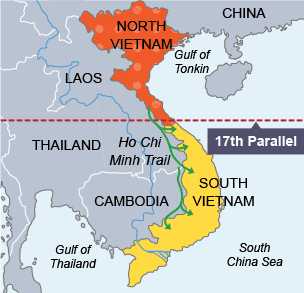
In the 1950s, the United States became involved in the Vietnam War. Why did the United States become involved in this war?
a)
to prevent the collapse of the government of North Vietnam
b)
to stop Vietnam from taking over Hong Kong
c)
to stop the spread of communism to South Vietnam
d)
to prevent attacks against United States shipping
73.

How did the US respond to finding out that the Soviets had missiles in Cuba?
a)
They sent the Air Force to bomb Cuba
b)
They began placing missiles in the Soviet Union.
c)
They placed a naval blockade around Cuba.
d)
They invaded Cuba and the Soviet Union.
74.

Who were the two participants in the Space Race?
a)
The US and Cuba
b)
China and US
c)
The USSR and US
d)
US and North Vietnam
75.

What was the name of the first satellite in space launched by the Soviet Union?
a)
Gagarin
b)
Apollo 11
c)
Sputnik
d)
Apollo 13
76.
President Franklin Roosevelt won the election of 1932. The country was in the Great Depression, and Roosevelt introduced the New Deal. Which was the MOST important goal of President Franklin Roosevelt's New Deal programs?
a)
to strengthen the economy
b)
to avoid going to war
c)
to improve public education
d)
to end racial discrimination
77.

What was the "New Deal" of the 1930s?
a)
a government program that gave free land to homesteaders
b)
a government program that helped women get the vote
c)
a government program that spread civil rights throughout the country
d)
a government program designed to help people during the depression
78.
President Franklin Roosevelt asked Congress to pass a series of acts called the New Deal. Which is one way the New Deal helped people during the Great Depression?
a)
It gave all people the right to vote.
b)
It created programs to put people back to work.
c)
It let all new immigrants become American citizens.
d)
It let people travel around the country freely.
79.
The Great Depression that began in 1929 hit farmers especially hard. Farmers had not been doing well in the 1920s and several years of severe drought turned the land into a "dust bowl." What was an immediate result of this?
a)
Many farmers decided to grow crops that did not use as much water.
b)
The government built large dams in the West for irrigation.
c)
Many farmers and their families lost their farms and moved west.
d)
The government helped farmers by buying their land and equipment.
80.
In 1929, the stock market crash was the beginning of the "Great Depression." Which of the following BEST describes the Great Depression?
a)
The depression was severe, but only in the United States.
b)
Governments acted quickly and the depression only lasted two years
c)
The depression caused revolutions all across the world.
d)
Many countries around the world experienced the economic depression
81.
When the stock market crashed in 1929, Herbert Hoover was president of the United States. The president who followed President Hoover began the New Deal, a program to help people during the Great Depression. This president was
a)
Warren Harding
b)
Calvin Coolidge
c)
Franklin Roosevelt
d)
Herbert Hoover
82.
In 1929, the United States entered an economic slowdown called the Great Depression. One of the early events was the stock market crash. What was a major cause of the stock market crash?
a)
Stock prices went up so fast that investors could not keep up with the changes.
b)
Stock prices fell, investors panicked and sold their stocks, which led to more panic.
c)
The government decided to close the stock market in New York.
d)
People decided to invest their money in stock markets in Europe.
83.

a)
Margaret Mitchell
b)
Charles Lindbergh
c)
Jesse Owens
d)
Duke Ellington
84.
Which of the following is a characteristic of daily life in the 1920s?
a)
Many
Americans lost all of their money in the Stock Market crash.
b)
Many Americans did not have jobs
and there were failed banks and businesses.
c)
Many Americans experienced an economic boom,
furthered by new technologies.
d)
All Americans experienced an economic boom,
furthered by new technologies.
85.
What positive effect did the migration north have on African Americans?
a)
Segregation
b)
Jim Crow Laws
c)
New job oppurtunities
d)
New sharecropping opportunities
86.
During the Harlem Renaissance African Americans had the opportunity to celebrate their culture in all of the following ways EXCEPT…
a)
Art
b)
Clothing
c)
Music
d)
Writing
87.
Which of the following best describes a factor that led to the crash of the stock market?
a)
Many Americans began buying more stocks
b)
Values of stocks increased due to mass production
c)
Factories were not able to produce goods for consumers
d)
Factories were overproducing and began to lay off workers
88.
Which of the following was an effect of unemployment during the Great Depression?
a)
Consumers
rushed to put all of their money in the banks.
b)
Consumers
made many purchases, so businesses boomed.
c)
Consumers
could not or did not want to buy, so some businesses failed.
d)
Consumers
could not buy goods fast enough before businesses sold out.
89.
What was an effect of the Japanese bombing of the Unites States Pacific fleet at Pearl Harbor?
a)
The United States began to help Britain with supplies.
b)
The United States economy quickly recovered from the Great
Depression.
c)
President
Roosevelt asked the United States Congress to declare war on Japan.
d)
President
Roosevelt asked the United State Congress to declare war on Italy and Germany.
90.
The United States dropped two atomic bombs in August 1945. What impact did these bombs have on the outcome of World War II?
a)
Germany,
Italy, and Japan joined to form the Axis Powers.
b)
Japanese
planes carried out a surprise attack on Pearl Harbor.
c)
Led to the surrender of the Germans and ended World War II.
d)
Led
to the surrender of the Japanese and ended World War II.
91.
During World War II, the nation was encouraged to “Do Your Part” in the war effort. Which of the following was NOT an example of this?
a)
raitioning
b)
Victory Garden
c)
scrap metal drives
d)
community soup kitchens
92.
Which president integrated the military and federal government?
a)
Truman
b)
Eisenhower
c)
Roosevelt
d)
Kennedy
93.
Integrated or segregated: Plessy v Ferguson
a)
Integrated
b)
Segregated
94.
This president sent federal troops to Arkansas to integrate the schools in Little Rock
a)
Truman
b)
Eisenhower
c)
Roosevelt
d)
Kennedy
95.
This NAACP lawyer used the 14th Amendment to work to integrate public schools
a)
Harry Truman
b)
Thurgood Marshall
c)
Antonin Scalia
d)
Sarah O'Connor
96.

How did Martin Luther King, Jr.'s "I Have a Dream" speech impact the civil rights movement?
a)
It called for violent resistance, resulting in riots across the country.
b)
It inspired many people, giving strength and momentum to the movement.
c)
It was largely ignored by the movement, though regarded as a superbly written speech.
d)
It was considered controversial and fragmented the movement into small groups.
97.

Which U.S. Supreme Court case is the subject of the excerpt above?
a)
Sweatt v. Painter
b)
Plessy v. Ferguson
c)
Hernandez v. Texas
d)
Brown v. Board of Education
98.

What event is being described in the picture which used non-violent activist actions?
a)
Freedom Riders
b)
Montgomery Bus Boycott
c)
Greensboro Sit-ins
d)
March on Washington
99.

After Brown v. Board of Education, 9 AA students were admitted into a High School. The governor and state national guard stood in front of the doors stopping the admission. President Eisenhower sent federal troops to escort the students. Where did the event take place?
a)
Little Rock, Arkansas
b)
Montgomery, Alabama
c)
Washington DC
d)
Del Rio, Texas
100.

Which event best completes the timeline shown above?
a)
Non-violent Freedom Riders attacked
b)
Plessy v. Ferguson separate but equal doctrine established
c)
First U.S. Supreme Court Justice, Sandra Day O’Connor appointed
d)
President Truman ordered the desegregation of the U.S. Armed Forces
100 %

