
 Worksheets
Year 9 sceince
Total questions: 24
Worksheet time: 20mins
Name
Class
Date
1.

The following is a picture of what type of mirror?
a)
Convex (diverging) mirror
b)
Concave (converging) mirror
c)
Plane Mirror
d)
Flat Mirror
2.
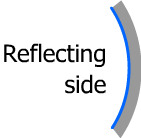
The following is a picture of what type of mirror?
a)
Convex (diverging) Mirror
b)
Concave (converging) Mirror
c)
Plane Mirror
d)
Flat Mirror
3.
A material that reflects or absorbs all of the light that strikes it is called which of the following?
a)
Transparent
b)
Translucent
c)
Diffuse
d)
Opaque
4.
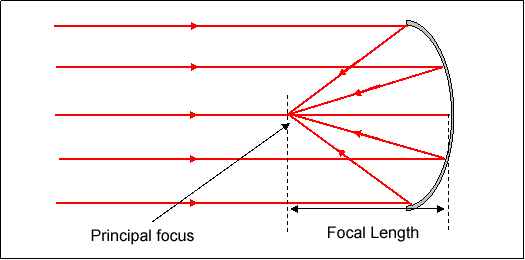
This is an example of a __________ mirror.
a)
Concave
b)
Convex
c)
Plane
d)
Magnifying
5.
Convex mirrors cause light to spread out.
a)
True
b)
False
6.
What does The law of reflection state?
a)
the angle the incident ray makes with a line drawn perpendicular to the surface of the mirror.
b)
shows how rays change direction when they strike mirrors and pass through lenses.
c)
The angle of reflection is equal to the angle of incidence.
7.
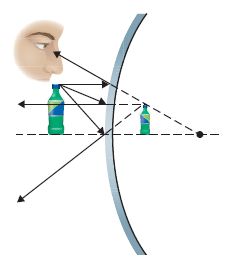
What kind of mirror is shown here?
a)
plane
b)
concave
c)
convex
d)
diffuse
8.
a mirror with a surface that curves inward like the inside of a bowl
a)
concave mirror
b)
convex mirror
c)
plane mirror
d)
flat mirror
9.

What does it mean to reflect?
a)
bounce off
b)
bend
c)
refract
d)
energy
10.

Which images are opaque?
a)
A & C
b)
A,C,E, & F
c)
D, E, & F
d)
A & E
11.
Smooth surfaces _______ a lot of light.
a)
reflect
b)
bend
c)
absorb
d)
twist
12.
Another name for light bending is ....
a)
Reflaction
b)
Absorbing
c)
Refraction
d)
mirror
13.

The Law of Reflection:
The angle of incidence is _________ the angle of reflection
The angle of incidence is _________ the angle of reflection
a)
bigger than
b)
the same as
c)
smaller than
14.
What type of image is formed when rays of light actually intersect?
a)
real
b)
virtual
c)
projected
d)
curved
15.
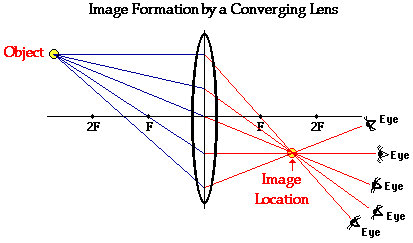
This image is.....
a)
inverted and smaller
b)
inverted and larger
c)
not inverted and smaller
d)
not inverted and larger
16.
An image that you can see , but does not really exist is called which of the following?
a)
Real Image
b)
Fake Image
c)
Virtual Image
d)
Digital Image
17.
a real image...
a)
is produced by virtual rays and can be projected on a screen
b)
is produced by real rays and cannot be projected on a screen
c)
is produced by virtual images and cannot be projected on a screen
d)
is produced by real rays and can be projected on a screen
18.

Is a convex lens thicker or thinner in the middle?
a)
Thicker
b)
Thinner
19.

_____ is a lens that is thicker in the middle and makes an object appear bigger.
a)
prism
b)
convex lens
c)
concave lens
d)
mirror
20.

______ is a lens that is thicker on its edges and makes an object appear smaller?
a)
mirror
b)
convex lens
c)
concave lens
d)
prism
21.
Which lens represents the path light takes through a concave lens?
a)
b)
c)
d)
22.
Which figure represents the path light takes through a convex lens?
a)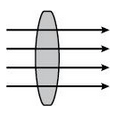
b)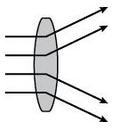
c)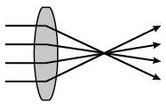
d)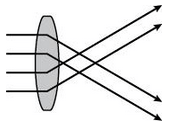
23.

What type of lens is used in the shown instrument?
a)
concave lens
b)
convex lens
c)
reflection lens
d)
reduction lens
24.

What type of lens creates the image seen in the eyeglasses?
a)
convex
b)
concave
c)
reflection
d)
plane
100 %

