
NEW
Font size
S
M
L
XL
 Worksheets
Chapter 7 Exam
Total questions: 51
Worksheet time: 57mins
Name
Class
Date
1.
Find the total magnification:
Eyepiece = 10X
Objective lens = 55X
Eyepiece = 10X
Objective lens = 55X
a)
10x
b)
55x
c)
65x
d)
550x
2.
The ___ is the basic unit of structure and function of organisms
a)
Atom
b)
Cell
c)
Matter
d)
All of these
3.
Which statement is a part of the cell theory?
a)
All cells come from pre-existing cells
b)
Bacteria are prokaryotic cells
c)
Eukaryotic cells are complex
d)
Humans are multicellular
4.
Which organelle is missing in prokaryotic cells?
a)
Nucleus
b)
DNA
c)
Ribosomes
d)
Plasma membrane
5.
Who looked at cork and named the cell?
a)
Robert Hooke
b)
Van Leeuwenhoek
c)
Robert Brown
d)
Francesco Redi
6.
Compared to the eukaryotic cell, prokaryotic cells are
a)
More complex
b)
Less complex
c)
Full of membrane-bound organelles
d)
Very large
7.
What 3 things do all cells have in common?
a)
Cell wall, ribosomes, genetic material
b)
Cell membrane, nucleus, genetic material
c)
Cell wall, ribosomes, nucleus
d)
Cell membrane, ribosomes, genetic material
8.
What is the difference between a prokaryotic cell and a eukaryotic cell?
a)
Eukaryotes have DNA, prokaryotes don't have DNA
b)
Eukaryotes are animal cells, prokaryotes are plant cells
c)
Eukaryotes have a nucleus inside the cell, prokaryotes don't have a nucleus
d)
Prokaryotes have a nucleus, eukaryotes don't have a nucleus
9.

According to cell theory, where did this cell come from?
a)
Another living cell
b)
Energy from sun
c)
A multicellular organism
d)
The nonliving environment
10.

This image shows the detailed structure of the tiny mitochondria organelle. Which microscope most likely took this image?
a)
Compound Light
b)
Scanning Electron
c)
Dissecting
d)
Transmission Electron
11.
Which microscope would you use to see a bed bug in 3D, with a magnification of about 500,000X?
a)
Compound Light
b)
Scanning Electron
c)
Dissecting
d)
Transmission Electron
12.

Which scientist did NOT contribute to the cell theory?
a)
Anton Van Leeuwenhoek
b)
Robert Hooke
Robert Hooke
c)
Albert Einstein
d)
Matthias Schleiden
Matthias Schleiden
13.

Who was the "scientist" who observed pond water and teeth scrapings in his single lens microscope?
a)
Hooke
b)
Leeuwenhoek
c)
Schleiden
d)
Virchow
14.

For generations, people believed in "spontaneous generation." Spontaneous generation is the idea that . . . .
a)
..... all living things are made of cells
b)
... all cells come from other cells.
c)
living things could "generate" from non-living matter.
d)
cells are the basic unit of structure and function
15.
In which eukaryotic organelle is the genetic material found?
a)
Endoplasmic Reticulum
b)
Golgi Complex
c)
Nucleolus
d)
Nucleus
16.

Using this image, what organelle is C?
a)
Cell Wall
b)
Mitochondria
c)
Large Cell Vacuole
d)
Chloroplast
17.
What is the function of the vacuole?
a)
Sac that stores water, nutrients, and waste products
b)
Sac filled with digestive chemicals
c)
Jelly-like substance within the plasma membrane
d)
stack of membranes that packages chemicals
18.
Where does photosynthesis occur?
a)
mitochondria
b)
stomata
c)
xylem
d)
chloroplast
19.

What cell part is NOT found in all cells?
a)
Cell Wall
b)
Cell Membrane
c)
Cytoplasm
d)
Genetic Material
20.
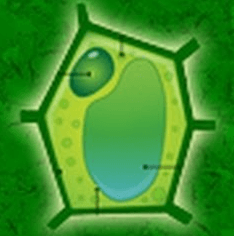
A rigid layer that lies outside the cell's membrane is...
a)
Cytoskeleton
b)
Cilia
c)
Cell Wall
d)
Flagella
21.

What does this organism use for movement?
a)
Pseudopod
b)
Cilia
c)
Flagella
d)
legs
22.
A cell placed in a hypertonic solution will
a)
Stay the same
b)
Shrink- get smaller
c)
Swell- get bigger
23.
When both inside and outside of a cell have the same concentration of water it is said that the cell has reached a state of ___________.
a)
osmosis
b)
equilibrium
c)
diffusion
d)
hypertonic
24.
What does selectively-permeable mean?
a)
Only certain substances are able to pass through
b)
Nothing is able to pass through
c)
Everything is able to pass through
25.

Which way will the water molecules move during osmosis?
a)
Out of the cell, so the cell shrinks.
b)
Out of the cell, so the cell swells.
c)
Into the cell, so the cell shrinks.
d)
Into the cell, so the cell swells.
26.

Where is there a high concentration of water?
a)
in the flower
b)
cannot be determined by picture.
c)
in the vase
d)
in the leaves
27.
Passive transport requires no
a)
concentration gradients
b)
osmosis
c)
motion
d)
energy
28.

A student put a few drops of lemon juice into an uninflated balloon.The student tied a knot in the balloon, placed it in a shoe box, and covered it with a lid. The following day, the student opened the box and was able to smell lemon in the box. Through what process were molecules able to pass through the balloon?
a)
respiration
b)
fermentation
c)
osmosis
d)
diffusion
29.

The picture below is an example of _________________.
a)
osmosis
b)
isotonic
c)
diffusion
d)
active transport
30.
A group of organs that work together to perform a major function is an organ ___________ .
a)
system
b)
column
c)
bank
d)
stack
31.
A group of similar cells that perform the same function.
a)
tissue
b)
organelle
c)
mass
d)
tendon
32.
Tissues that can carry messages.
a)
nervous
b)
epithelial
c)
auditory
d)
complex
33.
Tissues that cover the surfaces of your body, both inside and out
a)
epithelial
b)
connective
c)
human
d)
sensory
34.
Which of the following is the correct order of organization in living things from most basic (simple) to most complex?
a)
a. Organism, cell, tissue, organ, organ system
b)
a. Organ system, organ, tissue, cell, organism
c)
a. Cell, tissue, organ, organ system, organism
d)
a. Cell, organ, tissue, organ, organism, organ system
35.
Which is an example of an organism?
a)
a beetle
b)
a lake
c)
a heart
d)
a shell
36.
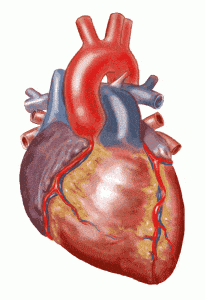
This is a example of ........
a)
cell
b)
organ system
c)
organ
d)
tissue
37.

The Golgi apparatus _____.
a)
packages/modifies cell products for export
b)
eliminates waste
c)
stores DNA
d)
makes energy
38.

What is the fluid inside a cell called?
a)
Endoplasimic Reticulum
b)
Orange Juice
c)
Water
d)
Cytoplasm
39.

This organelle helps plants keep their rigid structure.
a)
Cell wall
b)
Cell membrane
c)
Chloroplast
d)
Nucleus
40.

This organelle turns the light energy into a simple sugar.
a)
Mitochondria
b)
ER
c)
Chloroplast
d)
Nucleus
41.

This organelle makes proteins.
a)
Cell membrane
b)
Nucleus
c)
Ribosome
d)
ER
42.
This organelle controls what enters and leaves the cell.
a)
nuclear envelope
b)
nucleus
c)
cell membrane
d)
vacuole
43.
Has membrane bound organelles
a)
Prokaryote
b)
Eukaryote
c)
both
d)
neither
44.
Has ribosomes
a)
Prokaryote
b)
Eukaryote
c)
both
d)
neither
45.

Which type of cell is this?
a)
Prokaryote
b)
Eukaryote
c)
Archea
46.
Osmosis is the movement of _____ across a membrane.
a)
food
b)
energy
c)
oxygen
d)
water
47.

This picture represents which type of cellular transport?
a)
passive transport
b)
endocytosis
c)
exocytosis
d)
osmosis
48.

The cell below is in a _________ solution.
a)
Hypotonic
b)
Hypertonic
c)
Isotonic
49.
A cell in an isotonic solution will
a)
swell
b)
shrink
c)
stay the same size
d)
impossible to tell
50.
What are two types of passive transport?
a)
endo and exocytosis
b)
cookies and milk
c)
active and passive
d)
Osmosis and diffusion
51.
In active transport, water goes from
a)
low concentration to high
b)
high concentration to low
c)
back to front
d)
stays the same
Reset

