wayground logo

Free Printable Worksheets

NEW

Font size

S
M
L
XL
Worksheets

The tissues

Total questions: 50

Worksheet time: 26mins

Name
Class
Date
1.

Define tissue with regards to anatomy

a)

Multiple sheets of thin paper used to clean your nose

b)

The smallest structural and functional unit of an organism

c)

A series of different cells in the same area

d)

A group of structurally and functionally related cells that come together to perform common functions

2.
What is the function of epithelial cells?
a)
Act as barriers between the external environment, or between organs and fluidfilled cavities
b)
Provide movement by pulling on bones
c)
Provide secretions which help to digest food
d)
Act as the messaging pathway between different areas of the body
3.
What is the general structure of cuboidal cells?
a)
Square with large central nucleus
b)
Flat, 'fried egg' appearance
c)
Rectangular with nucleus towards basal end
d)
Dead apical cells filled with keratin
4.
Which tissue is this?
a)
Simple Squamous
b)
Stratified Squamous
c)
Simple cuboidal
d)
Pseudostratified columnar
5.
Which tissue is this?
a)
Simple squamous
b)
simple columnar
c)
transitional
d)
simple cuboidal
6.
which tissue is this?
a)
Pseudostratified columnar
b)
Stratified Squamous
c)
Simple Columnar
d)
Transitional
7.
Which type of epithelial tissue would allow oxygen to quickly pass through it?
a)
Simple Squamous
b)
Simple Cuboidal
c)
Simple Columnar
d)
Transitional
8.
What type of epithelial tissue would make up salivary, sweat, oil, and mammary glands?
a)
Simple cuboidal
b)
Simple columnar
c)
Simple squamous
d)
Transitional
9.

Which epithelial tissue has more than one layer of flattened cells?

a)

simple squamous

b)

stratified squamous

c)

transitional

d)

simple columnar

10.

Stratified epithelium is typically used for

a)

excretion

b)

secretion

c)

protection

d)

absorption

11.
The stomach consists of what type of muscle?
a)
Smooth muscle
b)
Skeletal muscle
c)
Cardiac muscle
d)
Deoxygenated muscle
12.
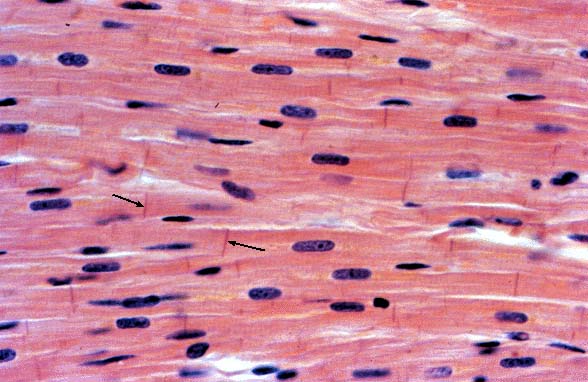
What tissue type is this? (The arrows are a clue)
a)
Cardiac muscle
b)
Skeletal muscle
c)
Smooth muscle
d)
Nervous tissue
13.
What type of muscle tissue is VOLUNTARILY controlled
a)
Skeletal Only
b)
Skeletal and Cardiac
c)
Smooth and Cardiac
d)
Cardiac Only
14.

Define tissue with regards to anatomy

a)

Multiple sheets of thin paper used to clean your nose

b)

The smallest structural and functional unit of an organism

c)

A series of different cells in the same area

d)

A group of structurally and functionally related cells that come together to perform common functions

15.

Which muscle type is striated?

a)

cardiac

b)

skeletal

c)

smooth

d)

cardiac and skeletal

16.

What type of muscle tissue is this?

a)

cardiac

b)

skeletal

c)

smooth

17.

What type of muscle tissue is this?

a)

cardiac

b)

skeletal

c)

smooth

18.

Label the muscle type from left to right.

a)

cardiac smooth skeletal

b)

skeletal cardiac smooth

c)

skeletal smooth cardiac

d)

cardiac skeletal smooth

19.
This type of muscle tissue is attached to bones wand helps control voluntary movement
a)
Skeletal
b)
Cardiac
c)
Smooth
20.
Muscle tissue
a)
Is tissue that functions in lining, covering, and glandular tissue
b)
Is tissue involved in protecting, supporting, and binding together other body tissues
c)
Is tissue that contracts and shortens to produce movement 
d)
Tissue that receives and conducts electrochemical impulses from one part of the body to another
21.

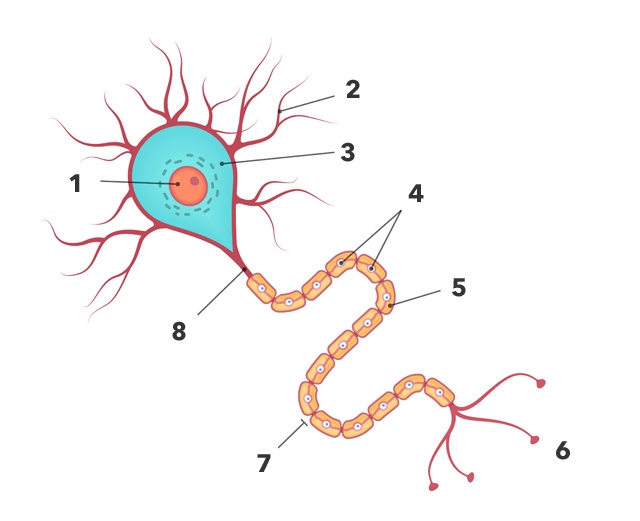
Given below is a diagram showing the structure of a neuron tissue.


Choose the correct labeling for the parts A, B, C, D and E.

a)

A – Nucleus; B – Cell body; C – Dendrite; D – Axon; E – Nerve ending.

b)

A – Nucleus; B – Dendrite; C – Cell body; D – Nerve ending; E – Axon

c)

A – Nucleus; B – Axon; C – Cell body; D – Dendrite; E –Nerve ending.

d)

A – Nucleus; B – Dendrite; C – Cell body; D – Axon; E – Nerve ending
22.
This insulating material forms a layer, around the axon of a neuron.  It enables electrical signals to travel down the axon at higher speeds.
a)
neuron
b)
myelin sheath
c)
dendrite
d)
neurotransmitter
23.

Identify #3

a)

axon

b)

cell body

c)

dendrite

d)

myelin sheath

24.

Gaps between Schwann cells that increase the speed of the transmission of the signal down the neuron are called

a)

axon terminals

b)

dendrites

c)

myelin

d)

nodes of Ranvier

25.

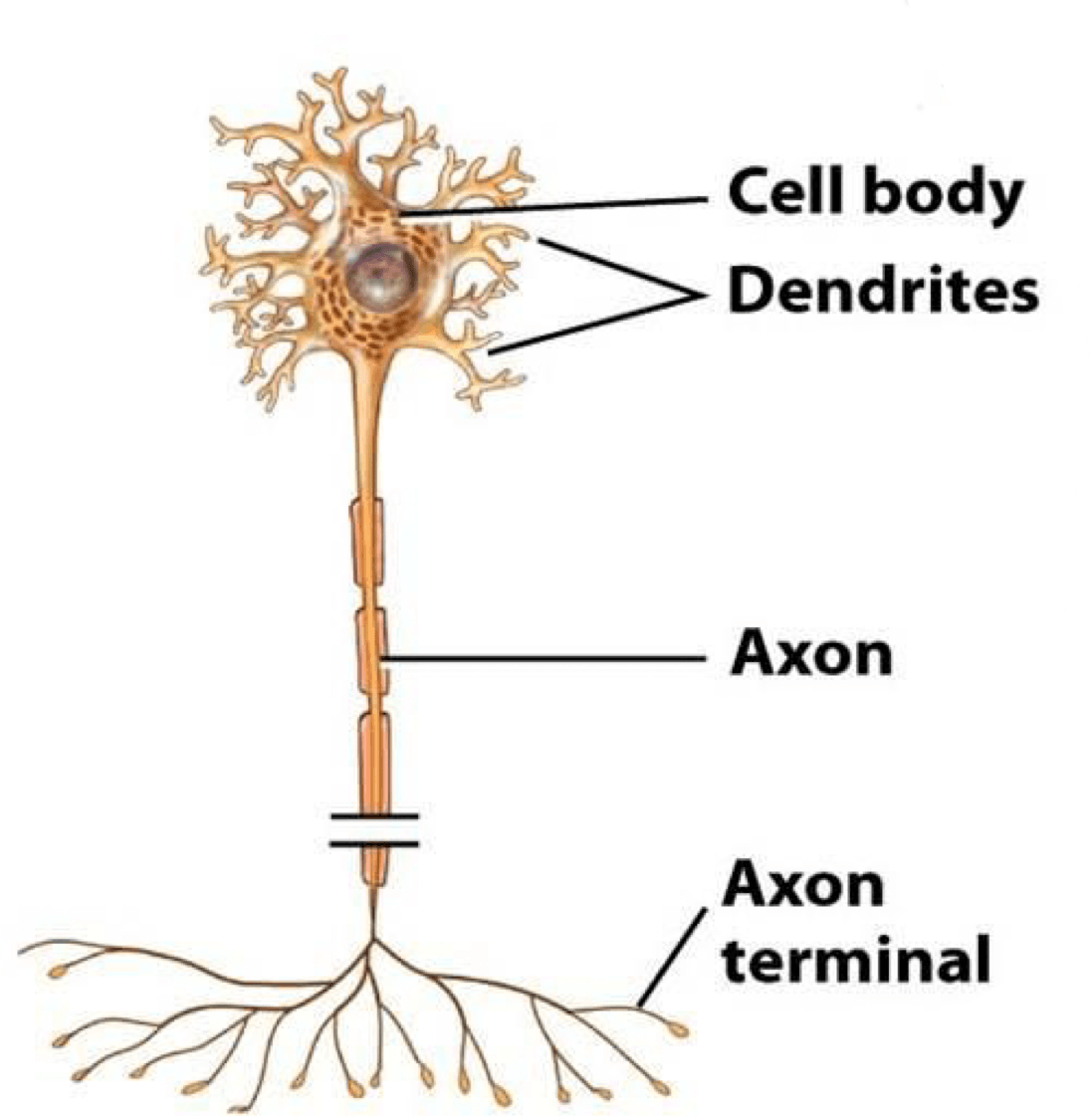
What type of neuron is represented on the image?

a)

Motor Neuron

b)

Interneuron

c)

Sensory Neuron

26.

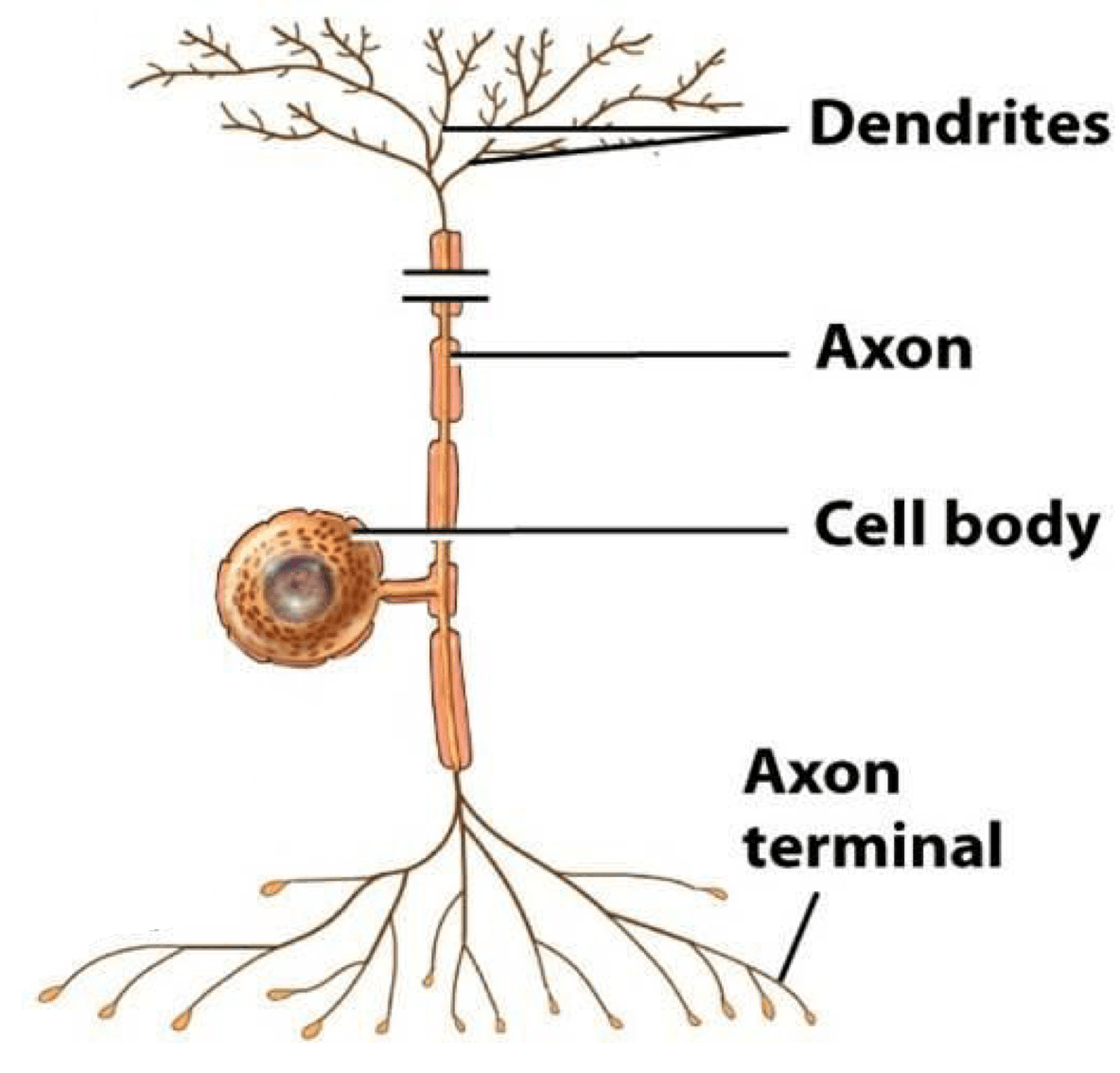
What type of neuron is represented on the image?

a)

Motor Neuron

b)

Interneuron

c)

Sensory Neuron

27.

What type of neuron is represented on the image?

a)

Motor Neuron

b)

Interneuron

c)

Sensory Neuron

28.

Type of neuron that perceive information about your environment.

a)

Motor Neuron

b)

Interneuron

c)

Sensory Neuron

29.

Type of neuron located only in the brain and spinal cord that pass impulses from one neuron to another.

a)

Motor Neuron

b)

Interneuron

c)

Sensory Neuron

30.

Type of neuron that sends nerve impulses to muscles and gland, by the command of other neurons.

a)

Motor Neurons

b)

Interneurons

c)

Sensory Neurons

31.
Which of the following is NOT a type of connective tissue?
a)
Bone
b)
Cartilage
c)
Skin
d)
Blood
32.
Name this tissue
a)
Bone
b)
Hyaline cartilage
c)
Fibrocartilage
d)
Adipose
33.
Name this tissue
a)
Bone
b)
Cartilage
c)
Blood
d)
Adipose
34.
Nervous tissue
a)
Tissue that is responsible for lining, covering, and glandular tissue
b)
Tissue responsible for protecting, supporting, and binding together other body tissues
c)
Tissues that contracts and shortens to produce movement
d)
Tissue that receives and conducts electrochemical impulses from one part of the body to another
35.
The functional unit that makes up compact bone is called the
a)
Osteon
b)
Trabeculae
c)
Central Canal
d)
Osteocyte
36.
What part of an osteon is number 3 pointing to?
a)
Lamellae
b)
Central Canal
c)
Osteocyte
d)
Canaliculi
37.
What part of an osteon is number 4 pointing to?
a)
Lamellae
b)
Central Canal
c)
Osteocyte
d)
Canaliculi
38.
What is B pointing to?
a)
Osteocyte
b)
Canaliculi
c)
Lacunae
d)
Lamellae
39.
What is D pointing to?
a)
Osteocyte
b)
Canaliculi
c)
Lacunae
d)
Lamellae
40.
A mature bone cell is called a _________.
a)
osteon
b)
osteocyte
c)
osteoclast
d)
osteoblast
41.
what are the rings around the haversian canal called?
a)
lacunae
b)
lamella
c)
osteocyte
d)
volkmann's canal
42.
An osteocyte "lives" in __.
a)
lacunae
b)
lamellae
c)
Haversian canals
d)
Volkmann's canals
43.
Canaliculi are for 
a)
providing protection 
b)
housing osteocytes
c)
providing nourishment
d)
holding bone together
44.

What can be found in the central canal of the haversian canal system?

a)

osteocytes

b)

lamella

c)

blood vessels and nerves

d)

red blood cells

45.

Chrondroblasts are

a)

Minor breaks in the cartilage

b)

Reactions that occur in the cartilage

c)

Cartilage cells

d)

None of these

46.

Does cartilage also contain lacunae, same as bone?

a)

Yes

b)

No

c)

Only certain types of cartilage

d)

Very rarely

47.
What part of blood carries hemoglobin?
a)
Red blood cells
b)
Plasma
c)
Platlets
d)
White blood cells
48.
The shape of the RBC allows for a greater surface area so the cell can
a)
fit through capillaries easily
b)
exchange gasses more quickly
c)
hold additional hemoglobin
d)
reproduce quicker
49.
The liquid portion of the blood is
a)
leukocytes
b)
erthryocytes
c)
plasma
d)
thrombin
50.

Why do platelets clump together?

a)

to produce oxygen

b)

to reduce oxygen

c)

to produce blood loss

d)

to reduce blood loss