wayground logo

Free Printable Worksheets

NEW

Font size

S
M
L
XL
Worksheets

Heat and Temperature

Total questions: 30

Worksheet time: 25mins

Name
Class
Date
1.

What is temperature?

a)

Thermal energy moving from a warmer object to a cooler one.

b)

A measure of the average kinetic energy of the individual particles of a substance.

c)

Total energy of all the particles.

d)

Transfer of energy by electromagnetic waves.

2.

What is heat?

a)

Thermal energy moving from a warmer object to a cooler one.

b)

A measure of the average kinetic energy of the individual particles of a substance.

c)

Total energy of all the particles.

d)

Transfer of energy by electromagnetic waves.

3.

What is thermal energy?

a)

Thermal energy moving from a warmer object to a cooler one.

b)

A measure of the average kinetic energy of the individual particles of a substance.

c)

Total energy of all the particles.

d)

Transfer of energy by electromagnetic waves.

4.

What is absolute zero?

a)

the temperature that water freezes

b)

temperature at which there is no energy, no motion

c)

temperature that you are very sure of and measured right

d)

the highest possible temperature
5.
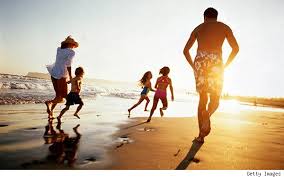
The sun shines down on this family as the play on the beach.
a)
conduction
b)
convection
c)
radiation
6.
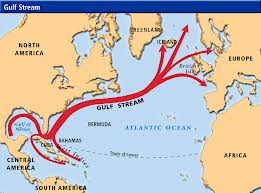
The Gulf Stream is a current that brings warm ocean water from the south to the north.
a)
conduction
b)
convection
c)
radiation
7.
Walking on the warm sand sand with your bare feet.
a)
conduction
b)
convection
c)
radiation
8.
Which direction will the heat flow while this person holds a hot cup of tea?
a)
from the cup to her hand
b)
from her hand to the cup
c)
no heat is transferred
9.
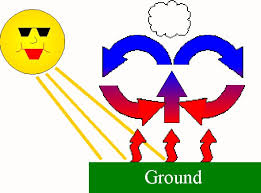
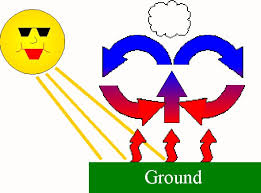
Warm air rises and the cool air sinks.
a)
conduction
b)
convection
c)
radiation
10.
The warm air from this heater creates a current when the warm air rises and the cold air sinks.
a)
conduction
b)
convection
c)
radiation
11.
Poor conductors like wood and plastic are called:
a)
conductors
b)
insulators
c)
burners
12.
In heat transfer, heat always flows from the _______________ substance to the _______________ substance.
a)
Hotter to colder
b)
Colder to hotter
c)
Hotter to hotter
d)
Colder to colder
13.
The type of heat transfer that happens through direct contact of molecules or particles with each other is ___________________.
a)
Convection
b)
Conduction
c)
Radiation
d)
insulation.
14.
The kind of heat transfer that travels through space in electromagnetic waves is ______________________.
a)
insulation.
b)
Radiation
c)
Conduction
d)
Convection
15.
___________________ is the type of heat transfer that occurs in fluids, such as warm air rising and cold air sinking; creating wind.
a)
Convection
b)
Conduction
c)
Radiation
d)
insulation.
16.
Warm air rises and the cool air sinks demonstrates this type of heat transfer. 
a)
conduction
b)
convection
c)
radiation
d)
Insolation 
17.
What is the definition of CONDUCTION?
a)
When heat is transferred from objects like rays of light or electromagnetically.
b)
a  hot liquid or air that  expands, becomes less dense, and rises or becomes more dense, and sinks.
c)
When heat transfers from objects that are touching.
d)
When heat transfers through the heater or AC in your house.
18.
Conduction occurs in...
a)
solids
b)
liquids
c)
gases
19.
What happens when ice cubes melt in a glass?
a)
Heat travels from the ice to the warmer water.
b)
No energy is transferred.
c)
Heat is transferred from the warmer water to the ice cubes.
d)
The water warms up due to the humidity
20.
Hot coffee is stirred with a spoon; the spoon gets hot due to
a)
conduction
b)
convection
c)
radiation
21.
A chair is several feet from a fireplace. The side of the chair facing the fireplace gets warm due to
a)
conduction
b)
convection
c)
radiation
22.
Near the ceiling of a room the air is warmer; the warm air rises because of
a)
conduction
b)
convection
c)
radiation
23.
Molecules in cold things move more _________
than in hot things.
a)
quickly
b)
slowly
c)
happily
d)
merrily
24.
The base unit of metric length.
a)
Meter
b)
Liter 
c)
Kilogram
d)
milligram
25.
The basic unit of metric volume is called a_____.
a)
Kilogram
b)
milligram
c)
Liter
d)
milliliter
26.
The abbreviation for gram is...
a)
G
b)
gg
c)
g
27.
What is this scientific tool?
a)
beaker
b)
tube
c)
graduated cylinder
d)
balance
28.
The metric unit of measurement for length is the: 
a)
gram
b)
liter 
c)
meter
d)
cm
29.
Which of the following is a sign that a chemical reaction has occurred?
a)
change in shape
b)
melting
c)
formation of a gas
d)
dissolving
30.
Is hammering wood together to build a house a chemical or physical change?
a)
chemical
b)
physical