wayground logo

Free Printable Worksheets

Font size

S
M
L
XL
Worksheets

Chapter 1 Review

Total questions: 77

Worksheet time: 3hrs 42mins

Name
Class
Date
1.
Which graph does NOT pass the vertical line test?
a)
Graph 1
b)
Graph 2
c)
Graph 3
d)
Graph 4
2.
Which set of values is a function?
a)
(9,5) (10,5) (9,-5) (10,-5)
b)
(3,4) (4,-3) (7,4) (3, 8)
c)
(6,-5) (7, -3) (8, -1) (9, 1)
d)
(2, -2) (5, 9) (5, -7) (1, 4)
3.
Is the relation a function? Why.
a)
Yes, because the x-value 11 has two y-values pair with it.
b)
Yes, because each x-value has only one y-value paired with it.
c)
No, because the x-value 11 has two y-values pair with it.
d)
No, because each x-value has only one y-value paired with it.
4.
What is the range of the following graph?
a)
-5, -1,  0 , 1, 5
b)
-4, -2, 0, 3, 6
c)
(-4, 1)  ( 6, 0)
d)
(6, 0)
5.
a)
Function
b)
Not a Function
6.
For the function {(0,1), (1,-3), (2,-4), (-4,1)}, write the domain and range.
a)
D: {1, -3, -4,}
R: {0, 1, 2, -4}
b)
D:{-4, 0, 1, 2}
R:{-4, -3, 1}
c)
D:{0, 1, 2, 3, 4}
R:{1, -3, -4}
7.
Which of the following is the domain of
   f(x) = √(8-4x)
a)
A) [0,∞)
b)
B) [2,∞)
c)
C) (-∞, 2]
d)
D)  (-∞, ∞)
8.
3.  What is the domain of 
    g(x) = (5x-5)/(x²-1)
a)
A) (-∞, ∞)
b)
B) All Reals except -1
c)
C)  (-∞,-1)U(-1,1)U(1,∞)
d)
D) All Reals except 1
9.
5.  Find the domain of
     j(x) = ∛(4x-8)
a)
A) (-∞, ∞)
b)
B) (-8, ∞)
c)
C) (2, ∞)
d)
D) (-∞, -2)
10.
Find the domain write answer in interval notation
1 / (3x-6) 
a)
x ≠ 2; (-∞,2)u (2,∞)
b)
x ≠2; (-∞,∞)
c)
x≠2
d)
x≠2; (-2,2)
11.
find the domain, write answer in interval notation
x³ / (x² +x−6)
a)
x ≠2, −3; (−∞,−3) u (-3,2) u (2, ∞)
b)
x≠2, −3; (-3,2)
c)
x≠2, −3; (-∞, -3) u (2,∞)
d)
x≠2, −3; (−∞,∞)
12.
Find the domain and write answer in interval notation
√ (7-3x)    (that is all under the radical)
a)
x≤7/3; (−∞,7/3]
b)
x ≥ 7/3; [7/3, ∞)
c)
x ≠ 7/3; (−∞,7/3) u (7/3,∞)
d)
(−∞, ∞)
13.
find the domain and write answer in interval notation. 
x² / (√(6-x)
a)
x < 6; (−∞, 6)
b)
x ≤ 6; (−∞,6]
c)
x≠6; (−∞, 6) u (6, ∞)
d)
x>6; (6, ∞) 
14.
What is f(-1)?
a)
6
b)
-2
c)
sqrt(2)
d)
DNE
15.
What is the RANGE of the function?
a)
(-∞, +∞)
b)
(-∞, 4]
c)
(-∞, 4)
d)
[0, 4]
16.
What is the DOMAIN of the function?
a)
(-∞, +∞)
b)
(-∞, 4]
c)
(-∞, 4)
d)
[0, 4]
17.
What is f when x equals 4?
a)
-5
b)
0
c)
3
d)
6
18.
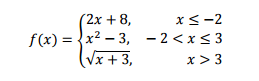
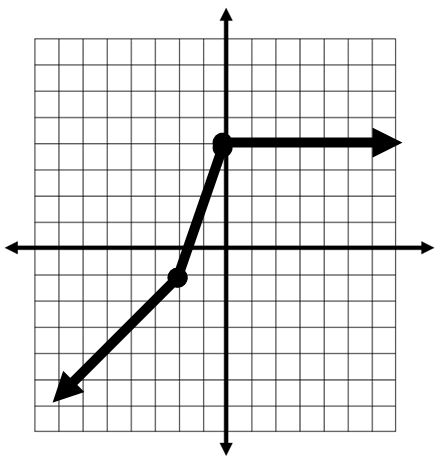
Which of the 3 piecewise equations is depicted by the graph? (Take your time)
a)
f(x)
b)
g(x)
c)
h(x)
19.
A piecewise function (f(x)) is shown in the graph. What is f when x equals -4?
a)
-4
b)
-2
c)
0
d)
Does not exist
20.
A piecewise function (f(x)) is shown in the graph. What is f when x equals 0?
a)
-4
b)
0
c)
1
d)
Does not exist
21.
Pick the correct graph
a)
A
b)
B
c)
C
d)
D
22.
Which statement is true about this function?
a)
The function is never constant
b)
The function is always increasing
c)
The function is never decreasing
d)
The function increases on the interval 11:00 < x < 15:00
23.
#7 - List the types of intervals that the graph demonstrates in order.
a)
decreasing, constant, increasing, constant
b)
increasing, decreasing, constant
c)
increasing, constant, increasing, constant
d)
increasing, constant, decreasing, constant
24.

Where is the graph constant?

a)

x > 4

b)

-1 < x < 2

c)

x < -4

d)

2 < x < 3

25.

Over what interval is the graph increasing?

a)

-2 < x < -1

b)

-1 < x < 2

c)

x > 4

d)

-4 < x < -2

26.
What is the domain of the graph?
a)
-7 ≤ x < 5
b)
-3 ≤ x < 1
c)
-3 ≤ y < 1
d)
-7 ≤ y < 5
27.
What is the range?
a)
-4 < x ≤ 5
b)
-4 ≤ x < 5
c)
-3 < y < 3
d)
-3 ≤ y ≤ 3
28.
What is the DOMAIN?
a)
(-∞, +∞)
b)
(-2, +∞)
c)
[-2, +∞)
d)
(-∞, 0) U (0, +∞)
29.
a)

4

b)

9

c)

3

d)

6

30.

If f(x) = 3x-1 and g(x) = x2+2,

what is (f ° g)(x) ?

a)

3x2 +5

b)

x2 +1

c)

3x2 +1

d)

3x2 +6

31.

If f(x) = 5x and g(x) = 2x-1,

what is the composition f(g(x)) ?

a)

10x-1

b)

10x-5

c)

5x2-1

d)

5x2-5

32.

If f(x) = x-5 and g(x) = 3x2-1,

what is (f ° g)(x) ?

a)

3x2-5

b)

3x2-1

c)

3x2-4

d)

3x2-6

33.

For f(x) = 2x2-1, what is and (f ° f)(-2) ?

a)

7

b)

97

c)

13

d)

6

34.
a)

(3x-1)/3

b)

x-3

c)

x/3

d)

x

35.

Given f and g in the graph,

what is f(g(2)) ?

a)

3

b)

8

c)

1

d)

4

36.

Given f and g in the graph,

what is (f ° g)(-1) ?

a)

1

b)

4

c)

-1

d)

6

37.

Given f and g in the graph,

what is f(f(3)) ?

a)

3

b)

2

c)

4

d)

1

38.

Calculate the Difference Quotient of

a)

5x +10h - 4

b)

-2x +10h - 4

c)

-5x -10h + 4

d)

-10x -5h - 4

39.

Calculate the Difference Quotient of

a)

2

b)

-2

c)

4

d)

-4

40.

Decompose this function.

a)
b)
c)
d)
41.

Decompose this function.

a)
b)
c)
d)
42.
For the function {(0,1), (1,-3), (2,-4), (-4,1)}, write the domain and range.
a)
D: {1, -3, -4,}
R: {0, 1, 2, -4}
b)
D: {-4, 0, 1, 2}
R:{-4, -3, 1}
c)
D: {0, 1, 2, 3, 4}
R:{1, -3, -4}
d)
D: {0, 1, 2, -4}
R: {1, -3, -4, 1}
43.

Given f(x) = x3 and g(x) = 1/x. What is the domain of (f∘g)(x)?

a)

(-∞,∞)

b)

(-∞,0)U(0,∞)

c)

(-∞,3)U(3,∞)

d)

Don't pick this one

44.

f(x) = 3x + 10

g(x) = x - 2

Find the domain of g(f(x))

a)

(-∞, ∞)

b)

(-∞, 2) U (2, ∞)

c)

(-∞, -2) U (-2, ∞)

d)

(-∞, 2] U [2, ∞)

45.

Given f(x) = √(x) +5 and g(x) = x2. What is the domain of (f∘g)(x)?

a)

(-∞,∞)

b)

(-∞,0)U(0,∞)

c)

[0,∞)

d)

[-5,∞)

46.
What are the transformations of this functions compared to the parent function y = √(x)?
a)
Shifted right 5, shifted down 2, and reflected over the x-axis
b)
Reflected over the x-axis, vertical stretch, and shifted right 5
c)
Reflected over the x-axis, vertical stretch, and shifted left 5
d)
Shifted right 5, shifted down 2
47.
What are the transformations to the graph compared to the parent function y=√(x)?
a)
Shifted right 2, shifted up 3, and reflected over the y-axis
b)
Shifted left 2, shifted up 3, and reflected over the y-axis
c)
Shifted left 2, shifted up 3, and reflected over the x-axis
d)
Shifted right 2, shifted up 3, and reflected over the x-axis
48.
Describe the transformation of y = f(x) for the new function
f(x) = ⅔(x - 7)2 
a)
Shrink of ⅔
Right 7
b)
Shrink of ⅔
Left 7
c)
Stretch of ⅔
Right 7
d)
Stretch of ⅔
Left 7
49.
If the blue graph is f(x) (the original function) and the red graph is the transformation, what is the equation of the red graph?
a)
-f(x)
b)
f(-x)
c)
f-1(x)
d)
f(2x)
50.
There is a relative maximum at:
a)
x = -1
b)
x = 3
c)
x = -0.5
d)
x = 1.5
51.
Use a graphing calculator to find a relative maximum of the following:
f(x) = x3 + 3x2 - 6x - 6
a)
x = 0.73
b)
x = -2.73
c)
x = -3.24
d)
x = 1.45
52.
Which one of the following functions is even?
a)
f(x) = x⁴ + x³
b)
g(x) = x⁴ + x²
c)
h(x) = x⁵ + x³
d)
k(x) = x³ + x
53.

y=8x128x4+6x+22y=8x^{12}-8x^4+6x+22  

a)

Even Function

b)

Odd Function

c)

Function - neither even nor odd

d)

Not a function

54.

y=x3+x3x24y=\frac{x^3+x}{3x^2-4}  

a)

Even Function

b)

Odd Function

c)

Function - neither even nor odd

d)

Not a function

55.
a)

Even Function

b)

Odd Function

c)

Function - Neither Even Nor Odd

d)

Both Even and Odd Function

e)

Not a Function

56.

Name that function

a)

logistic

b)

identity

c)

natural logarithm

d)

greatest integer

57.

Evaluate  f(x)=[[x+3]]f\left(x\right)=\left[\left[x+3\right]\right]  when  x=21.6x=-21.6  

a)

19-19  

b)

18-18  

c)

1818  

d)

1919  

58.

Evaluate  f(x)=[[x+3]]f\left(x\right)=\left[\left[x+3\right]\right]  when  x=2x=-2  

a)

1-1  

b)

11  

c)

22  

d)

33  

59.

Evaluate  f(x)=[[12x+6]]f\left(x\right)=\left[\left[\frac{1}{2}x+6\right]\right]  when  x=5x=5  

a)

88  

b)

8.58.5  

c)

99  

d)

55  

60.
What is the inverse of the function
f(x) = 2x + 4   ?
a)
f-1(x) = 4(x -2)
b)
f-1(x) = (x-4)/2
c)
f-1(x) = x/2 - 4
d)
f-1(x) = x/4 + 2
61.
Are these functions inverses of each other?
a)
Yes
b)
No
62.
If the equation of f(x) goes through (1, 4) and (4, 6), what points does f-1(x) go through?
a)
(1, 4) and (4, 6)
b)
(-4, -1) and (-6, -4)
c)
(-1, -4) and (-4, -6)
d)
(4, 1) and (6, 4)
63.
are these inverse functions?
a)
no
b)
yes
c)
no way to tell
64.
f(x) = {(3, 7), (4, -2), (5, -1), (8, 7)}
Is f-1(x) a function?
a)
Yes
b)
No
c)
No way to tell
65.
a)

9

b)

3

c)

5

d)

√15

66.

Given the function below - describe the transformation and give the name of the parent function. f(x) = (x + 3)2 - 6

a)

Quadratic

Left 3

Down 6

b)

Quadratic

Right 3

Down 6

c)

Linear

Right 3

Up 6

d)

Linear

Left 3

Down 6

67.

The parent function is indicated by the dotted curve. Determine the correct equation for the function graphed.

a)

f(x) = |x +3|

b)

f(x) = -|x| + 3

c)

f(x) = -(x + 3)2

d)

f(x) = -x2 + 3

68.

The parent function is indicated by the dotted curve. Determine the correct equation for the function graphed.

a)

Square Root

Left 5

Up 2

b)

Cube Root

Reflect

Left 5

Up 2

c)

Cube Root

Right 5

Up 2

d)

Square Root

Reflect

Left 5

Up 2

69.
h(x)=x2-3x-10,
j(x)=3x-2
What is (h/j)(-2)
a)
-2
b)
undefined
c)
0
d)
1
70.
Given f(x) = 3x2 + 7x and g(x) = 2x2 - x - 1, find (f + g)(x).
a)
11x2 - 1
b)
5x4 + 6x2 - 1
c)
5x2 + 6x - 1
d)
5x2 + 8x - 1
71.

Challenge! If f(x)=x34xf\left(x\right)=x^3-4x  and g(x)=2x5g\left(x\right)=2x-5  ,

find the domain restriction on (gf)(x)\left(\frac{g}{f}\right)\left(x\right)  .

a)

x25x\ne\frac{2}{5}  

b)

x52x\ne\frac{5}{2}  

c)

x0, 2x\ne0,\ 2   

d)

  x0,±2x\ne0,\pm2  

72.

If f(x)=x34xf\left(x\right)=x^3-4x  and g(x)=2x5g\left(x\right)=2x-5  ,

find the domain restriction on (fg)(x)\left(\frac{f}{g}\right)\left(x\right)  .

a)

x25x\ne\frac{2}{5}  

b)

x52x\ne\frac{5}{2}  

c)

x0, 2x\ne0,\ 2   

d)

  x0,±2x\ne0,\pm2  

73.

Identify all pairs of inverse functions from their graphs.

a)
b)
c)
d)
74.

What are you supposed to do Algebraically to verify that the two functions f(x) & g(x) are inverses of each other?

a)

Verify the f(g(x)) = x only

b)

Verify that g(f(x)) = x only

c)

Verify that BOTH f(g(x)) = x & g(f(x)) = x

75.

Find the inverse function

a)
b)
c)
d)
76.

Find the inverse:

g(x)=x+7x3g\left(x\right)=\frac{x+7}{x-3}  

a)

g1(x)=3x+7g^{-1}\left(x\right)=3x+7  

b)

g1(x)=3x+7x1g^{-1}\left(x\right)=\frac{3x+7}{x-1}  

c)

g1(x)=7x3x1g^{-1}\left(x\right)=\frac{-7x-3}{x-1}  

d)

g1(x)=3x7x1g^{-1}\left(x\right)=\frac{-3x-7}{x-1}  

77.

What value of k would make the function continuous?

a)

-4

b)

0

c)

4

d)

8