
 Worksheets
Tissues of the human body
Total questions: 48
Worksheet time: 36mins
Name
Class
Date
1.
How many types of tissue exist in the human body?
a)
1
b)
4
c)
5
d)
11
2.
TISSUES are groups of _______ with a common structure & function.
a)
organelles
b)
cells
c)
organs
d)
organisms
3.

What is the function of Connective Tissue?
a)
Conduct Impulses
b)
Help body movement
c)
Protect, Absorb, & Filter
d)
Cushion & Protect or Provide Strength
4.

What is the function of Epithilial Tissue?
a)
Conduct Impulses
b)
Help body movement
c)
Protect, Absorb, & Filter
d)
Cushion & Protect or Provide Strength
5.
What is the function of Nervous Tissue?
a)
Conduct Impulses
b)
Help body movement
c)
Protect, Absorb, & Filter
d)
Cushion & Protect or Provide Strength
6.

What is the function of MuscleTissue?
a)
Conduct Impulses
b)
Help body movement
c)
Protect, Absorb, & Filter
d)
Cushion & Protect or Provide Strength
7.

What kind of tissue is shown here?
a)
Epithelium
b)
Connective
c)
Nerve
d)
Muscle
8.

What kind of tissue is BONE made of?
a)
Epithelium
b)
Connective
c)
Nerve
d)
Muscle
9.

How many types of Muscle Tissue are there?
a)
1
b)
2
c)
3
d)
6
10.

Which tissue is this?
a)
Simple Squamous
b)
Stratified Squamous
c)
Simple cuboidal
d)
Pseudostratified columnar
11.

Which tissue is this?
a)
Simple squamous
b)
simple columnar
c)
transitional
d)
simple cuboidal
12.

which tissue is this?
a)
Pseudostratified columnar
b)
Stratified Squamous
c)
Simple Columnar
d)
Transitional
13.
Which type of epithelial tissue would allow oxygen to quickly pass through it?
a)
Simple Squamous
b)
Simple Cuboidal
c)
Simple Columnar
d)
Transitional
14.
Which type of muscle tissue would line the intestines?
a)
Smooth
b)
Cardiac
c)
Skeletal
d)
Transitional
15.
What type of Connective tissue is found at the ends of bones to reduce friction?
a)
Cartilage
b)
Dense connective tissue
c)
Adipose Tissue
d)
Loose connective tissue
16.
What type of tissue SIGNALS the intestines to move food along?
a)
Nervous Tissue
b)
Blood Tissue
c)
Smooth muscle tissue
d)
Skeletal Muscle Tissue
17.
Salivary glands are
a)
Endocrine Glands
b)
Exocrine Glands
18.
What type of muscle tissue is VOLUNTARILY controlled
a)
Skeletal Only
b)
Skeletal and Cardiac
c)
Smooth and Cardiac
d)
Cardiac Only
19.
Define tissue with regards to anatomy
a)
A group of structurally and functionally related cells that come together to perform common functions
b)
Multiple sheets of thin paper used to clean your nose
c)
A series of different cells in the same area
d)
The smallest structural and functional unit of an organism
20.
What is the function of epithelial cells?
a)
Act as barriers between the external environment, or between organs and fluidfilled cavities
b)
Provide movement by pulling on bones
c)
Provide secretions which help to digest food
d)
Act as the messaging pathway between different areas of the body
21.
What is the difference between exocrine and endocrine functions?
a)
Exocrine cells secrete fluids into ducts; endocrine cells secrete fluids into the blood stream
b)
They are synonymous
c)
Exocrine cells secrete fluids to the outside of the body; endocrine cells secrete fluids into the inside of the body
d)
Exocrine cells secrete clear fluids; endocrine cells secrete opaque fluids
22.

What tissue type is this?
a)
Adipose tissue
b)
Cardiac muscle
c)
Nervous tissue
d)
Skeletal muscle
23.
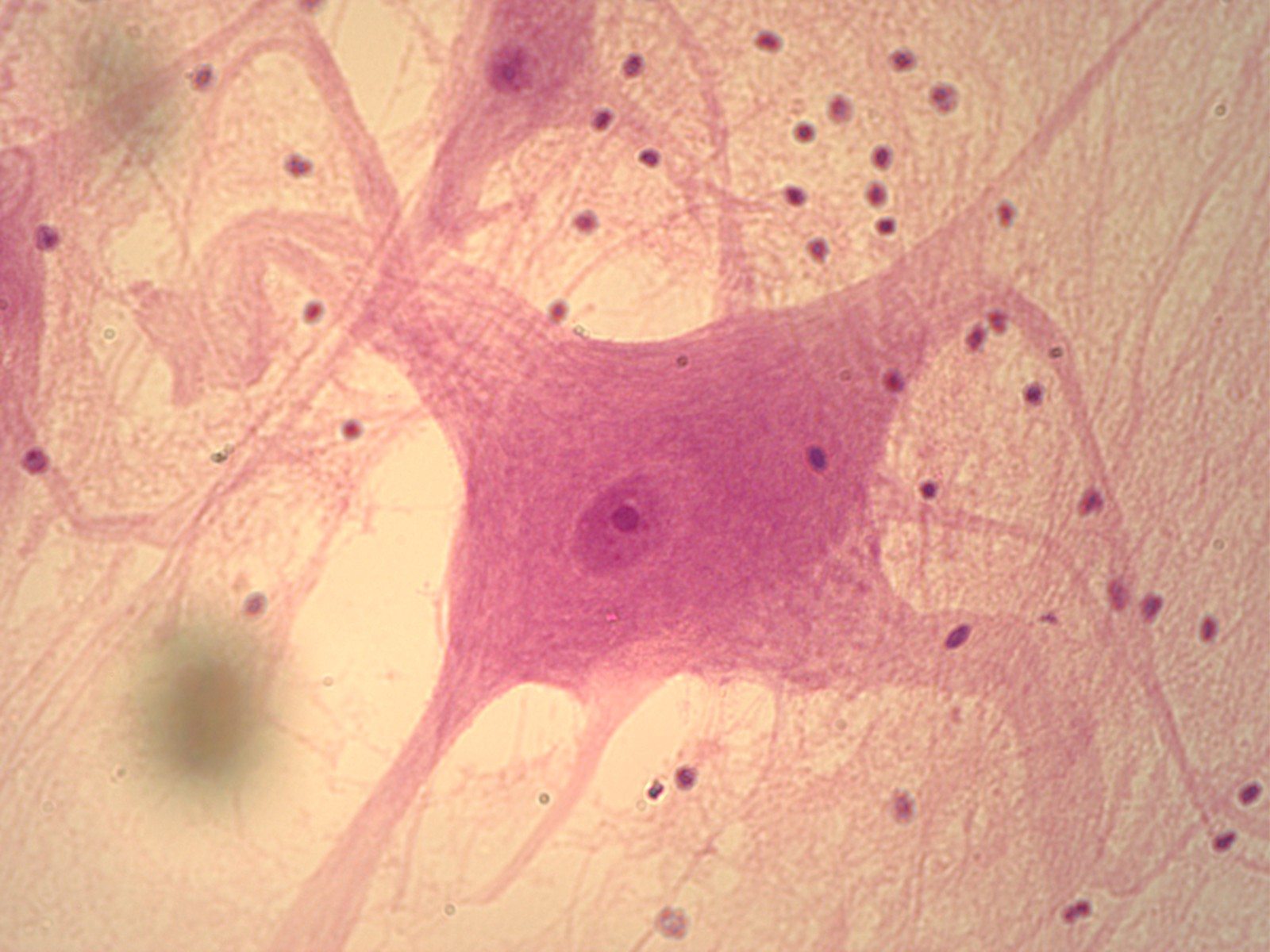
What tissue type is this?
a)
Nervous tissue
b)
Cardiac muscle
c)
Smooth muscle
d)
Connective tissue proper
24.

What tissue type is this?
a)
Skeletal muscle
b)
Nervous tissue
c)
Adipose tissue
d)
'Specialised' connective tissue
25.

Intercalated discs are found in which muscle type?
a)
Cardiac
b)
Skeletal
c)
Lateral
d)
Smooth
26.

Which type of muscle cells are voluntary?
a)
Skeletal
b)
Cardiac
c)
Medial
d)
Smooth
27.
Functions of connective tissue include
a)
storing energy reserves
b)
establishing a structural framework for the body
c)
providing protection for delicate organs
d)
all of the above
28.
The muscle tissue which shows no striations is
a)
skeletal muscle
b)
smooth muscle
c)
cardiac muscle
29.
The muscle that is located in the walls of hollow internal organs is
a)
skeletal muscle
b)
cardiac muscle
c)
smooth muscle
d)
voluntary muscle
30.
The back is my ____________ side
a)
super
b)
inferior
c)
ventral
d)
dorsal
31.
The forehead is my ____________ side
a)
inferior
b)
superior
c)
dorsal
d)
ventral
32.
Another word for front side is
a)
ventral
b)
posterior
c)
dorsal
d)
sagital
33.
In pseudostratified epithelium which of the following is NOT TRUE?
a)
All the cells attach to the basement membrane
b)
The nuclei are at various layers of the tissue
c)
It is multiple layers of cells
d)
They may have cilia and goblet cells
34.
What specialized function does transitional epithelium provide?
a)
absorption
b)
diffusion
c)
secretion
d)
stretch
35.
Which of the following is found in places where diffusion occurs, like the alveoli of the lungs?
a)
simple cuboidal
b)
simple squamous
c)
stratified cuboidal
d)
transitional
36.
The main function of muscle is to produce
a)
urine
b)
structure
c)
movement
d)
physiology
37.
The main function of nervous tissue is:
a)
to produce movement
b)
to produce structure
c)
to impede impulses from getting throughout body
d)
to send impulses throughout body
38.
Which of the following describes smooth muscle?
a)
voluntary, surrounds hollow organs, striated
b)
involuntary, not striated, uninucleate, surrounds hollow organs
c)
involuntary, connected by intercalated discs, striated
d)
striated, intercalated discs connect the cells, multiple nuclei
39.
The type of epithelial tissue that is present in ONLY the urinary tract and has the unique property of its ability to stretch and return back to its original shape is called:
a)
simple squamous epithelium
b)
stratified cuboidal epithelium
c)
transitional epithelium
d)
simple cuboidal epithelium
40.
Which of the following is NOT a function of connective tissue?
a)
supports organs and structures
b)
binds tissues together
c)
provides protection
d)
provides transport function
41.
Histology is the study of________.
a)
Cells
b)
Tissues
c)
Organs
d)
Organ systems
42.
Epithelium with more than one layer of cells
a)
Stratified epithelium
b)
Simple epithelium
43.
Flattened cells
a)
Squamous
b)
Cuboidal
c)
Columnar
44.
Cube shaped cells
a)
Squamous
b)
Cuboidal
c)
Columnar
45.
Column shaped cells
a)
Squamous
b)
Cuboidal
c)
Columnar
46.
Adipose tissue, cartilage, and ligaments are what type of tissue?
a)
muscle
b)
connective
c)
nervous
d)
epithelial
47.
Blood is an example of what type of tissue?
a)
muscle
b)
epithelial
c)
nervous
d)
connective
48.
Lines ducts and glands
a)
Columnar
b)
Cuboidal
c)
Simple Squamous
d)
Transitional
100 %

