wayground logo

Free Printable Worksheets

Font size

S
M
L
XL
Worksheets

AP Bio Unit 6

Total questions: 49

Worksheet time: 51mins

Name
Class
Date
1.

Which of the following are part of a bacterial lac operon? (Select all that apply)

a)

Promotor

b)

Genes for lac enzymes

c)

Regulatory genes

d)

Enhancers

2.

Match the following genetic regions to their roles:

a)

Makes a repressor protein

1.

Regulatory gene

b)

Place where transcription begins

2.

Promotor

c)

The on/off switch where the repressor protein binds

3.

Operator

d)

Codes for the main protein / enzymes

4.

Genes of Operon

3.

The trp operon in E. Coli is responsible for making 5 polypeptides involved in the tryptophan synthesis pathway. When tryptophan is present, it combines with the repressor protein to block the operator. What type of operon is trp?

a)

Repressible

b)

Inducible

4.

The operon model was discovered in E. Coli and is almost exclusively found in ​ (a)   .

Choose from the below words
prokaryotes
eukaryotes
5.

After eukaryotic transcription takes place, mRNA undergoes several modifications before leaving the nucleus to take part in translation. Some sections of mRNA are cut out, and the remaining sections are spliced together to create the finished mRNA molecule. Which of the following mRNA sections are spliced together in the finished mRNA molecule?

a)

introns

b)

exons

c)

operons

d)

ribozymes

6.

DNA replication involves many different enzymes. Helicase unwinds the DNA so that the parent strands can be seperated. DNA polymerase adds the nucleotides to synthesize the daughter strands. What is the role of primase?

a)

It adds a small RNA "primer" to allow DNA polymerase to begin

b)

It sorts the prime numbers of RNA into even piles

c)

It removes incorrecly matched nucleotides to avoid mutations

d)

It connects the gaps between nucleotide segments

7.

The human genome appears to have only about as many genes as the simple nematode worm, C. elegans. Which of the following best explains how the more complex humans can have relatively few genes?

a)

Human genes have unusually long introns involved in the regulation of gene expression

b)

More than one polypeptide can be produced from a gene by alternative gene splicing

c)

The human genome has a high proportion of noncoding DNA

d)

The human genome has a large number of SNPs (single nucleotide polymorphisms) which increases genetic variability

8.

Reorder the following stages of protein synthesis in eukaryotes:

a)

Activators bind to the enhancer

b)

A DNA bending protein folds the enhancer toward the promotor

c)

RNA polymerase transcribes the DNA beginning at the promotor

d)

Introns are removed from the mRNA; a poly-A tail is added

e)

mRNA leaves the nucleus to find a ribosome for translation

1)
2)
3)
4)
5)
9.

What type of molecule helps turn on specific genes?

a)

Inducers

b)

Repressors

c)

Methalation

d)

Morphogenesis

10.
A scientist observes a base sequence of AGCTAGCTAGCT.  Which of the following would be the complimentary strand?
a)
TGCATGCATGCA
b)
TCGATCGATCGA
c)
TAGCTAGCTAGC
d)
TTAAGGCCTTCC
11.
The enzyme that unzips the DNA to prepare for replication
a)
helicase
b)
replicase
c)
polymerase
d)
synthase
12.
In what phase of the cell cycle does DNA replication take place?
a)
G1
b)
S
c)
G2
d)
M
13.
The process of DNA replication is called semi conservative because it results in
a)
none of these
b)
Two DNA molecules.  One original molecule and one with two new strands
c)
two exact copies with new strands
d)
two identical molecules, each with 1 original strand and one new.
14.
Which enzyme seals okazaki fragments together on the lagging strand?
a)
Topoisomerase
b)
Helicase
c)
Polymerase
d)
Ligase
15.
What is A?
a)
Leading strand
b)
Lagging strand
c)
Okazaki Fragments
d)
DNA plymerase
16.
What strand is copied faster?
a)
Leading
b)
Lagging
17.

The separation of the two single strands of DNA creates a ‘Y’ shape?

a)

enzyme

b)

unzip

c)

A replication fork

18.

Which enzyme proofreads and removes RNA Primase

a)

Ligase

b)

Polymerase 1

c)

Polymerase 3

d)

Helicase

19.
The 5' end of DNA is marked by a(n)
a)
Phosphate Group
b)
Hydroxyl Group
c)
Purine
d)
Pyrimidine
20.
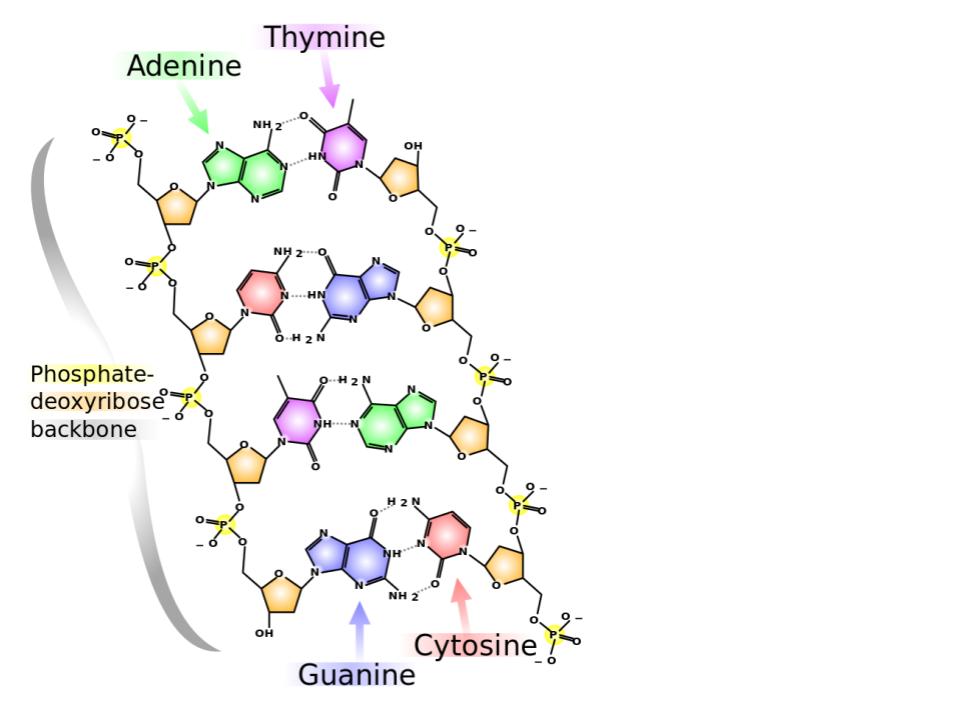
The two strands of DNA are held together by:
a)
Hydrogen Bonds
b)
Phosphodiester Bonds
c)
Glycolsyl Bonds
d)
Glycosidic Linkages
21.
The concept that DNA is made of two strands running in opposite directions is called:
a)
Antiparallel
b)
Isomerism
c)
Enantiomerism
d)
S/R Chirality
22.
Who's work concluded that the %A=%T  and %G=%C
a)
Chargaff
b)
Meischer
c)
Levene
d)
Hammerling
23.
In eukaryotic cells, transcription cannot begin until 
a)
the two DNA strands have completely separated and exposed the promoter.
b)
several transcription factors have bound to the promoter.
c)
the 5' caps are removed from the mRNA.
d)
the DNA introns are removed from the template.
24.
The anticodon of a particular tRNA molecule is 
a)
complementary to the corresponding mRNA codon.
b)
complementary to the corresponding triplet in rRNA.
c)
the part of tRNA that bonds with a specific amino acid.
d)
catalytic, making the tRNA a ribozyme.
25.
Which RNA bases would pair with TACGAA in transcription
a)
AUGCUU
b)
ATGCTT
c)
GCATCC
d)
GCAUCC
26.
Where does transcription occur in eukaryotic cells?
a)
Nucleus
b)
Ribosome
c)
Cytoplasm
d)
Rough E.R.
27.
RNA polymerase moves in which direction along the DNA?
a)
5' to 3' 
b)
3' to 5' along the template strand
c)
3' to 5' along nontemplate(coding) strand
d)
5' to 3' along the template strand
28.
The parts of a gene that do NOT code for amino acids in a protein are called
a)
introns
b)
exons
c)
codons
d)
anticodons
29.
The production of mature mRNA in eukaryotes involves
a)
cutting introns out and spicing exons together
b)
adding the 5' cap
c)
adding the 3' poly A tail
d)
all of these are correct
30.
Translation occurs:
a)
Outside of the Nucleus
b)
Inside of the Nucleus
31.
Translation is performed by:
a)
Ribosomes 
b)
Mitochondria
c)
Golgi Bodies
d)
Endoplasmic Reticulum 
32.
The anticodon is located on 
a)
DNA
b)
mRNA
c)
tRNA
d)
rRNA
33.
What is the term for making an RNA copy of DNA?
a)
Transription
b)
Translation
c)
Folding
d)
Coding
34.
Which of the follwoing best describes the significance of the TATA box in eukaryotic promoters?
a)
it is the recognition site for a specific transcription factor
b)
it sets the reading frame of the mRNA
c)
it is the recognition site for ribosomal binding
d)
it signals the end of the nucleotide sequence of the gene
35.
Translation is crucial to the process of making proteins. Which statement best describes what takes place during translation? 
a)
A copy of chromosomal DNA is created 
b)
Information in mRNA is converted into a sequence of amino acids in a protein 
c)
A RNA copy of a DNA strand is made.
d)
Instructions from DNA in the nucleus are brought to the cytoplasm 
36.

Which of the following is the start codon?

a)

UGA

b)

AUG

c)

GUA

d)

GAU

37.

What is the function of the P site in the large subunit?

a)

To phosphorylate the polypeptide

b)

To hold the growing polypeptide

c)

To assist with the tertiary structure of the polypeptide

d)

To perform the base pairing for the polypeptide

38.

Which of the following describes the function of the tRNA?

a)

tRNA has the codon required for translation

b)

tRNA allows for the translocation step

c)

tRNA has the RNA transcript for protein synthesis

d)

tRNA brings the amino acid to the ribosome

39.

Which of the following describes the function of the mRNA?

a)

mRNA moves the ribosome to the appropriate location in the cell for synthesis

b)

mRNA has the anticodon to pair with tRNA for protein synthesis

c)

mRNA is responsible for being the transcript synthesized from the DNA

d)

mRNA will make more copies of itself to enhance the process of transcription

40.

Which of the following describes the conversion factor between nucleic acids and proteins?

a)

3 amino acids = 1 nucleotide

b)

3 amino acids = 3 nucleotides

c)

3 nucleotides = 1 amino acid

d)

3 nucleotides = 3 amino acids

41.

A mutation can occur if a base pair is ____________, deleted or substituted for another.

a)

modified

b)

added

c)

transferred

42.

ATTTGAGCC- Original

ATTGAGCC - Mutated

The example above is an example of a

a)

Insertion

b)

Point mutation

c)

Deletion

d)

Substitution

43.

This type of mutation involves inserting a piece of DNA where it does not belong. Known as a frameshift mutation.

a)

Substitution Mutation

b)

Deletion Mutation

c)

Insertion Mutation

44.
An example of a mutation where a piece of chromosome breaks off and attaches to another chromosome is called ___.
a)
trisomy
b)
translocation
c)
inversion
d)
deletion
45.
A chromosome is found to be shorter than it's homologous match.  Which type of mutation would this most likely be?
a)
insertion
b)
deletion
c)
translocation
d)
inversion
46.
What process occurs during meiosis that can result in chromosomal disorders?
a)
crossing over
b)
non-disjunction
c)
anaphase I
d)
prophase II
47.
Complete a karyotype analysis on the karyotype provided.
a)
47, XY, +18 
b)
46, XX
c)
47, XY, +21
48.
The karyotype shows an individual with Edward's Syndrome.  What is the name of the specific disorder?
a)
monomy
b)
trisomy
c)
deletion
d)
translocation
49.

Match the following

a)
1.

Insertion

b)
2.

Deletion

c)
3.

Translocation

d)
4.

Duplication

e)
5.

Inversion