
 Worksheets
evolution QCE
Total questions: 52
Worksheet time: 31mins
How do you classify the following genotype : AA
Homozygous Dominant
Homozygous Recessive
Heterozygous
How do you classify the following genotype : Mm
Homozygous Dominant
Homozygous Recessive
Heterozygous
The two types of alleles are (select two)
dominant
doughnut
expressive
recessive


survival of the fittest

Charles Darwin and Alfred Wallace came up with this theory
Natural Selection
Mutation
Acquired Characteristcs
Principle of Common Descent
Evolutionary change on a small scale
macroevolution
microevolution
coevolution
parallel evolution
Evolutionary change on a large scale; Principle of common descent
macroevolution
microevolution
coevolution
parallel evolution
Natural selection is known as
family descent
survival of the fittest
convergent evolution
divergent evolution

Process by which unrelated organisms develop similarities due to living in similar environments
family descent
survival of the fittest
convergent evolution
divergent evolution

Process by which closely related organisms develop differences due to living in different environments
family descent
survival of the fittest
convergent evolution
divergent evolution
How long does it take new species to form on Earth?
The time required varies considerably.
millions of years
Speciation no longer takes place on Earth.
Why are the large finches now living on the Galápagos Islands different from the original source population from a nearby island?
Natural selection favored individuals that were more fit in the new environment.
Genetic drift occurred in the two populations.
The separation of habitats reduced gene flow between the populations.
All three answers are correct.
The last ice age produced many different species mainly because populations dispersed and colonized new habitats.
True
False
What is the most important factor that holds a gene pool of a species together and prevents speciation?
gene flow
behavioral isolation
sexual isolation
prezygotic barriers

The success of an organism in passing on its genes is the definition of
Adaptation
Evolution
Fitness
Speciation
Streamlined body in shark and dolphin is an example for
Convergent evolution
Coevolution
Divergent evolution
Predation
Industrial melanism in moth exhibit
Sexual selection
Disruptive selection
Stabilising selection
Directional selection
Genetic drift operates only in
Larger populations
Smaller populations
Mendelian population
Isolated population

Geographic distribution can be affected mainly by
Migration
Reproduction
Resources
All of the above

Images of the embryo and adult stages of three different organisms are shown.
Which of the following is the best conclusion that can be drawn from this evidence?
Having similar embryos indicates that these organisms eat the same types of food.
Having similar embryos indicates that these organisms live in a similar environment.
Having similar embryos indicates that these organisms share a recent common ancestor.
Having similar embryos indicates that a certain protein controls how many legs the adult organisms will have.
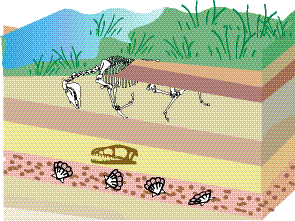
If a new trait DOES help an organism survive, what may happen to it?
It dies and its DNA is not passed on
It survives and its DNA is passed on
It changes its traits to adapt and survive
A change in a DNA sequence that affects genetic information
mutation
fitness
transformation
If scientists were to compare the fossil of a fern that lived millions of years ago with other fern fossils that were formed later, what would they most likely find?
that plants had bones millions of years ago
that plants change over time
that ferns stopped evolving 25 million years ago
that only animals evolve
The emergence of new rivers or streams is a type of ____________ isolation.
Temporal
Mechanical
Behavioral
Geographic
Occurs when a catastrophic event changes the environment suddenly.
Gradual extinction
Mass extinction
A number of different species arise from one common ancestor.
Adaptive Radiation (aka, Divergent Evolution)
Gradualism
Coevolution
Speciation

Why are similar fossils found all over the world?
The animals swam to new parts of the world before going extinct
The land masses were once connected
The organisms were transported to different areas of the world
They are not similar fossils.
How do transitional species help show evolution has occurred?
They show the changes that occurred over time
They show that an organism still lives today
They show how an organism died
They show an organism that was poorly adapted to its environment

Earth formed 4.5 billion years ago, but life did not show until around...
3.5 billion years ago
1 million years ago
200,000 years ago
4.2 billion years ago

Miller & Urey and other scientists have shown that:
Life on early Earth required material from space
Cells survived in the primitive atmosphere
Amino acids could be produced from inorganic molecules
Simple cells can be produced in a laboratory

1 Paleozoic
2 Cenozoic
3 Precambrian
4 Mesozoic
A flash flood carried a raft of Amazon ants away from their original population. There is enough distance between the two groups, that they will never meet in nature again. What type of speciation?
sympatric
allopatric
Some female peacocks prefer males with large, colorful tails while other female peacocks prefer males with no tail at all. Females are beginning to only mate with the type of males with the tail they prefer. What type of reproductive barrier is this?
sympatric speciation
allopatric speciation
The emergence of a mountain range is an event that would lead to _______________ speciation
Allopatric
Sympatric
Mating with geographic neighbors rather than randomly withing the entire population leads to the evolution of a single species into more than one species
allopatric speciation
sympatric speciation
parapatric speciation
mutation

