wayground logo

Free Printable Worksheets

NEW

Font size

S
M
L
XL
Worksheets

6th grade Social Studies Unit 1

Total questions: 66

Worksheet time: 51mins

Name
Class
Date
1.
is the set of beliefs, values, and practices that a group of people has in common.
a)
culture traits
b)
 Culture 
c)
culture region
d)
ethnic group 
2.
what does population mean
a)
a measure of the number of people living in an area. 
b)
is the set of beliefs, values, and practices that a group of people has in common.
c)
is an activity or behavior in which people often take part.
d)
the total number of people in agiven area,
3.
The latitude and longitude of a place?
a)
Relative location
b)
Absolute location
c)
Formal Region
d)
Prime Meridian
4.
How people impact their environment is included in which theme of geography?
a)
Location
b)
Place
c)
Movement
d)
Human-Environment Interaction
5.
Location, Place, Regions, Movement, and Human-environment interact are called the
a)
tools of geography
b)
5 themes
c)
momentos of time
d)
tutorials of geography
6.
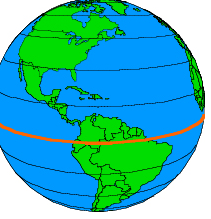
Line that separates the globe North and South.
a)
Equator
b)
Prime Meridian
c)
Latitude
d)
Longitude
7.
The United States & Canada are located in which hemispheres?
a)
Northern & Eastern
b)
Southern & Eastern
c)
Northern & Western
d)
Southern & Western
8.
What is this called?
a)
North, South, East, West
b)
Compass Rose
c)
A map
d)
A map key
9.
An organization that keeps order, sets rules, and provides services for a country. 
a)
 culture 
b)
Political map
c)
Nationalism 
d)
Government 
10.
Shows natural features of the world such as landforms and bodies of water. 
a)
cuisine
b)
Physical map
c)
Political map
d)
Rift valley 
11.
A group's way of life, including types of food, shelter, clothing, language, behavior, and ideas. 
a)
Nationalism 
b)
Economy 
c)
Race 
d)
Culture 
12.
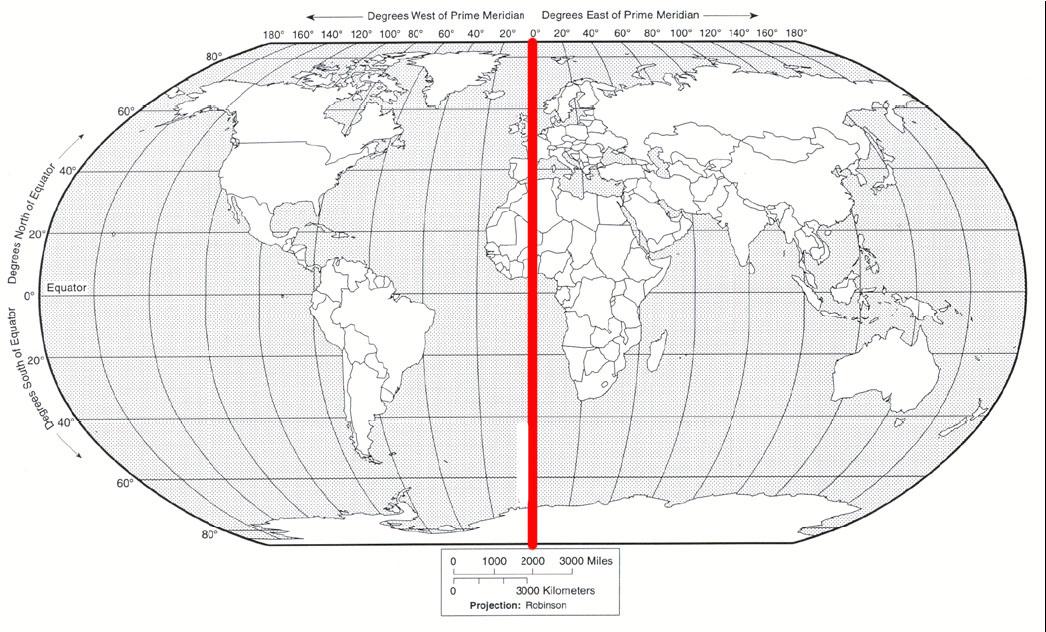
What is the name of the line at zero degrees longitude?
a)
Equator
b)
Prime Meridian
c)
North Pole
d)
South Pole
13.
Latitude and Longitude are measured in______.
a)
kilometers
b)
degrees
c)
miles
d)
hours
14.
a)
The map shows lines of longitude.
b)
The map shows lines of latitude.
15.
A set of degrees of latitude and longitude that help you locate a place on a map.
a)
coordinates
b)
positions
c)
hemispheres
d)
locations
16.
Which of the following letter is at approximately 60 degrees S, 40 degrees W? 
a)
A
b)
D
c)
E
d)
H
17.
Which letter would you find at 15oS, 60oW?
a)
A
b)
C
c)
L
d)
H
18.
To locate a place on the earth, you need to look at...
a)
where the lines of latitude and longitude meet
b)
the lines of latitude only
c)
the lines of longitude only
d)
the compass rose
19.
Which STATE is located at...
120°W, 45°N
a)
WA
b)
OR
c)
UT
d)
ND
20.
Name Continent A!
a)
North America
b)
Africa
21.
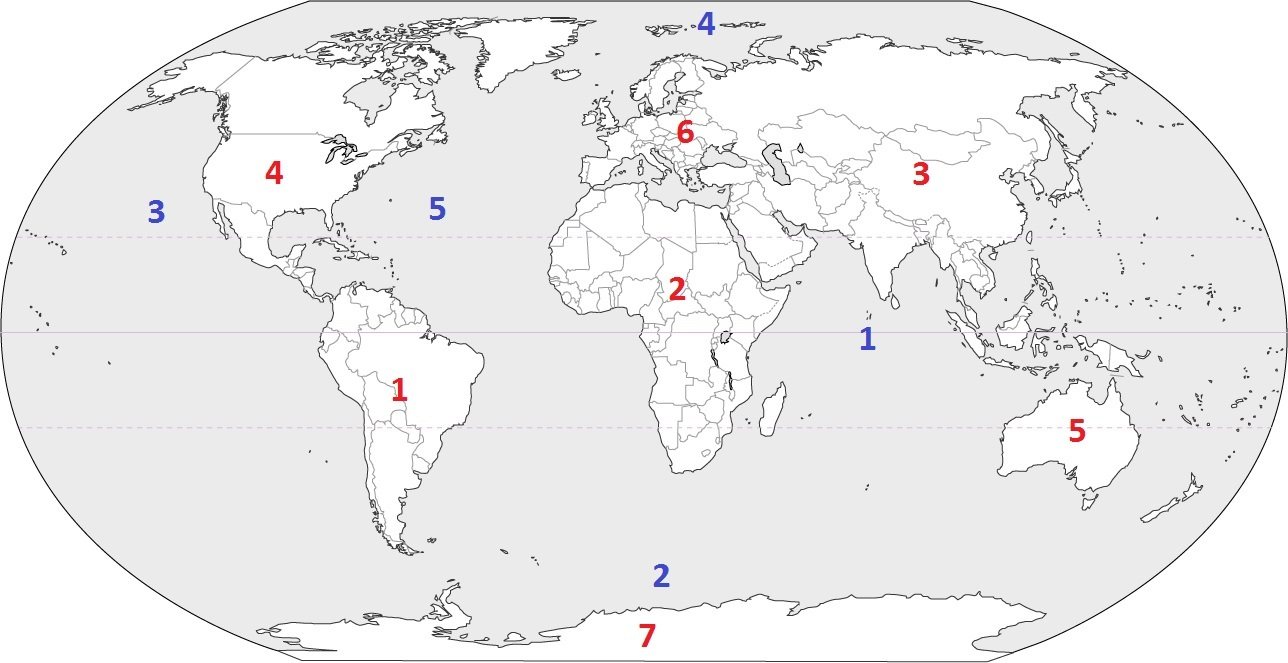
How many continents are there in the world?
a)
4
b)
5
c)
6
d)
7
22.
How many oceans are there in the world?
a)
7
b)
6
c)
5
d)
4
23.
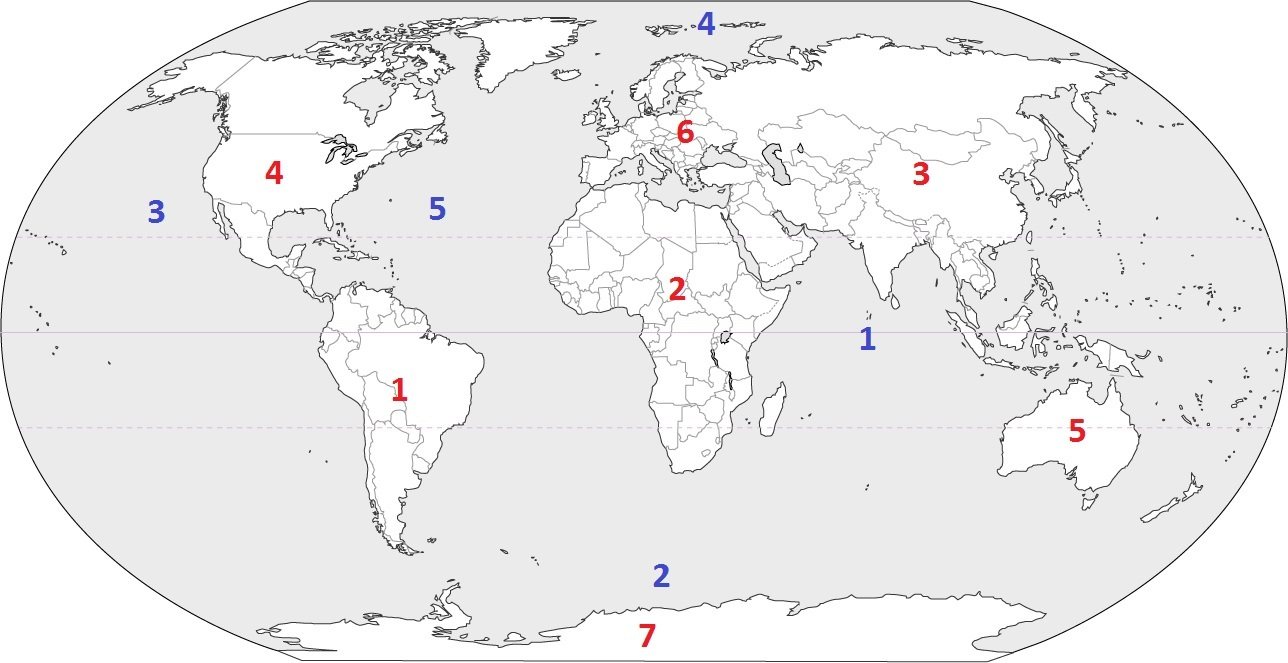
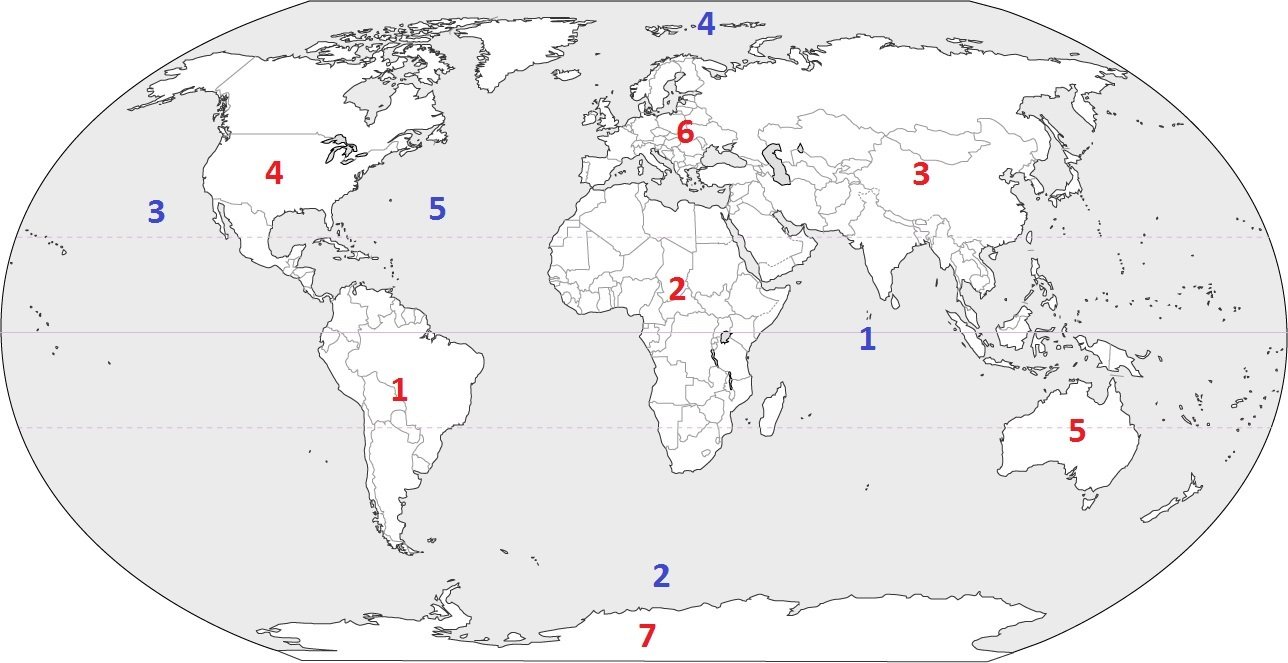
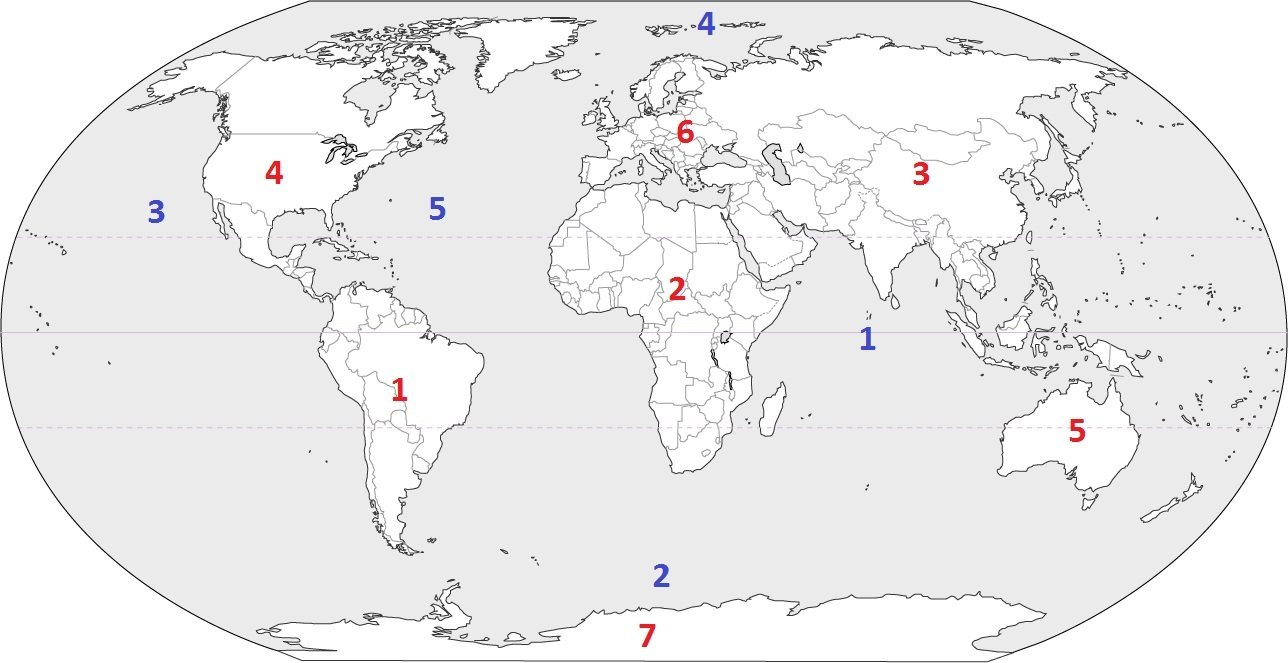
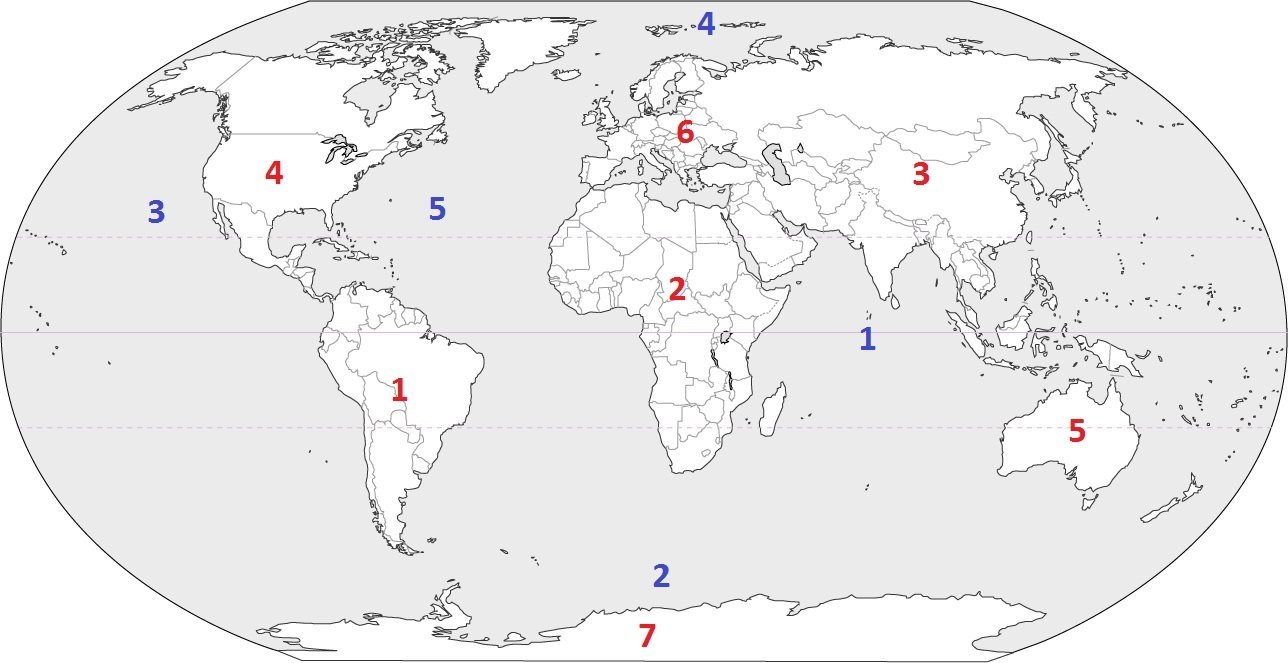
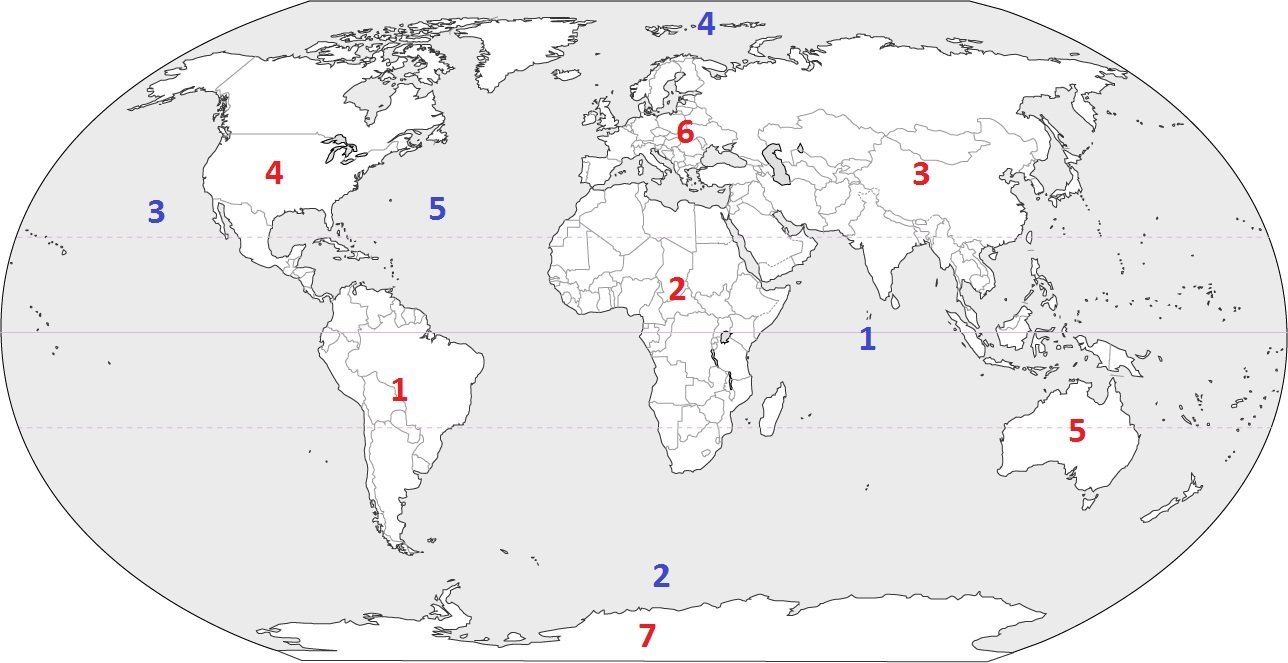
Which continent is located at #7?
a)
Asia
b)
Africa
c)
Australia
d)
Antarctica
24.
Which continent is located at #3?
a)
Australia
b)
Asia
c)
Europe
d)
South America
25.
Which continent is located at #5?
a)
South America
b)
Asia
c)
Australia
d)
Antarctica
26.
Which continent is located at #4?
a)
South America
b)
North America
c)
Europe
d)
Africa
27.
Which continent is located at #1?
a)
North America
b)
Antarctica
c)
South America
d)
Asia
28.
Which continent is located at #1?
a)
North America
b)
Antarctica
c)
South America
d)
Asia
29.
Which continent is located at #6?
a)
Asia
b)
Europe
c)
Africa
d)
Antarctica
30.
Which continent is located at #2?
a)
Africa
b)
South America
c)
Australia
d)
Europe
31.
Which ocean is located at #5?
a)
Pacific Ocean
b)
Atlantic Ocean 
c)
Indian Ocean
d)
Southern Ocean
32.
Which ocean is located at #1?
a)
Indian Ocean
b)
Atlantic Ocean
c)
Arctic Ocean
d)
Pacific Ocean
33.
Which ocean is located at #2?
a)
Southern Ocean
b)
Atlantic Ocean
c)
Pacific Ocean
d)
Indian Ocean
34.
Name this continent.
a)
North America
b)
Europe
c)
Africa
d)
Australia
35.
The imaginary line that divides the Earth into the Eastern Hemisphere and Western Hemisphere is the  _______.
a)
equator
b)
hemisphere
c)
middle
d)
prime meridian
36.
Name this continent.
a)
Europe
b)
Asia
c)
South America
d)
Antarctica
37.
Name this continent.
a)
Europe
b)
North America
c)
Africa
d)
South America
38.
What part of the map contains symbols?
a)
Key/Legend
b)
Scale
c)
Symbols
d)
Colors
39.
What part of the map is this?
a)
Key
b)
Legend
c)
Scale
d)
Symbols
40.
What part of the map tells directions?
a)
Scale
b)
Legend
c)
Symbols
d)
Compass Rose
41.
tells you the topic of a map, what the map is about
a)
Map Title 
b)
Map Key 
c)
Map Grid
d)
Compass Rose 
42.

The ability to read and write effectively.

a)

Literacy

b)

Urbanization

c)

GDP

d)

Ethnicity

43.

GDP best describes the total value of goods and _____________________ in a country.

a)

resources

b)

products

c)

services

d)

currency

44.

"Per capita" means?

a)

amount of oil

b)

per country

c)

amount of resources

d)

per person

45.

The vocal sounds and words common to a particular nation or group of people.

a)

Language

b)

Literacy

c)

Ethnicity

d)

Religion

46.

Industrialized areas in a country.

a)

Rural

b)

Population Denisty

c)

Urbanization

d)

Life Expectancy

47.

GDP stands for......

a)

Great Density Product

b)

Gross Domestic Places

c)

Great Domestic Places

d)

Gross Domestic Product

48.

The average number of people per square mile.

a)

Population

b)

Population Density

c)

GDP

d)

Literacy Rate

49.

A system of beliefs and worship, often involving a code of ethics and a philosophy.

a)

Culture

b)

Ethnicity

c)

Religion

d)

GDP

50.

Which does not have an impact on life expectancy?

a)

Pollution

b)

Language

c)

Health Care

d)

Clean Water

51.

People who live in urban areas live in __________________.

a)

agricultural areas

b)

cities

c)

the country

d)

rural areas

52.

The percentage of people in an area that can read and write.

a)

Literacy

b)

Education

c)

Urbanization

d)

Literacy Rate

53.
Movement is ...
a)
The way people, goods and ideas travel from place to place.
b)
The way people and the environment affect each other.
c)
Where a place is on Earth.
54.

Regions are ...

a)

Areas of the world that have common physical, human or cultural characteristics.

b)

An absolute location on Earth.

c)

The physical and human characteristics of a place.

55.
Human and Environment Interactions are ...
a)
The way people and the environment affect each other.
b)
Areas of the world that have common physical, human or cultural characteristics.
c)
The way people, goods and ideas travel from place to place.
56.
Location is ...
a)
The way people, goods and ideas travel from place to place.
b)
Areas of the world that have common physical, human or cultural characteristics.
c)
Where a place is on Earth.
57.

An example of an absolute location would be.........

a)

37.02 degrees N, 93.20 degrees W

b)

United States of America

c)

The South

58.

An example of relative location would be............

a)

37.02 degrees N, 96.2 degrees W

b)

10 miles south of Springfield on HWY 65

c)

Paris, France

59.
What is the movement theme about?
a)
A place with unifying characteristics
b)
how people, goods, and ideas get from one place to another.
c)
Where something is
d)
A location’s physical and human features.
60.

The beliefs, customs, laws, art, and ways of living of a group of people

a)

Culture

b)

History

c)

Economics

d)

Government

61.

A record of the past

a)

Social Studies

b)

History

c)

Prehistoric

d)

Culture

62.

The people who make and enforce the laws and settle disputes.

a)

Congress

b)

Executive Branch

c)

Supreme Court

d)

Governmnet

63.

The study of how people manage their scarce (limited) resources by producing, exchanging, and using goods and services.

a)

Business Management

b)

Economics

c)

Capitalism

d)

Government

64.

The study of people, places and the environment

a)

Geography

b)

Social Studies

c)

History

d)

Sociology

65.
Instead of using forks to eat, the Japanese use chopsticks. 
a)
Government
b)
Culture 
c)
History 
d)
News 
66.
Africa has the largest river in the world, this is an example of Africa's _.
a)
Geography
b)
Culture
c)
Government
d)
History