wayground logo

Free Printable Worksheets

NEW

Font size

S
M
L
XL
Worksheets

UNIT 1 Review

Total questions: 24

Worksheet time: 23mins

Name
Class
Date
1.

The 4 macromolecules include

a)

Carbohydrates

Proteins

Lipids

Nucleic Acids

b)

Glucose

Amino Acids

Fatty Acids & Glycerol

Nucleotides

c)

Carbohydrates

Proteins

Amino Acids

Enzymes

2.

The monomer of a protein is?

a)

Nucleotides

b)

Monosaccharide (glucose)

c)

Amino Acids

d)

Fatty Acids & Glycerol

3.

The monomer of a nucleic acids is?

a)

Amino Acids

b)

Fatty Acids & Glycerol

c)

Nucleotides

d)

Monosachharides

4.

What is the function of a carbohydrate?

a)

Source of quick energy

b)

transporting materials in and out of the cell

c)

Genetic and hereditary information

d)

long-term energy storage

5.

What is the function of a lipid?

a)

Source of quick energy

b)

Store and transmit genetic information

c)

Long-term energy storage

d)

Move substances in and our of the cell

6.

What is the function of a nucleic acid?

a)

Source of quick energy

b)

Long-term energy storage

c)

Store and transmit genetic information

d)

Move substances in and out of the cell

7.
function includes building muscles
a)
proteins
b)
nucleic acids
c)
lipids
d)
carbohydrates
8.

What is structure A?

a)

Substrate

b)

Active site

c)

Enzyme

d)

Products

9.
How do enzymes speed up chemical reaction?
a)
Increasing activation energy
b)
Decreasing activation energy
c)
Increasing deactivation energy
d)
Decreasing deactivation energy
10.
What is the monomer of proteins?
a)
amino acids
b)
polypeptides
c)
nucleotides
d)
monosaccharides
11.
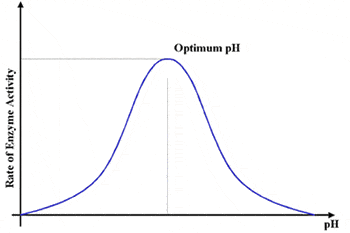
Which of the following conclusions can be drawn from this graph?
a)
The optimum pH of the enzyme is 6.6.
b)
The optimum pH of the enzyme is 5.8
c)
The enzyme’s activity increases as pH increases 5.0 to 9.0
d)
The enzyme’s activity is greater around pH of 8.0 .
12.
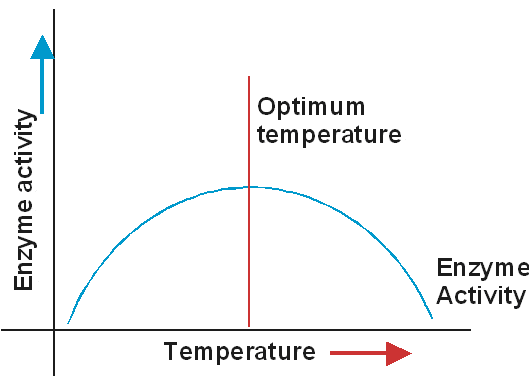
At high temperatures enzyme activity declines because of:
a)
Denaturation
b)
Decreased Kinetic Motion
c)
Increased H-Bonding
d)
Dissociation of Ionic Compounds
13.

Which explanation best fits the graph for pH's effect on an enzyme?

a)

Enzymes are unaffected by pH

b)

Low pH causes enzymes to denature

c)

Enzymes are affected by changes in pH

d)

Low pHs cause more H-Bonds to happen near the active site

14.
Why do plants conduct photosynthesis?
a)
To make light
b)
To make mitochondria
c)
To make glucose
d)
To release carbon dioxide
15.
Which choice correctly shows the gases that enter and exit plants during photosynthesis?
a)
Enter: Oxygen
Exit: Carbon dioxide
b)
Enter: Water vapor
Exit: Glucose
c)
Enter: Carbon dioxide
Exit: Oxygen
d)
Enter: Light
Exit: Water vapor
16.

Use the diagram to answer the question. What is made in the light reaction that the Calvin cycles uses?

a)

H2O

b)

carbon dioxide

c)

NADPH & ATP

d)

oxygen

17.
Which product is produced by the splitting of water during the light-dependent reactions of photosynthesis?
a)
NADPH
b)
oxygen
c)
glucose
d)
carbon dioxide
18.
Cellular Respiration's goal is to
a)
make water
b)
make ATP
c)
make glucose
d)
make  oxygen
19.
In photosynthesis ...
a)
water is chloronated
b)
light energy is changed to glucose
c)
osmosis happens
d)
ATP is made
20.

What is the purpose cellular respiration?

a)

to breakdown food molecules in order to release ATP

b)

to breakdown food molecules in order to release oxygen

c)

to breakdown food molecules in order to release FADH

d)

to breakdown food molecules in order to release carbon

21.
The mitochondria is responsible for ...
a)
photosynthesis
b)
anaerobic respiration
c)
aerobic respiration
d)
fermentation
22.
Aerobic respiration is different from anaerobic respiration in that aerobic respiration needs...
a)
chlorophyll
b)
carbon dioxide
c)
glucose
d)
oxygen
23.

In which organelle does photosynthesis occur?

a)

mitochondria

b)

stomata

c)

xylem

d)

chloroplast

24.
The energy carrier that the cell uses to power its day to day activities is 
a)
ATP
b)
NADH
c)
FADH2
d)
glucose