wayground logo

Free Printable Worksheets

Font size

S
M
L
XL
Worksheets

Microscope Practice Quiz

Total questions: 37

Worksheet time: 3hrs 4mins

Name
Class
Date
1.
Find the total magnification: 
Eyepiece = 10X 
Objective lens = 55X
 
a)
10x
b)
55x
c)
65x
d)
550x
2.
When would you use the diaphragm?
a)
When you wanted to move the stage
b)
When you wanted to adjust the light
c)
When you wanted to put the microscope away
d)
When you sneeze
3.
You should always carry the microscope by the
a)
arm and base
b)
arm and body tube
c)
arm only
d)
the objectives
4.
When looking at a specimen on your slide, you should always start with the
a)

scanning lens

b)
medium objective lens
c)
high objective lens
d)
super extra high power lens
5.
When looking through your microscope, you move your slide to the right- It appears
a)
to move to the right
b)
to stay the same
c)
to move to the left
d)
vanish
6.
The__________ sharpens the image under high magnification.
a)
the diaphragm
b)
fine adjustment knob
c)
coarse adjustment knob
d)
the ocular
7.
What power do you start with when using a microscope?
a)
High power
b)
Medium power
c)

scanning power

d)
Extra high power
8.
What is the function of stage clips?
a)
To move the objectives
b)
To keep the slide secure
c)
To adjust the focus
d)
To look through
9.
Find total magnification for:
Eyepiece = 20X 
Objective lens = 20X
 
a)
20x
b)
40x
c)
200x
d)
400x
10.
The higher the magnification, the ________ you see of the specimen.
a)
more
b)
less
c)
higher
d)
lower
11.
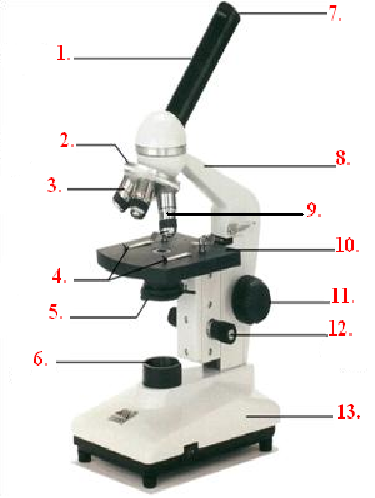
Part 7
a)
Diaphragm
b)
Stage Clips
c)
Light Source
12.
Part 8
a)
Light Source
b)
Diaphragm
c)
Base
13.
Part 9
a)
Stage
b)
Eyepiece
c)
Diaphragm
14.
What is part 4?
a)
Coarse Adjustment Knob
b)
Fine Adjustment Knob
c)
arm
15.
Holds objective lenses; Rotatates to change objectives
a)
Arm
b)
Base
c)
Revolving/Rotating Nosepiece
16.
Moves the stage slightly to sharpen the image
a)
Body Tube
b)
Course Adjustment Knob
c)
Fine Adjustment Knob
17.
Lenses consist of low 4X, medium 10X, and high 40X
a)
Eyepiece
b)
Stage
c)
Objective Lenses
18.
Projects and provides light upward to view specimen; 
a)
Diaphragm
b)
Light Source
c)
Stage
19.
Number 13
a)
Arm
b)
Light
c)
Base
20.
Number 10
a)
Stage
b)
Stage Clips
c)
Diaphragm
21.
The higher the magnification, the ________ you see of the specimen.
a)
more
b)
less
c)
higher
22.
The part of a microscope that lets you control the amount of light passing through the slide is called __.
a)
diaphragm
b)
lens
c)
fine adjustment knob
d)
coarse adjustment knob
23.
Holds objective lenses; Rotatates to change objectives
a)
Arm
b)
Base
c)
Nosepiece
d)
Diaphragm
24.
Piece 7
a)
Ocular Lens
b)
Objective Lens
c)
Base
d)
Arm
25.
Another name for eye piece is 
a)
Optical
b)
Low power lens
c)
Ocular
d)
Oil immersion lens
26.
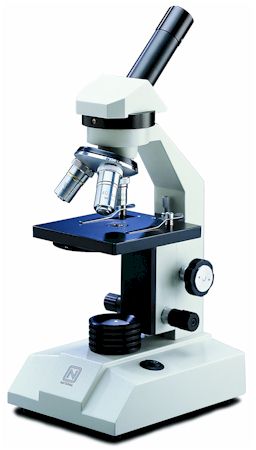
What is the name of the microscope? 
a)
Compound
b)
Recurve
c)
Standard 
d)
Scientific 
27.
What is the piece that you look into?
a)
Eyepiece
b)
Eye body
c)
Base
d)
Sight
28.
You should always carry the microscope by the
a)
arm and base
b)
arm and body tube
c)
arm only
d)
the objectives
29.
A microscope is an instrument that.
a)
makes faraway objects look closer.
b)
makes small objects appear larger.
c)
decreases the size of small objects.
d)
increases the size of small objects.
30.
What is wrong this how the student is carrying the microscope in the image?
a)
They are using two hands.
b)
They are carrying it close to their body.
c)
The plug is not wrapped around the base.
d)
They are walking. 
31.

What happens to your field of view as you increase magnification?

a)

it increases

b)

it decreases

c)

it stays the same

d)

it disappears

32.

In order for our microscopes to work, what must be able to pass through the object we are looking at on the slide?

a)

light

b)

air

c)

water

d)

fire

33.

A letter "e" has been placed on the slide in the proper orientation. How does it appear on the slide when you look through the microscope?

a)
b)
c)
d)
34.

The coarse focus

a)

sharpens the image under low and high power

b)

focuses the image under low power

c)

contains the low power magnifying lens

d)

contains the high power magnifying lens

35.

Holds and turns the objective lenses into viewing position

a)

body tube

b)

stage

c)

diaphragm

d)

revolving nosepiece

36.

The light source

a)

controls the amount of light that enters the microscope

b)

shines light through the object being viewed and into the microscope

c)

connects the arm to the base

d)

supports the microscope

37.

You can figure out the magnification of a compound microscope by multiplying the magnifying power of the eyepiece lens (always 10x) by the magnifying power of the objective lens you use. If you are using the middle power objective lens (10x) what is the total magnification?

a)

10x

b)

20x

c)

100x

d)

1000x