
 Worksheets
Metals, Nonmetals, Metalloids
Total questions: 33
Worksheet time: 58mins
Name
Class
Date
1.
Which of the following is a physical characteristic of a metal?
a)
texture
b)
malleable
c)
brittle
d)
semi-conductor
2.
Which of the following is a physical characteristic of a nonmetal?
a)
texture
b)
malleable
c)
brittle
d)
semi-conductor
3.
Which of the following is a physical characteristic of a metalloid?
a)
texture
b)
malleable
c)
brittle
d)
semi-conductor
4.
A student is examining the physical properties of a sample. The sample is malleable, but does not conduct electricity nor have luster. This sample would be a...
a)
metal
b)
nonmetal
c)
metalloid
5.

An element has properties of BOTH metals and nonmetals. WHERE would it be found in the periodic table?
a)
To the right
b)
To the left
c)
on the zig zag line
6.
If a student observes a silvery solid that is malleable, good conductor, and ductile it is a...
a)
nonmetal
b)
metal
c)
metalloid
7.
What does luster mean?
a)
Breaks into pieces
b)
can be hammered into thin sheets
c)
No shine
d)
reflects light, shiny
8.
What does brittle mean?
a)
Breaks into pieces
b)
can be hammered into thin sheets
c)
No shine
d)
reflects light shiny
9.

Elements in the DARK gray area can best be described as -
a)
Malleable
b)
Brittle
c)
Dull
d)
Poor conductors
10.

Look at the periodic table that is provided. Where would metals be located?
a)
to the left of the table in blue
b)
to the right of the table in pink
c)
in the zigzag line in yellow
11.

Look at the periodic table that is provided. Where would nonmetals be located?
a)
to the left of the table in blue
b)
to the right of the table in pink
c)
in the zigzag line in yellow
12.
Which of the following is a good conductor of heat?
a)
Metal
b)
Nonmetal
c)
Metalloid
13.
All of the following would classify an element as a metal except?
a)
Dull
b)
Luster
c)
Malleable
d)
Hard
14.
Which of the following properties refers to the ability of metals to be drawn into wires?
a)
A. malleability
b)
B. compressibility
c)
C. ductility
d)
D. luster
15.

Some students conducted a laboratory investigation to learn more about the physical properties of different elements. They observed four samples and recorded their observations in the table . Based on these observations, which sample is most likely a nonmetal?
a)
Sample 1
b)
Sample 2
c)
Sample 3
d)
Sample 4
16.
´Elizabeth was examining elements and their physical properties. She described an element is her science journal as having no shine, an insulator, and very brittle. What would this element be a metal, nonmetal, or metalloid?
a)
metal
b)
nonmetal
c)
metalloid
17.
Non-metals are good conductors of heat and electricity.
a)
TRUE
b)
FALSE
18.
Which is a metalloid?
a)
Boron
b)
Aluminum
c)
Lead
d)
Bismuth (Bi)
19.
The elements argon, krypton, and xenon are all non-metals. What property would these elements have in common?
a)
Good conductor of thermal energy
b)
Poor conductor of electricity
c)
Shiny, lustrous surface
d)
Soft and malleable
20.
A student is given a sample of an unknown substance. He is asked to determine if it is classified as a metal, a metalloid, or a nonmetal. He discovered that the unknown element conducted some heat and electricity, had a shiny luster, and broke easily. This element is most likely a
a)
metal
b)
nonmetal
c)
metalloid
d)
cannot be determined
21.
If an object is a better conductor of heat and electricity than nonmetals, but not as good of a conductor as metals, then it is a-
a)
semi-conductor
b)
non-conductor
c)
good conductor
22.
Silicon is a semiconductor and has properties of both metals and nonmetals. What type of element is Silicon?
a)
Metal
b)
Nonmetal
c)
Metalloid
d)
Pretty
23.

How would this element be classified?
a)
Metal
b)
Nonmetal
c)
Metalloid
d)
Metamorphic
24.
Anytime you see the word SEMICONDUCTOR - what substance do you have?
a)
Metal
b)
Nonmetal
c)
Metalloid
25.
Iron (Fe) is classified as a metal while Silicon (Si) is classified as a metalloid. Which physical property do these two elements most likely have in common? They both
a)
exist as gases at room temperature
b)
have a metallic shine or luster
c)
are brittle and shatter easily
d)
conduct electricity very well
26.

The table shows the properties of four elements. Which element in the table is classified as a metal?
a)
Manganese
b)
Sulfur
c)
Silicon
d)
Neon
27.
Which of the following correctly lists the three main groups of elements from greatest conductivity to least conductivity?
a)
Nonmetals -metalloids-metals
b)
metals-nonmetals-metalloids
c)
metalloids-metals-nonmetals
d)
metals-metalloids-nonmetals
28.
What physical properties are used to classify elements as metals, non-metals, or metalloids?
a)
Color, smell, physical state
b)
Reactivity, streak, hardness
c)
Ability to burn, mass, density
d)
Luster, conductivity, malleability
29.

Which element is a metalloid?
a)
Titanium
b)
Selenium
c)
Potassium
d)
Polonium
30.
Elements in this area can best be described as -
a)
Malleable
b)
Brittle
c)
Dull
d)
Insulators
31.

Elements in this area can best be described as -
a)
Semi-conductors
b)
Insulators
c)
Ductile
d)
Siny
32.
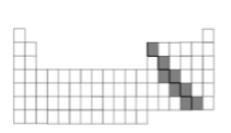
Elements in this area can best be described as -
a)
Shiny and brittle
b)
Insulators
c)
Good conductors
d)
Dull and malleable
33.
I am a semiconductor, lustrous, brittle and a solid at room temperature. Who am I?
a)
Metal
b)
Nonmetal
c)
Metalloid
d)
rubber band
100 %

