wayground logo

Free Printable Worksheets

Font size

S
M
L
XL
Worksheets

Universal Gravitation/Formation of the solar system/Distances

Total questions: 49

Worksheet time: 33mins

Name
Class
Date
1.
The measure of the pull of gravity on an object is ___________________.
a)
motion
b)
weight
c)
speed
d)
friction
2.
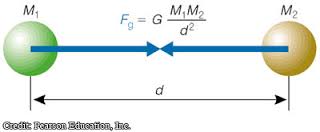
Two factors effecting the magnitude of the force of gravity between 2 objects are...
a)
mass and distance 
b)
mass and matter
c)
distance and weight 
d)
weight and mass
3.
Gravity attracts all objects towards one another.
a)
False
b)
True
c)
It depends
d)
I don't care
4.
Force of gravity is directly proportional to
a)
Mass
b)
Weight
c)
Distance
d)
Time
5.
Force of gravity is inversely proportional to
a)
Mass
b)
Weight
c)
Distance
d)
Time
6.
As the product of two objects' masses increases, the pull of gravity
a)
Increases
b)
Decreases
c)
Stays the same
7.
As distance separating the objects increases the force
a)
increases
b)
decreases
c)
stays the same
8.
If I double the distance between two objects, what happens to their gravitational Force?
a)
4x bigger
b)
4x smaller
c)
2x bigger
d)
2x smaller
9.
Complete the following statement: The farther away two planets are the _______ the gravitational force between them.
a)
more
b)
same
c)
dosen't matter
d)
less
10.
A moon is located at  1 unit out from the planet it orbits. If that moon was orbiting at 2 units out from the planet, how much would the gravitational force on the moon be compared to its distance at 1 unit?
a)
1/4
b)
1/6
c)
2x as much
d)
4 times as much
11.
What states that "every object in the universe attracts every other object"?
a)
Law of Universal Gravitation
b)
Newton's First Law of Motion
c)
My mother
d)
Inertia & gravity
12.
The amount of matter in an object
a)
mass
b)
weight
c)
inertia
d)
gravity
13.
The size or magnitude of earth’s gravitational force on Satellite B is
a)
equal to Satellite A
b)
less than Satellite A
c)
more than Satellite A
d)
zero
14.
What shape is this orbit?
a)
square
b)
circle
c)
ellipse
d)
line
15.

the path a body follows as it travels around another body in space

a)

revolution

b)

rotation

c)

orbit

d)

hemisphere

16.

a cloud of gas and dust from which bodies in space are formed

a)

revolution

b)

photosphere

c)

nuclear fusion

d)

nebula

17.

The planets of the solar system formed as

a)

the center of the gas cloud cooled.

b)

planetesimals flattened into a rotating disk.

c)

planetesimals collided into one another.

d)

the sun absorbed extra gas and dust from the solar system.

18.

What happens during nuclear fusion in the sun?

a)

Helium nuclei combine to form hydrogen.

b)

Helium nuclei combine to form oxygen.

c)

Hydrogen nuclei combine to form helium.

d)

Oxygen nuclei combine to form helium.

19.

As a nebula collapses it also begins:

a)

Expand

b)

Spin or Rotate

c)

Shake

d)

Turn to ice

20.

A nebula collapses down into a disk known as :

a)

A compact disk

b)

An irregular cloud

c)

An protostellar disk

d)

An circular disk

21.
What is the period of rotation?
a)
How long it takes a planet to orbit the sun
b)
How fast a planet orbits the sun
c)
How fast a planet spins
d)
How elliptical a planet's orbit is
22.
What is  the period of revolution?
a)
How long it takes a planet to orbit the sun
b)
How long it takes a planet to spin around
c)
How fast a planet spins
d)
How elliptical a planet's orbit is
23.
If a planet is closer to the sun, its orbit will be _____ than one farther away. 
a)
longer
b)
slower
c)
bigger
d)
shorter
24.
The law of universal gravitation is credited to whom?
a)
Einstein
b)
Galileo
c)
Darwin
d)
Newton
25.
If Earth's mass was cut in half, what would happen to your mass?
a)
increase because gravitational force increases
b)
decrease because gravitational force decreases
c)
decrease because gravitational force increases
d)
nothing, mass is not affected by gravitational force
26.
If Earth's mass was cut in half, what would happen to your weight?
a)
Increase because gravitational force increases
b)
decrease because gravitational force decreases
c)
decrease because gravitational force increases
d)
nothing, weight is not affected by gravitational force
27.
As distance between two objects increase the pull of gravity 
a)
Increases
b)
Decreases
c)
Stays the same
28.
A satellite moves ______________when it is moved farther from the object that it orbits.
a)
more quickly
b)
more slowly
c)
at the same speed
d)
with no change in speed
29.
Complete the following statement: The farther away two planets are the _______ the gravitational force between them.
a)
more
b)
same
c)
dosen't matter
d)
less
30.
An ellipse is drawn around two points called
a)
aphelion
b)
perihelion
c)
foci
d)
axis
31.
The place where a planet is closest to the Sun as it orbits the Sun is called the
a)
perihelion
b)
aphelion
32.
The place where a planet is farthest away from the Sun in its orbit around the Sun is called the
a)
aphelion
b)
perihelion
33.
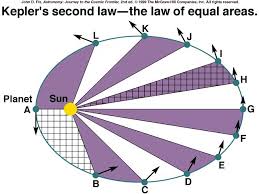
Where is the planet moving faster
a)
Position A to B
b)
Position B to C
c)
Position H to I
d)
Position I to J
34.
What is true about the area between points A, B and the Sun, and the area between points H, I and the Sun?
a)
The area between A, B and the Sun is the largest.
b)
The area between H, I and the Sun is the largest
c)
Both areas are equal in size
d)
There is not enough information to determine the areas
35.
What has an eccentricity of zero
a)
a straight line
b)
a large ellipse
c)
a circle
d)
a small ellipse
36.
Kepler's 2nd Law deals with 
a)
the shape of the planets' orbits
b)
the speed/area the planet travels 
c)
the length of time it takes the planet to orbit the sun
37.
A planet moves __________ when it is farthest from the sun.
a)
faster
b)
slower
38.
Kepler's first law states that the orbits of the planets are oval in shape or 
a)
ellipses
b)
perfect circles
39.
Which diagram shows a planet with the least eccentric orbit?
a)
1
b)
2
c)
3
d)
4
40.
During which month is the earth moving the slowest? 
a)
July 
b)
March
c)
January
d)
September
41.

Which of Kepler's laws states that planets travel faster when they are close to the sun then they do when they are farther from the sun?

a)

Kepler's 1st law

b)

Kepler's 2nd law

c)

Kepler's 3rd law

42.

Which of the following list the correct hierarchy in the Universe from biggest to smallest?


¿Cuál de las siguientes enumera la jerarquía correcta en el Universo de mayor a menor?

a)

Universe, galaxies, solar system, stars and planets

b)

Planets, stars, solar system, galaxies, universe

c)

Solar system, galaxies, stars, planets, universe

d)

Universe, solar system, galaxies, planets and stars

43.

Astronomical units are used for....

a)

Distances within a solar system

b)

Distances between solar systems

c)

Distances within galaxies

d)

Distances between galaxies

44.

The distance that light can travel in a year is called....

a)

A light second

b)

A light minute

c)

A light month

d)

A light year

45.

_________would be the best unit to use to measure the distance between our sun and Proxima Centauri (our nearest star neighbor).

a)

Astronomical units

b)

Light seconds

c)

Light years

46.

An astronomical unit is...

a)

The average distance between the Earth and the Sun

b)

The average distance between the Sun and Neptune

c)

The diameter of the sun

d)

The time it takes light to travel across our solar system

47.

This geometrically derived unit equals about 3.26 light years

a)

Astronomical Unit

b)

Light year

c)

Parsec

d)

Light second

48.

_______________ would be the best unit to use to measure the distance between the asteroid belt and Pluto

a)

Astronomical units

b)

Light seconds

c)

Light years

d)

Parsecs

49.

What's wrong with Han Solo's claim of making "the Kessel Run in less than 12 parsecs"

a)

Even the Millennium Falcon can't travel that fast

b)

He should have used 'astronomical units'

c)

Parsec is a measure of distance, not time

d)

He should have used 'light seconds'