wayground logo

Free Printable Worksheets

NEW

Font size

S
M
L
XL
Worksheets

Ecology UA Review

Total questions: 45

Worksheet time: 29mins

Name
Class
Date
1.
A producer?
a)
Eats other plants and animals
b)
Makes its own food
c)
Eats dead plants or animals
d)
Makes toys for kids
2.
A consumer?
a)
Makes its own food
b)
Eats dead plants and animals
c)
Eats plants and other animals for energy
d)
Buys toys for kids
3.
This organism draws its water from the ground, traps sunlight in its chlorophyll, and makes glucose (sugar) in broad green parts of its body. Is it a...
a)
Producer
b)
Consumer
c)
Decomposer
4.
What are the effects of deforestation ?
a)
loss of habitat
b)
increased green house gasses 
c)
soil erosion and flooding
d)
all of the above
5.
Resource that can be replaced at a rate close to its rate of use or in an unlimited supply.
a)
Renewable resource
b)
Nonrenewable resource
6.
Widespread deforestation is a major factor in causing which ecological process?
a)
famine
b)
erosion
c)
monsoons
d)
tornadoes
7.
When humans burn fossil fuels, most of the carbon quickly enters the                       as carbon dioxide.
a)
Water
b)
Atmosphere
c)
Sun
d)
Air
8.
Which one of these does not add CO2 to the atmosphere?
a)
cooking with gas
b)
planting trees
c)
burning wood
d)
riding in a bus
9.
Why is the ocean important to the carbon cycle?
a)
It keeps sediment containing carbon underwater for millions of years
b)
The ocean gives out more carbon then it takes in (increases global warming)
c)
The ocean isn't important to the carbon cycle.
10.
What is it called when plants give off water vapor as a waste product?
a)
condensation
b)
evaporation
c)
sublimation
d)
transpiration
11.
A friend of yours believes that predators are extremely detrimental (bad) for ecosystems and that the ecosystem would be better off without them. You should
a)
disagree
b)
agree
c)
tell on them
d)
unfriend them indefinitely
12.
The maximum number of individuals that a particular environment can support is called _______.
a)
community
b)
survivorship
c)
biotic potential
d)
carrying capacity
13.
Under ideal conditions with unlimited resources, a population will have ________.
a)
linguistic growth
b)
experimental growth
c)
exponential growth
d)
logistic growth
14.
What is NOT factor that threatens biodiversity?
a)
Population growth
b)
Habitat Loss
c)
Overexploitation
d)
Clean water
15.
How can habitat disruption affect biodiversity?
a)
It can lead to loss of biodiversity.
b)
It will lead to new species taking over all of the habitats.
c)
It will lead to climate change.
d)
It will cause the animals to get sick.
16.
Define habitat fragmentation.
a)
The excessive use of a species that has economic value.
b)
All species dying in one area
c)
The different environmental conditions that occur along the boundaries of an ecosystem.
d)
The separation of an ecosystem into small areas.
17.
This graph shows
a)
carrying capacity
b)
logistic growth
c)
exponential growth
d)
population density
18.
Plants and animals that migrated to places where they are not native and cause harm to the native species
a)
introduced
b)
invasive
c)
extinct
d)
endangered
19.
a)
nonrenewable resources
b)
renewable resources
c)
global warming
d)
soil erosion
20.
What type of growth curve is pictured?
a)
exponential 
b)
logistic
c)
predator-prey
d)
invasive
21.
What is the carrying capacity of this population?
a)
100
b)
200
c)
300
d)
400
22.
Which limiting factor would increase due to the number of individuals in a population?
a)
Unusual weather
b)
Natural disaster
c)
Disease
23.
In this energy pyramid, which organisms have the most energy available?
a)
Producers
b)
Carnivores
c)
Herbivores
d)
Top Predator
24.
For a pyramid of numbers, the width of the bar shows the__________ of organisms present in each trophic level at a particular time. 
a)
number
b)
biomass
c)
energy
d)
volume
25.
What is the weather conditions in an area over a long period of time?
a)
climate
b)
temperature
c)
elevation
d)
precipitation
26.
Changes from minute-to-minute, hour-to-hour, day-to-day
a)
Climate
b)
Weather
27.
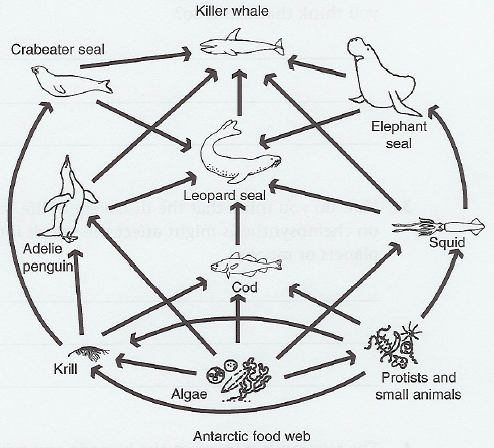
How many predators does the squid have?
a)
1
b)
2
c)
3
d)
4
28.
What is the greenhouse effect?
a)
The warming of a planet due to trapped radiation.
b)
The cooling of Earth due to air pollution.
c)
The heating of a solid, such as a rock.
29.
Which is one cause for Global Warming we discussed today?
a)
Burning Fossil Fuels
b)
Pollution from factories
c)
Both are causes for Global Warming
30.

Humans have the ability to cause climate change.

a)
True
b)
False
c)

maybe

31.
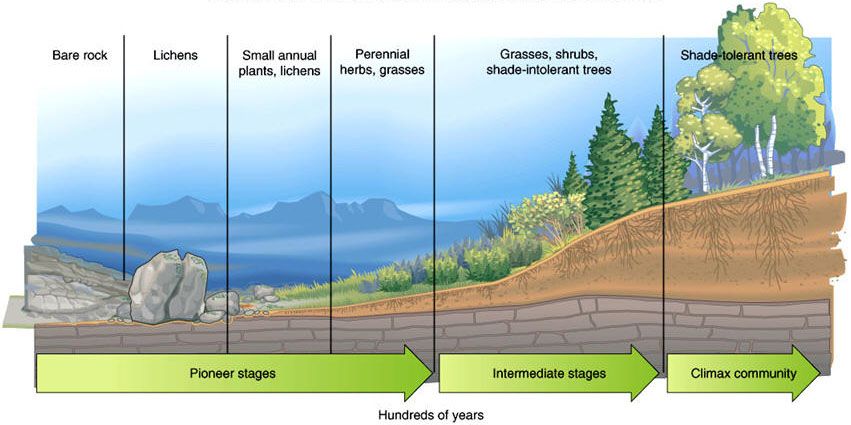
The picture shows what type of succession?
a)
primary
b)
secondary
c)
tertiary
d)
quadanary
32.
The following graph tells us what?
a)
Sea Levels are decreasing.
b)
Sea Levels are rising.
33.

Ecological issue shown in the diagram.

a)

Biological Magnification

b)

Acid precipitation

c)

Eutrophication

d)

Invasive (introduced) species

e)

Pollution

34.

Using resources at a rate in which they can be replaced

or recycled while preserving the long-term environmental health of the biosphere.

a)

Sustainable use

b)

Natural Resources

c)

Renewable resources

d)

Non-renewable resources

35.
Which habitat exhibits the greatest biodiversity?
a)
A habitat with 15 different species with about 300 individuals each
b)
A habitat with 10 different species with about 75 individuals each
c)
A habitat with 4 different species with about 150 individuals each
d)
A habitat with only one species with about 2000 individual
36.
Why is biodiversity so important?
a)
Because all species depend on each other to survive, so if one becomes extinct another species that relies on it could go extinct as well
b)
Because it’s better to have only one variation of each species.
c)
Because it better to only have a few species on Earth.
d)
Honestly, I have no idea what biodiversity is!
37.

How do humans cause extinctions and lowered biodiversity?

a)

By preserving habitats

b)

Deforestation used to build human communities

c)

By storing genetic material of endangered species

d)

By eliminating invasive species

38.

The following are abiotic factors in a river, except

a)

Temperature

b)

Sunlight

c)

Salinity

d)

Precipitation

39.

The following are abiotic factors of the deep sea, except

a)

temperature

b)

salinity

c)

pressure

d)

sunlight

40.

Marine ecosystem that connects a river with the ocean

a)

estuary

b)

salt marsh

c)

mangrove swamp

d)

coral reef

41.
What factors affect aquatic ecosystems? 
a)
Light, salinity, temperature
b)
Sun, moon and stars
c)
Nothing
d)
Coral reefs, whales
42.

Predator population lags behind prey population because:

a)

Increase in predators leads to decrease in prey

b)

Increase in predators leads to increase in prey

c)

Increase in predators leads to decrease in producers

43.
What statement is TRUE about the graph?
a)
The prey is the green line because there needs to be more prey than predators.
b)
The prey is the red line because there needs to be more predators than prey.
c)
The green line is the producers
d)
The red line is the producers
44.

Forest rangers occasionally set fires as a way to manage wildlife areas and prevent bigger fires in the future.

a)

True

b)

False

45.

Which of the following things does NOT put carbon into the atmosphere?

a)

burning of fossil fuels

b)

oak tree

c)

volcanoes

d)

cows