
NEW
Font size
S
M
L
XL
 Worksheets
8th Grade 1st 6 Weeks Unit Exam JD
Total questions: 15
Worksheet time: 3hrs 47mins
Name
Class
Date
1.
An atom has 25 protons and 25 electrons. How many neutrons are in this atom's nucleus?
a)
25
b)
30
c)
25
d)
50
2.
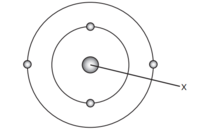
(8.5A) Which of these best describes one of the subatomic particles that could be found at location X in the model of an atom shown above?
a)
It has mass but no charge.
b)
It has no mass and a positive charge.
c)
It has a large mass and a negative charge.
d)
It has no mass and an equal number of positive and negative charges.
3.
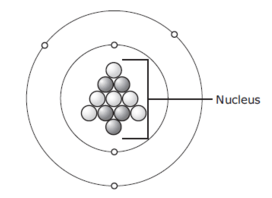
(8.5B) An atom of which element is represented by this model?
a)
Boron (B)
b)
Carbon (C)
c)
Neon (Ne)
d)
Sodium (Na)
4.
(8.5B) When trying to identify an unknown element, a scientist determines what other elements the unknown element reacts with chemically. Which property of the unknown element determines the other elements it reacts with?
a)
The total number of neutrons in the unknown element.
b)
The total number of particles in the nucleus of the unknown element
c)
The number of protons in the nucleus of the unknown element
d)
The number of valence electrons in the unknown element.
5.
(8.5C) The periodic table is organized into groups and periods of elements. The characteristics of a certain group of elements are listed below.
-is shiny
-is solid at room temperature
-has atoms with two valence electrons
Which of these elements is in this group?
-is shiny
-is solid at room temperature
-has atoms with two valence electrons
Which of these elements is in this group?
a)
Lithium
b)
Strontium
c)
Aluminum
d)
Silicon
6.

(8.5C) A student is studying the ways different elements are similar to one another. Diagrams of atoms from four different elements are shown below.
Which two atoms are of elements in the same group in the periodic table?
Which two atoms are of elements in the same group in the periodic table?
a)
Atom 1 and Atom 2
b)
Atom 1 and Atom 4
c)
Atom 2 and Atom 3
d)
Atom 3 and Atom 4
7.
(8.5C) A researcher wants to experiment with an element that reacts like phosphorous (P) but has a greater atomic mass. Which element should the researcher select for the experiment?
a)
Nitrogen (N)
b)
Sulfur (S)
c)
Arsenic (As)
d)
Silicon (Si)
8.
(8.5D) Serotonin is a chemical substance that acts as a neurotransmitter. It helps relay messages in the human brain. The formula for one molecule of serotonin is shown below.
C10H12N2O
How may atoms in all are in a molecule of serotonin?
C10H12N2O
How may atoms in all are in a molecule of serotonin?
a)
10
b)
25
c)
24
d)
100
9.
CaCO3 ---> CaO + CO2
In the chemical reaction shown above, the products are best classified as-- (6.5C)
In the chemical reaction shown above, the products are best classified as-- (6.5C)
a)
two elements
b)
one element and one compound
c)
two compounds
d)
two compounds and one element
10.

(6.6A) Some students conducted a laboratory investigation to learn more about the physical properties of different elements. They observed four samples and recorded their observations in the table below.
Based on these observations, which sample is most likely a nonmetal?
Based on these observations, which sample is most likely a nonmetal?
a)
Sample 1
b)
Sample 2
c)
Sample 3
d)
Sample 4
11.
(8.5A) In the early 1900s many scientists thought that an atom consisted of a positive substance with negative charges scattered throughout the substance. Then Ernest Rutherford completed an experiment that changed the concept of an atom. His discovery led to the understanding that an atom consists mostly of empty space with-
a)
protons orbiting a dense nucleus made of electrons and neutrons
b)
electrons orbiting a dense nucleus made of protons and neutrons
c)
neutrons and protons orbiting a cloud of electrons
d)
electrons and protons orbiting a cloud of neutrons
12.
(8.5B) The atoms of a certain element each contain 11 protons and 1 valence electron. Which statement correctly identifies this element and describes its chemical reactivity?
a)
The element is sodium, and it is highly reactive.
b)
The element is flourine, and it is not very reactive.
c)
The element is sodium and it is not very reactive
d)
The element is flourine, and it is highly reactive
13.
(8.5B) A chemist is identifying the elements present in a sample of seawater. What characteristic of an element's atoms always determines the element's identity?
a)
The number of protons
b)
The number of neutrons
c)
The location of valence electrons
d)
The number of valence electrons
14.
(8.5A) Which of the following best describes an electron?
a)
It has no charge and about the same mass as a proton
b)
It has a negative charge and much less mass than a proton
c)
It has a positive charge and much more mass than a neutron
d)
It has a negative charge and about the same mass as a neutron
15.

Four students were given a list of compounds and asked to identify which ones are organic.
Which student correctly identified the organic compounds in the list?
Which student correctly identified the organic compounds in the list?
a)
K
b)
L
c)
M
d)
N
Reset

