
 Worksheets
Molecules of life & Cell Structure
Total questions: 30
Worksheet time: 19mins

The attraction that causes water and other liquids to form drops is called ________________. This is also water’s ability to be attracted to other water molecules.
adhesion
capillary action
cohesion
surface tension

Water striders can walk across the surface of calm water. Their feet push the surface of the water down slightly, but they do not break the surface. Why?
The insects are light enough so they do not break the hydrogen bonds holding the water molecules together
The insects actually use their wings to hover slightly above the water’s surface and they only skim it with their feet.
The insect’s feet are non-polar, so they are repelled by the polar water molecules and are pushed away from the water’s surface.
The insects are small enough to see the individual water molecules, so they are able to step carefully from one molecule to the next
Which property of water is responsible for cooling off the human body when sweat evaporates into water vapor?
Surface Tension
High latent heat of vaporization
Ice floats on water (solid water -ice- is less dense than liquid water
Adhesion

What is this molecule?
sucrose
α-glucose
lipid
β-glucose

What kind of molecule is represented by the diagram?
starch molecule
glucose molecule
fat molecule
monosaccharide
The bonds linking amino acids are called
Peptide bonds
Glycosidic bonds
Ester bonds
Hydrogen bonds

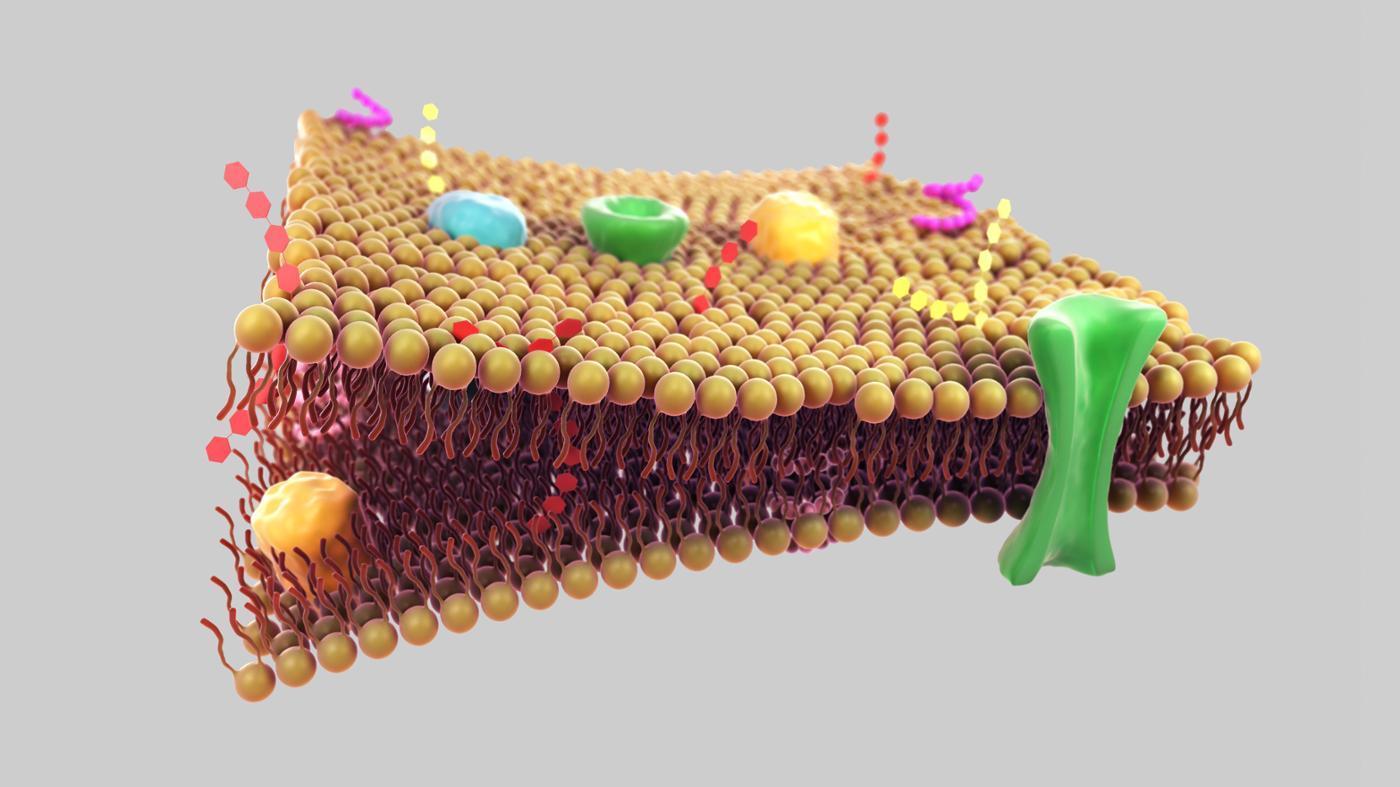
The phospholipid bilayer comprises which part of the cell?
cytoplasm
cell membrane
cytoskeleton
cell wall

What type of lipid is this?
steroid
cholesterol
phospholipid
triglyceride

Diagram shows a stucture of nucleotide. Name the part labeled 2?
Pentose sugar
Phosphate
Nitrogenous Base
Phosphorous
Name of the bond which holds nucleotides together.
Phosphodiester Bond
Amino Bond
Nucleic Bond
Peptide Bond
This is a system of membranous tubules and sacs in eukaryotic cells that functions as a path along which molecules move from one part of the cell to another. Can be rough or smooth.
Mitochondria
Chloroplast
Endoplasmic reticulum
Centrioles
What cells are primarily found in the mesophyll which used for photosynthesis and storage?
Collenchyma
Sclerenchyma
Parenchyma
Sieve Tube Cells

Diagram shows a structure of neuron. What does the letter "A" represent?
Axon
Dendrite
Axon Terminal
Cell Body

The picture is an example of _________________.
facilitated diffusion
simple diffusion
osmosis
active transport

The _________________ model describes the structure of the plasma membrane.
fluid mosaic
double helix
Bohr
distribution

Cells use a process called __________ to move bulky materials out of a cell using a vesicle.
exocytosis
endocytosis
phagocytosis
pinocytosis


Which type of tissue is shown in the picture?
connective
epithelial
muscle
nervous

Which type of tissue is shown in the picture?
connective
nervous
epithelial
muscle

Which type of muscle tissue is shown?
smooth
skeletal
cardiac
epithelial

What type of plant cells are pictured?
parenchyma
collenchyma
sclerenchyma
epidermis


