
 Worksheets
13.1 Describing weather
Total questions: 46
Worksheet time: 43mins
Name
Class
Date
1.

What part of the water cycle does this picture show?
a)
condensation
b)
precipitation
c)
evaporation
2.
Which of these is an example of precipitation?
a)
snow
b)
air
c)
clouds
d)
vapor
3.
Which is the opposite of condensation?
a)
runoff
b)
evaporation
c)
precipitation
d)
transpiration
4.
Which best explains why runoff is important?
a)
It returns water to other locations on Earth
b)
It increases the chance of flooding
c)
It makes evaporation occur faster
d)
It increases condensation
5.
Snow, sleet, hail, and rain are all examples of ________________.
a)
evaporation
b)
condensation
c)
accumulation
d)
precipitation
6.

What is it called when WATER is FORMED from an LIQUID to a WATER VAPOR Oor an [GAS]?
a)
EVAPORATION
b)
PRECIPITATION
c)
TRANSPIRATION
7.

What does groundwater do?
a)
It sends water to our buildings, houses, and water transplant places
b)
to the sky
c)
to the sun
d)
To the Earth's surfaces
8.

What is it called when plants give off water vapor as a waste product?
a)
condensation
b)
evaporation
c)
sublimation
d)
transpiration
9.
When water _________, dew forms.
a)
Melts
b)
Evaporates
c)
Condenses
d)
Precipitates
10.
The water cycle is also known as ..........
a)
Hypertonic Solution
b)
Hydrological Cycle
c)
Hyperlogical Cycle
d)
None of these
11.
Precipitation occurs because
a)
the droplets evaporate in the air
b)
the droplets are too light for the air to hold
c)
the droplets are too heavy for the air to hold
12.
The water cycle has no start or end
a)
true
b)
false
13.
The ________ is the driving force of the earth's surface.
a)
sun
b)
moon
c)
stars
14.
The first step in the water cycle
a)
evaporation
b)
condensation
c)
precipitation
d)
there is no first step
15.
Any type of liquid or solid water that falls to earth's surface
a)
evaporation
b)
condensation
c)
precipitation
d)
runoff
16.
What is the process during which water cools and turns from a gas to a liquid?
a)
Codensation
b)
Runoff
c)
Precipitation
d)
Evaporation
17.

what does this tool measure?
a)
wind direction
b)
wind speed
c)
air temperature
d)
humidity
18.

What is the name of this tool?
a)
wind vane
b)
anemometer
c)
wind sock
19.

what does the #4 show in the diagram?
a)
condensation
b)
evaporation
c)
precipitation
d)
run off
20.

Which stage does the #3 show in the diagram?
a)
condensation
b)
evaporation
c)
precipitation
d)
run off
21.
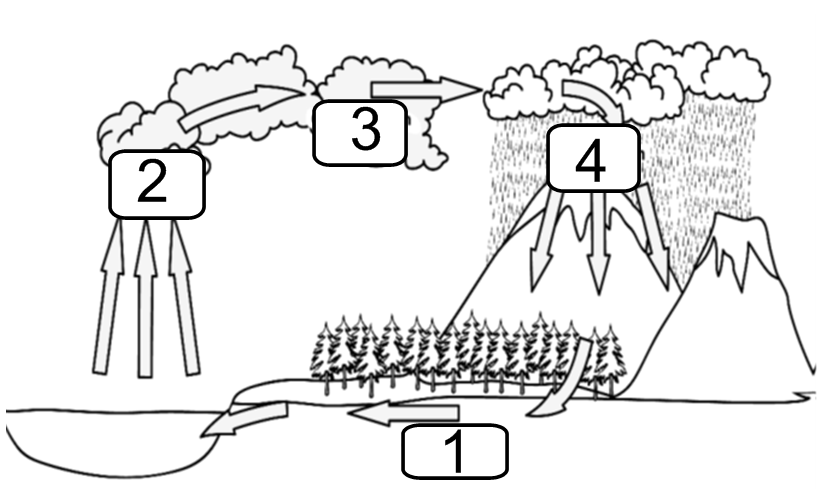
Which stage does the #2 show in the diagram?
a)
condensation
b)
evaporation
c)
precipitation
d)
run off
22.
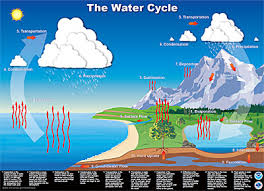
During which stage do clouds form?
a)
condensation
b)
evaporation
c)
precipitation
23.
What is the water cycle?
a)
the 3 forms of water
b)
the movement of water on, above, or below the surface of the Earth
c)
when water melts
d)
when clouds form
24.
What happens to air pressure as you move upward into the atmosphere?
a)
increases
b)
decreases
c)
stays the same
25.
A device that is used to measure atmospheric pressure is a ___________.
a)
barometer
b)
thermometer
c)
kilometer
d)
micrometer
26.
Air pressure is greater _______.
a)
at the top of the mountain
b)
at the bottom of the mountain
c)
at the center of the mountain
27.
Density of air is greater ________.
a)
at the top of the mountain
b)
at the bottom of the mountain
c)
at the center of the mountain
28.
___________is the result of the weight of a column of air pushing on an area.
a)
air pressure
b)
density
c)
volume
d)
none of the above
29.
What does the air consist of?
a)
molecules
b)
helium
c)
density
d)
weather
30.
What happens to the amount of oxygen molecules as altitude increases?
a)
fewer molecules
b)
more molecules
c)
same amount of molecules
d)
nothing happens to the molecules
31.
78% of earth's atmosphere is composed of ______________.
a)
methane
b)
oxygen
c)
argon
d)
nitrogen
32.
Air pressure is greatest when near Earth's surface because?
a)
The air molecules are farther apart.
b)
The air molecules are closer together.
c)
Air molecules collide.
33.
Clouds are made up of tiny drops of ______ or ice. The moisture in the cloud affects the weather.
a)
dust
b)
water
c)
cloud particles
d)
precipitation
34.
They are highest clouds in the sky. They look curly, white and feathery. Usually mean good weather.
a)
Cumulus
b)
Cumulonimbus
c)
Cirrus
d)
Stratus
35.
This is sometimes called a thunderhead cloud. It looks very tall like mountains and heavy rain comes from it.
a)
Cumulus
b)
Cirrus
c)
Stratus
d)
Cumulonimbus
36.
They are low in the sky and look soft and fluffy.
a)
Cirrus
b)
Cumulonimbus
c)
Cumulus
d)
Stratus
37.
The amount of water vapor in the atmosphere compared to how much it could hold.
a)
Saturation
b)
Vaporicity
c)
Humidity
d)
Relative Humidity
38.
_____________ is the temperature to which air must be cooled to reach saturation.
a)
Humid point
b)
Temperature index
c)
Relative Humidity
d)
Dew Point
39.
What is an example of gas in the atmosphere?
a)
Ice Crystals
b)
Water Droplets
c)
Water Vapor
40.
The amount of water vapor in the atmosphere.
a)
Saturation
b)
Vaporicity
c)
Humidity
d)
Relative Humidity
41.
Warm saturated air contains _______ water vapor than cold saturated air.
a)
more
b)
less
42.

If the air is "saturated", that means:
a)
the air is full of water
b)
the air is partially full of water
c)
it's amount of water vapor in the atmosphere right now
d)
how much liquid water it potentially can hold
43.

Dew is most likely to form
a)
after heavy rain on a humid day
b)
when humid air contacts cold ground
c)
when the snow on the ground melts
d)
during windy nights when it rains
44.

As the air temperature increases, the air's capacity for water vapor:
a)
increases
b)
decreases
c)
remains the same
d)
is unrelated to air temperature and can either increase or decrease
45.
Which type of air has a relative humidity of 100%?
a)
space
b)
hot
c)
dry
d)
saturated
46.
Why can't you see the water vapor in the air?
a)
There is very little of it.
b)
It is a clear, colorless gas.
c)
It is very far away.
d)
It only happens at night.
100 %

